
The ‘Most Impactful Trade Deadline Acquisition’ Award Goes to Tyler Mahle
Atlanta's deadline was widely criticized, but Mahle quickly changed that narrative with a dominant stretch after joining the Braves.
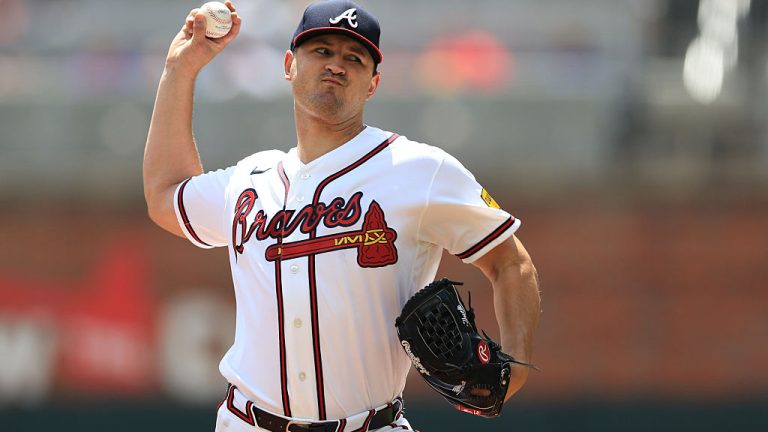
The Atlanta Braves clinched the NL East with one week to spare in the regular season. On the surface, this was not that noteworthy. Atlanta has won seven of the last 10 division titles and has been among the league’s best teams during that span. However, this year was different.
After an injury-plagued 2025 season that saw Atlanta miss the playoffs completely for the first time since 2017, along with losing the division to the Philadelphia Phillies in each of the last two seasons, many wondered if this was it for the current iteration of the Braves roster.
In the offseason, many liked what Atlanta did by bringing in players such as Mike Yastrzemski, Robert Suarez, and Ha-Seong Kim, but there still seemed to be something left on the bone. At the trade deadline, the overwhelming majority tagged the Braves as deadline losers, saying they failed to add anything of significance.
This is where those people were wrong. Lane Thomas was okay for Atlanta after being acquired. Brent Suter appeared in 12 games out of the bullpen, posting a 1.82 ERA and an 84.6% LOB rate. But clearly, the biggest trade deadline acquisition, not only for Atlanta but in the entire league, has been none other than Tyler Mahle.
Atlanta’s Under-the-Radar Addition
Tyler Mahle signed a one-year, $10 million deal this past offseason with the San Francisco Giants. In his first 11 starts of the year, Mahle recorded a 1-7 record with a 6.04 ERA, 4.88 FIP, 1.54 WHIP, and 2.38 K/BB rate.
After his 11th start, the Giants placed him on the 15-day IL with a left hamstring strain that would sideline him for one month. Upon his return, Mahle looked like a completely different pitcher, posting a 3.79 ERA, 3.62 FIP, 1.18 WHIP, and 2.46 K/BB rate. Solid outings, but nothing headline-worthy.
As the trade deadline countdown continued, many wondered if the Braves would acquire any starting pitching. With the injury bug yet again ravaging Atlanta’s rotation, even Alex Anthopoulos stated that he was looking for starters.
On August 2, one day before the deadline, the Atlanta Braves sent right-handed reliever Anthony Molina to the Giants in exchange for starting pitcher Tyler Mahle. This would be the only starting pitcher acquisition Atlanta made, sparking major discussions surrounding the organization.
The Numbers Speak for Themselves
It took Mahle just one game to calm many of those concerns, and by game two, they were silent.
He made his debut at Yankee Stadium, facing off against Max Fried while wearing the No. 54 Braves jersey Fried wore himself just a couple of seasons ago. Mahle went pitch for pitch with Fried, lasting six innings while scattering just three hits and two walks, striking out nine and allowing zero runs.
Five days later, Mahle made his home debut against the Mets, pitching six innings while scattering four hits and zero walks and striking out seven. His lone run allowed came on a Luis Torrens home run in his final inning.
Mahle would go on to make a total of nine starts for the Atlanta Braves after being acquired at the deadline. He recorded a quality start in seven of those nine starts, posting a 1.99 ERA and 0.96 WHIP.
Those numbers are impressive as it is, but if you remove his final start of the season, in which he gave up six hits and five runs across five innings, those stats become mind blowing. Until that final start on September 24, Mahle had posted a 1.28 ERA and a 0.89 WHIP, allowing multiple runs just once. You can’t just remove a start, but it highlights just how amazing Mahle was for Atlanta.
But I’m not done.
Just under 60 starting pitchers threw enough innings to qualify post-trade deadline. Among those starters, Mahle tied for third in quality starts, ranked sixth in ERA, eighth in WHIP, ninth in WPA, 11th in K/BB, and 17th in fWAR.
If we look only at the starting pitchers who were traded at the deadline, Mahle may have been viewed as one of the worse, if not the worst, of those notable names at the time. Understandably so. Many did not take to the acquisition well, while other teams acquired names such as Tarik Skubal, Casey Mize, Robbie Ray, and Foster Griffin. Fast forward to the end of the season, and things look massively different.
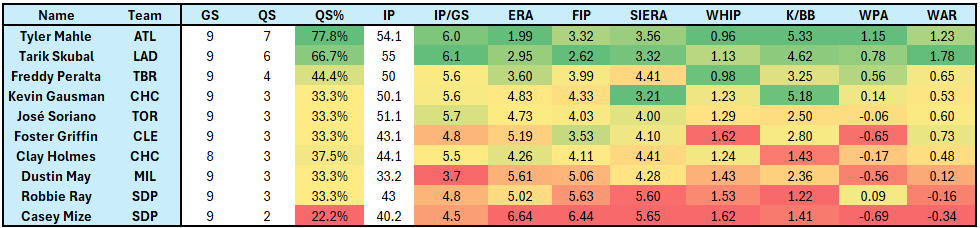
Mahle ranks first in quality starts, ERA, WHIP, K/BB, and win probability added since the deadline concluded among those notable names. He ranked second in FIP and fWAR, only behind Skubal, and third in SIERA.
Not only has he been the best starting pitcher moved at the deadline, but he also provided the most value.
The Dodgers sent over our No. 30 overall prospect in Zyhir Hope and No. 51 prospect in River Ryan to acquire Skubal. The Blue Jays traded away our No. 25 prospect, Arjun Nimmala, to acquire José Soriano. The Cubs traded our No. 95 prospect, Jefferson Rojas, to acquire Clay Holmes and Tyrone Taylor. Casey Mize, Dustin May, and others returned some of those organizations’ top prospects as well.
With all except Soriano being rentals, it’s clear that the Atlanta Braves not only acquired the most impactful starting pitcher at the deadline, but they also got by far the best deal. Maybe it’s finally time for people to give Alex Anthopoulos his credit and trust his moves more often than not, something even a section of Braves fans need to do.
The Changes Behind Mahle’s Success
Typically, when a pitcher is acquired by a new team, that team has its own ideas on how to improve that pitcher. Atlanta, in my humble opinion, is among the best at altering a pitcher’s arsenal to maximize their potential and impact. This is exactly what they have done with Tyler Mahle.
The philosophy here is actually quite simple. It’s the same philosophy that has helped turn Dylan Lee into one of the game’s best relievers over the last few seasons, revamped Tyler Kinley and Pierce Johnson’s careers in Atlanta, and aided in Bryce Elder’s success.
Throw your best pitch more. Throw your worst pitch less.
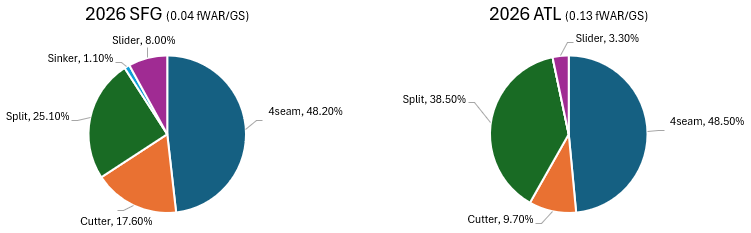
Mahle had always thrown his four-seam fastball nearly 50% of the time. It’s not necessarily his best pitch, but as you will see, it’s good enough and is the base pitch that allows the rest of his arsenal to play up.
His best pitch this season with the Giants was his splitter. Historically, it’s been one of his two best pitches, and coming into an organization that emphasizes the pitch as much as any, you can understand why Atlanta would attempt to unlock it even more.
With the Giants, Mahle threw it 25% of the time, but it was his best pitch in terms of zone contact (79%), chase (42%), and whiff (28%). It also recorded the lowest average exit velocity at 86.6 mph out of any pitch in his arsenal and the lowest wOBA allowed to opposing batters at .304.
Atlanta saw this and thought, Well, let’s just throw that more. He threw his split at nearly a 39% rate with the Braves. Many of those rates have stayed relatively similar, with opposing batters’ wOBA dropping significantly to .256.
So now that we’ve identified the “throw your best pitch more” part of the change, let’s look at the opposite. Entering 2026, Mahle’s cutter had been the best pitch in his arsenal in terms of Stuff+. However, this year, it became arguably his worst.
Despite throwing it at just under an 18% clip, his cutter performed at an arsenal-worst 92% zone contact, 17% chase, and 14% whiff rate. It had allowed opposing batters to hit .294 with a .426 SLG against it. What did Atlanta do? Simply tone down the usage, back to levels closer to what he threw in the best two seasons of his career, 2025 and 2021.
In 2021 with the Reds, Mahle threw his cutter just 5.6% of the time. In 2025, he threw it 12.5% of the time. Atlanta seemed to find the middle and had Mahle reduce the usage of his cutter down to just under 10%. It still has not performed well, but the lesser usage helps offset potential damage.
Mahle threw just 17 sinkers with the Giants, the only time he attempted the pitch in his career. The Braves removed that pitch from his arsenal. As for the slider, the Giants had already significantly decreased its usage, but it still performed terribly.
His slider ran just a 31.6% zone rate and only a 17.6% CSW%. It was a relatively uncompetitive pitch with the Giants. Sure, it produced a 22.6% chase and 23.6% whiff rate, but when batters didn’t chase it, the pitch gave him the most trouble, leading to both walks and damage with a .436 wOBA allowed.
The reduction down to just over 3% has minimized potential damage, and he has not allowed a hit on the pitch with the Braves. Like the cutter, it’s still not a “good” pitch, but simply throwing it less has made a significant improvement to Mahle’s overall performance.
Looking Ahead to October
With the regular season behind us, all eyes in Atlanta have turned to October. The Braves will slot into the three seed in the National League, and they will face their division rival Phillies in the first round.
Tyler Mahle will play a huge part in the success or failure of Atlanta in the playoffs.
Chris Sale will slot in as the Game 1 starter, as he should. He has been every bit as good as he was in his Cy Young season, and would arguably win another one this year if Jacob Misorowski didn’t exist. Game 2 will be Mahle’s. He’s earned it, and it will be an important one.
After Sale and Mahle, things do not look as set in stone. In a Game 3 scenario, Atlanta will need all hands on deck to cover the 27 outs it takes to complete a ballgame. Grant Holmes, AJ Smith-Shawver, and Martín Pérez or Bryce Elder, if they’re healthy, will be tasked with teaming up with the bullpen to cover these games.
This means that Sale and Mahle must give the Braves not only innings in their outings, but effective ones. Atlanta can’t afford to roll out some of their top arms out of the bullpen early in those games.
For Sale, it’s easy to see how he can succeed. For Mahle, history is not as kind, but if his success in a Braves uniform this year indicates anything, a solid six or seven innings seems more than reasonable.
October is the No. 1 priority for both parties. I would be lying, however, if I did not take a peek already at the offseason and wonder if Atlanta and Mahle have any interest in a reunion, considering he is a free agent after the season.
What Tyler Mahle has done can’t be understated, and he will have earned whatever contract he receives next. Unfortunately for Atlanta, the better and better he pitches, the higher and higher that contract’s dollar amount gets. And good for him. Atlanta will happily take that trade-off if it equates to October success this season.
But in a world where players such as Adley Rutschman and Tarik Skubal were traded at the deadline, Tyler Mahle will go down as possibly the best and most impactful piece moved this year.
Become a Member of Just Baseball
Subscribe and upgrade to go ad-free!
* Save 25% by subscribing annually.

Written by
Taylor is a baseball enthusiast and a writer for Just Baseball. An Atlanta native, he shares his love for the Braves, card collecting, and scouting the…