
The Atlanta Braves Didn’t Fail at the Deadline, They Stayed Disciplined
The Atlanta Braves have been criticized for a quiet trade deadline, but a closer look shows just why they are betting on themselves.
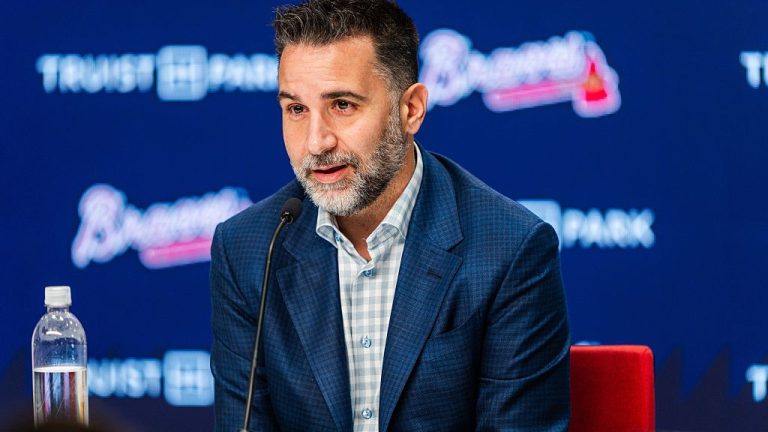
The 2026 MLB trade deadline has come and gone, and for much of Braves Country, it feels like the Atlanta Braves once again failed to make a meaningful splash.
Last season, in the middle of an injury plagued and disappointing campaign, many fans wanted Atlanta to become sellers by moving impending free agents and any player not expected to contribute beyond 2025. Instead, the Braves made only a handful of minor moves and largely stood pat.
There is certainly some nuance behind the decisions not to trade players like Marcell Ozuna and Raisel Iglesias that has since been explained, but that deadline put significant pressure on the front office heading into the offseason.
Alex Anthopoulos responded by bringing back Ha-Seong Kim, signing Mike Yastrzemski and Robert Suarez, trading for Mauricio Dubón, and adding veteran depth with Dominic Smith and Jorge Mateo. The general consensus was that Atlanta had a solid offseason, even if it was far from the blockbuster many fans were hoping for.
Despite battling injuries to the pitching staff and seeing key contributors like Ronald Acuña Jr. and Drake Baldwin spend time on the injured list, the Braves entered deadline day with a 67-45 record, the third best record in baseball, and an eight game lead in the National League East. To many, that looked like a team that should push all of its chips into the middle and go toe to toe with the Dodgers in October. Instead, Atlanta made a few modest upgrades and once again resisted the temptation to make a blockbuster move.
That decision did not sit well with much of the fanbase, the media, or the national baseball conversation. Honestly, I understand why. Atlanta entered the deadline as one of the best teams in baseball, had obvious questions in the rotation, and the front office openly acknowledged it was searching for an impact starter. When Monday came and went without that move, frustration was a completely reasonable reaction.
Where I disagree is the idea that failing to acquire an impact arm automatically means the Braves failed. I also think the term impact starter was thrown around far too loosely. Several of the pitchers who changed teams were immediately labeled proven playoff caliber arms, but I am not convinced. Furthermore, the prices were significantly higher than I would feel comfortable taking the risk on.
Before we get into why I believe Atlanta made the right decision, let’s first look at what Alex Anthopoulos and the Braves actually did accomplish at this year’s trade deadline.
The Moves Atlanta Did Make
The biggest addition for the Braves at the deadline was Lane Thomas. After being connected to Atlanta for seemingly the past few years, the Braves finally landed the veteran outfielder, acquiring him and Bailey Falter from the Kansas City Royals in exchange for pitching prospects Lucas Braun and Carter Holton. Falter appears to be more of a financial component in the deal, helping lower the overall prospect cost needed to acquire Thomas.
Braun entered the season ranked as Atlanta’s fifth overall prospect by Just Baseball and currently sits eighth in MLB Pipeline’s rankings. Outside of those lists, however, he generally falls somewhere in the twenties across the industry, including my own rankings. While Braun has shown flashes throughout his minor league career, injuries have consistently interrupted his development, and I have a difficult time projecting him as a long term major league starter. Holton finds himself in a similar position after battling both injuries and inconsistent performance.
From a roster construction standpoint, Thomas makes a lot of sense. Atlanta’s biggest offensive weakness this season has come against left handed pitching. Braves left fielders had combined for a league worst 80 wRC+ and the second worst .650 OPS in baseball. Thomas has built his career on punishing lefties, posting an .849 OPS against them, and should fit naturally into a platoon with Mike Yastrzemski, who owns a career .800 OPS against right handed pitching.
After Thomas, the rest of Atlanta’s deadline moves were much more about improving depth than making headlines.
The Braves acquired Tyler Mahle from the Giants in exchange for Anthony Molina. Mahle is the back-end rotation option many fans wanted, even if he is not the impact starter Anthopoulos publicly said the club was pursuing. Mahle’s overall 2026 numbers are underwhelming, but since returning from injury he has posted a 3.79 ERA and a 3.62 FIP across seven starts, suggesting there may be more upside than his season line indicates.
Atlanta also added Brent Suter in exchange for Nacho Alvarez Jr. While Suter will never overwhelm hitters with velocity, the veteran left hander has built a long career by limiting damage, generating weak contact, and keeping the ball on the ground.
The remaining moves were geared toward organizational depth. Joey Bart and Eli White were each moved in separate deals that brought back minor league relievers Duncan Davitt and Tyler Uberstine. Uberstine in particular has produced some intriguing underlying numbers at Triple-A and could become an interesting development project for Atlanta’s pitching staff.
That was the extent of the Braves’ deadline activity. On the surface, it certainly feels underwhelming, but I also do not believe it reflects a front office that was unwilling to improve. As we’ll get into next, Atlanta explored the top of the market. The question simply became whether the available pitchers were actually worth the price.
Big Game Hunting
If there was one consistent theme throughout both the offseason and the trade deadline, it was Alex Anthopoulos’ pursuit of an impact starter capable of leading a postseason rotation.
The biggest name to change teams was, of course, Tarik Skubal. The Dodgers had been connected to Skubal for what felt like an entire year, making the trade feel more inevitable than surprising. In the end, Los Angeles sent Zyhir Hope, Just Baseball’s No. 40 overall prospect, River Ryan, (JB No. 41), and Brady Smith to Detroit.
Using both Just Baseball’s rankings and my own evaluations, a comparable Braves package likely would have been built around Eric Hartman, (JB No. 32), Cam Caminiti, (JB No. 79), and Luke Sinnard.
There is no debating Skubal’s talent. He is a two-time Cy Young Award winner and arguably the best pitcher in baseball. Pairing him with Chris Sale would have given Atlanta what may have been the most dominant one two punch in the sport. The question was never about the player. It was about the price.
That is an enormous package to surrender for what ultimately amounts to a two month rental. If that move ends with a World Series championship, no one thinks twice about the prospect cost. If it doesn’t, you have dramatically weakened your farm system with little to show for it. Personally, I would not have made that trade either.
Another name connected to Atlanta was Logan Webb, but reports indicated the Giants never had much interest in moving their ace despite receiving calls.
Perhaps the most fascinating story of the deadline involved Jacob deGrom.
The Rangers reportedly changed course several times leading up to the deadline, making it difficult to gauge whether they were buying, selling, or somewhere in between. Anthopoulos remained engaged throughout those discussions, and according to reports, the Rangers even told deGrom that if he wanted to go to Atlanta, they would make a deal happen.
Instead, deGrom exercised his no trade clause and chose to remain in Texas. That one is admittedly disappointing.
The Braves have pursued deGrom before, dating back to his years with the Mets, and the thought of a postseason rotation led by Sale and deGrom is enough to make any baseball fan dream a little. Unfortunately for Atlanta, that opportunity never materialized.
Looking Back at the Offseason
Before diving further into the deadline, I think it’s worth revisiting the criticism surrounding Atlanta’s offseason. One of the biggest complaints all winter was that the Braves failed to add another proven starter to the rotation. With several notable free agents available, many fans and media members believed Atlanta needed to make a significant investment.
Now, with four months of baseball behind us, we can look back at those same pitchers and compare how they have actually performed against Atlanta’s current rotation.
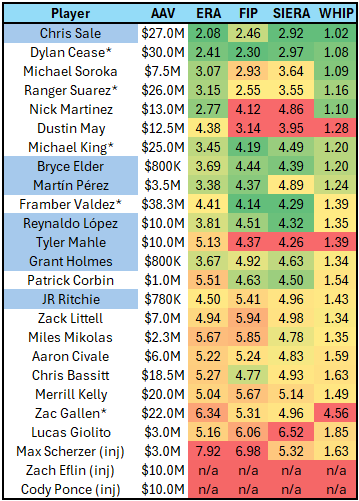
Starting with the qualifying offer candidates, Dylan Cease has been exactly what many expected. He has pitched like every dollar of his contract has been worth it and, looking back, he remains the one qualifying offer free agent I consistently pounded the table for all offseason.
Ranger Suarez has also delivered a strong season for Boston. While I still have some concerns about how well his profile will age over the life of his contract, there is no denying he has given the Red Sox exactly what they hoped for in 2026.
The rest of the group becomes much more interesting.
Michael King has experienced an up and down season and, statistically, has been only marginally better than Atlanta’s current rotation outside of Sale. The same can largely be said for Framber Valdez, whose production has fallen well short of what many expected from the former Astros ace. Zac Gallen, meanwhile, has struggled throughout the year.
Looking back, there’s a legitimate argument that Atlanta made the right decision by passing on the qualifying offer market rather than committing massive contracts to King, Valdez, or Gallen. Could King or Valdez have helped? Absolutely. But neither player has performed well enough to call Atlanta’s decision a clear mistake.
Outside of the qualifying offer market, there were several intriguing alternatives.
Former Braves first round pick Michael Soroka has been outstanding for Arizona when healthy, although he has been sidelined since June 19. Nick Martinez has become the latest success story in Tampa Bay’s pitching development system, while Dustin May appears to have revitalized his career with St. Louis. None of these were exactly the headline names most fans would be clamoring for.
Many of the names fans discussed throughout the winter included Chris Bassitt, Gallen, Merrill Kelly, Zack Littell, Zach Eflin, Valdez, Suarez, and Cease. With the benefit of hindsight, it is fair to say Atlanta’s decision to trust its own pitching development has aged much better than many expected.
Separating the Names From the Results
Now we get to the trade deadline. If fans were frustrated that the Braves did not add a frontline starter during the offseason, those feelings only grew stronger once the deadline passed.
I am not here to tell anyone how they should feel. I simply want to add some context to the pitchers who actually changed teams and ask one question: Were they truly worth the price?
Skubal is the easy exception. He is a top three pitcher in baseball. That is not an opinion, it’s simply reality. If there was one true difference maker available at this deadline, it was Skubal.
Outside of him, though, how many starters could you confidently label an impact, playoff caliber number two? Personally, I am not sure I could name one with confidence. That is exactly why I am comfortable letting other organizations pay those prices.
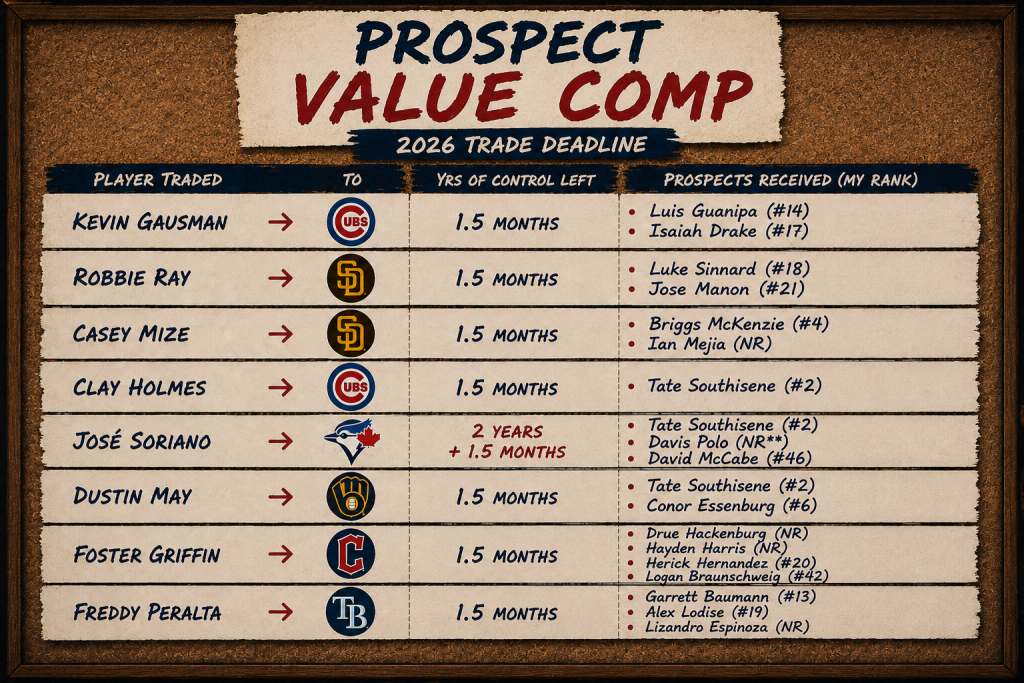
Freddy Peralta would have fit that description in seasons past. This season, however, his 5.37 ERA would rank last among Atlanta’s current rotation options. The same is true for Kevin Gausman. While he has been one of baseball’s most reliable starters for much of his career, his 4.38 ERA in 2026 is only better than Mahle among Atlanta’s current rotation options.
Clay Holmes, who joined the Cubs alongside Gausman, presents another interesting case. Over the past two seasons he has been excellent and would absolutely improve Atlanta’s rotation. The problem is that he has not appeared in a major league game since May 15. There is simply no way to know how much of an impact he will have once he returns, and that is a hefty prospect price to pay for that gamble.
José Soriano was arguably the second biggest starting pitcher moved at the deadline, and Toronto paid a significant price to acquire him, headlined by (JB No. 27), Arjun Nimmala. Since May 1, however, Soriano owns a 4.59 ERA, which would rank behind Sale, Grant Holmes, Reynaldo López, and Martín Pérez. His underlying metrics have also trended in the wrong direction, and perhaps even more concerning, his Stuff+ has declined every season since 2023.
Robbie Ray and Casey Mize were two of the pitchers most frequently connected to Atlanta, and both ultimately landed in San Diego. On the surface, both have impressive ERAs, trailing only Sale among the pitchers discussed here. Dig a little deeper, though, and the picture changes.
Ray’s expected ERA sits 1.35 runs higher than his actual ERA. His expected FIP is also higher than his current mark, and his 4.76 SIERA would rank second worst among Atlanta’s current rotation behind only Pérez. Will that regression come? Maybe. Maybe not. But it is certainly part of the evaluation and a risk you have to understand.
Mize was my favorite trade target, and he will likely be my top free agent target this offseason as well. When healthy, Mize looks every bit like a legitimate number two starter who would fit perfectly behind Sale and alongside a healthy Spencer Schwellenbach. The problem has never been talent. It has been availability.
Mize has already spent time on the injured list twice this season and has dealt with lingering health issues throughout the year. That risk cannot simply be ignored. Atlanta is already dealing with similar issues within their rotation, is it worth the loss of prospect capital to add another for two months?
The Right Move Isn’t Always the Biggest One
By now, the pattern should be pretty clear.
Every one of these pitchers came with significant question marks. Many have actually produced at or below the level of Atlanta’s current rotation despite costing premium prospect capital to acquire.
My entire argument comes down to one belief: outside of Skubal, none of the starters moved at the deadline represent a significant enough upgrade over what the Braves already have in-house. Several have actually performed worse, while others carry underlying metrics that suggest regression could be on the horizon.
It’s not about an individual pitcher. I am simply trusting the pitching development Atlanta has. Atlanta’s rotation has been underrated all season long, and you must evaluate whether the price was worth what, in many cases, amounted to only a marginal statistical upgrade
That is not prospect hugging. That is not being afraid to make a move. It is simply understanding value and weighing the upgrade you are actually receiving against the future assets you are giving up.
Others may disagree, and I actually encourage that discussion. Nobody knows today which decisions will ultimately prove right or wrong. For me, the prospect capital required to make only a marginal improvement to Atlanta’s chances simply was not worth sacrificing highly regarded future talent. Other organizations reached a different conclusion, or believed they had a greater need than the Braves did, and that is perfectly reasonable as well.
Sometimes, however, the best move is the one you choose not to make. That philosophy appears to have paid off during the offseason. Whether it proves true again at this deadline remains to be seen.
Over the next two months, we’ll find out.
Become a Member of Just Baseball
Subscribe and upgrade to go ad-free!
* Save 25% by subscribing annually.

Written by
Taylor is a baseball enthusiast and a writer for Just Baseball. An Atlanta native, he shares his love for the Braves, card collecting, and scouting the…