
After Chris Sale, Who Starts for the Braves in October?
Chris Sale is a clear playoff ace, but who follows him? Here's what Atlanta's ideal October pitching plan looks like.
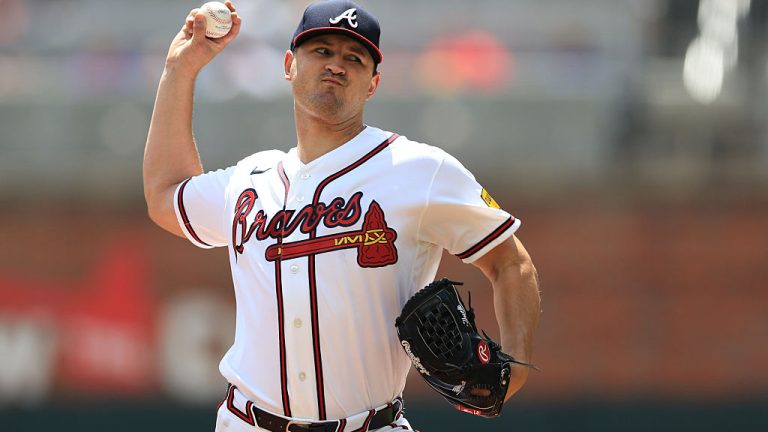
There has been plenty of discourse surrounding the Atlanta Braves‘ lack of significant transactions, both during the offseason and leading up to the trade deadline. Yet, as we enter the final month of the regular season, the Braves are in as good a position as almost anyone.
Atlanta enters September with an 82-56 record, the fourth best record in baseball. They’re four games up in the division and 9.5 games clear of the final Wild Card spot.
The Braves also have a +113 run differential, fourth in baseball as well. They have played the 23rd most games against teams with at least a .500 record at 63, but they have the second most wins in those matchups with 39. Their .619 winning percentage in those games ranks second behind only the Milwaukee Brewers, who have played 59 such games.
Yes, there have been ups and downs, but that is baseball. No team, as we have seen with the Dodgers this season, can go an entire year without going through some struggles. The Braves are no different.
With the playoffs quickly approaching, many across Braves Country have started looking ahead to potential October matchups. The offense has been a bit of a concern lately, but one of the biggest talking points has still been the rotation.
With news that Spencer Schwellenbach and Hurston Waldrep are out for the season, and with Spencer Strider looking less likely to be available by the day, Atlanta has to look within for more options.
So, who should start the non-Chris Sale playoff games for the Braves?
Who Gets the Ball in Game 2?
If healthy, Schwellenbach would slot directly into the Game 2 role, and I do not think there would be a Braves fan anywhere complaining about it. Unfortunately, that will not be the case. That leaves the current Game 2 race between two pitchers.
Tyler Mahle
In my eyes, Tyler Mahle is the leader in the clubhouse for the opportunity. His overall season numbers are not spectacular on paper, including a 4.25 ERA and 3.95 SIERA. However, his numbers since arriving in Atlanta paint a much different picture.
Since coming over from the San Francisco Giants before the deadline, Mahle has made five starts for Atlanta and has recorded a quality start in four of them. Across those outings, he has scattered 24 hits and five walks to allow just five runs while striking out 32 batters.
That translates to the fourth best ERA in baseball since the deadline (1.48). Among 79 qualified pitchers during that stretch, Mahle also ranks inside the top 16 in FIP (2.85), WHIP (0.96), SIERA (3.08), and K:BB ratio (23.1%).
It’s not as if he has compiled those numbers against nothing but struggling offenses, either. His five starts have come against teams currently ranked fourth in wRC+ during that same span (Brewers), sixth (Mets), eighth (Twins), 16th (Yankees), and 27th (Rockies).
Simply put, Mahle has pitched better than every other realistic option for the Game 2 nod since being acquired by the Atlanta Braves. And while he is the front-runner in the clubhouse right now, there is another pitcher aiming to catch him with one month to go.
AJ Smith-Shawver
Last season, AJ Smith-Shawver showed real growth toward becoming the pitcher many thought he could eventually be. Across nine starts, he posted a 3.86 ERA, 3.90 FIP, and 1.15 WHIP while allowing more than three runs just once. Unfortunately, he was removed from what would become his final start of the season before eventually undergoing Tommy John surgery.
He has battled all the way back this year and is now looking to pick up where he left off.
Smith-Shawver certainly looked the part during his five Triple-A starts, posting a 1.66 ERA, 1.06 WHIP, and 28.7% strikeout rate. He has now made three starts at the big league level this season, allowing two, four, and three runs, respectively, while failing to pitch beyond the fifth inning in any of them.
The starts themselves have not been bad, but the command has been an issue. However, that should not necessarily be surprising. Command and control are typically among the last things to fully return for a pitcher after Tommy John surgery.
For a pitcher who relies heavily on his splitter, the ability to locate his fastball, changeup, and slider becomes especially important because consistently commanding the split itself is incredibly difficult.
Recently, Smith-Shawver has not been able to do that, and the results have reflected it. He has struck out just 10 batters across his three starts while walking 8 and allowing 14 hits.
Still, there is a month left. As he gets more repetitions at the major league level, Smith-Shawver has a legitimate opportunity to overtake Mahle for the Game 2 spot if he can begin putting everything together over the final month of the regular season.
Other Options
The race is not over, though. Martín Pérez has been arguably the most consistent pitcher the Braves have had this season outside of Sale. Bryce Elder has the sixth most quality starts in baseball with 15. Grant Holmes has allowed just four or more runs in two of his 25 starts this year. Reynaldo López is entering the final phase of his rehab program and should re-join the team within the next week.
So, there are more options. However, considering how Mahle has performed since being acquired and the pure stuff Smith-Shawver possesses, I believe those two represent the most appealing choices for a Game 2 start in October.
The competition is not necessarily limited to those two, but it will be an uphill climb for anyone else to enter the mix.
Finding the Right Formula for Game 3
Games 1 and 2 feel relatively straightforward. Game 3 could be as well, if Smith-Shawver proves he’s ready for a postseason start. The later games in a series are where things become much more interesting.
After Sale, Mahle, and possibly Smith-Shawver, there are two distinct paths Atlanta can take.
Standard Starter
Most teams take the traditional approach and simply give the ball to the next best starting pitcher on the staff. For teams such as the Los Angeles Dodgers, Milwaukee Brewers, and Philadelphia Phillies, that seems like the obvious route.
For the 2026 Atlanta Braves, things are not nearly as clear.
As mentioned earlier, arms such as Pérez, Elder, and Holmes have all pitched well enough to at least warrant consideration for a Game 3 or 4 start. More often than not, they keep Atlanta in the game. At the same time, none of them consistently shut down opposing offenses, which creates some obvious risk in a postseason setting.
That is where the times through the order numbers become interesting. During their first trip through an opposing lineup, the options shown below have produced very respectable numbers. Atlanta would gladly take those results in October. The problem comes when hitters see them again.
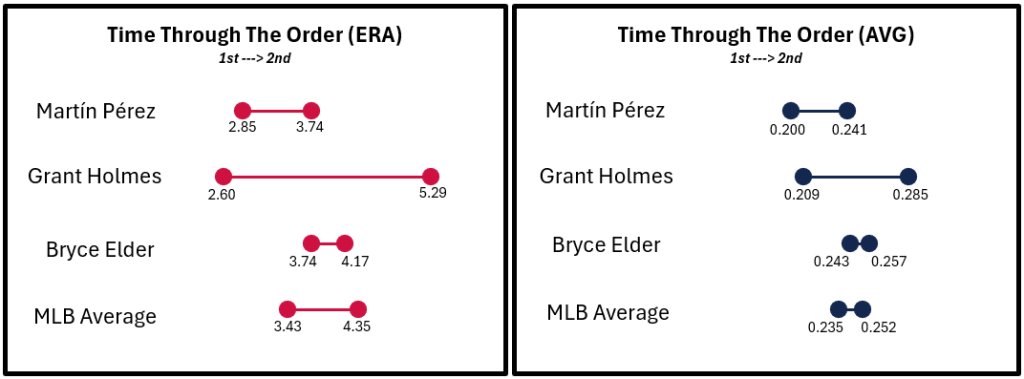
Pérez is the most consistent of the trio from the first time through the order to the second, posting a better ERA and batting average against than league average. The issue is he lacks a true swing-and-miss arsenal teams typically want in October.
Elder has also been consistent, just in a very different way. Both metrics are slightly worse than league average for him the first time through an order, but the degree to which he regresses a second time through is by far the smallest difference out of the group. He will either give Atlanta a quality start, something he has done in 15 of his 26 outings this season, or struggle to make it out of the second inning.
Holmes shows the clearest regression of the group as the lineup turns over. The good news for Atlanta is that he also has plenty of experience working out of the bullpen.
So what is my solution? Do not necessarily allow these pitchers to face the opposing lineup more than once. Atlanta can structure Game 3/4 in several different ways to put its pitchers in the situations where they are most likely to succeed.
Committee Approach
Technically, you could call this a piggyback strategy or even a bullpen game, depending on which pitchers are involved. Whatever you want to call it, the concept remains the same.
Atlanta has several pitchers with starting experience who can look very good for two, three or four innings before things begin to tail off. Combine that with one of the best bullpens in baseball, and it becomes much easier to see a path toward covering the 27 outs necessary to win a postseason game.
One starter handles the first two or three innings. Another starter comes out of the bullpen and covers the next two or three. From there, Atlanta turns the game over to its traditional bullpen arms for the final stretch.
One example could be Elder handling innings one through three, Holmes taking innings four through six, and then the Braves deploying their bullpen as needed for the final three innings. If Elder gets in trouble, Walt Weiss can deploy a stopper such as Didier Fuentes or Dylan Dodd to get them out of a jam and give Holmes a clean inning to start with.
The actual names are less important than the process. However, for me, Elder makes the most sense to start in this type of scenario. Pérez, Holmes, and even López all have previous experience pitching out of the bullpen, giving Atlanta more flexibility with how Weiss could deploy them.
This strategy would also make Sale’s workload especially important, as using three to five pitchers in one game means fewer arms would be available for the earlier games in the series.
But the good news? The flexibility the Braves have with their pitching options makes up for some of the lack of impact those arms bring.
How I Would Build Atlanta’s October Staff
So, how would I structure Atlanta’s pitching staff once October arrives? First, here is my ideal playoff pitching staff, so we know exactly what we are working with.
| Name | Handedness |
| Chris Sale | LHP |
| Tyler Mahle | RHP |
| AJ Smith-Shawver | RHP |
| Bryce Elder | RHP |
| Grant Holmes | RHP |
| Reynaldo López | RHP |
| Martín Pérez | LHP |
| Victor Mederos | RHP |
| Dylan Dodd | LHP |
| Didier Fuentes | RHP |
| Dylan Lee | LHP |
| Robert Suárez | RHP |
| Raisel Iglesias | RHP |
Game 1 is Chris Sale. There really is not much of a debate surrounding that.
I actually believe pitching-off can be a great strategy when used in the right situation. However, with Atlanta’s opponent currently unknown, I am not going to dive too far down that rabbit hole yet.
Game 2 belongs to Tyler Mahle. He has consistently provided five or six innings of excellent pitching per start since joining Atlanta, and I am going to trust that until he gives me a reason not to.
This is also a game where I would have one of Smith-Shawver, Pérez, Holmes, or López available in case Mahle runs into trouble. That gives Atlanta another pitcher capable of covering multiple innings effectively behind him if needed.
For Game 3, at least for now, I am starting Bryce Elder. He is the one pitcher among these options without much bullpen experience, so I want to put him in the role where he is most comfortable.
If Elder settles into the game, as he has in roughly 60% of his starts this season when he has delivered a quality start, Atlanta is essentially playing with house money. If he does not, that is where the flexibility of this roster becomes extremely valuable.
Two of Smith-Shawver, Pérez, Holmes, or López can be available behind him to cover innings and prevent Atlanta from asking Elder to navigate an opposing lineup multiple times if he simply does not have it that day.
In this scenario, Atlanta would technically roster only six traditional bullpen arms, with four of the team’s current starters sliding into the ‘pen. That comes with risk, but I think it is necessary considering the uncertainty surrounding the Game 2 and Game 3 spots.
The goal is not necessarily to build a pitching staff that looks conventional on paper. The goal is to have enough arms capable of getting 27 outs at least three or four times during each postseason series. And Atlanta has pitchers who can help bridge those innings.
Fuentes can be utilized as a stopper or as a multi-inning reliever. That is even more flexibility for Atlanta to work with. He has recorded more than one inning in relief 16 times this season. Dodd has settled into a reliable bullpen role. Between Triple-A and the majors this season, he has made 11 relief appearances of more than one inning as well.
Finally, Victor Mederos gets the last bullpen spot on my roster. He has eight appearances out of Atlanta’s bullpen this season in which he has recorded more than one inning. He also has 10 such outings in Triple-A this year, along with six starts. Mederos brings the electricity to ignite a team and fanbase.
In summary, Atlanta can and will have enough arms to cover 27 outs throughout a postseason series. Whether it is a three-game Wild Card series, a five-game Division Series, or a seven-game Championship Series or World Series, the Braves have enough pieces to win.
The deciding factor is whether those pitchers perform when given the opportunity.
Atlanta can put many of them in roles that better emphasize what they do well while limiting their weaknesses. At some point, however, the players themselves still have to execute. And that does not apply only to the pitching staff. None of this will matter if the offense does not show up.
It may not be the traditional October rotation, and it certainly is not the ideal pitching staff Atlanta envisioned entering the season. But it is one capable of getting through October. The Braves have enough arms. Now they have to figure out the best way to use them.
Become a Member of Just Baseball
Subscribe and upgrade to go ad-free!
* Save 25% by subscribing annually.

Written by
Taylor is a baseball enthusiast and a writer for Just Baseball. An Atlanta native, he shares his love for the Braves, card collecting, and scouting the…