
Top 100 Prospects: Biggest Risers
With every update to our Top 100, some prospects see their stock go way up. These are the biggest risers from the last list to the latest one.
Our latest Top 100 Prospects update featured several significant movers, ranging from teenagers beginning to translate projection into production to upper-level prospects already forcing their way into major league plans.
These are the 11 biggest risers on our latest Top 100.
Top 100 Biggest Risers
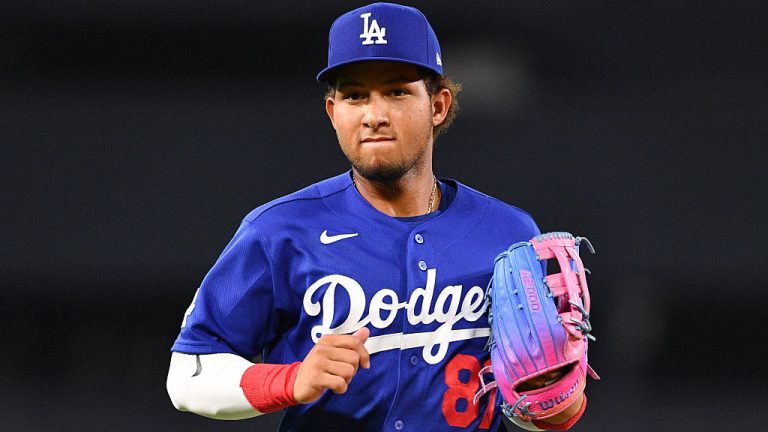
Eduardo Quintero — No. 36 to No. 14
In a loaded Dodgers system that features two other top-20 prospects in the outfield alone, Eduardo Quintero’s 2026 season still manages to stand out.
Playing all year at age 20, Quintero has dominated High-A pitching to the tune of a 149 wRC+ while walking nearly as often as he strikes out. What made him such an easy riser for us is the combination of floor and ceiling.
Quintero already looks capable of playing at least an above-average center field, while his combination of plate discipline and bat-to-ball ability gives him an unusually stable offensive foundation. He owns a 17.6% walk rate despite swinging just 33% of the time, and when he does pull the trigger, he makes contact at an 82% clip.
It is the profile of a player who should be able to accumulate value in several different ways even if the power never reaches its upper end.
The ceiling, though, comes from just how many tools are still waiting to be maximized. Quintero has been a weapon on the bases, going 42-for-49 on stolen-base attempts, and he is slugging .495 despite already having one of the most advanced approaches at the level.
In most organizations, Quintero probably would have reached Double-A by now. The Dodgers’ remarkable backlog of outfield prospects has instead left him to continue terrorizing the High-A Midwest League.
Quintero should begin 2027 in Tulsa, and there may still be another physical jump coming. With room to add strength to his lean frame without sacrificing the athleticism that drives so much of his current value, there could be another level of impact ahead. If that comes, Quintero has a chance to push his way into the conversation as one of the very best prospects in baseball.
Read more about Eduardo Quintero on Just Baseball’s Top 100 list.
Josuar Gonzalez — No. 45 to No. 20
Few prospects have turned more heads in their first full season of stateside pro ball than Josuar Gonzalez.
After making minced meat of the DSL in 2025, Gonzalez has carried that production stateside, dominating at the complex before continuing to rake in Low-A despite missing time with an injury. Across the two levels, he has posted a 153 wRC+ while walking roughly 16% of the time and striking out at a sub-20% clip.
Gonzalez has legitimate five-tool potential. He is already flashing impressive exit velocities for his age, even if a flatter swing path currently leads to more balls on the ground than you would ideally like to see. He pairs that impact potential with above-average bat-to-ball skills and, perhaps most impressive for such a young hitter, excellent swing decisions.
The athleticism ties the entire profile together. Gonzalez has a twitchy, projectable frame that makes him a factor on the bases and gives him an excellent chance to remain at shortstop long term. He projects as a plus defender at the six, meaning the offensive bar he needs to clear to become an impact big leaguer is relatively low.
But the offensive ceiling looks considerably higher than that. Gonzalez is already combining patience, contact and emerging impact against older competition. If the power continues to develop as he matures physically and he begins elevating the baseball more consistently, he could quickly establish himself as one of the best prospects in the sport.
Read more about Josuar Gonzalez on Just Baseball’s Top 100 list.
Angel Genao — No. 43 to No. 23
One of the premier bat-to-ball artists in the minor leagues, Angel Genao recently earned the bump to the big leagues and has continued to show why his offensive profile is so appealing.
Genao posted a 134 wRC+ across Double-A and Triple-A this season while running a zone-contact rate north of 90%. That elite contact ability has always been the foundation of the profile, but the biggest development in his age-22 season has been the added impact.
Genao produced a 45% hard-hit rate at Triple-A and has pushed that number to 53% in his small major league sample. For a hitter who puts the bat on the ball as often as he does, that is more than enough impact to make the offensive profile work.
There are still some limitations. Genao puts the ball on the ground more often than you would like, which caps some of the damage he can do. But the increase in quality of contact makes that concern much easier to live with, particularly when paired with such an advanced ability to avoid empty swings.
Defensively, Genao brings another layer of stability. He can handle all three infield spots at an average-or-better level, giving Cleveland the flexibility to move him around the diamond without sacrificing much value. That versatility should help him accumulate WAR even if he never settles into one permanent position.
Genao will graduate from prospect status by our next update, and his rise into the top 25 is a reflection of just how complete the profile has become. Elite bat-to-ball skills, improving impact and a high defensive floor give him one of the safer paths to becoming a productive everyday player among the prospects near the top of this list.
Read more about Angel Genao on Just Baseball’s Top 100 list.
Josiah Hartshorn — No. 63 to No. 24
Very few teenagers have the offensive polish that Cubs switch-hitter Josiah Hartshorn has already shown.
Hartshorn has announced himself with authority in his first professional season. After posting a 145 wRC+ over 39 games at Low-A while walking more often than he struck out, he earned a promotion to High-A and has hardly missed a beat.
Through 72 games at the level, Hartshorn has launched 16 home runs, struck out just 20.5% of the time and produced a 136 wRC+.
As a switch-hitter, Hartshorn’s blend of hit and power has quickly made him one of the most impressive offensive prospects in the minor leagues. The advanced approach is the cherry on top. He controls the zone, makes enough contact to get to his power consistently and has already shown that the production can survive a jump in competition.
For a hitter this young, there simply are not many obvious holes to poke in the offensive profile.
The biggest limiting factor in Hartshorn’s overall value is defensive utility. His long-term home is likely first base or a corner-outfield spot, putting considerably more pressure on the bat than there would be for a player at a premium defensive position. The good news is that Hartshorn’s offensive ceiling looks more than capable of carrying that profile.
Hartshorn is shaping up to be another draft success for the Cubs, and his jump from No. 63 to No. 24 reflects just how dramatically his stock has changed in one season. If he continues producing against upper-level pitching in 2027, he has a chance to push his way into the top 15 prospects in baseball.
Read more about Josiah Hartshorn on Just Baseball’s Top 100 list.
Kaelen Culpepper — No. 61 to No. 37
Recently called up to the big leagues, Kaelen Culpepper has one of the most well-rounded skill sets of any infielder on this list.
Culpepper is a true sum-of-his-parts player. He combines above-average contact ability with good swing angles and enough impact to project as a 15-to-20 home run threat. He is also an above-average runner and has shown enough defensively to handle shortstop at least adequately, giving him several different avenues to provide value.
There have been some expected growing pains in his first taste of major league pitching. Culpepper has been aggressive, chasing 46% of pitches outside the zone while walking just 3.4% of the time, but that is not especially concerning given the size of the sample and the difficulty of the adjustment.
More encouraging is that his power has already translated. Culpepper has snuck out two home runs in just 15 games, and a swing path geared toward pull-side loft has already started to pay dividends against big league arms.
That ability to create damage without sacrificing the rest of his game is what makes the profile so appealing. Culpepper does not need any one tool to carry him. He can make contact, get to enough power, add value on the bases and remain on the dirt defensively.
This will be Culpepper’s final Top 100 ranking before graduation, and his rise from No. 61 to No. 37 reflects how much he has rounded out his profile since being drafted in 2024. He increasingly looks like the kind of well-rounded everyday infielder who can contribute value across the board rather than needing one carrying tool to succeed.
Read more about Kaelen Culpepper on Just Baseball’s Top 100 list.
Cooper Flemming — No. 68 to No. 45
The 53rd pick in the 2025 draft, Cooper Flemming has progressed nicely in his first full season of professional baseball.
Across 107 games at Low-A, Flemming has hit 10 home runs, stolen 14 bases and posted a 126 wRC+ while striking out just 18% of the time. The foundation of the offensive profile is already encouraging.
Flemming owns above-average bat-to-ball skills, including a 78% zone-contact rate, and has paired that offensive steadiness with defensive versatility, seeing time at all three infield positions while playing primarily shortstop.
What makes Flemming a notable riser—and one of the more interesting players to follow in 2027—is the potential for considerably more power to come. He just turned 20 in August and, at 6-foot-3 and 190 pounds, still has plenty of room to add strength to his frame.
That creates an intriguing developmental path. Flemming has already demonstrated the contact ability necessary to give himself a strong offensive foundation. If the power develops into even an average-or-better tool as he physically matures, his bat could become the driving force of the profile even if he eventually has to move off shortstop.
Flemming’s first full professional season has firmly pointed the arrow upward. He should get his first taste of High-A in 2027, where another step forward in his power production could send him climbing even higher up this list.
Read more about Cooper Flemming on Just Baseball’s Top 100 list.
Braylon Doughty — No. 96 to No. 46
A Competitive Balance Round A selection by Cleveland in the 2024 draft, Braylon Doughty has announced himself in 2026 as one of the better pitching prospects in baseball.
Pitching his age-20 season across High-A and Double-A, Doughty has thrown 89.1 innings with 10.68 strikeouts per nine and just 2.01 walks per nine while posting a 3.32 ERA and 2.66 FIP. The combination of bat-missing ability and strike throwing is especially impressive for a pitcher who will not turn 21 until December.
Doughty’s fastball is fairly conventional and is not the pitch that makes the arsenal jump off the page, but he commands it well and uses it effectively to set up a deep collection of secondaries.
His feel for spin allows him to create multiple distinct breaking-ball shapes, highlighted by a big 12-to-6 curveball reminiscent of Barry Zito’s signature hook. The changeup gives him another legitimate weapon, particularly against left-handed hitters.
What stands out as much as the individual pitches, though, is Doughty’s ability to command an arsenal featuring such disparate shapes. For such a young pitcher, the combination of stuff, sequencing and strike throwing gives him a considerably higher floor than the typical arm with this kind of swing-and-miss upside.
Doughty will likely return to Akron to begin 2027, but he may not stay there long. With his blend of command and bat-missing stuff, he has a chance to reach Triple-A next season and could be knocking on the door of Cleveland’s rotation sooner rather than later.
Read more about Braylon Doughty on Just Baseball’s Top 100 list.
Joseph Dzierwa — No. 92 to No. 54
Six-foot-8 left-handed precision artists do not exactly grow on trees, but that is what Joseph Dzierwa has looked like in his first full professional season.
The lanky lefty has dominated across High-A and Double-A, pitching to a 2.00 ERA over 117 innings. A pitcher with Dzierwa’s size and delivery might be expected to battle scattershot command, but he has done the opposite, walking just 6.2% of opposing hitters while striking out 29.7%.
His fastball plays effectively at the top of the zone, and the angle he creates with a closed-off delivery makes him especially uncomfortable for left-handed hitters. His upper-70s sweeping slider gives him a breaking ball that moves sharply away from lefties, while his changeup fades beautifully away from right-handed hitters and gives him another weapon to neutralize opposite-handed bats.
That combination of deception, command and bat-missing stuff has allowed Dzierwa to overwhelm hitters at two levels in 2026. There is nothing especially complicated about why he has climbed from No. 92 to No. 54: he has performed like one of the better pitching prospects in the minors while answering many of the command questions that naturally come with a pitcher of his size.
Dzierwa’s first full professional season has gone about as well as anyone could have hoped. At this point, the biggest remaining questions are simply whether he can do it again and whether the same ingredients continue to work against the highest levels of competition.
Read more about Joseph Dzierwa on Just Baseball’s Top 100 list.
Josh Hammond — No. 76 to No. 56
A former two-way prep standout, Josh Hammond’s first professional season has shown off the exciting collection of tools that made him a first-round pick in 2025.
There is still plenty of rawness in the offensive profile. Hammond is currently killing a lot of worms, running a groundball rate around 50%, but the ingredients for much more damage are already there. His bat speed is comfortably above average, and there is still plenty of room for additional strength and power to come as his frame matures.
His two-way background has also translated neatly to the defensive side. Hammond has plus arm strength, moves well enough to remain on the left side of the infield and has shown the actions necessary to give him a legitimate chance to stick at shortstop long term.
The bat-to-ball ability is another encouraging piece of the puzzle. Hammond has run an overall contact rate north of 80%, an impressive mark for a young hitter with this much bat speed and physical projection.
If he can begin lifting the ball more consistently, there is a path toward significantly more game power without needing to sacrifice much contact.
Hammond remains more projection than finished product at this stage, but the foundation is an exciting one. If the Royals can help him convert more of that bat speed into impact while he continues developing at shortstop, he could make another sizable jump up this list in 2027.
Read more about Josh Hammond on Just Baseball’s Top 100 list.
Seaver King — No. 97 to No. 61
Seaver King’s rise up the board has coincided with a legitimate offensive breakout.
After posting just an 88 wRC+ across High-A and Double-A in 2025, King has torched Double-A and Triple-A pitching this season to the tune of a 155 wRC+. The biggest development has been the added impact.
King has long looked more like a hit-over-power player, but that profile has changed significantly in 2026. Through 54 games at Triple-A, King has posted a 50.3% hard-hit rate along with an eye-popping 31% HR/FB rate.
For a player who began his college career at Wingate before transferring to Wake Forest and was already viewed as a strong contact-oriented athlete, the emergence of this kind of damage production materially raises his offensive ceiling.
The defensive foundation was already in place. King has the athleticism, actions and arm strength to stick at shortstop, giving him a premium defensive home while the bat continues to develop.
That makes this breakout especially meaningful. King no longer looks like a player who will need his defense and versatility to carry the profile. If even most of this newfound impact proves sustainable, there is a path to becoming an everyday shortstop with real offensive value.
King is now knocking on the door of the big leagues and could earn a September call-up. With CJ Abrams sliding over to second base, there is a very real possibility that Washington’s Opening Day shortstop in 2027 is Seaver King.
Read more about Seaver King on Just Baseball’s Top 100 list.
George Klassen — No. 100 to No. 62
A player we at Just Baseball have long been higher on than the industry, George Klassen is already showing in the big leagues why we kept the faith.
Klassen can run his fastball into the upper 90s, but what makes him such an intriguing pitching prospect is the depth and quality of the secondary arsenal. He throws a true bullet slider in the low 90s that helps drive a high groundball rate, giving hitters a very different look from the elevated velocity of the heater.
The biggest development has been the changeup. Klassen is now using it frequently against left-handed hitters, and it has given him a much-needed weapon to keep opposite-handed bats off balance.
He will also mix in a sinker and curveball, creating a deep enough arsenal that hitters rarely get to sit on one shape. That ability to change speeds and movement profiles has already translated in his brief major league sample, in which Klassen has produced a 31.3% whiff rate.
The raw stuff has never been the question. Command, however, remains his Achilles heel. Klassen has carried a 16.8% walk rate into the big leagues, and that will ultimately determine whether he reaches his ceiling as a starter or settles into a more volatile role.
Still, pitchers who can miss bats at this level with this many legitimate weapons are difficult to ignore. Klassen’s command risk keeps some volatility in the profile, but his combination of velocity, secondary depth and bat-missing ability is more than enough to justify his rise into the top 70 prospects in the sport.
Read more about George Klassen on Just Baseball’s Top 100 list.
Become a Member of Just Baseball
Subscribe and upgrade to go ad-free!
* Save 25% by subscribing annually.

Written by