
CJ Abrams’ Position Change Opens the Door for a Top Prospect
Top prospect Seaver King could be knocking on the door of the big leagues in the near future.
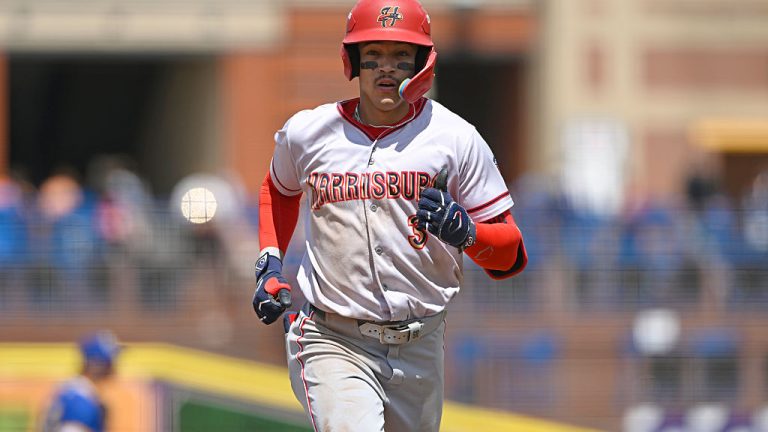
This year, the Washington Nationals have taken a massive step forward in their rebuild, in large part thanks to the sustained offensive performance of star CJ Abrams. Just 25 years old, he’s set the National League ablaze with his bat and is performing like one of the best hitters in all of MLB.
Abrams has managed a 140 wRC+ to this point in 2026, recording the fifth-highest mark among qualified position players in the NL and 13th overall among major league hitters. His offensive output — 32 Batting Run Value — places him in the 98th percentile, but it has been paired with arguably the worst defense among all position players.
And no, that’s not an exaggeration; Abrams quite literally ranks in the 1st percentile defensively with -17 OAA. He presents slightly more favorably with -4 DRS, which would place him as the fourth-worst qualified shortstop in baseball.
Abrams’ defensive struggles aren’t a new story either, as he’s failed to eclipse the 5th percentile in OAA even once in his five-year major league career. In each of those years, he’s recorded -9 OAA or less, reaching double-digit negatives in three of those instances.
While he remains one of the most pivotal pieces of a young and surging Nationals core, Abrams’ future is not at shortstop. Earlier this week, reports surfaced that he’d be moving to second base for the near future, where the Nationals hope he can work out his defensive flaws.
For now, Nasim Nuñez will assume the shortstop role, but one Nationals’ top prospect could find himself as Washington’s everyday shortstop in the coming weeks: Seaver King.
Now, with Abrams’ move to second base, King’s avenue to major league playing time may finally be open.
Stats were taken prior to play on August 23.
A Prospect With a Pathway
Originally drafted by the Nationals as the 10th overall selection in the 2024 first-year player draft, Seaver King concluded his standout college career at Wake Forest University after being named an All-American at Wingate University the two years prior.
Fast forward to 2026, and the 23-year-old shortstop found himself ranked 97th on Just Baseball’s Top 100 Midseason Prospects list and as the Nationals’ fifth overall prospect. Standing 6-foot-flat and 195 pounds, King has showcased several advanced tools paired with well-above-average athleticism and is knocking on the door of a big-league promotion.
King opened his professional career in the very same year he was drafted, spending just 20 games at the Low-A level to close out the season. There, King recorded a 121 wRC+ through 90 plate appearances, ultimately resulting in a promotion to High-A to begin the following campaign.
By the end of the 2025 season, King had worked his way to Double-A, but things weren’t exactly going well for the shortstop.
Through 80 games at Double-A that season, King slashed .233/.287/.313, sporting a meager 78 wRC+. His line-drive rate took a massive hit, dropping from 26.3% at High-A — where he managed a 105 wRC+ through 45 games — all the way down to 19.1% at Double-A.
With the Nationals selecting fellow shortstop Eli Willits first overall in the 2025 draft, King needed to make major adjustments quickly if he wanted to stay on track as the shortstop of the future in Washington.
Luckily, King has taken some massive strides forward this season at both the Double-A and Triple-A levels, in large part thanks to several swing adjustments highlighted by our Aram Leighton.
In short, King is utilizing his lower half more effectively, allowing him to make damaging contact more consistently. He’s always had a powerful swing, but honing in on ideal contact has truly set him apart this year.
Let’s take a look at King’s performance this year and why he might just be major league ready.
King’s 2026 Season
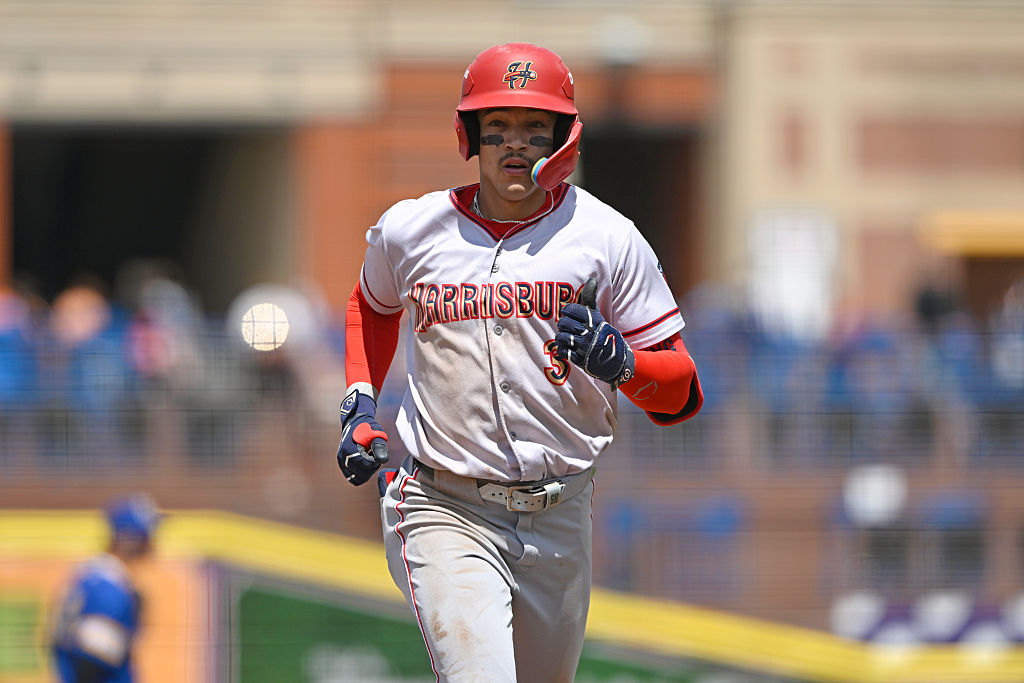
This year, King righted the ship almost right away at Double-A, coming out of the gate swinging a hot bat. Through 35 games, the right-handed hitter blasted five home runs, which marked a new career high, while slashing .336/.427/.562 with a 163 wRC+.
With his offseason swing adjustments, King was able to hit line drives more consistently, with 32.1% of his batted-ball events at Double-A falling into the category. In turn, his results fared much better than his first go-around with the Harrisburg Senators.
King’s domination quickly earned him a promotion to Triple-A, where he hasn’t slowed down significantly since.
To this point, King has appeared in 52 games with the Rochester Red Wings, where he’s slashing .323/.408/.558 with a 153 wRC+. In those contests, he’s already sent 13 fly balls into the seats.
Using Statcast data from Triple-A, we can more tangibly see the effect of King’s mechanical changes on his offensive performance.
Among all hitters at the Triple-A level, King ranks in the 80th percentile with an average exit velocity of 90.4 mph. 49.7% of his batted-ball events have left the bat with an exit velocity north of 95 mph, placing him in the 89th percentile in that regard. He’s also barreling the ball at an absurd 12.4% clip, which ranks in the 88th percentile.
There are still several drawbacks in King’s offensive profile, including the fact that he’s walking just 8.9% of the time and is chasing 33.6% of pitches outside the zone. He’s also pulling the ball in the air just 8.4% of the time; given his exit velocity outputs, though, that shouldn’t be too much of a drawback.
As a defender, King possesses an above-average arm in addition to 60-grade speed, which pair well together at shortstop. While he may not be as seasoned at the position as several of his peers, he projects to be an upgrade compared to Abrams and shouldn’t be a defensive liability.
At this point, King has made a very strong case that he belongs in the majors this season.
The Bigger Picture
Since the news of Abrams switching positions was announced publicly, he and his agent, Mike Sanders, have made it abundantly clear that they are unhappy with the shuffle. In an interview with The Athletic, Sanders shared that Abrams was “not thrilled” and believes himself to be a shortstop “short-term and long-term.”
Given his athleticism, it’s worth noting that King could shift to third base long-term if Abrams can remedy some of his defensive woes.
Regardless, both players are incredibly young, as is the majority of the Nationals’ core. Sanders also shared that Abrams’ priority is to win, and the Nationals’ pool of young talent could make that wish a reality in the near future.
With the right alignment and an improvement to their pitching staff, Washington could make some serious noise in the coming years. Ideally, both Abrams and King are a part of that success.
Become a Member of Just Baseball
Subscribe and upgrade to go ad-free!
* Save 25% by subscribing annually.

Written by
Mason Linken first began writing about baseball after founding FBC Reports, and contributing to SABR's book "Henry Aaron". At Just Baseball, Mason is responsible for covering…