
Five Elite Prospects Who Could Move at the 2026 MLB Trade Deadline
The trade deadline is usually framed around stars changing teams. The more interesting question is who a team is willing to move to get them.
The trade deadline is usually framed around the stars changing teams. The more interesting question is often what—or who—a contender is willing to sacrifice to acquire them.
None of these prospects should be considered likely to move. Each is talented enough to become an important part of his current organization’s future. But roster congestion, competitive urgency and the availability of impact major leaguers could create the kind of uncomfortable conversations that lead to blockbusters.
Before getting to the five headliners, there are several other names worth watching.
Honorable Mentions
The Entire Biloxi Shuckers Roster
You could throw a dart at a Biloxi roster sheet and hit a player with plenty of intrigue.
Setting aside Jesús Made, who should be viewed as untouchable, the Shuckers still have Andrew Fischer, Josh Adamczewski, Josiah Ragsdale, Blake Burke and Dylan O’Rae. All five are 23 or younger and have produced a wRC+ north of 120.
That is an almost comical concentration of young offensive talent on one Double-A roster.
The Brewers rarely deviate from their preferred script. They develop internally, protect their best prospects and search for value around the margins rather than winning deadline bidding wars. Should Milwaukee decide that this is the year to act more aggressively, however, it has enough depth at Biloxi to build a substantial package without touching Made.
Any one of these players could serve as an attractive secondary piece. Bundling two or three of them could give Milwaukee access to a caliber of return it does not typically pursue.
Carlos Lagrange, RHP, New York Yankees
A true flamethrower, Lagrange uses every inch of his 6-foot-7 frame to produce one of the most electric fastballs in baseball.
The raw ingredients are present for him to become a middle-of-the-rotation starter—and perhaps something more—but his command has become increasingly problematic against upper-level hitters. He has also been clipped for more home runs, and the combination of elevated walk and homer rates has inflated his ERA beyond what the quality of his stuff might suggest.
Lagrange could also become part of the Yankees’ October solution. His fastball would play immediately in a short relief role, where the command concerns would become more manageable and he would not need to navigate a lineup multiple times.
That makes him a complicated trade candidate. New York could reasonably envision him helping its bullpen this season, but his combination of proximity, velocity and starting upside also makes him precisely the type of prospect other teams will request in talks for an impact addition.
Lazaro Montes, OF/DH, Seattle Mariners
Montes possesses some of the best raw and game power in the minor leagues.
The massive left-handed slugger overwhelmed Double-A pitching as a 21-year-old, producing a 143 wRC+ before earning a promotion to Triple-A. His power is not theoretical. When Montes gets the ball in the air, he is capable of changing a game with one swing.
The question is whether his hit tool will allow that power to play consistently against major-league pitching.
Montes has produced a contact rate below 65% above High-A across the past two seasons. There is enough patience to prevent the entire offensive profile from collapsing, but his hit tool may ultimately settle near the bottom of the scouting scale.
The defensive value is also limited. Montes is likely to spend most of his major-league career at designated hitter, placing nearly the entire burden of his value on the bat.
A 21-year-old who has mashed his way into the upper minors would ordinarily command enormous trade value. The combination of extreme swing-and-miss and minimal defensive utility, however, makes Montes unusually volatile. Seattle may discover that rival clubs value him more cautiously than his age, level and home-run totals would typically suggest.
And now, on to the main event:
Zyhir Hope, OF, Los Angeles Dodgers
2026 Recap
The Dodgers are testing the upper bounds of whether an organization can have too many talented outfielders.
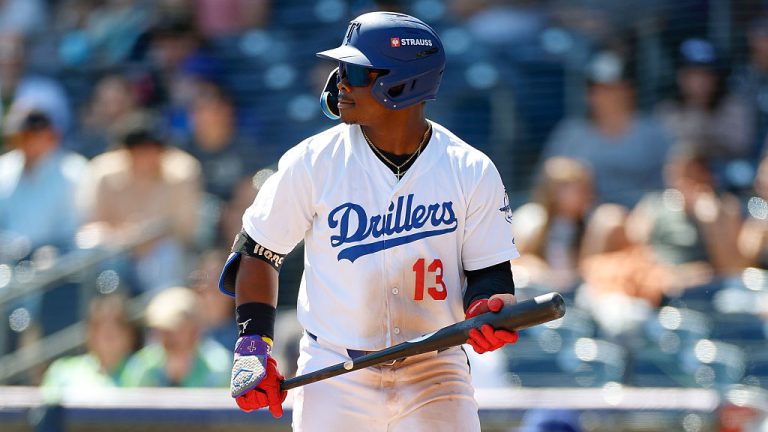
Hope is one of three Tulsa Drillers outfielders ranked inside Just Baseball’s Top 100, and the other two—Josue De Paula and Mike Sirota—are consensus top-20 prospects in the sport. That should not obscure how impressive Hope has been during his age-21 season at Double-A.
Through 87 games, Hope has produced a 130 wRC+ with 21 home runs.
The most encouraging development has been the improvement in his contact rate. After posting a yellow-light figure of 68.3% between High-A and Double-A in 2025, Hope has raised that mark to 74.1% while spending the entire 2026 season at Double-A.
For a left-handed hitter with double-plus raw power and average-to-slightly-above-average swing decisions, a contact rate around 73% is more than palatable.
Hope will likely move to an outfield corner over the long term, but his plus arm strength continues to show up. He has also stolen 17 bases in 20 attempts. The result is a rare power-speed combination with enough contact ability, plate discipline and defensive value to fill in the remaining cracks in his profile.
Read more on Hope’s full prospect profile here
Why He Could Be on the Move
The aforementioned logjam.
As tantalizing as Hope’s skillset may be, he remains third in the pecking order among Tulsa’s three highly regarded outfielders. The Dodgers have assembled such a loaded major-league roster that adding another star could almost feel like overkill, but when an organization is pursuing a three-peat, overkill is already baked into the equation.
Hope has enough talent to break through Los Angeles’ loaded farm system and earn a role in much the same way Andy Pages did. The problem is the timeline.
Even under an optimistic projection, Hope may not receive a clear opportunity for regular major-league at-bats until 2028. By then, he could still be competing with De Paula, Sirota and James Tibbs III, who has flashed considerable power at Triple-A Oklahoma City, in addition to whatever established outfielders remain on the major-league roster.
It is rare for a prospect of Hope’s caliber to resemble anything close to a surplus asset. The Dodgers, however, have repeatedly demonstrated both the player-development ability to create these logjams and the willingness to cash in blocked prospects when the right major-league upgrade becomes available.
What Would It Take?
Hope may be the most logical member of the Tulsa trio to include in trade discussions, but the Dodgers are not going to accept 75 cents on the dollar simply because their farm system is overflowing with talent.
Moving a consensus top-50 prospect—and one whom many evaluators place considerably higher—would require one of two extraordinary scenarios.
The first would be a pursuit of Tarik Skubal. Should Detroit reverse course and make him available, Skubal would be one of the most premium rental starters to reach the deadline market since CC Sabathia in 2008.
Hope is the type of centerpiece almost no other contender could offer for two months of even an ace of Skubal’s caliber. Detroit’s push back into the race has made that outcome increasingly difficult to envision, but the Dodgers are one of the few organizations capable of building a compelling offer without hollowing out their system.
The second scenario would involve an impact starter who combines performance, club control and cost certainty. Joe Ryan represents the general archetype, although another unexpected name could emerge as the market develops.
An affordable starter under control beyond 2026 would strengthen the Dodgers’ current rotation while helping them manage a massive long-term payroll. That cost certainty may carry additional value with the current collective bargaining agreement expiring after the season and another contentious round of labor negotiations looming.
Hope is too talented to be included merely as the price of doing business. If Los Angeles moves him, it will be because the return materially alters either its 2026 championship outlook or the long-term structure of its rotation.
Josiah Hartshorn, OF/1B, Chicago Cubs
2026 Recap
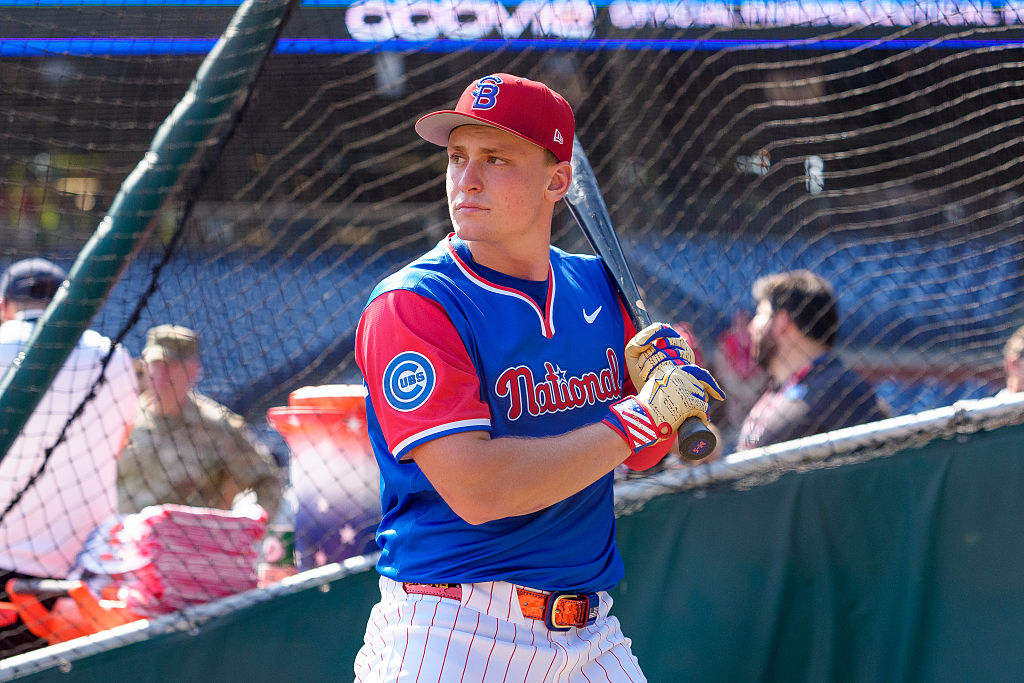
A sixth-round overslot selection out of California in 2025, Hartshorn has taken to professional baseball like a fish to water.
He dismantled Single-A pitching, producing a 146 wRC+ while walking more often than he struck out. Following a promotion to High-A, he has become slightly more aggressive, but the trade-off has been a considerable increase in power. Hartshorn has already launched 10 home runs through his first 45 games at the level.
The appeal begins with a rare offensive foundation.
Hartshorn is a true switch-hitter with above-average contact ability from both sides of the plate, posting a 79.3% contact rate across the two levels. Pair that bat-to-ball skill with the pull-side lift he has displayed during the opening months of his professional career, and there is plenty for evaluators to dream on.
Hartshorn will likely be limited to an outfield corner or first base and does not project to provide significant defensive value. That places more pressure on the bat, but this is about as polished an offensive profile as one will find from a prep hitter who will not turn 20 until February.
He controls the strike zone, makes consistent contact and is already beginning to translate his strength into game power against older competition.
Why He Could Be on the Move
The Cubs’ pitching staff has reached Black Knight territory from Monty Python. It is being held together by guts, guile, duct tape and bubble gum while insisting that each new injury is merely a flesh wound.
Pete Crow-Armstrong is having an MVP-caliber season, and when the offense is clicking, Chicago looks capable of overwhelming opponents. The concern is whether its current collection of starters and relievers is equipped to carry that offense through October.
As presently constructed, the pitching staff leaves the Cubs dangerously vulnerable in a postseason series.
Dangling a prospect such as Hartshorn—now a consensus top-100 name around the industry and a top-70 prospect for us at Just Baseball—would allow the Cubs to pursue a meaningful pitching upgrade without subtracting from the major-league roster or dealing one of their upper-level prospects who could contribute later this season.
These are famous last words whenever an organization considers trading a teenage breakout prospect, but Chicago can also look at its recent amateur-drafting track record and reasonably believe it can find another Hartshorn.
Jed Hoyer and his front office may trust that process enough to cash in one of its greatest recent successes.
That does not make Hartshorn expendable. It makes him the kind of prospect whose rapid rise creates an opportunity to solve a major-league problem that has become too urgent to ignore.
What Would It Take?
Pitching is the glaring five-alarm fire, but the Cubs are not going to sacrifice Hartshorn for a rental whose primary qualification is the ability to absorb innings.
Chicago should be among the teams kicking the tires on Joe Ryan and other controllable starters capable of pitching near the front of its rotation. Hartshorn would not necessarily complete such a deal on his own, but he could serve as one of the central pieces in a package for a starter capable of helping the Cubs for multiple seasons.
The other possibility is a dominant late-inning reliever with years of club control.
A pitcher in the mold of former Cubs farmhand Jeremiah Estrada—an overpowering leverage arm who will not reach free agency until the end of the decade—could justify building a deal around a prospect of Hartshorn’s caliber.
That would be a steep price for a reliever, but October exposes bullpen deficiencies quickly, and truly elite late-inning arms with several affordable seasons remaining rarely become available.
It will take an aggressive offer to pry Hartshorn loose. His age, offensive polish and breakout trajectory give him a chance to become considerably more valuable over the next 12 months.
The condition of Chicago’s pitching staff, however, makes him more available than a prospect of his caliber would ordinarily be.
The Cubs are good enough to justify urgency. The question is whether they believe Hartshorn’s future value outweighs the opportunity to address the weakness most likely to end their season.
Eric Hartman, OF, Atlanta Braves
2026 Recap
There are breakouts, and then there is what Eric Hartman has done in 2026.
Hartman entered professional baseball as a 20th-round selection in the 2024 draft, an athletic prep outfielder from Canada whose carrying tool was his 70-grade speed.
He showed promise during his first full professional season, producing a 113 wRC+ at Single-A, but still looked more like a slash-and-dash prospect who needed his legs to maximize a relatively light offensive profile.
That description no longer fits.
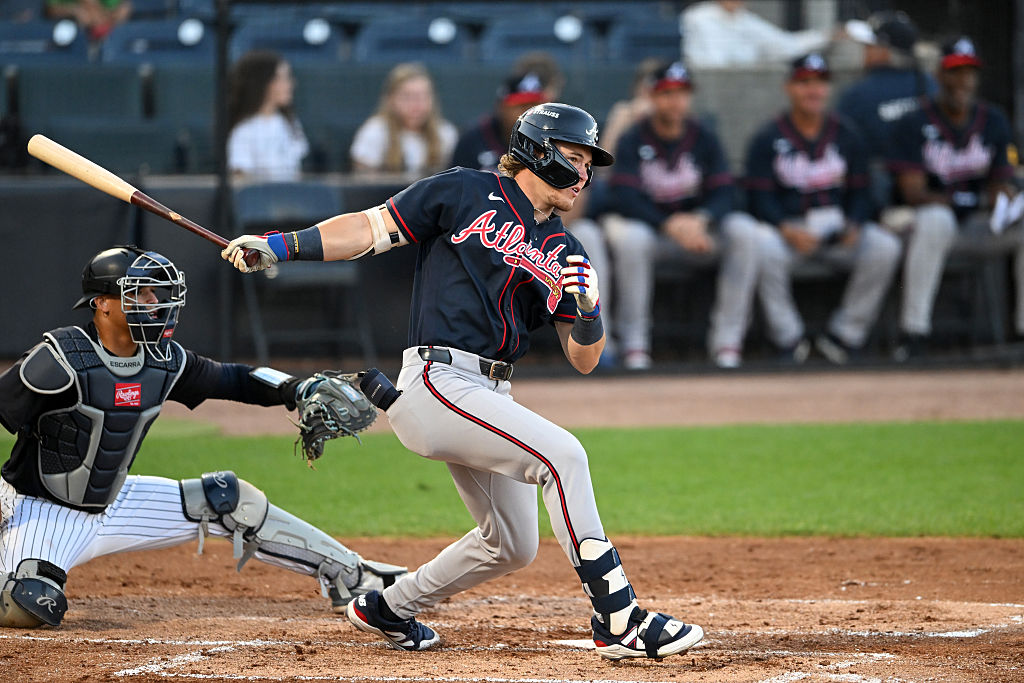
After making adjustments designed to create more loft in his swing, Hartman has authored one of the loudest breakouts in the minor leagues. Through 85 games at High-A, he has produced a 130 wRC+ with 22 home runs and 32 stolen bases in 37 attempts.
The underlying transformation is nearly as jarring as the surface-level production.
Hartman has cut his ground-ball rate by approximately 14 percentage points while raising his home run-to-fly-ball rate from roughly 6% to 21%. More of his contact is getting into the air, and a significantly larger share of those fly balls are leaving the ballpark.
That kind of power jump would be notable for any prospect. For a player who turned 20 in June, it is almost unheard of.
Hartman’s speed remains an impact tool, and he has a legitimate chance to remain in center field as his reads and routes continue to improve. That gives him several pathways to everyday value even if this season’s extreme power output eventually regresses.
What was once a speed-first profile now offers one of the most compelling combinations of power, athleticism and defensive upside in the minors.
Hartman began the year almost entirely off the national radar. He is now a consensus top-100 prospect and a top-40 player for us at Just Baseball.
Why He Could Be on the Move
Atlanta remains atop the National League East, but what looked like a potential runaway division in May has become a legitimate fight through the summer.
Philadelphia is nipping at the Braves’ heels, while the upstart Marlins have remained close enough to leave Atlanta little room for complacency.
The offense is capable of carrying a contender. Drake Baldwin, Matt Olson, Michael Harris II and Ozzie Albies form the core of one of the better lineups in the National League. Ronald Acuña Jr. is currently on the shelf, but he is expected to return and has remained one of the most impactful hitters in baseball when healthy.
The greater uncertainty resides in the rotation.
Chris Sale continues to defy Father Time, but Atlanta has far too many questions behind him. AJ Smith-Shawver is rehabbing at Triple-A, while neither Spencer Strider nor Spencer Schwellenbach has a firm return date.
Atlanta possesses enough power at the back of its bullpen to shorten postseason games. The problem is finding enough dependable innings to reach those relievers with a lead.
This is unquestionably a team capable of playing deep into October. It is also a team whose rotation, as presently constructed, could prevent it from getting there.
That combination creates the conditions under which an organization might consider moving a prospect whose value has exploded over the previous three months.
What Would It Take?
Rinse and repeat the conversation about acquiring a starting pitcher with club control.
Hartman should not be viewed as the price of adding a generic innings eater. Including him in a deal for a rental such as Freddy Peralta would represent an aggressive overpay unless the Braves received additional value in the package.
A controllable middle-of-the-rotation starter is a more logical target. Hartman could headline—or at least serve as the most valuable prospect in—a package for a pitcher capable of stabilizing Atlanta’s 2026 rotation while remaining part of the staff beyond this postseason.
The Braves also have more reason than most contenders to contemplate an aggressive short-term move.
Their 2027 rotation picture should be considerably healthier. Schwellenbach should be back, Strider could re-enter the equation, and JR Ritchie has shown the ability to provide meaningful innings. Smith-Shawver should also be further removed from his injury.
That gives Atlanta a narrow but real incentive to prioritize the present. The Braves may not need to solve their rotation for the next five years. They need enough dependable pitching to maximize the current version of a core built around Acuña, Harris, Olson, Baldwin, Albies and Austin Riley.
Trading a 20-year-old prospect in the middle of a meteoric breakout is the type of move that can make a front office look foolish within a few years. Hartman’s expanded power output may have fundamentally altered his ceiling, and dealing him before the industry fully understands whether this is his new normal carries enormous risk.
But flags fly forever.
Atlanta is good enough to justify taking that risk, provided the return meaningfully changes its chances of winning the World Series in 2026.
Sebastian Walcott, INF, Texas Rangers
2026 Recap
This portion can be kept relatively brief: There is not much to report.
Walcott underwent elbow surgery during spring training and missed nearly the entire first half of the season. He returned to game action in July and has performed well in an extremely small sample while repeating Double-A as a 20-year-old.
At his best, Walcott is the type of toolshed prospect who seems more likely to appear as a created player in MLB The Show than on an actual baseball field.
He is tall and athletic with long levers, whippy bat speed and the ability to produce some of the highest exit velocities in the minor leagues.
Walcott is unlikely to remain at shortstop permanently, but he possesses more than enough arm strength to stay on the left side of the infield. His power ceiling would also comfortably support a move to third base.
The questions center on how frequently he will access that power.
Walcott’s swing works on a flat path through the hitting zone. It can look brilliant when he hammers a line drive to left field that continues carrying over the wall, but the same bat path also contributes to a bloated ground-ball rate.
Pair that contact distribution with fringy bat-to-ball skills, and there is a considerable gap between the power Walcott possesses and the power he consistently accesses in games.
He hits the ball hard enough for those concerns to remain manageable at age 20. The Rangers have also challenged him with exceptionally aggressive assignments, leaving him substantially younger than most of his competition throughout his professional career.
Still, for Walcott to reach the lofty heights Texas believes he can, he will need to elevate the baseball more frequently. His immense raw-power ceiling is currently being capped less by physical ability than by the shape of his contact.
Why He Could Be on the Move
Walcott is unquestionably the crown jewel of the Rangers’ position-player pipeline.
That raises an obvious question: Why would Texas even entertain moving him?
The answer lies in the state of the American League.
In a watered-down and tightly compressed league, Texas has as compelling a case to reach the World Series as almost anyone. There is no dominant team creating an insurmountable barrier between the Rangers and another pennant.
Texas is receiving high-end pitching from Jacob deGrom and Nathan Eovaldi, with MacKenzie Gore supplying capable production behind them. Cal Quantrill is the definition of a professional out-getter, while Kumar Rocker has flashed the double-plus slider that once made him the third overall pick in the draft.
The rotation is not perfect, but it combines frontline talent with enough depth to resemble a credible October staff.
The urgency comes from the pitchers leading it. DeGrom recently turned 38, while Eovaldi is 36. Assuming both veterans will remain healthy and perform at this level again in 2027 would be a dangerous game.
The Rangers may not receive a better opportunity to pair this version of their rotation with a relatively open path through the American League.
Texas is also receiving above-average offensive production from seven of its nine penciled-in starters, and that does not include Corey Seager, who is currently on the injured list after struggling earlier in the season.
The Rangers cannot assume Seager will return as his peak self and single-handedly elevate the offense. But if he provides meaningful production and Texas adds another impact bat, the club could separate itself from the rest of the American League West.
That possibility does not make Walcott expendable. It merely creates a narrow set of circumstances under which keeping him might be less valuable than maximizing the current competitive window.
What Would It Take?
A player with Walcott’s upside cannot be moved flippantly. This would need to be a targeted acquisition involving impact talent, meaningful upside and club control.
Texas could pursue another starting pitcher, but the organization already has several potential reinforcements in motion. Jack Leiter is working his way back from the injured list, as is 2023 World Series hero Jordan Montgomery.
Leiter did not look particularly sharp before his injury, and Montgomery has not pitched meaningful major-league innings since 2024. Neither can be treated as a guaranteed solution. Their presence does, however, make targeting an offensive upgrade the more prudent approach if Texas is seriously considering shopping Walcott.
The glaring weakness in the Rangers’ lineup is behind the plate. Kyle Higashioka and Elias Díaz are unlikely to strike much fear into an opponent when their names appear on the lineup card.
Rutschman has not consistently reached the heights suggested by his first two major-league seasons, but the broader discussion about what has gone wrong with the former No. 1 overall pick has obscured a quietly productive 2026 campaign.
He would represent a massive upgrade for Texas—not merely for the remainder of this season, but beyond it.
The Orioles would also have a reason to listen, provided their season moves in the wrong direction before the deadline. Baltimore has already committed to Samuel Basallo as a major part of its future, giving the organization a viable succession plan behind the plate.
The Orioles also emptied a considerable amount of prospect depth to acquire Shane Baz. Recouping a premium talent such as Walcott for Rutschman would allow Baltimore to replenish the high-end upside it sacrificed while shifting value toward a player with years of potential club control.
Rutschman would cost considerably more than Walcott alone, and the possibility remains a long shot.
But Chris Young has shown that he is a big-game hunter. He pushed his chips into the middle before Texas’ 2023 championship run and has continued building around the remaining window of an expensive veteran core.
A player such as Rutschman is rarely available. He is also precisely the type of talent that could justify cashing in a prospect of Walcott’s caliber.
Texas should not trade Walcott simply because the American League looks vulnerable. It should consider doing so only if the return creates an unmistakable present-day advantage while extending that advantage beyond one postseason.
Rutschman is one of the few conceivable targets capable of clearing that threshold.
Bryce Rainer, SS, Detroit Tigers
2026 Recap
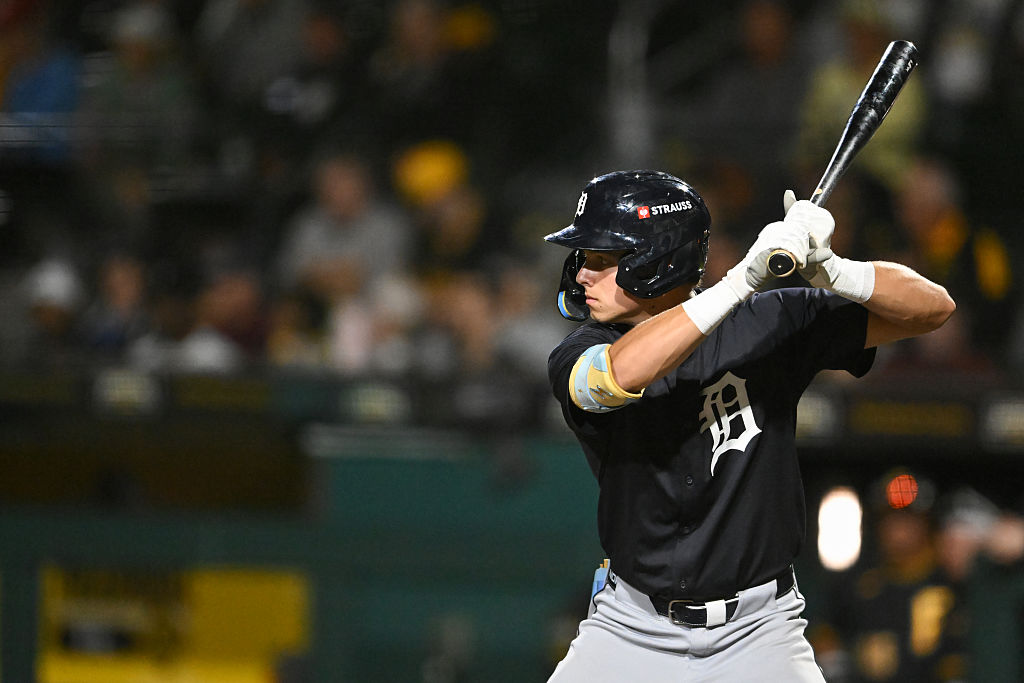
After a slow start in which he struck out in more than 40% of his plate appearances, Bryce Rainer has settled in at High-A West Michigan and begun flashing the tools that made the Rainer-versus-Konnor Griffin debate a legitimate conversation leading into the 2024 draft.
The foundation of the profile is 70-grade raw power from the left side.
Rainer produces enormous exit velocities, and the impact is not confined to one narrow part of the field. His power plays from gap to gap, giving him the ability to do damage even when he is not consistently getting the ball into the air to his pull side.
The larger question has always been whether he will make enough contact to access it.
Rainer employed a noticeable hand pump early in the season that created additional movement before launch and complicated his ability to arrive on time. Since toning it down, his contact rates have improved from a glaring concern to merely fringy.
That distinction matters.
Rainer is still striking out approximately 35% of the time at High-A, but his combination of plate discipline and all-fields power has allowed him to remain highly productive, running a 129 wRC+ despite the swing-and-miss.
His batted-ball distribution presents another developmental hurdle.
Rainer is putting the ball on the ground roughly 56% of the time, a product of a bat path that is comfortable staying through the baseball and shooting hard contact the other way rather than consistently lifting pitches to the pull side.
His raw power alleviates some of that concern. Rainer can split gaps with hard line drives that would be routine singles or outs for lesser hitters, and he has produced an absurd home run-to-fly-ball rate of approximately 28% at High-A.
When he does elevate the baseball, it tends to travel a very long way.
The shorthand comparison is Colson Montgomery: a three-true-outcomes shortstop with substantial left-handed power and enough patience to withstand a high strikeout rate.
The packaging is different, however. Montgomery has historically relied heavily on pulling the ball in the air, while Rainer possesses more raw power but currently hits far too many balls on the ground.
There is significant volatility here. Rainer could develop into an impact middle-of-the-order bat who stays on the left side of the infield, or the combination of strikeouts and ground balls could prevent his immense physical ability from translating consistently.
Why He Could Be on the Move
Detroit appears increasingly prepared to go down with the ship alongside Captain Tarik Skubal.
Rather than trading the most enticing rental starter to reach the market in more than a decade, the Tigers appear committed to clawing their way back into the American League Wild Card race.
Keeping Skubal changes the entire deadline equation.
With the ace in the fold, Detroit presents a nightmare matchup for anyone forced to face it in the opening game of a postseason series. Few potential Wild Card opponents could counter with a pitcher capable of neutralizing that advantage.
But retaining Skubal only makes sense if the Tigers are prepared to build a team capable of reaching October and advancing once they get there.
The offense has intriguing pieces, led by rookie sensation Kevin McGonigle and All-Star outfielder Riley Greene. Dillon Dingler is having the best offensive season of his career, while Gleyber Torres’ return could not have arrived at a better time.
Max Clark is also waiting at Triple-A and could, at minimum, step into center field, provide quality defense and grind through competitive plate appearances.
The pitching staff behind Skubal offers far fewer certainties.
Framber Valdez has not lived up to the major contract Detroit gave him during the offseason. Casey Mize has pitched well when healthy, and Keider Montero has been a pleasant surprise, but the Tigers remain dangerously dependent on Skubal to provide both elite performance and innings.
There are internal bullpen possibilities. Jackson Jobe is working his way back and could be pressed into a relief role during the stretch run, much as he was in 2024.
Detroit could also supplement the bullpen without surrendering one of the best prospects in its system. Relievers become expensive at the deadline, but competent middle-inning and setup options are still more attainable than impact starting pitchers.
What the Tigers cannot easily manufacture internally is another starter capable of changing the shape of a postseason series.
That is where Rainer becomes relevant.
Detroit would not be selling low on him. He remains a consensus top-100 prospect with first-round pedigree, immense physical upside and the potential to become an impact player by 2028.
But his profile also contains more risk than those of many similarly ranked prospects. Different organizations will reach substantially different conclusions about whether his strikeout rate and ground-ball tendency are developmental obstacles or permanent limitations.
If another team believes fully in the ceiling, Detroit could capitalize on that enthusiasm before Rainer reaches the upper minors.
Most importantly, the Tigers are operating under a deadline that extends beyond the trade deadline. Skubal can become a free agent after the season.
Keeping him while refusing to leverage meaningful prospect capital would represent an uncomfortable middle ground. If Detroit is going to accept the risk of losing him for nothing more than a qualifying-offer return, it should also accept the cost of constructing a roster capable of maximizing his final months in a Tigers uniform.
What Would It Take?
Rainer’s volatility makes him a fascinating trade piece.
There will be evaluators who see a future 35-home-run shortstop or third baseman with patience, arm strength and impact power. Others will see a hitter whose strikeout and ground-ball rates create too narrow a path toward reaching that ceiling.
That range of opinions could produce a market in which one organization values Rainer much more aggressively than the industry consensus.
The controlled starters previously discussed throughout this exercise would make sense for Detroit. Joe Ryan or another affordable starter with multiple seasons remaining would provide both immediate postseason value and protection against Skubal’s potential departure.
But the Tigers may feel a different kind of desperation than the Dodgers, Cubs or Braves.
Detroit is not merely trying to strengthen an already complete roster. It is attempting to capitalize on what may be the final months of Skubal’s tenure without the pitching depth normally required of a serious World Series contender.
That could push the organization toward a short-term acquisition that would not qualify as a clean surplus-value victory.
There may be a match made in heaven between the Motor City and Queens.
Freddy Peralta and Clay Holmes would give Detroit two different avenues to stabilize its pitching staff. Peralta has struggled in 2026, but his stuff and track record still offer considerably more upside than the typical rental starter. Holmes, once healthy, could either provide rotation depth or become a multi-inning leverage weapon.
Neither pitcher is a perfect answer. Together, however, they could transform the depth of Detroit’s staff.
Rainer would be the centerpiece required to make New York listen. Detroit could supplement the package with one of its upper-level position players—perhaps Max Anderson or Thayron Liranzo—along with a lower-level secondary piece.
Including Rainer, Anderson and Liranzo together would be unnecessarily aggressive for two pitchers who may both leave after the season. Even a more measured package, however, would be uncomfortable.
The Tigers would be giving away a potential middle-of-the-order hitter for a short-term gain that may not appear favorable on a traditional trade-value calculator.
That may be the point.
Rainer is extremely talented, and there is ample reason to believe he could become an impact player in Detroit by 2028. But the Tigers are attempting to win in 2026 with a historically valuable ace approaching free agency.
They cannot preserve every part of the future while also claiming to maximize the present.
If Detroit keeps Skubal, it should behave like a team that kept Skubal.
That may require leveraging a prospect of Rainer’s caliber to acquire the pitching necessary to turn a dangerous Wild Card entrant into a legitimate October threat.
Become a Member of Just Baseball
Subscribe and upgrade to go ad-free!
* Save 25% by subscribing annually.

Written by