
Why Would the Chicago Cubs Trade Seiya Suzuki?
The right fielder is a top offensive weapon for the Cubs, so why even think of moving him to a different team?
Every MLB trade deadline, teams generally fall into three categories. You have your buyers, your sellers, and your teams that do nothing.
Sometimes, though, there are teams that fall into a fourth category — those are the teams that are both buyers and sellers.
These teams usually sit middle of the pack or a little higher, within range of a playoff spot but not exactly guaranteed one. They often want to improve weaknesses without selling the farm, and that can mean selling a major league asset that makes sense and doesn’t just create another hole in the roster.
One could argue that the Chicago Cubs are one of these candidates for this year’s trade deadline. The team is clearly talented, which is why they were able to get off to a 27-12 start on the back of not one, but two 10-game winning streaks.
The team also has some glaring weaknesses, which is how they got to where they are now. Partly due to a 10-game losing streak, Chicago is now 40-37 and has gone from first place and 3.5 games up in the NL Central down to third place and 7.5 games back from the division-leading Brewers.
The Cubs could start by addressing an injury-ravaged starting rotation that currently has four starters on the IL. Chicago has also gotten below-average production at DH (98 wRC+, -0.4 fWAR) and well-below-average production at shortstop from Dansby Swanson (.183 average, .617 OPS).
Cubs president of baseball operations Jed Hoyer has minor league assets to work with in a potential trade, but not nearly as many as other teams. Industry rankings have the Cubs’ farm system near the bottom third of baseball, though to their credit, Just Baseball places three of their prospects among the top 100 in baseball.
And that is why Chicago makes sense as a team that could be both a buyer and a seller at this year’s trade deadline. They have areas to improve but might need to tap into the major league roster to do it.
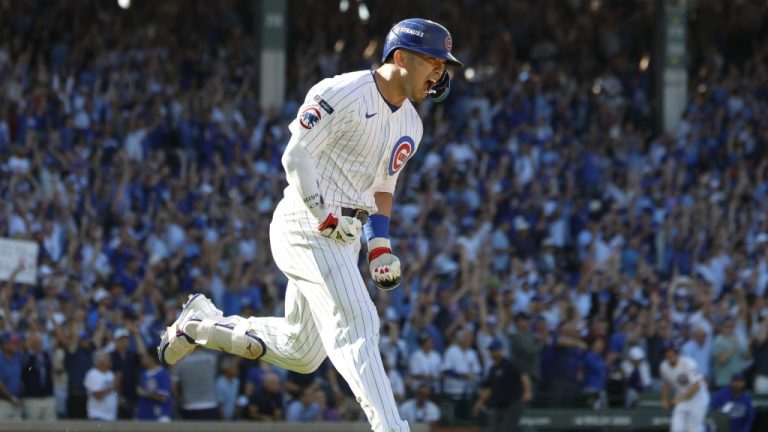
One name from the roster that has been floated around as trade bait is outfielder Seiya Suzuki. The 31-year-old continues to consistently post strong offensive numbers in his fifth MLB season, all of which having been spent on the North Side of Chicago.
He brings the same type of offense you would normally want to keep on a roster. So, why on earth is he the one who it would make sense to trade?
Why Would the Chicago Cubs Trade Seiya Suzuki?
If there’s one thing you can count on Suzuki for, it’s offense. In 594 career MLB games, he has slashed a very respectable .269/.347/.469 and has accumulated a 126 wRC+.
Suzuki has traditionally been a solid source of run production, as he has at least 74 runs, 20 homers, and 73 RBI in each of the last three seasons. 2025 saw him record his first 30-homer, 100-RBI season with 32 and 103, respectively.
At one point, defense in right field had become a liability for Suzuki. It got to the point where the Cubs shifted him to designated hitter for a majority of his games for the first time in his career last season (102 out of 151 games).
Suzuki has been back in right field for most of this year, though, and has been looking much better. He would already be at career bests with seven defensive runs saved, two outs above average, and a four foot versus average jump, which ranks among the best in the league.
Again, these are all plenty of reasons for a team to want to acquire Suzuki, so why give him up when you already have him? Let’s start with the obvious: the contract.

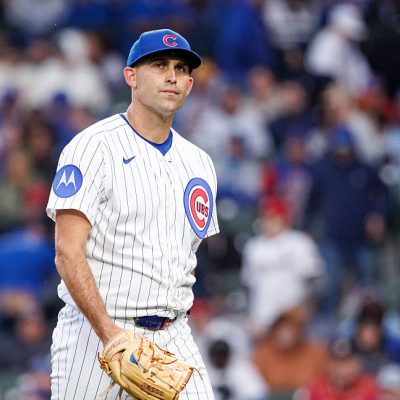
Suzuki is in the final season of a five-year contract, so Chicago would be wise to try and get something for him before he tests the waters of free agency. It’s worth noting that the contract also has a full no-trade clause, so any old trade won’t get the job done.
The Cubs also have options to at least get by in Suzuki’s absence. Former top prospect Matt Shaw is starting to show flashes of his potential, batting .252/.308/.437 with a 106 wRC+ in 50 games. They also have Michael Conforto, who has nine doubles, four homers, and a 114 wRC+, currently his highest mark since 2020, over 48 games.
Additionally, waiting in the minors is Kevin Alcantara. He may not be ranked among the team’s top prospects anymore, but he’s fought off high strikeout rates to hit .258 with a .916 OPS, 10 doubles, and already 16 homers through 49 games. He could be an infusion of power for the Cubs down the stretch.
Whoever the replacement(s) might be, Chicago can afford the hit to the offense to improve elsewhere. Through June 23, they sit eighth in MLB at 4.75 runs per game.
And who knows, a trade might not even mean the end of the Seiya Suzuki era. It’s entirely possible that the outfielder could return to Chicago in free agency in the same way Jack Flaherty recently did when he was traded from the Tigers to the Dodgers in 2024 only to return to Detroit the very next season.
Maybe the chances of a Suzuki trade are low, but the reasoning behind one is logical. Whether the best path forward to a playoff spot is with or without him is up for the Cubs to decide.
Become a Member of Just Baseball
Subscribe and upgrade to go ad-free!
* Save 25% by subscribing annually.

Written by
Matt Carroll is a writer for Just Baseball and former site expert at Reviewing the Brew. He studied journalism at the University of Wisconsin-Madison and currently…