
Matthew Liberatore’s Future in St. Louis Is Far From Certain
St. Louis Cardinals starting pitcher Matthew Liberatore has hit a proverbial wall. How will the front office handle his recent skid?
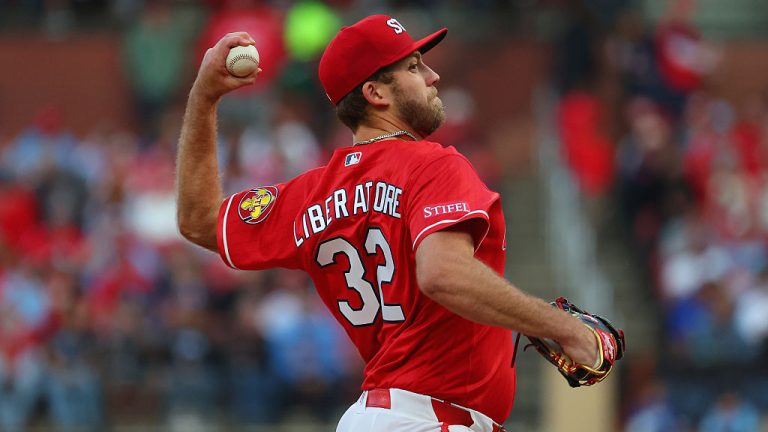
As the MLB trade deadline rapidly approaches, the St. Louis Cardinals are running into a Matthew Liberatore-sized problem. There’s no right answer. Right now, it looks like there are no answers, period.
This season, Liberatore has a 5.56 ERA through 16 starts with a -0.7 bWAR.
His performance places him comfortably among MLB’s worst qualified starters in xERA, ERA, and HR/9.
This month in particular, the southpaw has been an amalgamation of ineffectiveness and poor execution.
Through four June starts, Liberatore has averaged under four innings per game and holds a 10.34 ERA. Those brief outings have caused the Cardinals to lean more heavily on their bullpen, resulting in a bothersome workload.
For example, in the Cardinals’ three-game series against the Royals last weekend, St. Louis starters combined for 8.2 innings. Liberatore’s 1.2-inning blowup on June 18 was the main culprit.
Cardinals beat writer Derick Goold shared his thoughts on the recent stretch of poor performance from the left-hander:
“He falls into patterns, or he only has one way that he wants to go with hitters from either side of the plate, that is effectively the same thing,” Goold said on 101ESPN’s BK and Ferrario.
“He’s giving away the script that he’s going to follow. The curveball is seen as a way to unlock that. It’s coming around. It hasn’t really manifested in games. That third time through remains really difficult for him…all that stuff is in play here, and that’s what they’re saying and discussing.”
To Goold’s point, since Rob ‘Pitching Ninja’ Friedman called for a Liberatore breakout, citing his curveball as a driving force, it has posted a -9 run value, and opposing hitters are slugging .500 against it.
Although the expected data on the offering suggests positive regression, the young starter might be past splitting hairs on peripheral numbers.
Some analysts have discussed tipping pitches as a possibility. Lance Lynn, a former Cardinal himself, spoke to the theory on Cardinal Territory with Jim Hayes.
He surmised that although he hadn’t personally seen any tipping, the mere idea could further complicate Liberatore’s approach, leading to even more of a mental blockade.
The Cardinals’ preseason ace doesn’t have any time to mull things over, as his next start looks to be a doozy.
Liberatore’s next appearance is scheduled for Tuesday, June 30, against a torrid Atlanta Braves lineup.
The Braves rank in the top 10 as a unit in home runs, batting average, and slugging percentage. One of MLB’s hottest offenses will be clashing with potentially the league’s coldest pitcher.
How should the Cardinals go about handling this situation? What are the options? Let’s dive in.
The Cardinals Could Return Liberatore to the Bullpen
This is a classic solution to a malfunctioning starter. The Seattle Mariners employed a similar strategy this season with veteran Luis Castillo.
However, they renamed it “piggybacking,” which was just another way of saying one starter would share his game with the former Red. Whoever he shared a game with would flip between being the starter and the bulk relief option with Castillo.
Initially, Bryce Miller, who had been reinstated from the injured list, was sharing his games with the outcast veteran.
Miller said on the dynamic, “This setup’s not very comfortable… I haven’t done this in a while, really, since college, pitching out of the bullpen. So I don’t know. I didn’t really know how to navigate it, but just did the best I could.”
Although every player is different, starting pitchers tend to be creatures of habit. The recurring theme of starting pitchers needing their routines is nothing new.
Expecting Liberatore to make a seamless transition to the bullpen is overly optimistic. Additionally, he’s been stretched out as a starter and currently lacks an out-getting pitch.
His best offering, measured by run value, is the changeup at a mundane 0.9. All of Liberatore’s other pitches have marks well in the negative.
Although he has seen success in the past as a relief option, it’d take a few weeks to reacclimate to a new role anyway.
That being said, another route the Cardinals could take is a demotion to the minor leagues.

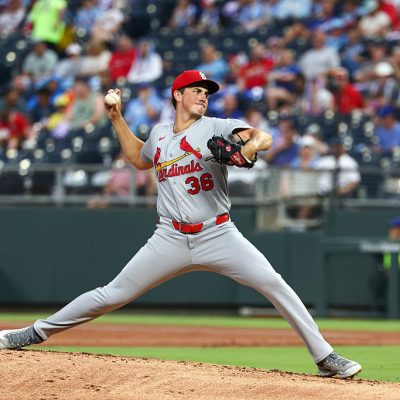
St. Louis Could Demote Liberatore to Triple-A Memphis
Unbeknownst to most of the public, Liberatore still has one option remaining due to his long tenure with the big-league club.
Sometimes, when a player is working through such rigorous trial and error, it’s better suited for a controlled environment. The Cardinals currently hold the third wild-card spot in the National League. Regardless of any plan the front office might be sticking to, fans are calling this team competitive.
Liberatore simply can’t pitch if he’s going to throw games away, and St. Louis has already shown more of an openness to hitting the reset button on stalling products.
This season alone, multiple presumed fixtures have been sent to Triple-A due to uninspiring production, to say the least.
Matt Svanson, Victor Scott II, and Nolan Gorman are prime examples of a new, cutthroat mentality by the Cardinals’ front office. The latter duo remains in the minor leagues, and Svanson, since his return, has a 2.89 ERA in eight games.
Scott was St. Louis’ Opening Day center fielder, and after posting a .534 OPS through 155 at-bats and infamously bunting with RISP, he’s been sent down to rediscover himself as a hitter.
Gorman, a former top prospect, has been searching since his thought-to-be breakout 2023 campaign. Recently, on June 25, he homered for Triple-A Memphis. There are clear signs of swing adjustments, as his turn looks tighter, which could lead to a quicker and more controlled bat.
All of this is to say, St. Louis is no longer playing the waiting game. And Liberatore’s clock might be running out.


The Cardinals infamously stumbled in 2025, largely due to Miles Mikolas and Eric Fedde’s lowly performances.
As of June 29, Liberatore has a higher ERA than either of them this season with their respective teams. Additionally, the Cardinals’ 2026 Opening Day starter has an ERA nearly a full run higher than Fedde or Mikolas posted in the first half of 2025.
Cardinals president of baseball operations (POBO) Chaim Bloom made player development a focal point when he succeeded long-time organizational leader John Mozeliak. He did so by hiring educated professionals Rob Cerfolio, Jacob Buffa, and Joe Douglas.
In Bloom’s first draft, JJ Wetherholt was the Cardinals’ headlining selection, and he is already making an impact in the Show.
At some point, the correct decisions overshadow the uneasiness of change. Liberatore might be destined for a hard reset in the minor leagues.
However, if the Cardinals can’t find a home for Libby in Triple-A, or deem him a lost cause, what do the next steps look like?
This Could Be the End of the Matthew Liberatore Era in St. Louis
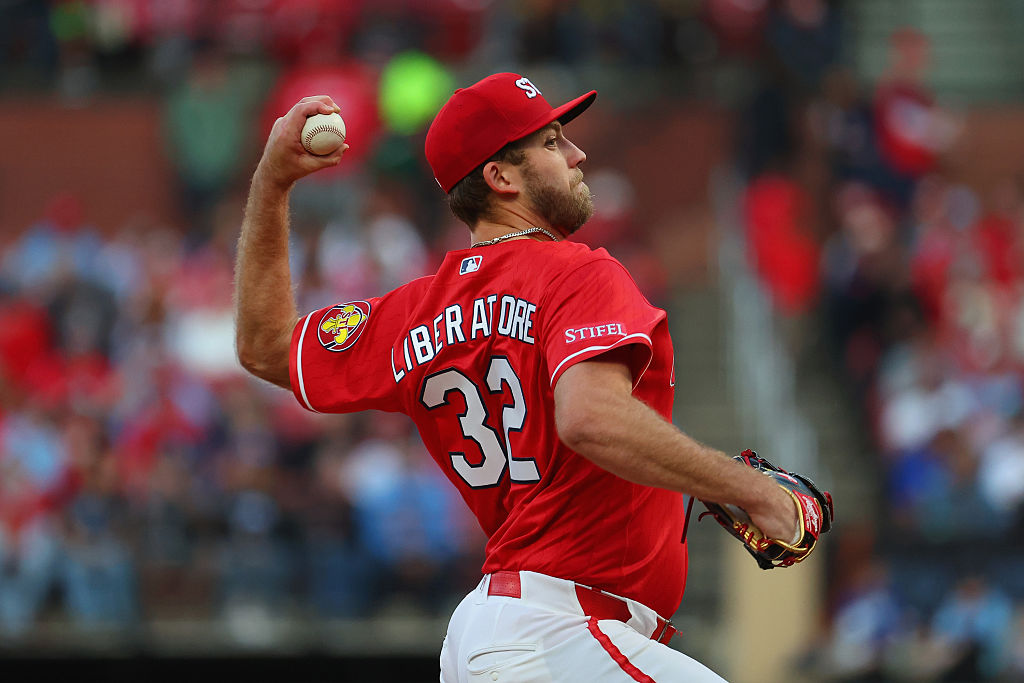
One of the most pressing aspects of the Liberatore conversation has nothing to do with him—but everything to do with the Cardinals’ revamped farm system.
St. Louis jumped from 12th in baseball ahead of the 2025 season to fourth, according to an article written by Jim Callis, Sam Dykstra, and Jonathan Mayo of MLB.com.
In Just Baseball’s updated Top 100, the Cardinals had four players make the list, with 2026 phenom Joshua Báez just missing out.
One of the hardest decisions for a POBO to make is cutting bait. The Cardinals’ last regime was stuck in rigor mortis after losing out on talents such as Randy Arozarena and Sandy Alcantara.
Now, in his first year at the helm, Bloom will be dealing with a similar problem for the first time. Fortunately, there are a few players who make it that much easier on him.
Right-handed pitcher Hunter Dobbins was acquired this past offseason from the Boston Red Sox in the Willson Contreras deal. In 17.1 innings across two starts, the 26-year-old has a 3.63 ERA.
Although Dobbins’ 5.44 xERA is concerning, the sample size is still small, and he still outperforms Liberatore in fastball velocity, groundball rate, and strikeout rate. At some point, the Cardinals will have to find out what they have in the young righty.
Another name that Cardinals fans should be clamoring for is Quinn Mathews. The Stanford product, who was selected in the fourth round of the 2023 MLB draft, is back on track this season.
After an injury-plagued 2025 held the lefty to a mere 99 innings, he’s reamped his volume and has the strikeouts rolling.
Mathews is striking out over 11 batters per nine innings. So what’s the hesitation? The 25-year-old is walking over six batters a game this year. Liberatore’s rate is close to half of that.
MLB doesn’t provide the same cushion that Triple-A does when you fool around with ball four. But if Liberatore can’t figure things out, how much worse could it get? Mathews’ strikeout potential currently bests what Liberatore presents.
Missouri Hall of Fame sportswriter Bernie Miklasz weighed in on his Liberatore take – and he was blunt.
“Listen, nothing personal. I like Libby a lot. I’ve been rooting for him. I’ve been patient with him and defending him, like years ago, when everyone was ready to give up on him. You know, I’ve been fair to him, but I’m telling you, keeping him in this rotation is not the answer. Sorry.”
Miklasz furthered his point by citing Liberatore’s pitch-mix, which has been negative across the board over his last seven starts.
It’s safe to say the tides have turned on Liberatore in St. Louis. At one point, he was the promised child who was going to rectify the loss of Arozarena and save an aging pitching staff.
Now, he might be an outsider on a team not only looking to overhaul its roster, but also its culture.
Become a Member of Just Baseball
Subscribe and upgrade to go ad-free!
* Save 25% by subscribing annually.

Written by
AJ Stone is a sportswriter and journalist currently attending the University of Missouri School of Journalism. His work has appeared on Redbird Rants, Heavy.com, Arcadia News,…