
How Can the Cardinals Get Joshua Báez’s Bat in the Lineup?
St. Louis Cardinals' prospect Joshua Báez won't stop terrorizing Triple-A pitching. Is a call-up in the cards for the slugging power bat?
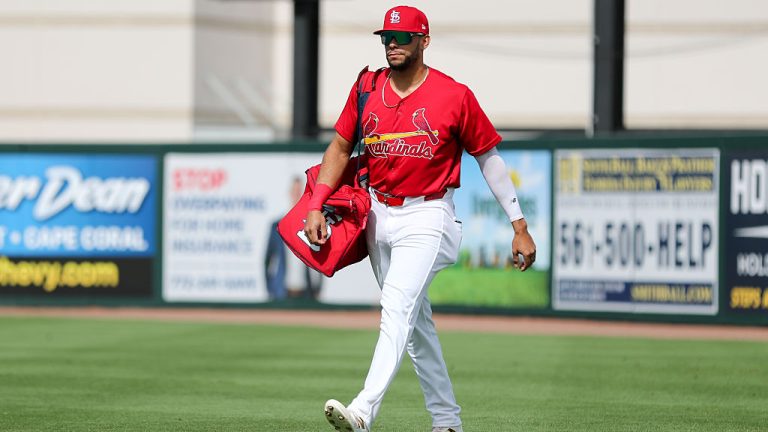
The St. Louis Cardinals have been the definition of a surprise contender this season. JJ Wetherholt’s fantastic introduction, steadiness up and down the lineup, and Jordan Walker’s breakout highlight a young and fierce roster–but the biggest surprise might be in Triple-A.
This spring, Cardinal fans familiarized themselves with the name Joshua Báez. In ten games, he socked three home runs, and slashed .292/.417/.667. However, all of that and an OPS of 1.081 were not enough to earn an opening day roster spot.
Since being optioned, Báez has transformed himself into something impossible to ignore.
Through 69 Triple-A games, the 6-foot-3 right-hander has a ridiculous .969 OPS. Most of his production is raw power, fueled by a league-leading 26 home runs.
Famously, Báez reinvented himself after a stalled start to his professional career. Initially, after his selection in the second round of the 2021 MLB draft, Baez was ranked as St. Louis’ number seven prospect via MLB Pipeline.
After a combination of injuries, swing-and-miss, and an overall lack of production, Báez was clinging for dear life to his MLB Pipeline ranking, and fell entirely off Baseball America’s list.
Now, he’s becoming undeniable, and the Cardinals are running out of reasons to keep him in Triple-A.
All stats updated prior to games on Friday, June 26
Báez’s Bat Is Becoming Hard to Ignore
Although his surface-level numbers speak volumes, the underlying metrics are where things get exciting.
Báez’s ISO this season is .353. For context, Kyle Schwarber of the Philadelphia Phillies, who leads MLB in homers, has an ISO of .338.
When someone sports such copious power numbers, it’s easy to assume they’re a ‘three true outcome’ player. In Báez’s case, that assumption would be wholly incorrect.
The home runs are there, the strikeouts are there, but so far, he’s replaced the walk with base hits. His batting average of .273 highlights his consistency and improved contact rates.
Recently, on June 16, Báez launched four home runs in a game for the Memphis Redbirds. However impressive you think that may be, it becomes even more so when you see how he did it.
The first ball he deposited over the fence was a ‘normal’ home run, pull side to left center field. Báez followed that up with a towering shot on a pitch up in the zone, backside. Then, he turned and burned for a screaming line drive that just stayed inside the left field foul pole. And finally, his historic night was capped off with a dramatic, illuminating blast that fluttered through the lights. Rightfully so, he fell to a knee and admired his good work–Adrian Beltre style.
It’s easy to forget in the midst of his legendary power surge that Báez stole 54 bases last season, and already has 13 swipes in 2026.
That kind of power/speed combination rarely spawns in baseball, and if St. Louis has possession of such a player, they can’t afford to waste prime seasons.
On the power side of his dual-threat ways, Báez is rounding the bases so often due to an approach that’s reached trend status in modern baseball: the pulled fly ball.
Báez’s pull percentage jumped 36.4% in 2025 to 52.9% this season. Consequently, his strikeout rate and walk rate have both gone the wrong way, respectively. This is a byproduct of chasing contact out in front, which can leave a hitter more susceptible to chasing and whiffing.
Báez has his flaws, there’s no doubt. Strikeouts and a lack of overall discipline still plague his game, even though he leads MiLB in long balls. Several evaluators across baseball, including Just Baseball’s own Aram Leighton, have been hesitant when it comes to the Cardinals’ outfielder.
However, at some point, the prospect of failure is diluted by current success. With Báez’s recent track, times have changed.
The question is no longer, ‘when will Báez figure out how to cut down on strike three?’ and has rather morphed into ‘how much longer can the Cardinals justify leaving this kind of power/speed potential in Triple-A?”
With Báez pushing his own narrative and the trade deadline fast approaching, President of Baseball Operations Chaim Bloom may have a gutsy decision awaiting him.
Where Exactly Does He Fit on the Cardinals?
As of right now, the Cardinals have five players on their active roster regularly manning innings in the outfield: José Fermín, Nathan Church, Nelson Velázquez, Lars Nootbaar, and the aforementioned newfound star, Walker.
Lance Lynn, a former Cardinals pitcher and St. Louis legend, recently appeared on the Cardinals Territory Podcast and had a simple message about Baez.
“If you’re not going to bring a guy up like that, that’s not going to play every day, you don’t bring him up,” he said.
Most analysts surrounding Cardinal baseball agree, but the route to playing time is simpler than it may seem.
Nootbaar, 27, was recently activated off the 60-day injured list. He had double-heel surgery in the offseason.
Since his return, the Statcast darling has finally matched his peripheral data with production on the field, albeit in a small sample size.
In 59 at-bats, Nootbaar has a 147 OPS+ and has already reached 0.5 Baseball Reference WAR. On top of his offensive production, he’s played a serviceable outfield.
Unfortunately, despite his quick return to productive baseball, Nootbaar remains St. Louis’ best route for the Cardinals to grant Báez playing time. The 27-year-old outfielder only has two more years of team control, and his recent stretch is all the more tantalizing to opposing executives.
Nootbaar’s seamless reintegration from the shelf has positioned the St. Louis front office to sell high, ahead of a second-half Báez promotion.
Potential suitors for the World Baseball Classic legend in Nootbaar include the Philadelphia Phillies, Tampa Bay Rays, Cleveland Guardians, and Atlanta Braves. All of whom could use an additional bat in their outfield, whether it be in a platoon or an everyday role.
The Phillies recently lost Adolis García for the foreseeable future and require a replacement. Tampa Bay is in a position to compete and often buys on the cheap end. Nootbaar could serve as a low-cost, big-impact addition.
The Braves have struggled this season with injuries, and could use a more impactful bat than Mike Yastrzemski come October. Finally, the Guardians, known for their chippy style, would benefit most from adding an established MLB bat such as Nootbaar. Their lineup runs rather thin for spurts at a time.
Nootbaar has been electric since his debut in St. Louis, but sometimes, for an organization to mature, they have to pick a direction. Báez’s potential currently outweighs Nootbaar’s value. The simplest way of putting it: would any team trade Báez for Nootbaar? Most likely not.
If the Cardinals were to deal Nootbaar, Báez wouldn’t even have to take over every day in center field. Instituting a platoon dynamic between Báez and Church could provide for a soft launch, allowing the polarizing talent to settle in, rather than be thrust into a ‘sink or swim’ situation.
If things come to pass, and a spot is freed up for the surging prospect, when could St. Louis see him?
When’s The Right Time for a Promotion?
It could be detrimental to Báez’s development to rely on him in an everyday role. As many esteemed writers have pinpointed, the hype for a promotion mirrors Walker’s quick rise to prominence–and Cardinals’ fans know how that story went from 2024 to 2025.
Bloom and the rest of the Cardinals front office have spoken time and time again about how excited they are for Báez’s future. And that’s just the thing: the future isn’t now.
St. Louis looks primed to trade away, at the bare minimum, starting pitcher Dustin May and a grouping of relievers. With the Cardinals’ knack for winning on the margins and the likelihood of a depleted roster after July, it’s likely the team will falter in the second half. Subsequently, there’s no reason to rush the development of a potential franchise-altering prospect.
However, if ‘runway’ and a foundation for the next wave of perennial success are pillars in the Bloom-regime’s plan, a September call-up shouldn’t be out of the question.
Báez can grab a quick cup of coffee in MLB and recalibrate based on his peaks and valleys, similarly to how the Cardinals handled Masyn Winn in 2023.
St. Louis has something cooking in the minor leagues. Ahead of the season, MLB Pipeline had the Cardinals’ farm system as the fourth-best in MLB. That was before Báez’s torrid home run brigade. Before the continued ascension of catching phenom Rainiel Rodriguez (Just Baseball’s No. 15 prospect). Before Liam Doyle (JB No. 94) proved everyone right, and before a contingency of other prospects took legitimate steps toward big-league berths.
Báez’s awakening in 2026 is a testament to the new-look minor league system and staff, put in place by Bloom. The last thing St. Louis needs is to overheat his motor, so wake me up when September starts.
Become a Member of Just Baseball
Subscribe and upgrade to go ad-free!
* Save 25% by subscribing annually.

Written by
AJ Stone is a sportswriter and journalist currently attending the University of Missouri School of Journalism. His work has appeared on Redbird Rants, Heavy.com, Arcadia News,…