
Prospects Who Just Missed the Top 100 Update
Whittling down a Top 100 to just 100 prospects is such a difficult task. Here are the top eight names who just missed the cut in our latest update.
As always, whittling down the top 100 prospect list to the century mark is a can’t-win exercise that leaves very talented prospects on the cutting-room floor. Even with a max exodus from our preseason list given the loaded 2026 rookie class, there were a handful of names I found myself disappointed to not be able to fit into last week’s update.
Here’s eight of the names who received the strongest consideration with a look at what made their candidacy so strong, but also the hair-splitting concerns that maybe left them short.
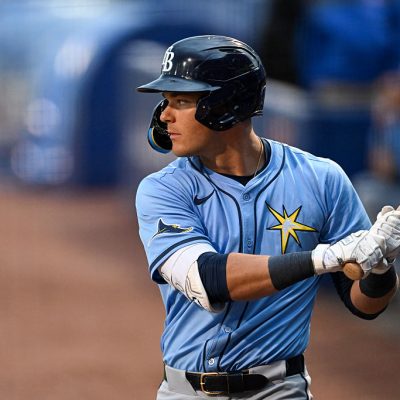
Tate Southisene – 2B – Braves
The Braves first round selection in the 2025 draft (22nd overall) out of the Nevada prep ranks, Southisene has made the smoothest of transitions into pro ball in his first full season. Drafted as a shortstop, the Braves have given Southisene the majority of his reps at second base, which dinged him a bit from a top 100 perspective.
When projecting WAR output, a move to second base places more pressure on the bat, though he has immediately accommodated that pressure by standing out as one of the most productive hitters at the lower levels. Through his first 51 games, Southisene posted a 156 wRC+ at Low-A before being promoted to High-A.
The 19-year-old already offers above average bat speed and a good feel for the strike zone. The upper levels will be a better test to gauge where the hit tool lands after posting a 75% contact rate in his Low-A stint. Already showcasing comfortably above average raw power, Southisene’s swing path skews towards the flatter side of things, but he has a chance to offer plenty of pop as he cleans that up some and continues to develop.
The plus wheels only helps his case as well, snagging 36 bags in the aforementioned 51 Low-A games. Southisene will almost surely crack the top 100 list after another few graduations.
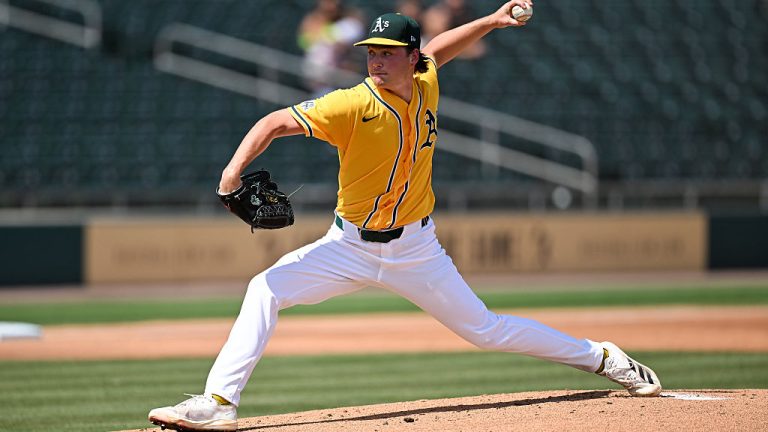
Jamie Arnold – LHP – Athletics
The 11th pick in the 2025 draft out of Florida State, Arnold entered his draft year with 1-1 potential, but he took a half step backwards from his standout sophomore campaign. Arnold was still assigned straight to Double-A to begin his pro career where he has provided mixed results through his first 11 starts.
Arnold’s uniquely low release for southpaw paired with plus extension gives him a distinct attack angle, but his inconsistent command paired with a lack of efficacy with . The four seamer generates above average whiff numbers, but that is more predicated on deception than characteristics, as it averages 11 inches of induced break both vertically and horizontally at mostly 92-94 MPH.
The sinker has developed into a reliable ground ball pitch, though the surface level numbers have not been good with either version of the heater, with opponents hitting over .300 against them with an OPS around .850. The underlying data points towards better fastball results and Arnold has taken steps to diversify his arsenal beyond the heavy dependence on a slider that has always comfortably been his best pitch.
If either of the variants of his changeup can continue to come along, it should only help his fastballs play up, though the fastball could play closer to above average if Arnold’s command of the four-seamer in particular improves.
Given the relatively aggressive leap to Double-A to begin his pro career, I almost feel guilty scrutinizing the 11-game sample to the degree that I am, however Arnold was left off of our preseason top 100 list due to concern about whether he had a clear plus pitch beyond the slider as well as the trend with his fastball command in particular in his draft year.
Arnold has hedged that concern by simply adding more pitches, mixing in a splitter and cutter after signing. With a deep bag of pitches and an outlier angle, Arnold still offers middle-rotation upside, there’s just more variables that have to go right then most of the other arms that cracked the list. That said, Arnold is another player who I expect to leap into our top 100 as he settles into both pro ball and the upper levels.
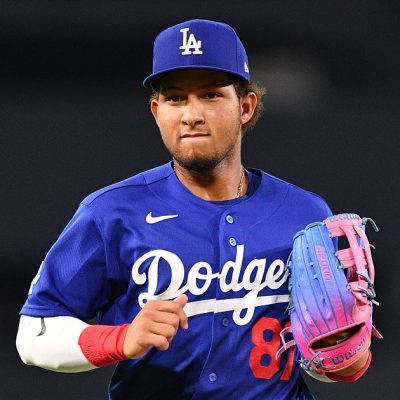
Justin Gonzales – OF – Red Sox
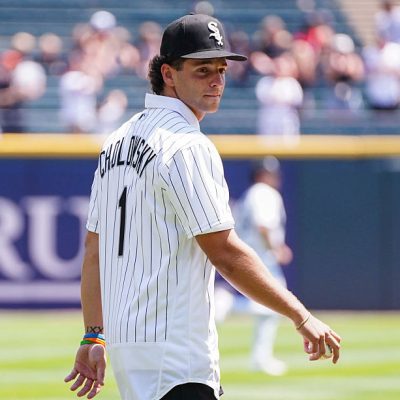
Gonzales was a very buzzy name during spring training as 19-year-old has continued to grow into his massive frame, now standing at 6-foot-6, 275 pounds. He made some adjustments to try to create more loft in a swing that had produced far too many ground balls in the early going of his pro career, only adding to the excitement of what could be a plus plus power ceiling if Gonzales can put it all together.
The challenge is, even with the improvements in the box, Gonzales’ swing is long, with him tending to cheat for the fastball. He’s handled velocity well, but the draw back has been numbers that crater against secondaries, with a fair amount of front foot heavy, one armed swings and too much chase.
The raw power is clearly 70 grade, which is a big reason why Gonzales almost made the cut, as well as the fact that he has been an above average bat as a 19-year-old at High-A despite the limitations. The glove is shaky in corner outfield, placing more pressure on the bat as well.
If everything comes together, the bat can surely accommodate the pressure provided from a lack of defensive value as It’s truly 40-homer upside. But subjectively, the swing doesn’t pass the sniff test, with some objective underlying markers to validate the concerns, which paired with the lack of value beyond the bat, just kept the Red Sox prospect on the outside looking in.
Braylon Payne – OF – Brewers
A surprise first round pick by the Brewers in the 2024 draft, Payne’s standout tools have immediately been on display since he broke into pro ball. Seen as more of a slash and dash speedster out of the gate, the Brewers have worked hard with Payne to get his lower half more involved and the results have been eye-popping as the 19-year-old is now posting elite exit velocities for his age (EV90 of 107.7 MPH, max of 115.3).
The draw back has been that Payne has struggled with whiff. Had Payne cracked the list, he would have joined Lazaro Montes as the only top 100 prospects with a contact rate below 65%, both hovering a tick or two below at the time of this being written.
Payne has the tendency to step in the bucket and leave the ball with his front side, causing him to swing over secondaries located in the bottom half of the zone or outer half. Payne will need to shore that in order to hit enough for his ridiculous tools to translate, but there is a tantalizing blend of double plus raw power and double plus speed with a shot to stick in center field that makes you want to test your limits of how low of a contact rate you can tolerate.
Still just 19 years old until the end of the 2026 season, Payne has plenty of time to iron things out, offering as much upside as any prospect outside of the top 100.
Andrew Fischer – 3B – Brewers
The Brewers’ first round selection in the 2025 draft, Fischer has immediately impressed with his immense power, albeit with plenty of whiff. There’s no doubting that Fischer has found enough comfort at High-A to get his, launching 20 homers in 54 games to start the 2026 season, but with a contact rate of just 60% while striking out a third of the time.
It’s standout bat speed with a swing path that is optimized for launch. A 65% hard-hit rate paired with an average launch angle of 24 degrees is going to result in mistake pitches consistently being deposited over the wall. But what happens when Fischer starts to see less mistakes? Will his 52% contact rate against non-fastballs rear its head? Or can he close that gap to become a more complete hitter?
For a college bat at High-A who is likely an average-at-best defender at third base, those questions need to be answered before he can be considered a top 100 prospect. The Double-A promotion shouldn’t be too far away, which should be a telling test.
Kane Kepley – OF – Cubs
A superb defender up the middle with elite wheels and great bat to ball skills, Kepley fits the bill of a high floor piece who at least has a great chance of landing as a fourth outfielder. Standing at 5-foot-8, 180 pounds, Kepley leverages his compact frame in the box with impressive selectivity, chasing less than 15% of the time, resulting in gargantuan walk rates at the lower levels to begin his pro career.
With a player like Kepley, the hit tool likely has to be comfortably plus for him to project as an everyday centerfielder, which he has showcased so far at High-A with an 85% contact rate through his first 54 games at the level. He has struggled with spin though, hitting just .120 against breaking balls in that span with some uncomfortable looking swings mixed in, which won’t get any easier once he reaches Double-A.
He packs a bit more of a punch than the frame would suggest though, offering gap to gap power with the ability to sneak some homers out to the pull side. Kepley is knocking on the door of the top 100 list, but he will need to prove that he can handle breaking balls, of which he will only see more and better versions of as he climbs.
Joshua Baez – OF – Cardinals
The most controversial of our omissions, Baez is a subjective vs. objective battle that reminds me a little bit of when we caught people off guard with our relatively low ranking of Kristian Campbell on last year’s preseason list. Baez similarly broke out from nowhere, posting a 145 wRC+ between High-A and mostly Double-A while cutting his strikeout rate by 15% from the year prior.
His swing was vastly improved from the chaotic operation that resulted in a strikeout rate that hovered around 35% in his career entering 2025. Baez’s rough injury luck from the start of his career also drifted further in the rearview. Though a stiffer mover, Baez is still an explosive athlete, turning in plus run times, helping him steal a ridiculous 54 bags on 63 tries.
Though a far improved operation, the stiffness is still evident in his swing, particularly at the lower half. Baez’s swing is grooved, which paired with the aforementioned lack of lower half adjustability, should leave him exposed to spin.
This was a concern heading into the season, contributing to us leaving him off of our preseason top 100 prospect list despite his dominance of Double-A. That is where the subjective vs. objective balance of player evaluation comes in. It’s incredibly difficult to deny Baez’s production, especially last season’s with the underlying data even looking solid enough (objective), however there’s not many examples of hitters with his mechanical limitations having success and I do believe more experienced pitchers and more tailored reports will exploit this (subjective).
The merging of the two sides of the equation has been Baez’s 2026 performance at Triple-A. He has continued to hit the ball hard and slug his way to good surface level stats, but it has come with far more whiff, seeing his contact rate drop to 63% while the chase has ballooned to 36%, each 11% off from his 2025 marks.
Baez’s contact rate against breaking balls is down to 53% through his first 56 games, though he has continued to showcase the ability to demolish hangers. Subjectively, I am concerned Baez will not hit enough for his exciting power and speed combination to shine through, objectively, Baez checks the boxes of a top 100 prospect. The result? A guy who just missed.
Felnin Celesten – SS – Mariners
Celesten has come with plenty of hype since signing with the Mariners for nearly $5 million in the 2023 IFA period, but injuries and inconsistent play had limited the switch hitting infielder to mostly flashes of his exciting upside until this season.
The 20-year-old looks to be putting things together offensively at High-A, turning in a 140 wRC+ through his first 51 games, with a walk rate that is up by 6% and a strikeout rate down by 4%. But when you look beneath the hood, it’s surprising that Celesten has performed this well. His average exit velocity is actually down from last season, sitting at 85.8 MPH, the contact rate is only up by 2% and his hard-hit rate is actually down to 28%.
The only explanation I can put together on Celesten’s offensive leap is that he hammering fastballs to an OPS north of 1.000 while showcasing some more selectivity at the plate. While the chase rate is only a few percentage points lower overall, he is expanding 7% less frequently against fastballs.
The other concern is that while Celesten has the defensive tools to be a shortstop, he is inconsistent at the position and can struggle with the fundamentals. Through his first 168 starts at short as a pro, Celesten has made 50 errors. He’s been better this year, but it is still something to monitor.
There’s still exciting potential for the switch-hitter, I am just not sure the raw tools that have been lauded are necessarily shining through the way people may think when looking at the surface level stats.
Become a Member of Just Baseball
Subscribe and upgrade to go ad-free!
* Save 25% by subscribing annually.

Written by
Aram Leighton is the Co-Founder and Executive Editor for Just Baseball. A Syracuse University grad, Aram is one of the hosts of the Just Baseball Show…