
2026 MLB Draft – Top 100 Prep Prospects
Just Baseball ranks the top 100 prep prospects who could be selected in the 2026 MLB Draft this summer.
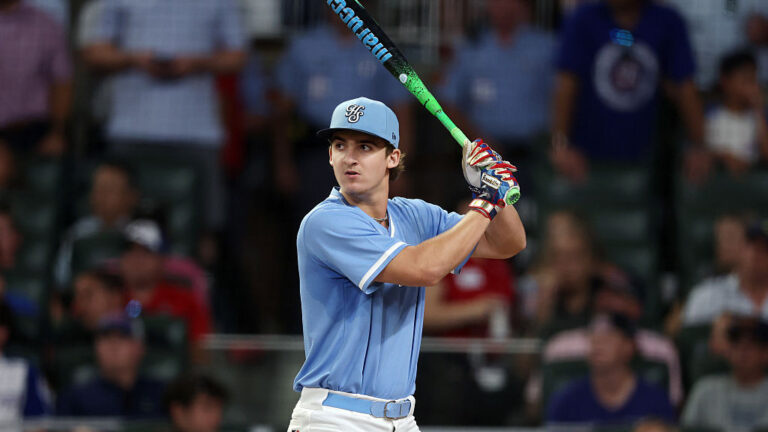
UPDATED: 6/24/2026
The MLB Draft is now just a few weeks away, and we are proud to release our latest update on the 2026 cycle.
There’s plenty of movement and shuffling on this edition of the board, which is taken from our Top 250 Prospects list. Grady Emerson holds down the top spot once again, though a few names make their first appearance in the top ten, including the likes of Brody Bumila and Trevor Condon. The strength of this side of the draft is pitching, especially with southpaws.
Make sure you read our Top 100 College list, which was also updated today.
1. Grady Emerson – SS
HT/WT: 6’2/180 | Bat/Throw: L/R | School: Fort Worth Christian (Argyle, TX) | Commitment: Texas | Projected Age: 18.4
One of the most famous names in this class, Emerson already boasts a long list of accolades on his baseball card. He’s the first player in USA Baseball’s history to have played twice on both the 15U and 18U national teams, a testament to his talent and longevity at the top of his class.
It’s a safer profile compared to his peers, but he’s a lithe, projectable athlete with rhythm to both sides of his game. At the plate, it’s as balanced and relaxed as they come.
Emerson employs a wider base from the left side and stays compact through the baseball, lacing line drives to all fields. He has a knack for putting the barrel on the baseball, and he covers the zone well, especially on offerings closer to his knees. He doesn’t chase out of the zone often, either, making him an on-base threat.
There is impressive bat speed and leverage in his swing, but he has yet to sell out for power. He has flashed pull-side juice in the past, though for now, most of his extra bases will come by way of the gaps. As he matures physically, he will grow into more pop, and these doubles will turn into home runs.
His performances were a bit more streaky to start the summer, but Emerson ended the year on an extremely high note. It’s a higher floor offensively, but there’s a high ceiling to find here. It’s an advanced bat.
Defensively, Emerson doesn’t project to leave the “six.” He’s an agile defender with solid range, strong instincts, and an above-average arm across the diamond. He seldom rushes plays and controls his body well. In the case that Emerson happens to move to another position, he’d handle the hot corner with ease.
Now a Texas recruit, Emerson’s profile screams that of a top ten selection. It’s a mix of projection and polish that not many can rival in this class.
Interview: https://youtu.be/wtPC9_w-Ts4?si=-FLWELD1ztZDXQm_
2. Eric “EJ” Booth – OF
HT/WT: 6’0/207 | Bat/Throw: L/L | School: Oak Grove (Bassfield, MS) | Commitment: Vanderbilt | Projected Age: 18.0
A metric darling through and through, Booth has garnered a lot of attention this summer, and for good reason. A sturdily built athlete, Booth has a strong case as the most athletically gifted prospect in this class — his loud tools in a powderkeg frame scream impact bat at the next level.
Booth has two different swings, much like what Garrett Mitchell had at UCLA. In games, Booth tends to use a more choppy swing with a flatter swing plane, prioritizing contact over power, though it’s more fluid and pleasing during batting practice.
Despite the choppier nature, Booth can crush the baseball. It’s a noisy operation with an open stance and high hands, but he has exceptionally quick hands, loud bat speed, and excellent rotation. Booth can make later swing decisions than most of his peers, allowing him to get his B-swing off.
He will use the whole field, though his current power favors his pull side, as he’s already hit balls at 108 MPH with wood bats in that direction. Additionally, Booth rarely whiffs and draws plenty of walks. This summer, Booth didn’t have a whiff percentage over 25% on any offering and posted an 85% in-zone contact rate. Pretty impressive.
There will be swing adjustments in the future, so his swing isn’t finished, but this is a good mold of clay for a development team to work with.
He’s capable of playing all three outfield spots and could become an average or better glove in a corner spot thanks to great route running and double-plus speed. However, the body and lack of arm strength might limit him to left field.
Overall, Booth’s profile features many exciting tools, and as a bonus, he turns 18 just a week before the draft. He’ll be a model darling. If he goes unsigned, he’ll head to Nashville to attend Vanderbilt.
3. Jacob Lombard – SS
HT/WT: 6’3/185 | Bat/Throw: R/R | School: Gulliver Preparatory (Miami, FL) | Commitment: Miami | Projected Age: 18.9
Fans of baseball should be well acquainted with the Lombard family name at this stage. George Sr. played multiple seasons in the big leagues from 1998 to 2006, and George Jr. was the first round selection of the New York Yankees in 2023.
Jacob is the next in line, and he may be the most gifted athlete of the bunch.
He’s an explosive athlete with tons of strength throughout his frame, and it absolutely shows on the field. Lombard employs a narrower stance from the right side, opening his hips vigorously and generating plenty of ground force and barrel lag.
He has adequate bat speed, great rotation, quick hands, and a direct nature to the baseball. Lombard does plenty of damage in the air, as his swing is tuned to lifting the ball regularly and sending it to either gap with authority. It’s plus raw juice in the stick, though it may be more above-average in terms of game power moving forward.
While he does stay within the zone and draws walks, the hit tool leaves a bit more to be desired. There is swing-and-miss to his game, most notably fastballs upstairs and breaking balls down. There’s work to be done in that department, but he’s on a trajectory that puts him among the best slugging amateurs in recent memory.
In the dirt, Lombard is a top-of-the-scale runner with exquisite lateral mobility at shortstop. It’s a ton of range and fluidity, plus he has the arm strength to hold down the “six” for the long haul. There’s some utility to his game, as well. He’s gotten run in the outfield and could hold station in center if he’s moved out there.
All in all, there’s significant upside with Lombard, bordering upon “superstar.” Cleaning up the volatility of the hit tool will be paramount in the spring, but his loud tools will make him a high-end pick regardless.
Lombard committed to the University of Miami in late October.
4. Gio Rojas – LHP
HT/WT: 6’4/190 | Bat/Throw: R/L | School: Marjory Stoneman Douglas (Coral Springs, FL) | Commitment: Miami | Projected Age: 19
The next in a long line of Marjory Stoneman Douglas alumni, Rojas has become one of the top southpaws in the country, and it’s easy to see why.
At 6-foot-4, 190 pounds, Rojas is an extremely projectable athlete with long limbs, broad shoulders, and a lean frame that suggests he can add plenty of muscle in the coming years. As a bonus, Rojas is highly athletic and has a buttery smooth delivery on the mound.
It’s an up-tempo operation with a slingshot-like release, showcasing loud arm speed from a lower arm slot with a wider angle to the plate. His delivery is very deceptive and can make at-bats particularly tough for left-handed hitters.
His fastball can be a true power pitch at its best. It explodes out of his hand, and he’s demonstrated the ability to both elevate it and locate it on the top rail. He has already hit a peak of 98 MPH, regularly sitting in the 92-96 MPH range throughout his starts, and it’s easy to imagine him throwing even harder in the future.
The pitch produces significant zip and run through the zone with loud spin rates, commanding it well to both sides of the plate, but it’s especially lethal upstairs. Currently, it’s given hitters a lot of trouble.
His low-80s slider is a dangerous pitch, showing exceptional bite and tilt right out of the hand, with up to sixteen inches of sweeping action. He’s still working on commanding the offering, but at its best, he starts it behind left-handed hitters and lets it sweep across the zone.
His low-80s change-up also shows significant potential, releasing it halfway to home plate and fading heavily away from right-handed hitters.
It’s a powerful arsenal with developing command and considerable upside that scouts will appreciate in this cycle. It’s really advanced. If Rojas ends up on campus, he’ll be draft-eligible as a sophomore at Miami in 2028.
5. Jared Grindlinger – LHP,OF
HT/WT: 6’3/185 | Bat/Throw: L/L | School: Huntington Beach (Huntington Beach, CA) | Commitment: Tennessee | Projected Age: 17.2
The younger brother of current Tennessee backstop Trent, Jared reclassified in February to the 2026 ranks and immediately became one of the top players in the class. While we’ve had our fair share of two-way talents in recent years, Grindlinger has the best chance of any to play both at the next level.
We’ll start with what he brings on the mound, where he’s an excellent strike-thrower with solid pitchability. It’s a smooth operation with minimal effort, using subtle hip counter-rotation to glide down the mound and stay in control. He can generate quality extension down the bump and has loud arm speed, too.
The fastball has reached 96 MPH in short spurts, sitting in the low-90s routinely with modest shape, though most expect him to throw much harder. He throws the low-80s slider as much as the fastball, landing it for strikes with solid shape and snap, running it into the mid-80s at his hardest. There’s feel for a solid change-up with spin-killing abilities and solid shape, as well. It’s a polished package for a starting pitcher.
As a hitter, it’s just as polished. Grindlinger has exceptional zone awareness and rarely whiffs on pitches, whiffing just three times over the summer. It’s solid bat speed and torque that should continue to rise as he fills out his frame. He has the skills to be a high on-base hitter with solid power.
Grindlinger has a long stride and above-average speed, and his arm strength should play well in the right-field corner. He plays with a fluidity and maturity that is rare for players his age.
He’ll be a tough report for scouts given the two-way prowess, but if he has to pick one, both routes start in the top two rounds. He’ll be one of the youngest players in history if selected, with his draft-day age projected just shy of 17 years and 3 months. This would help teams understand his strengths and evaluate his future routes.
Grindlinger committed to the University of Tennessee on April 1st, though it’s hard to envision him in a collegiate uniform.
6. Brody Bumila – LHP
HT/WT: 6’9/255 | Bat/Throw: L/L | School: Bishop Feehan (Raynham, MA) | Commitment: Texas | Projected Age: 18.5
After bursting onto the scene in 2024, Bumila suffered an elbow injury that kept him on the bench for most of 2025, but he’s back.
At six-foot-nine, 255 pounds, Bumila is built like a basketball center, and he’s a stellar athlete on the hardwood. However, many scouts are impressed with his body control, burgeoning stuff, and the deceptive angle he generates on the bump.
He sinks into his back leg well, driving down the mound with crossfire and width to his release, which sits under five feet off the ground. For a human being of his size, that’s a wildly impressive mark.
The fastball is a fun pitch metrically. Already up to 99 MPH, Bumila generates plenty of life through the zone, with quality carry on the top rail and tail mixed in. It’s a high-spin monster that gets on hitters very quickly. As he matures physically, many expect him to sit in the mid-to-upper-90s.
Bumila’s low-80s change-up is his best secondary, displaying excellent velocity separation and tumbling away from the barrels of righties, though he’s shown feel to throw it to lefties as well. There’s feel for a sweeping breaking ball in the upper-70s, though it lags behind the FB/CH combination.
Unfortunately, Bumila suffered another elbow injury at the end of the spring, and his future has become slightly murkier as a result. There’s a real chance he makes it to Texas. That said, someone may take a chance on him on Day 1 despite the injury history.
7. Bo Lowrance – SS,3B
HT/WT: 6’5/200 | Bat/Throw: L/R | School: Christ Church Episcopal (Greenville, SC) | Commitment: Virginia | Projected Age: 18.9
One of the more talked-about names during the late summer, Lowrance’s 6-foot-5, 200-pound frame exudes projection. He has exceptional length in his limbs, and while many prospects of his size struggle to control their bodies, Lowrance does a great job of repeating his mechanics and staying in sync.
Lowrance’s offensive upside is extremely promising. He keeps it simple at the plate, wasting little movement before showcasing impressive bat speed, hand speed, and barrel lag through the zone. He has a heavy barrel that stays in the zone for a long time, and he’s able to generate good leverage and extension thanks to his length.
Most of his production has come on the opposite side of the field, though Lowrance has demonstrated the ability to pull the baseball with authority. Most expect his power to be plus once fully mature, while the hit tool has some basic floor. Lowrance has handled velocity quite well so far, especially in the zone, and he makes smart swing decisions.
Defensively, Lowrance has played shortstop, and he has impressed scouts with his mobility and skills at the position this spring. Athleticism has improved, speed has increased, and the actions are befitting of a future at the position. He has improved significantly and has earned first-round grades as a result. He will be a hot commodity on draft day.
Lowrance’s commitment belongs to Chris Pollard and the University of Virginia.
8. Trevor Condon – OF
HT/WT: 5’11/175 | Bat/Throw: L/R | School: Etowah (Woodstock, GA) | Commitment: Tennessee | Projected Age: 18.6
An ultra-athletic prospect, Condon has a throwback style on the field. He’s as fiery a competitor as you’ll see in the amateur ranks, playing with passion and intensity on both sides of the ball. Calling him a “gamer” would be selling him short.
He’s a table-setter with an old-school swing that’s quite unique. Condon starts his load early, essentially waiting for the pitcher to release the ball after an inward toe tap. Once released, his hips burst open, and he reacts quickly.
There’s a noticeable barrel tip and high hands in his load, which has impacted his ability to reach velocity upstairs, but his quick hands and barrel stand out. He’ll ambush fastballs early and yank them to the pull side, where most of his power plays, while using the whole field to his advantage.
His swing will need refinement as he moves into uncharted waters in the minors, but so far, he’s made it work. As a bonus, Condon possesses top-tier speed that will dominate infielders. His profile isn’t too different from guys like Slade Caldwell and Slater de Brun.
In the field, Condon has the potential to be a premium center fielder, thanks to his speed and significant range. While his route-running needs some polish, he’s willing to put his body on the line to make plays.
The tools are definitely there. If Condon isn’t chosen next summer, he’ll head north to Knoxville to play for Tony Vitello’s team at Lindsey Nelson Stadium.
9. Carson Bolemon – LHP
HT/WT: 6’4/210 | Bat/Throw: R/L | School: Southside Christian School (Greenville, SC) | Commitment: Wake Forest | Projected Age: 19.3
If anyone has the strongest track record in the prep pitching ranks, it’s Bolemon.
One of the most integral pieces to USA Baseball’s 18U gold medal, Bolemon is an extremely polished southpaw with excellent feel for pitching. Boasting a strong, athletic frame, he drives down the mound, utilizing the strength in his lower half well and staying direct to the plate.
The delivery is smooth and deceptive, as he hides the ball very well with a short, compact arm swing that leads to a high three-quarters arm slot. Batters struggle to see the ball out of his hand, plus it’ll get on them quickly.
Given Bolemon’s higher release, he generates a ton of backspin and carry on his fastball, flashing impressive spin rates over 2,500 RPMs. He’s been up to 97 MPH already, though he’ll park it in the 90-94 MPH range across his outings. He throws with downhill angle, which has led to a heightened groundball rate, and he’ll fill up the zone consistently with the offering.
However, it’s the pair of breaking balls that stand out the most in his arsenal. His upper-70s/low-80s curveball is the better of the two, flashing significant depth out of the fastball tunnel and diving hard to the dirt with impressive bite.
The slider is thrown with more tilt and creeps into the mid-80s, displaying similar bite to the curveball. He can land both offerings for strikes at will, and many opponents struggle to adjust to the pitches. They’re both above-average to plus pitches at the next level.
He’ll round out his arsenal with a tailing upper-80s change-up that he’ll drop his slot for and reserve for righties. It has solid potential at this stage.
He pitches with conviction, displays pitchability, and has the look of an arm that’ll possess above-average command. It’s how you draw them up. He’s on the older side of the class, which makes him a draft-eligible sophomore if he makes it to Wake Forest.
10. Coleman Borthwick – RHP,1B
HT/WT: 6’6/255 | Bat/Throw: R/R | School: South Walton (Freeport, FL) | Commitment: Auburn | Projected Age: 18.2
At 6-foot-6, 255 pounds, Borthwick is not your typical prep prospect. Built like an NFL tight end, he’s got a physical and durable frame, towering over his peers on the diamond. Given his size, he has the looks of a potential power arm on the mound, and while many believe that’s his outcome, there’s upside in the stick.
We’ll start on the mound, where Borthwick’s unorthodox delivery and loud stuff take center stage. Borthwick lands closed and throws to the plate with crossfire and angle, kick-stepping his way down the bump. It’s certainly unique, and while the move does hamper his extension, the angles created allow his arsenal to play.
Another unique aspect of his operation is the low release he generates despite his gargantuan size, as he releases the ball from a low three-quarters slot with loud arm speed. The ball jumps on hitters quickly as a result, plus he still generates some downhill plane.
He’ll generate quality carry on the top rail with his fastball, though it’s played more as a groundball machine to date. His release adds plenty of run and sink to the pitch, boring in on the hands of righties. He’s hit 98 MPH at his peak, routinely sitting in the 92-96 MPH range and holding it for lengthy durations.
The mid-80s slider is a future plus offering. It’s a hellacious breaker with tight spin and late biting action, flashing more sweep than depth. He spins the ball hard, consistently above 2,700 RPMs, and he misses plenty of bats with it. There’s a cambio in his arsenal, though it lags behind the 1-2 punch.
There’s relief risk here, though he has the look of a powerful late-inning reliever if he can’t start. With the bat, Borthwick’s power and leverage stand out, plus he’s got some feel for hitting with good contact rates. He can get overly aggressive with chases, plus many believe he’ll wind up at first base in due time, but he’s shown the capability of playing third thanks to his athleticism.
He projects to be a model-friendly profile on draft day, as he’ll be one of the younger prospects in the class. If he goes undrafted, he’d spend three years at Auburn.
11. Logan Schmidt – LHP
HT/WT: 6’4/220 | Bat/Throw: L/L | School: Ganesha (Aliso Vieja, CA) | Commitment: Louisiana State | Projected Age: 17.11
Originally part of the 2027 class, Schmidt made the jump into this year’s crop in June. This move has paid dividends so far, as Schmidt is considered the last of the top southpaws in this class. He checks many boxes for scouts, including size, handedness, arsenal strength, and command.
While there isn’t a lot of projection to his frame, it’s proportionate strength with durability and excellent body control on the mound. Schmidt is deceptive and hides the ball very well, plus he generates impressive extension numbers, which helps his arsenal appear more powerful.
He started the summer in the low-90s, but finished the season throwing in the 93-96 MPH range, topping out at 97 MPH at his peak. Due to his lower release point, Schmidt generates more run than carry, but with his command, he can spot the corners and overpower opposing hitters with his fastball. This is a strong asset to his profile.
His best secondary pitch is a mid-80s change-up that he sells very well with a similar arm speed to his fastball. So far, it’s been used mostly against righties, but it has significant fade and depth.
He also has a curveball and a slider, though they sometimes blend. The curveball is the better of the two, with sharper bite and tilt in the upper-70s, while the low-80s slider is a more gradual breaker with good shape.
Given his body control and strike-throwing ability to date, Schmidt has the potential to develop above-average to plus command with quality stuff. He won’t turn 18 until after the draft due to his reclassification, and if he doesn’t sign, he’ll play at LSU in Baton Rouge.
12. Sean Duncan – LHP
HT/WT: 6’3/180 | Bat/Throw: R/L | School: Terry Fox Secondary (Port Coquitlam, BC) | Commitment: Vanderbilt | Projected Age: 18.2
British Columbia has pumped out quality talent over the past few years, including the likes of Tyler O’Neill, Cade Smith, and Nick Pivetta. Heck, the legendary Larry Walker was born in Maple Ridge. As the top Canadian arm in this class, Duncan is looking to join that distinguished list.
An ultra-projectable southpaw with outstanding athleticism, Duncan possesses excellent body control with rhythmic fluidity as he moves down the mound. While the arm action is long, he’s on time and gets plenty of scap retraction, which leads to uber-quick arm speed at release.
After being 90-92 MPH throughout a majority of the summer, Duncan saw an uptick in velocity during the fall, pitching more in the 92-95 MPH range. Many expect this to become the norm in due time.
He generates quality ride upstairs, solid extension, and a flatter VAA that helps the fastball play up and miss bats. As he adds more consistent velocity and strength, the expectation is that Duncan will have a potentially plus heater.
His best secondary is a low-80s slider with teeth and tilt, playing at its best when down in the zone. He’ll get lefties fishing out in front while displaying the ability to tie up righties and land it on their back foot. He has good feel for a mid-80s change-up with solid fading action that plays off the heater, as well.
There’s a big up arrow beside Duncan’s name on rankings after an excellent fall display, and he has Top 100 upside. Duncan is committed to Vanderbilt, though he underwent elbow surgery late in the spring season.
13. Archer Horn – SS,RHP
HT/WT: 6’2/200 | Bat/Throw: L/R | School: St. Ignatius College Prep (San Mateo, CA) | Commitment: Stanford | Projected Age: 18.5
One of the more decorated two-way players in the country, Horn’s bat has really taken off over the past calendar year, and many believe he’ll keep the bat in his hand at the next level. He’s well-built with proportionate strength and displays excellent athleticism on both sides of the ball.
At the plate, Horn’s impact is beginning to take shape. Featuring a narrow and crouched stance, Horn stays compact and direct to the baseball, peppering the middle of the field and the gaps with intent. There’s solid bat speed and feel to lift the baseball, especially when he’s attacking the opposite field gap.
He’s learning to pull the baseball, and that should come in due time. He’s displayed the ability to attack the pull side in batting practice, and many believe it’ll transition in-game soon. He’ll get passive and allow pitchers to get to their best weapons early, though he has shown that he likes to stay in the zone and rarely chase.
Defensively, he has the arm strength and mobility to stay on the left side, though his body may move him to third base. It’s soft hands with good footwork, too.
Some scouts do prefer Horn on the mound, where he’s been up to 94 MPH with life and throws a diabolically good change-up.
His Stanford commitment will draw some caution from teams, but the talent may be too good to ignore. He would be eligible in 2029 as a junior if he makes it to campus.
14. Cole Prosek – C,3B
HT/WT: 6’1/195 | Bat/Throw: L/R | School: Magnolia Heights (Senatobia, MS) | Commitment: Mississippi | Projected Age: 19.0
One of the best bats in the Deep South, Prosek hit at every stop on the summer circuit. While he’s not the most athletic player on the field, his polished offensive game has enamored many scouts.
Prosek’s swing is geared for legitimate impact at the next level. It’s a simple and relaxed swing that he repeats well, featuring a moderate leg kick/drift with little wasted motion. He can separate his hips and shoulders well, plus his hands are extremely strong at impact.
Prosek’s bat path features plenty of loft, impacting the baseball to both sides of the park, but his ability to pull the ball in the air consistently stands out.
He’s more than just a masher, though. While he’s aggressive and expands the zone often, Prosek’s bat-to-ball skills are solid. He’s tough to beat inside the zone, plus there’s adjustability to his swing.
The bat will be the primary selling point moving forward; he’s a below-average runner with a thick lower half, which affects his mobility in the dirt. Many expect him to transition to third base, where he has an average arm, though a first base role can’t be ruled out.
If Prosek attends Mississippi, he would be sophomore-eligible in 2028.
15. James Clark – SS,OF
HT/WT: 6’1/195 | Bat/Throw: L/R | School: St. John Bosco (Bellflower, CA) | Commitment: Duke | Projected Age: 18.10
Clark was one of the top risers during the entire summer circuit. Coming from the talented St. John Bosco team, Clark stood out at multiple events, including a notable Area Codes appearance and winning a gold medal at the 18U World Cup.
He’s a toolsy, bat-first infielder with solid athleticism for his size, featuring quick hips and good strength throughout. He’s more of a contact hitter than a power threat at this point, with some slap-hitting tendencies, but many believe he’ll develop solid power.
Clark takes efficient, compact swings with a heavy barrel through the zone, showing quick hands, good bat speed, and excellent lower-half movement in his swing. His contact skills are advanced, and he approaches at the plate with polish.
Currently, Clark often uses the gaps and accelerates into second gear, running plus times and being ready to take an extra base or two. He has the ability to challenge pitchers and fielders alike. Additional strength and a slight swing tweak should help him turn some doubles and triples into home runs.
In the field, Clark has natural instincts to handle the shortstop position for the foreseeable future. He displays some bounce in his game, with solid range, soft hands, and a keen internal clock. His arm strength is also adequate, though his footwork does create inconsistencies in accuracy. If shortstop doesn’t work out, he would get a chance to play in center.
Clark was originally committed to Princeton, which could have complicated his draft status, though in January, Clark flipped to Duke.
16. Tyler Spangler – 3B,SS
HT/WT: 6’3/195 | Bat/Throw: L/R | School: De La Salle (Danville, CA) | Commitment: Stanford | Projected Age: 18.9
The top Northern California bat in this class, Spangler is a lean, projectable infield prospect with some of the best bat-to-ball skills in the entire country. It’s polished, it’s easy, and he looks the part.
Spangler starts with an upright, narrow stance from the left side, drifting slightly down the box with little wasted movement. He has a lengthy track record of putting the bat on the baseball, seldom whiffing against the opposition.
He spent more time letting the ball travel and lacing the ball to the opposite field this summer, but Spangler can take tight turns to the baseball to the pull side and generate loft.
It’s quick hands with solid bat speed and barrel lag/whip through the zone, and given the projection left to his frame, scouts believe it’s just a matter of time before the power turns on. Many believe he’ll develop average or above-average power in due time.
The biggest thing for Spangler to work on is improving the bloated groundball rate and pummeling the baseball in the air, especially to his pull side. Assuming that happens, he’ll have one of the more potent offensive profiles in this class.
A shortstop by trade, many believe that Spangler will outgrow the position and shift over to the hot corner, where he projects to be a solid defender. He displays quality body control, tempo, and soft hands in the dirt, showcasing adequate arm strength across the diamond.
One thing to watch regarding Spangler’s profile is his commitment to Stanford, which has proven to be a significant obstacle for signing prep players in recent years. He certainly has the tools and projection to entice scouts, though he did miss the spring with an injury. If he winds up at Stanford, he would be eligible as a junior in 2029.
17. Jensen Hirschkorn – RHP
HT/WT: 6’7/205 | Bat/Throw: L/R | School: Kingsburg (Kingsburg, CA) | Commitment: Louisiana State | Projected Age: 18.6
No pitcher ascended draft boards more than Hirschkorn did this summer.
An extremely projectable right-hander from Northern California, Hirschkorn dominated opponents at every stop. This included his historic Area Codes performance, where he struck out all nine batters he faced. His combination of projection, raw stuff, and body control checks many boxes for scouts, as many believe he has significant upside as a starting pitcher moving forward.
Hirschkorn’s delivery is as smooth as it gets, and it’s also incredibly deceptive. His body control is excellent for someone his size, as he remains controlled and methodical on the mound. He hides the ball extremely well, with hitters rarely seeing it out of his hand due to his shorter arm swing.
Given the quick, whippy nature of his arm and his projection, scouts believe his velocity could reach the upper 90s soon. He has already hit 96 MPH at his peak, typically sitting between 91-95 MPH with a downhill plane. His fastball has good carry and tailing action through the zone, and Hirschkorn can command the ball to both halves of the plate.
His low-80s breaking ball is his best pitch, enhanced by his deceptive delivery and ability to tunnel pitches. It can sometimes get slurvy and show some tilt, but it works best when thrown short with depth and bite. To right-handed hitters, it’s a devastating pitch and shows above-average to plus potential. He also throws a solid mid-80s changeup with big fading life.
Hirschkorn’s command is notable, as he consistently finds the strike zone. His best days are ahead of him, having established himself as one of the top arms in this class. Hirschkorn committed to Jay Johnson’s crew in late October, setting the stage for a potential three-year collegiate career in Baton Rouge.
18. Aiden Ruiz – SS
HT/WT: 5’10/165 | Bat/Throw: S/R | School: The Stony Brook (Queens, NY) | Commitment: Vanderbilt | Projected Age: 19.3
If you check the definition of “pest” in a dictionary, it’s just a photo of Aiden Ruiz.
A switch-hitting infielder with an excellent glove in the dirt, Ruiz is an electric presence on the diamond. Scouts love to watch him; opponents dislike playing against him.
With wiry strength and loud twitch, Ruiz has dynamic bat-to-ball skills and enjoys slap-hitting the ball around the field. So far, most impact has come from the left side, but both swings show clean bat paths aimed at putting the ball in play and challenging fielders. His ultra-quick hands and explosive hips let him make later swing decisions than most peers.
He may not have a ton of power, so most of his extra bases will come from gaps or using his speed on the bases. He’s an extremely aggressive runner, willing to steal bases repeatedly.
In the field, he’s a high-energy defender with plenty of bounce. His glove at shortstop is advanced, showing quick transfers, great instincts and IQ, and rangy movements. It’s hard to find a play Ruiz can’t make at the position. His arm strength is above average, too.
Everything in Ruiz’s skill set indicates a Day 1 profile. He will be on the older side of the class at 19.3 years old, making him a draft-eligible sophomore in 2028 at Vanderbilt.
19. Connor Comeau – 3B,OF
HT/WT: 6’4/180 | Bat/Throw: L/R | School: Anderson (Austin, TX) | Commitment: Texas A&M | Projected Age: 17.11
One of the youngest players in the entire class, Comeau’s uber-projectable frame will catch your eye upon first glance. His frame is incredibly lean and lanky, oozing projection that few can rival in this class.
Despite the wiry look, Comeau’s tools stand out, and many believe his best days are ahead of him. Comeau can control his long levers well, repeating a short, compact swing with stout lower-half usage and great extension at impact. While there is a noteworthy barrel wrap, his hands are swift, whipping the barrel around his body and generating significant bat speed in the process.
While most of his impact was in the opposite field throughout the summer, he began to pull the ball with more authority in Jupiter, which included a long pull-side home run. Many believe he will grow into above-average power. The bat-to-ball skills aren’t too shabby, either. He has a keen eye and understands the zone well, rarely chasing pitches out of the zone. The bat has a chance to be really good.
Defensively, he’s a bit position-less at this time. He’s been given reps at shortstop, though many believe he’ll shift over to third base as he grows into his body. If third base isn’t a viable option in the future, he’ll transition into a corner outfield role with good arm strength.
Comeau will not turn 18 until a few weeks after the draft, which will help his case among model-heavy teams. He is committed to Texas A&M.
20. Blake Bowen – OF
HT/WT: 6’3/215 | Bat/Throw: R/R | School: JSerra Catholic (Riverside, CA) | Commitment: Oregon State | Projected Age: 18.6
One of the most physical players in this class, Bowen stands out among his peers on the diamond upon first glance. He’s built like an NFL tight end. It’s broad shoulders, it’s impressive strength throughout his frame, and it’s loud tools across the board.
An imposing figure to opposing pitchers, Bowen has shown an improved approach this summer, which has allowed him to rise steadily on draft boards. There’s some noise to his swing, most notably an inward leg kick, but Bowen stays compact throughout and unleashes violence on the baseball.
He displays significant hip/shoulder separation once his foot plants into the dirt, which allows the barrel to fly through the strike zone. It’s impressive bat speed with barrel control and feel to lift the baseball, especially to the pull side.
While he can get tested against spin, Bowen has posted healthier contact rates and seldom chases out of the strike zone, displaying a more selective approach than in previous summers.
It’s a well-balanced offensive profile that should continue to improve with further development.
In the grass, Bowen has the speed and instincts to begin his professional career in center. Despite his size, he’s a quality athlete with excellent speed, allowing him to cover ground easily. As he ages, there’s a good chance that he’ll move to right field, where his superb arm strength fits in perfectly. He’s already been gunned at 96 MPH in showcase settings, and the accuracy is there.
It’s a power-oriented profile that will attract tons of scouting heat next spring. Bowen is committed to Mitch Canham’s crew at Oregon State and would be eligible as a junior if he makes it to campus.
21. Joseph Contreras – RHP
HT/WT: 6’4/207 | Bat/Throw: S/R | School: Blessed Trinity Catholic (Alpharetta, GA) | Commitment: Vanderbilt | Projected Age: 18.2
Joseph, the son of 11-year veteran Jose Contreras, emerged strongly with a standout summer campaign, showcasing one of the most dynamic arsenals in the amateur scene. His profile attracted the attention of Team Brazil as he pitched against a talented Team USA lineup in the WBC.
With a wiry frame and great projection, Contreras has significant arm talent, although there is some relief risk associated with his profile.
A short strider, which is common for someone who throws from an over-the-top release, he throws downhill with good arm speed. While his delivery isn’t effortful, his head whack and some violence at release have affected his command.
His fastball has reached up to 98 MPH, and he has demonstrated the ability to maintain mid-90s velocity over longer outings. He generates good backspin and carry from the high slot, though he will occasionally show more tail and run down in the zone.
Contreras throws two distinct change-ups: a traditional circle change and a splitter. The circle change sits in the mid-80s with fade, serving as a bridge offering to the bigger splitter. The splitter, in the upper 70s, shows excellent velocity separation and big depth out of the hand, diving to the dirt with bite. It has the potential to be an above-average to plus pitch.
He also features a mid-80s “death ball” slider that remains short to the plate with snapping action, pairing well with his fastball.
If his strike-throwing improves, he has starting upside, but currently, he projects as a leverage reliever with a unique profile. He’s on the younger side of the class and has recently committed to Vanderbilt.
22. Kaden Waechter – RHP
HT/WT: 6’3/185 | Bat/Throw: R/R | School: Tampa Jesuit (St. Petersburg, FL) | Commitment: Florida State | Projected Age: 18.11
Kaden, the son of former major-league starter Doug Waechter, is a promising starting pitcher prospect with excellent athleticism and a powerful three-pitch arsenal.
With broad shoulders and plenty of projection, Waechter is a highly athletic arm with superb body control and refined actions on the mound. He moves smoothly, generates solid extension, and has considerable arm speed from a lower release point. This makes him an ideal candidate for starting.
His three-pitch mix is built around power, beginning with a heater that challenges hitters. His pitches stand out with metrics such as spin rates over 2,500 RPM and high carry marks, consistently sitting between 91-95 MPH and reaching 96-97 MPH. His fastball can be explosive, occasionally flashing late tail and adding cut when pitching away, while also working inside to right-handed batters. He attacks hitters aggressively.
His primary secondary pitch is a mid/upper-80s slider with sharp movement and two-plane break that hitters find difficult to handle. It comes from the same arm slot as the fastball, and he can shape it into a cutter at times. He commands it very well, including throwing inside and letting it break into lefties’ back foot.
He also has a firm change-up with tumble, thrown in the same velocity range as his slider, and has shown willingness to use it against both lefties and righties.
Given his command, delivery, and repertoire, Waechter has the potential to develop into a middle rotation starter in the future. He is currently committed to attending Florida State University, where he will be eligible again as an older junior in 2029.
23. Luke Williams – SS,OF
HT/WT: 6’0/180 | Bat/Throw: R/R | School: Franklin Regional (Murrysville, PA) | Commitment: Vanderbilt | Projected Age: 18.6
Williams is one of the more athletically gifted athletes in this class, and while he missed much of the summer due to injury, it’s hard to ignore the upside in his profile. He’s a powderkeg of twitch that, while lacking the polish of his peers, has some of the loudest tools available for a prep bat.
Williams utilizes an even stance from the right side of the dish, standing with a wide base and triggering the operation with a leg raise. He has explosive hands and hips, allowing the barrel to fly through the strike zone with electric speed. He projects to be a slugger at the next level, as he opts to lift the baseball with dangerous intent, especially to the pull side.
However, the hit tool will need a coat of polish. The swing can get a bit crude, and he’ll find himself stepping into the bucket, making him susceptible to spin on the outer half. He’ll be tested as he climbs the ladder, but the impact could be loud.
Given the injury, Williams did not play in the field upon his return, but he has shown exceptional speed and arm strength at multiple positions in the past. He has the bounce and lateral range to handle shortstop, though he could transition to the outfield and play in center field, assuming he stays fully healthy.
His spring will prove vital for his evaluation. Williams flipped his commitment from Virginia to Vanderbilt, and he’d be eligible again in 2029.
24. Taj Marchand – SS
HT/WT: 6’2/190 | Bat/Throw: R/R | School: James Island Charter (Charleston, SC) | Commitment: Mississippi | Projected Age: 17.11
Marchand wasn’t invited to many major events this summer, but he still made his mark on the scouting community. He was a standout at every stop on the summer calendar, and while there’s a chance he could be two-way, many see him as a future shortstop with developing offensive tools.
Although Marchand’s swing is a bit unconventional and the profile has some flaws, his metrics stand out. His contact skills are exceptional. Marchand makes excellent contact and handles pitches on the outer half well, with his adjustability out of the zone catching everyone’s eye—posting a 29% whiff rate on those pitches. He tends to let pitches travel through the zone and often hits the ball the other way. While he chases pitches at a very high rate, exceeding 35%, his contact ability helps compensate for that red flag.
Marchand creates extension and stretch between his hands and front foot, enabling quick hands, good rotation, and bat speed. He sometimes struggles with drifting over his front hip or foot, and he will likely need some swing adjustments to generate more leverage and power. Overall, he has a promising offensive profile.
With solid arm strength and mobility, many believe he can stick at shortstop. He remains calm and consistent in his actions, showing good footwork, range, and a strong internal clock. He has the tools to stay on the left side of the infield.
As a Mississippi recruit, he also pitches, reaching 92 MPH with a developing breaking ball, but his hitting skills have been too impressive to ignore. He could elevate his profile into the first 100 picks come July.
25. Jace Mataczynski – SS
HT/WT: 6’3/189 | Bat/Throw: R/R | School: Hudson (Hudson, WI) | Commitment: Auburn | Projected Age: 18.4
Jace Mataczynski, like many cold-weather prospects, exploded onto the scene in a hurry and has remained in the crosshairs of the scouting community ever since. The Auburn commit from Wisconsin displays premium athleticism and twitch in a 6’3″, 185-pound frame, evident in both his offensive and defensive profiles.
At the plate, it’s a right-handed swing that could still stand to add a touch more refinement. He starts in a wide base with a higher handset, close to his ear. From there, it’s a drift back into his load before a small jabbing step into his swing. Mataczynski’s wide base helps him get into his legs well, and there’s plenty of present bat speed. We envision some of the mechanical rawness working itself out via his impressive athleticism.
Defensively, he has a good chance to stick at short. He’s a fluid mover with smooth actions and a decisive first step. His hands are soft, and there’s a rapid arm there, too (he’s been clocked up to 98 mph in the infield). This is the type of talent and twitch that can end up looking like a draft steal.
If Mataczynski’s offensive game continues to trend in the right direction, he’ll check most of the boxes you’re looking for in a projection-reliant shortstop profile.
Credit: JD Cameron
26. Robert Omidi – 2B,OF
HT/WT: 6’1/195 | Bat/Throw: L/R | School: St. Martin (Mississauga, ON) | Commitment: Kentucky | Projected Age: 18.0
The top Canadian bat in the class, Omidi began to surge up draft boards after strong showings at Area Codes and WWBA.
He’s a well-built left-handed hitter with noise to his swing, but his offensive profile is well-rounded and will be valuable on draft day. Omidi features a large leg kick to trigger his swing, but he stays direct to the baseball with a consistent bat path and quick hands.
It’s a polished hit tool with solid contact rates, displaying the ability to lace the baseball to every part of the park. He can get behind on upper-end velocity, though that’s the lone blemish on his profile.
His ability to pull the baseball to the gap has been a welcome sight. He generates quality leverage with his leg kick, allowing him to get into his lower half and drive the baseball. As he develops, most expect the power to continue trending up, and he’s capable of average or better power production at the next level.
The bat is the calling card of his profile, as he is a bit positionless at the moment. He’s had playing time at a myriad of positions, including shortstop, second base, and left field. Given the stockier nature of his frame and fringy arm strength, Omidi fits best at second base if he stays in the dirt. If he moves to the outfield, most expect him to be put in left field, where the bat projects well enough to provide enough value.
Omidi will turn 18 years old just before the draft and would attend the University of Kentucky if undrafted.
27. Blake Bryant – RHP
HT/WT: 6’5/180 | Bat/Throw: R/R | School: Citizens Christian Academy (Douglas, GA) | Commitment: Clemson | Projected Age: 18.10
One of the biggest risers this summer, Bryant’s athleticism, projection, and deception really stand out at first glance.
Standing 6-foot-5 and weighing 180 pounds, Bryant has notable physical projection and moves very fluidly down the bump. His mechanics are clean, with some drop-and-drive, and he flashes big arm speed from a three-quarters arm slot. Given his projection and arm speed, many believe his current 91-94 MPH velocity will increase into the mid-90s once he adds muscle to his frame.
He has already flashed mid-90s velocity, reaching up to 96 MPH at his peak. Thanks to Bryant’s deceptive arm swing, he can hide the ball well, making it difficult for hitters to pick it up out of his hand. His pitches have significant zip and life through the zone, and although his command can occasionally waver, he demonstrates feel for locating to both sides of the plate.
His low-80s slider is a devastating pitch, showing sweeping action and sharp movement. His command of the slider is impressive — Bryant can throw it for strikes on both a front-door and back-door basis at will. There’s a 57% whiff rate on the offering, too. It projects as a plus breaker.
He also features a mid-80s change-up with solid fading life, well-located to his arm side.
All signs point to him being a potential starting pitcher, and many believe he can develop into a good one. The Clemson commit is on the older side of the class, but if he ends up on campus, he only misses the sophomore-eligible deadline by less than a month.
28. Rocco Maniscalco – SS
HT/WT: 6’2/190 | Bat/Throw: S/R | School: Oxford (Oxford, AL) | Commitment: Mississippi State | Projected Age: 17.2
After reclassifying to the 2026 ranks in late July, Maniscalco has a chance to make history. As it stands, Maniscalco is projected to be 17.2 on draft day, making him one of the youngest draft-eligible players and potentially the youngest first-rounder in history. For reference, Ken Griffey Jr. holds the record as the youngest first-rounder ever at 17.6 years old.
With that out of the way, Maniscalco’s toolset has many scouts assigning a “high follow” tag in their reports, as he could develop into one of the most complete packages in this class once fully matured. His glove gives Maniscalco a high floor.
It’s as polished as it gets in the amateur scene, with scouts awarding double-plus grades for his defense, and some even rating it as elite.
Maniscalco remains calm, cool, and collected on the field, covering lots of ground at the “six” position with a smooth, buttery operation. He’ll handle everything hit his way. Add in soft hands, an excellent internal clock, and above-average arm strength across the diamond, and you have a recipe for success.
Offensively, Maniscalco has solid swings from both sides of the plate, though he needs a bit more polish. He’s a hit-over-power bat with most of his impact coming through the gaps and up the middle, though he’s shown the ability to lift the ball to the pull side.
He tends to keep his swing plane linear and gets on plane quickly, generating solid torque. His approach is mature for his age, though he can be somewhat passive. He sometimes struggles with the timing of his foot strike, which has affected his swing so far. However, that should improve with further development.
He has a good chance to develop into a doubles-heavy hitter who can line drives around the park. Not long after his reclassification, Maniscalco committed to Brian O’Connor’s crew in Starkville.
29. Noah Wilson – OF
HT/WT: 6’2/195 | Bat/Throw: L/R | School: McCallie School (Ooltewah, TN) | Commitment: Vanderbilt | Projected Age: 19.0
Wilson projects to be one of the more polarizing prospects in this class. Here’s why: He’s an absolute toolshed with outstanding athleticism, but his game has rawness that requires polish. With that said, there are unique traits that grab your attention, and he found success in front of a large scouting contingency in Jupiter.
Wilson’s swing is distinctive; he flares his back elbow up during his load, which enables a steeper entry into the zone, and his barrel flies through it. It’s a flatter bat path in-game, electing to lace the ball to all fields and utilize the gaps to show off his double-plus speed on the bases.
He’s flashed a smoother swing in batting practice, and there’s some impact that has made its way to game settings, especially up the middle of the field. It’s likely average power when all is said and done.
He’ll need to iron out the bat-to-ball skills, however. The swing can get inconsistent, as he’ll open early and lose leverage, resulting in timing issues. He does struggle to catch up to velocity in the zone, especially on the upper third, as well. His pure contact skills will need to improve if he’s to become a true table-setting option at the next level.
As a defender, Wilson has the speed and range to handle a center field role, though his arm strength may move him into a left field role if he comes across a better defender.
If he can iron out his toolset this spring, he has the chance to be one of the first prep outfielders off the board. The Vanderbilt commit will be a draft-eligible sophomore if he elects to travel to Nashville.
30. Trey Ebel – SS
HT/WT: 6’0/180 | Bat/Throw: R/R | School: Corona (Rancho Cucamonga, CA) | Commitment: Texas A&M | Projected Age: 17.9
Just a year after his older brother, Brady, was taken 32nd overall by Milwaukee, scouts are flocking to Corona High to see another Ebel.
Trey is one of the best bat-to-ball artists in the country, posting a 90% contact rate on the summer circuit in 2025. He keeps his swing minimal, with the biggest movements coming from his hands as he gets into the launch position. Despite this, Ebel’s swing is super compact and stays on plane through the zone. He possesses excellent timing and feel for the barrel, electing to spread the ball around the diamond.
He has grown into some bat speed over the past calendar year, and there’s more impact on the horizon. Most of his power will play to the pull side, though he figures to use the gaps to produce extra-base hits.
He’s selective, bordering on passive. He seeks the fastball and has posted excellent results against them, and while he draws walks, he can let pitchers get to their weapons quickly. Other than that, it’s a polished offensive profile that’s continuing to grow.
Ebel is a high-IQ defender with steady actions and outstanding instincts up the middle. The tools in the dirt won’t jump out at you, but the polish and feel for the position will catch your attention quickly. It’s soft hands, a great internal clock, and average arm strength with accuracy.
Committed to Texas A&M, Ebel will not turn 18 until well after the draft, which adds another feather to his cap alongside the bloodlines and polish.
31. Cole Koeninger – 3B,RHP
HT/WT: 6’3/210 | Bat/Throw: R/R | School: Keller (Keller, TX) | Commitment: Tennessee | Projected Age: 18.11
One of the top two-way athletes in this class, Koeninger is a sturdy, extremely athletic player with impressive tools on either side of the ball. Scouts are currently divided on which route he’ll ultimately choose, though both routes include considerable upside when fully developed.
We’ll start with the bat, where he’s got above-average to plus power projection with feel to hit. It’s a short, direct path to the baseball at its best, featuring a unique backfoot swing to the outside of his body. Koeninger takes tight turns to the baseball and delivers a heavy barrel through the zone.
When he’s balanced throughout his operation, Koeninger can pummel the baseball, especially to his pull side. He can find himself getting himself too far out in front of his hips, which makes him susceptible to swing-and-miss. Ironing that out will be a key component in his development.
In the dirt, he’s a fluid lateral mover with plus or better arm strength across the diamond, meaning he’ll stay on the left side of the infield. As he fills out his already physical frame, Koeninger should shift over to third base, where he’ll be a viable defender at the next level.
If he chooses to pitch, he’s got starting pitcher upside with one of the best breaking balls in the class. His low-80s curveball can be an absolute hammer, featuring quality depth and snap out of the fastball tunnel. Koeninger can spin it very well, land it for strikes, and generate ugly swings from the opposition.
His fastball itself has power, reaching up to 97-98 MPH in brief stints, although he typically sits 91-95 MPH across longer outings. It’s steep to the plate from a high three-quarters release, displaying decent carry with tailing action late in the zone. He’ll flash some cut/ride qualities at times, too. There’s a firmer slider and nascent change-up in the arsenal, as well.
He’s a fluid mover down the bump with quality extension numbers, though he can find himself showing the ball to batters behind his back. It’s a short, but inconsistent, arm swing behind his back.
It’s a good mold of clay to work with on both sides of the ball, and there’s a non-zero chance that he continues doing both at the next level. Committed to Tennessee, Koeninger would be one of the older juniors in the 2029 class if he ends up in Knoxville.
32. Landon Thome – 2B,SS
HT/WT: 6’0/185 | Bat/Throw: L/R | School: Nazareth Academy (Burr Ridge, IL) | Commitment: Florida State | Projected Age: 18.7
When future Hall of Famer Jim Thome was drafted in 1989, he was not the hulking slugger that everyone remembers. He was more slender and lean, struggling to stand out amongst the crowd physically.
His son, Landon, is built similarly, though he’s not as tall. With that said, it’s a really polished game, and most believe he’ll grow into more impact moving forward. Thome’s swing is not dissimilar to his father’s, keeping it simple with solid lower-half usage and an easy operation.
He’s able to generate great torque and coil with a counter-rotation in his hips, which leads to solid bat speed through the zone. There’s whip to the barrel, and he’s shown sneaky power to his pull side. It’s quality barrel control, as well. Most believe he can reach above-average power production.
Thome doesn’t chase out of the zone regularly, meaning he’ll rack up a good amount of walks, though his swing can get long, and he’ll have some issues with whiffs in the zone. Thome’s swing will need to shorten up as he climbs the ladder, though many believe he’ll grow into more consistency.
At this stage, Thome is a future second baseman with body control and soft hands, but his fringe-average arm strength puts him on the right side of the bag. If he gets more physical, there’s a non-zero chance of a move to the hot corner.
Given the polish, bloodlines, and offensive projection, Thome has Top 100 potential in this class. After being committed to Tennessee prior to Tony Vitello’s departure, Thome flipped his commitment to Florida State in December.
33. Alex Weingartner – OF,RHP
HT/WT: 6’2/198 | Bat/Throw: R/R | School: St. Augustine Preparatory (Berlin, NJ) | Commitment: Penn State | Projected Age: 18.6
The younger brother of current Cardinals farmhand Ryan, Alex has seen his draft stock blossom over the past calendar year. It culminated in a historic performance at this year’s Super 60 event, where Weingartner broke the 60-meter dash record and hit triple digits on throws from the outfield. The stock has continued to rise after that performance.
The tools have really taken a step forward over the past calendar year, and his future is almost certainly with the stick in his hands. Weingartner is an incredibly twitchy athlete with a ton of present strength in a lean frame.
He delivers a heavy barrel through the zone with some loft to his bat path, which stays compact and direct to the baseball. He likes to use every part of the field to his advantage, and he’s produced quality exit velocities that point to average power at the next level. Weingartner has mature swing decisions, rarely expanding the zone. His aggressive nature on the basepaths and double-plus speed add another wrinkle to the equation.
As a defender, that speed translates to center field, where he has exceptional range and an arm that is incredibly strong. That arm strength shows up on the mound, as he’s hit 95 MPH in recent outings, but most scouts believe he’ll have to ditch the mound and focus on the bat full time.
With how loud the tools are, it’s hard to envision Weingartner making it to State College.
34. Will Brick – C
HT/WT: 6’2/195 | Bat/Throw: R/R | School: Christian Brothers Academy (Memphis, TN) | Commitment: Mississippi State | Projected Age: 18.1
Brick was one of the top prospects in the 2027 ranks, but a late reclassification into the 2026 class revitalizes a demographic that’s on the weaker side. He immediately ranks as the best backstop in this class, and scouts believe he is the best prep catching prospect since Blake Mitchell in 2023.
The reasoning is straightforward: Brick’s combination of offensive firepower and excellent defense behind the plate gives him immense upside.
Brick is a guaranteed lock to stay behind the plate long-term. He’s a strong athlete behind the dish, showing explosiveness out of the crouch and solid lateral mobility. His catch-and-throw skills are among the best of any catcher nationwide. His arm is powerful and accurate, with excellent pop times in games and the ability to throw out runners from his knees with ease. It’s very impressive.
His offensive game is also quite solid. Given his physicality, it’s no surprise that Brick has displayed monster power during batting practice. He has posted high exit velocities with big bat speed, and many believe he will develop above-average or better game power.
However, Brick has yet to show this power in game situations. He’s focused on his bat-to-ball skills and lets the ball travel, consistently hitting the opposite field gap. His approach at the plate is polished, with low whiff rates and rarely chasing pitches. Scouts want to see him unlock more pull-side power to elevate his game to another level, which should happen in time.
The idea of a 50-hit/55-power backstop is very enticing. Add his leadership skills and achievements, and you’ve got a top prospect.
His reclassification means he will no longer be sophomore-eligible in college, as he’ll be just 18.1 on draft day. He recently committed to Mississippi State.
35. Jack Brenner – C,SS
HT/WT: 6’0/178 | Bat/Throw: R/R | School: Fond Du Lac (Fond Du Lac, WI) | Commitment: Oklahoma | Projected Age: 18.10
One of the more polished bats in the Midwest, Brenner’s versatility, contact prowess, and approach stand out amongst the crowd. He’s athletic, strong, and provides polish on both sides of the ball.
We’ll start at the plate, where Brenner keeps it simple with his operation. He starts with an even stance in the back of the box, staying compact throughout his swing and rotating very well. His bat path is relatively clean and built for stung line drives up the middle of the diamond, though he’ll utilize the whole field and covers the zone very, very well. He ran miniscule whiff rates last summer, posting a 91% contact rate overall and an in-zone contact rate of 97%.
The ability to manipulate the barrel and adjust accordingly is impressive. Brenner has not sold out for power to date, but he’s shown off the strength to the gaps and has let his above-average speed do the talking. That said, there’s enough projection to push the idea that he could get to fringe-average or better pop with added muscle.
To date, Brenner has been trotted out in numerous roles defensively, making him a bit of a Swiss Army Knife. He’s got the mobility and arm strength to handle reps behind the dish, though Brenner’s tools may fit better at shortstop. There’s a non-zero chance that he could be placed in an outfield role, as well. His versatility will give him value in some capacity, no matter where he ends up defensively.
The Wisconsin native flipped his college commitment to Oklahoma in November after a standout performance in Jupiter.
36. Martin Shelar – OF
HT/WT: 6’2/200 | Bat/Throw: R/R | School: Marist (Decatur, GA) | Commitment: Mississippi State | Projected Age: 18.11
There aren’t many players in this class who can generate the kind of power Shelar has. Standing at 6-foot-2 and weighing 200 pounds, Shelar has plenty of strength all over his body and can hit a baseball with force.
From a narrow, slightly open stance, he uses a toe tap mechanic before effectively engaging his lower half down the line, rotating aggressively and opening his hips quickly. His swing resembles that of Drew Burress to scouts.
Although his swing can get steep, it produces a lofted bat path with massive bat speed, even though he’s still learning to consistently backspin the ball. He has already reached exit velocities over 108 MPH with wood bats. His approach is pull-heavy with a knack for lifting the baseball regularly.
While his power stands out, Shelar employs an advanced approach and minimizes whiffs. He’s a tough out, capable of controlling pitches in the zone and showing flexibility in his swing. He rarely chases pitches out of the zone, drawing plenty of walks. His refined hitting approach pairs well with his projected power. Overall, his offensive package has the potential to be very good.
Defensively, Shelar has the speed and route-running ability to handle center field initially, but his physicality and likely speed decline will move him to right field. His arm fits perfectly there, having been measured in the mid-90s with accuracy and carry during showcase events.
Shelar will turn 19 less than a month after the draft, though he won’t be eligible again until his junior year of college. He is one of the top recruits in Brian O’Connor’s first class at Mississippi State.
37. Dominic Santarelli – 1B,OF
HT/WT: 6’2/230 | Bat/Throw: L/L | School: St. Joseph’s (Pleasant Prarire, WI) | Commitment: Louisiana State | Projected Age: 18.8
Built like a bodybuilder, Santarelli looks like he pulls tractor-trailers for a living. He possesses massive strength throughout his body, including a stout lower half, a prominent chest, and very broad shoulders. It’s difficult to miss him when he’s on the diamond.
After reading that description, it should come as no shock that Santarelli has some of the best pure power in this class. It’s true light-tower power, and his batting practice sessions are must-see events.
He’s a violent rotator with thunderous bat speed, running exit velocities past the 110 MPH echelon with ease. His bat path is direct to the baseball and features some loft, allowing him to impact the baseball to all fields with serious intent. Scouts have placed double-plus grades on the power as a result.
While there is some swing-and-miss to his game, many expect him to be an on-base threat with a keen eye and a low chase rate. It’s huge offensive upside, especially if the contact begins to trend up.
Despite his size, Santarelli is a solid athlete and isn’t landlocked at first base. He runs well and has showcased solid arm strength, giving him a chance in a corner outfield spot, though the route-running can get adventurous. If he winds up at first base, he moves around the bag rather well and can provide defensive value.
The hulking slugger flipped from Louisville to Louisiana State on signing day, joining a highly touted group of incoming players for Jay Johnson’s team.
38. Ethan Wachsmann – RHP
HT/WT: 6’5/210 | Bat/Throw: R/R | School: Grandview (Centennial, CO) | Commitment: Wake Forest | Projected Age: 18.1
Colorado has a good group of prep arms in this year’s class, but Wachsmann has put himself at the top of that group. After hitting 97 MPH as a junior, he has found another tick in his fastball velocity, now touching 100 MPH to start his senior campaign with Grandview.
Wachsmann has added quite a bit of strength to his frame over the past year, and there’s still room to add more thanks to broad shoulders. He has the look of a future workhorse starter. It’s a lightning quick right arm that works out of a traditional three-quarters arm slot and the rest of the operation is rather easy and clean.
The aforementioned velocity jump is noteworthy, and it’s a quality fastball with big spin rates and life through the zone. He’ll generate plenty of tail given his release characteristics. It’s a true power offering.
The secondaries do lag behind slightly to the heater, but the capacity for spin is there. He debuted an upper-80s cutter this spring and has a big breaking ball in the low-80s that both have spin in the 2,800-2,900 RPM range. There’s feel for a low-80s change-up with tunneling abilities and fade, as well.
He’s a metric-friendly arm that will be favored heavily by model-driven teams. Wachsmann is committed to Wake Forest.
39. Kaiden McCarthy – RHP
HT/WT: 6’0/190 | Bat/Throw: R/R | School: Vermont Academy (Chester, VT) | Commitment: Tennessee | Projected Age: 17.11
Vermont is an atypical state when it comes to baseball talent. Only two players from the state have been drafted since 2010: Rayne Supple (38th round in 2015, unsigned by the Cubs) and Owen Kellington (4th round in 2021, signed by the Pirates). There’s a legitimate chance McCarthy gets drafted higher than Kellington did in 2021.
McCarthy is lauded for his athleticism, clean operation, and dynamic arsenal. He repeats his mechanics very well, with absurd arm speed from his three-quarters arm slot. McCarthy generates excellent hip/shoulder separation at foot plant, keeps his arm on time, and features significant scapular retraction. It’s as good as it gets when it comes to pitching mechanics, especially from someone this young.
The fastball jumps out of his hand, getting on hitters quickly and hammering the strike zone. To date, McCarthy has already run his heater up to 97 MPH, generating significant tailing life. He’ll generate carry when he commands it in the upper third of the zone.
His best secondary is a parachute-esque cambio in the upper-70s that features significant velocity separation and tumbling action. The pitch hammers the brake pedal viciously on its way to the plate, falling off the table in the process. He has the confidence and conviction to throw it to batters of either handedness, giving him an advanced feel for the offering already.
There’s a breaking ball with traits to like in the same velocity band as the change-up, too. He’ll generate good vertical depth out of the hand and features a slight tilt.
Overall, McCarthy has everything you would want to see in a young starting pitching prospect. He won’t turn 18 until after the draft and is committed to Tennessee.
40. Cooper Harris – RHP
HT/WT: 6’3/205 | Bat/Throw: R/R | School: Flower Mound (Flower Mound, TX) | Commitment: Texas | Projected Age: 18.1
Harris is built like the prototype: He’s got strength throughout his body, paired with long limbs, a high waist, and broad shoulders. He has plenty of projection as a result, and many believe Harris is an arm that could reach 100 MPH with further development.
An excellent athlete, Harris repeats his delivery well, featuring a rocker-step trigger and a super-high leg kick before striding down the mound. It’s a deeper arm stroke, though it’s fluid and loose, flashing whippy arm speed from an over-the-top release.
As a result, he pitches with a steep angle to the plate, though he lands closed and uses some crossfire. He’s sat in the low-90s to date, though he has flashed higher velocity in shorter spurts, reaching 95-96 MPH when necessary. He backspins the baseball well and has late-life tailing action, and while it won’t be a bat-misser, he’ll generate plenty of groundballs for the defense behind him.
Given his projection, athleticism, and arm speed, Harris is capable of sitting in the mid-90s in the future.
He has two sharp breaking balls, with the mid-80s slider projecting as the better offering. It plays off the angles created by his release and displays significant bite and tilt, and Harris routinely approaches the 3,000 RPM barrier. The mid-70s curveball is softer but has more depth and is used to steal strikes. There’s also a change-up that lags behind his other pitches.
He locates his fastball well to both sides of the plate, and most believe he’ll have respectable command at the next level. There’s a solid floor here as a groundball pitcher, though the upside is enormous.
One of the youngest arms in the class, he’ll be highly sought after by teams that emphasize their models. Harris is committed to the University of Texas.
41. Jack Slightom – RHP
HT/WT: 6’4/200 | Bat/Throw: R/R | School: Lyons Township (Willow Springs, IL) | Commitment: Cincinnati | Projected Age: 18.3
Slightom is a textbook example of a late-rising Midwesterner in the draft cycle and now projects as one of the more intriguing high school arms in the class. He offers a compelling blend of projection, athleticism, and a fast-improving arsenal.
Over the past year, Slightom has made significant velocity gains, having been in the upper-80s to low-90s last summer. He touched 95 MPH at the WWBA in Jupiter and has since bumped his fastball up to 98 MPH this spring, sitting consistently in the low-to-mid-90s during starts. His fastball comes out of a low slot with deception, jumping on hitters and playing particularly well at the top of the zone thanks to late life. Scouts expect even more velocity as he continues to fill out his lean frame.
Slightom’s low-80s breaking ball can get slurvy, but at its best, it’s a sharp sweeper with significant lateral bite. He also mixes in a mid-80s cutter and has experimented with a changeup, though his feel for the latter is still developing.
As he’s grown, his command has improved, especially with his breaking ball. With immense upside and model-friendly traits, Slightom is the type of prep arm that should draw interest from data-driven organizations. The Cincinnati commit looks like a strong Day 1 target as draft day approaches.
42. Kevin Roberts Jr. – OF,RHP
HT/WT: 6’5/217 | Bat/Throw: R/R | School: Jackson Preparatory (Meridian, MS) | Commitment: Florida | Projected Age: 17.11
Once high school teammates with Konnor Griffin at Jackson Preparatory, scouts have had plenty of eyes on Roberts for a while. Now in his senior season, Roberts will continue to have a similar scouting contingency in attendance for him, as he’s got some of the highest upside of any prep in this class.
He’s stood out as a prominent two-way for a couple of years, though Roberts strictly hit this past summer. It’s an imposing figure in the right-handed box with an extra-large frame, which features long limbs and significant body projection. He oozes athleticism, as well.
Unlike most of his lanky peers, Roberts does a good job of controlling his body and staying short to the baseball. He handles fastballs remarkably well and does a good job of putting the bat on the baseball, though he hit the ball on the ground much more than scouts would like this summer.
However, when Roberts can lift the baseball, it’s loud. He generates excellent leverage/torque by sinking into his back hip well and displaying twitchy hips, allowing his bat to fly through the zone. He’s showcased significant power to his pull side this summer and should grow into much more. It’s robust offensive upside.
Defensively, Roberts has moved to the outfield, where his long strides and speed allow him to cover plenty of ground. It’s double-plus arm strength that fits perfectly in right field. That arm has translated to the mound in the past, where he’s bumped 96 MPH and possesses a budding breaking ball and change-up. However, it’ll be a tough endeavor to take the stick out of his hands.
Roberts is extremely young for the class, as he won’t turn 18 until after the draft, which bodes well for model-friendly teams. Roberts is currently committed to the University of Florida.
43. Will Adams – 1B,OF
HT/WT: 6’2/210 | Bat/Throw: L/R | School: Hoover (Hoover, AL) | Commitment: Louisiana State | Projected Age: 18.3
Possessing one of the most potent bats in the Deep South, Adams has put himself squarely on draft boards with a loud start to his senior spring.
Once a two-way prospect, the physical left-handed hitter currently leads Alabama in home runs and it’s easy to see why. It’s a polished swing with plenty of leverage and hitterish traits that teams will covet on draft day.
It’s legitimate impact to every part of the field, as Adams is unafraid to mash the baseball to the backside gap and pull the ball with authority. It’s easy power, and it’s beginning to stand out, too. He has the look of a slugger, but he’s more than just that.
Adams feasted on heaters last summer, posting a 90% contact rate on velocity and whiffing just once on a fastball in the zone. He takes a direct path to the baseball and adjusts well, plus he has mature swing decisions. It’s a really good bat that will drive the profile.
Adams has primarily played at first base in the past, though he’s got sneaky athleticism and moves well enough for his size. There’s enough to suggest he can handle a corner outfield role, especially with his speed and arm strength trending up. If not, he’ll move back to first base.
With a track record of consistent performances and a breakout spring, it’s looking unlikely that Adams will make it to Louisiana State.
44. Gavin Giese – RHP
HT/WT: 6’3/190 | Bat/Throw: R/R | School: Dana Hills (San Clemente, CA) | Commitment: San Diego | Projected Age: 18.8
Giese is one of the more notable helium names in this year’s draft class, and he brings big league pedigree. His father, Dan, pitched in the majors and later served as the Yankees’ Director of Professional Scouting.
Giese is a blueprint prep projection arm: an elite mover with a loose delivery, and a lean frame primed for additional strength gains. He features a long arm swing but displays excellent scapular retraction, allowing the arm to spiral freely into a high three-quarters slot.
This spring, Giese’s fastball has climbed into the low-90s, consistently holding velocity through outings and peaking at 95 MPH, and there’s more velocity likely to come as he fills out. It’s a high-spin heater with lively action through the zone, and he commands it well to both sides of the plate.
Giese offers two breaking balls that currently grade out as average, showing good feel for spin even though they’re on the softer side for now. His best pitch is his stout low-80s changeup, which features arm speed identical to the fastball but hits the brakes aggressively and tumbles under barrels. Giese’s advanced pitchability further enhances his profile.
Committed to his father’s alma mater, San Diego, Giese is expected to be a hot commodity in the latter half of Day 1. With physical growth and refinement ahead, his best baseball is almost certainly still in front of him.
45. Dylan Bowen – SS
HT/WT: 5’11/190 | Bat/Throw: R/R | School: Hanover Central (St. John, IN) | Commitment: Oklahoma State | Projected Age: 19.5
Bowen may be one of the older prep players in the class, but his talent and tools are generating excitement and driving him up draft boards. An athletic infielder with a polished approach at the plate, Bowen has made noticeable improvements over the off-season.
He’s adjusted his setup, raising his hands slightly while maintaining looseness and streamlining his movement, allowing for a more efficient launch. Bowen consistently lives on the barrel, staying short and direct to the baseball with a simple, quick swing.
He uses his quick hands to drive balls into the gaps for extra bases and shows occasional pull-side power. He doesn’t sell out for power, focusing instead on backspin and disciplined plate appearances, as he rarely chases and consistently draws walks.
Defensively, Bowen has the skills to remain at shortstop, featuring bouncy actions, range, smooth hands, and solid arm strength. He’s also an above-average to plus runner.
While model-driven teams may discount him for age (19 years, 5 months on draft day), his all-around game and polish make him a strong prospect. Bowen is committed to Oklahoma State.
46. Ethan Bass – SS
HT/WT: 6’2/185 | Bat/Throw: R/R | School: Glenbrook North (Northbrook, IL) | Commitment: Wake Forest | Projected Age: 18.9
A glove-first infielder who exudes confidence in his game, Bass has long captivated scouts with his personality and skill. He’s a true gamer in every sense of the word. As he prepares for his senior campaign, he has positioned himself well, as his power has increased over the past year.
Bass has gone through several adjustments to his swing, mainly changing his leg lifts and hand setups, though his latest version features an upright stance with a hanging front foot. Once his foot hits the ground, he does a great job of generating leverage and engaging his lower half, allowing him to tap into solid power to the gaps.
His swing is optimized for putting the ball in the air, showcasing a whippy barrel through the zone. There is some swing-and-miss to watch moving forward, especially against heaters in the zone. It’s a power-over-hit profile currently, but the hit tool has improved over the past year.
His defensive skills give him a solid floor. He has quick, bouncy actions in the dirt with excellent footwork, impressive range, and a strong arm across the diamond. He’ll stick up the middle, specifically at shortstop, though his speed could give him a shot in center field. The value of the glove is enticing.
If the hit tool continues to develop, he’ll have many suitors on Day 1. Bass is committed to attending Wake Forest.
47. Cooper Sides – RHP
HT/WT: 6’6/225 | Bat/Throw: R/R | School: Orange Lutheran (Red Bluff, CA) | Commitment: Louisiana State | Projected Age: 18.7
After spending most of his high school career at Red Bluff High in Northern California, Sides is heading south to enroll at Orange Lutheran, where he’ll join a powerhouse team for his senior year. He’s already gained attention in scouting circles due to his high-level pitchability, projection, and deep pitch mix, showcasing one of the best floors among prospects.
Sides moves easily down the mound, flashing a whippy arm with plenty of scap retraction, angle, and quality extension. He likes to experiment with arm slots with each pitch, keeping hitters guessing what’s coming next.
His arsenal features a low-90s fastball, though many believe that with his projection and arm speed, he’ll throw even harder in time. Currently, he’s reached a max of 95 MPH and features late life, especially on the top rail. He paints the strike zone easily, placing pitches well to both sides of the plate and letting his heater set up his secondary pitches.
His best secondary is a low-to-mid-80s slider with two-plane tilt, although he’ll manipulate its shape to add more depth and tighter spin, sometimes turning it into a cutter. He also uses a bigger curveball in the upper-70s with an 11-5 shape to steal strikes, and he’s gaining confidence in a mid-80s change-up he’ll cut slightly.
With his projection, pitchability, and athleticism, Sides has a higher floor and could earn a signing bonus similar to Aaron Watson from last year’s draft. If he chooses to attend college, he’ll be eligible again in 2029 while at Louisiana State.
48. James Tronstein – 2B,OF
HT/WT: 6’0/185 | Bat/Throw: R/R | School: Harvard-Westlake (Los Angeles, CA) | Commitment: Vanderbilt | Projected Age: 18.3
One of the more famous names from the SoCal scene, Tronstein is a true swing-tinkerer who has evolved throughout the years.
After a subpar summer against premier competition, Tronstein overhauled his setup, becoming more upright and loose. This has allowed his athleticism to shine in his swing, and he’s unlocked another echelon to his game this spring. Tronstein possesses solid twitch and extremely quick hands at the plate, as well as stout hip/shoulder separation from the right side.
He’s gotten into more pull side power this spring, though Tronstein’s swing is more tuned to line drives around the diamond and stays compact to the ball. He tends to be aggressive and expands the zone often, something scouts would like to see calm down at the next level. That said, Tronstein’s impact has improved, and his draft stock is growing as a result.
Defensively, he has the tools to play at multiple cornerstone positions. During the summer, Tronstein was trotted out in center, where he has displayed solid routes and a strong, accurate arm. It’s above-average speed and covers plenty of ground, too. That arm strength translates to shortstop, where the twitch is evident in his jumps and motion. There’s a non-zero chance that Tronstein can start his career there, though his toolset is better equipped for the grass.
Tronstein flipped his commitment from Stanford to Vanderbilt in the winter, and he’ll likely be a tough sign away from Nashville.
49. Jake Carbaugh – RHP
HT/WT: 6’6/225 | Bat/Throw: R/R | School: Plant City (Plant City, FL) | Commitment: Mississippi State | Projected Age: 18.0
One of the youngest players in the class, Carbaugh has made considerable progress in strength and his arsenal over the past calendar year. What was an upper-80s arm jumped into the low-90s consistently over the summer, and now he’s found another echelon of velocity, touching 96 MPH to start his senior campaign at Plant City High.
A silky smooth mover down the bump, Carbaugh operates on the horizontal axis of the strike zone thanks to his sidearm slot, which features considerable arm speed and whippy action at release.
Carbaugh gets significant running action out of the hand, routinely generating over fifteen inches of zip through the zone and occasionally getting to twenty inches. It’s an offering that will bore into the hands of righties and create firewood regularly. Given his low release and solid extension, he creates a flat VAA to the plate and will generate some vertical carry to miss bats on the top rail.
Carbaugh has added power to a low-80s sweeper that he spins very well, consistently posting spin rates above 2,800 RPMs. He can get under the baseball and flash some “hump” out of the hand, but Carbaugh gets plenty of sweeping action and bite across the plate. He has incorporated a hard cutter to bridge the gap between his fastball and sweeper, too.
His mid-80s change-up has extreme diving action and routinely generates as much run as the heater, tunneling well and killing spin very well. It’s a true above-average or better offering as he gains more reps with it.
All in all, Carbaugh fits the “metric darling” demographic to a tee. His best days are ahead of him, whether that be in Starkville or in a professional organization.
50. Malachi Washington – OF
HT/WT: 6’1/195 | Bat/Throw: R/R | School: Parkview (Stone Mountain, GA) | Commitment: Louisiana State | Projected Age: 18.1
Enrolled at one of the premier programs in the state of Georgia, Washington is an incredible athlete whose game has taken a step forward over the past couple of years.
He had a massive power uptick as a junior in 2025, as he hit fifteen home runs during the spring campaign after hitting zero during his first two seasons at Parkview. This power comes as a result of massive hand speed and serious twitch, which enables the barrel to fly through the zone.
Most of Washington’s impact tends to go to the opposite field, where he’ll pepper the gap and let the plus speed do the work on the basepaths. That said, he’s posted quality exit velocities to date, and as his game evolves, he’s expected to become a gap-to-gap hitter with consistent barrel feel.
In terms of the pure hit tool, Washington is uber-aggressive and expands the zone consistently, which does exacerbate holes in his swing on the outer half of the plate. However, he’s kept strikeouts to a minimum thus far. There will be continued tweaks to his swing, though he stays synced throughout and repeats his mechanics well. Improved swing decisions and shortening the length of his swing will alleviate some offensive concerns.
In the outfield, he lets the speed eat at the “eight” and gets excellent jumps off the bat, making tough plays look easy. It’s a strong arm, as well. As long as he doesn’t outgrow his athleticism, he’s a surefire pick to stay in center.
The Louisiana State commit turns 18 just before the draft, making him a friendly prospect for model-driven teams.
51. Savion Sims – RHP
HT/WT: 6’8/210 | Bat/Throw: R/R | School: Prestonwood Christian Academy (Carrollton, TX) | Commitment: Oklahoma | Projected Age: 19.1
Simply put, Sims is in rarefied air within the amateur scene.
At six-foot-eight, 210 pounds, his enormous projection comes from his lanky, slender frame, but despite the slim build, he’s already touching triple digits. In fact, it’s incredibly easy for him at this stage of development. It looks like he’s playing catch when he’s on the mound.
That said, some refinement is needed to unlock his full upside.
Pitching from the stretch only, Sims’ delivery is loose and features exceptional arm speed from an over-the-top release. He generates extension well over seven feet. This summer, Sims hit 100 MPH at PG National, and he’ll sit 94-98 MPH throughout his outings.
Thanks to his higher release, he produces plenty of backspin and a downhill plane, flashing late tailing life. Sims will miss bats in the zone, and while he can spray the ball a little, he has thrown enough strikes so far. This is a potentially double-plus or better offering.
He will rely on the heater regularly – he threw it nearly 80% of the time this summer – though his secondaries show promise. His mid-80s slider plays well off his release angle, snapping to the dirt with depth and bite. It flashes plus upside, though he’s working on gaining more feel with it. There’s also a power changeup in the mid-80s.
Currently, he’s somewhat of a one-trick pony, much like what Miguel Sime Jr. was at this stage a year ago. That said, Sime signed for a $2 million bonus. He’s still a work in progress, with relief risk involved, but the upside is tantalizing.
Sims transferred to Prestonwood Christian Academy in Texas for his senior season. He is committed to the University of Oklahoma.
52. Bryce Hill – RHP
HT/WT: 6’5/220 | Bat/Throw: R/R | School: Greenwich Country Day (Greenwich, CT) | Commitment: Stanford | Projected Age: 18.3
Hill is one of the hardest throwers in the prep class, possessing the size, projection, and arsenal to profile as a starter. He’s reached mid-90s velocity for multiple summers, though an injury last year kept him out of major showcases like Area Codes and East Coast Pro. Now fully healthy, Hill has taken his velocity to another level, touching 98–99 MPH in front of large scouting crowds.
The velocity comes easily, as he shows loud arm speed from a three-quarters slot with strong extension down the mound. His fastball features good zip and life, generating more sink and run than carry, and he’s begun to sit in the mid-90s with improved command as he’s added strength. It’s one of the best fastballs in this year’s class.
Hill also mixes in a solid changeup with good velocity separation and fade in the low-80s, and his feel to spin a breaking ball has improved, though both secondaries lag behind his fastball and will require further refinement.
Hill is among the younger prospects in the class, but his commitment to Stanford could complicate signability. Matt Scott faced a similar decision in 2022, though Hill may be a more advanced prospect at this stage. Regardless, Hill is expected to draw interest on Day 1.
53. Julian Garcia – RHP
HT/WT: 6’3/210 | Bat/Throw: R/R | School: St. John Bosco (San Pedro, CA) | Commitment: Long Beach State | Projected Age: 18.3
We’ve discussed extensively the talent at St. John Bosco High in California, and while most of that has focused on their bats, there’s one arm that stands out on their roster. Although he missed last spring due to internal brace surgery, Garcia returned over the summer and has found another gear in 2026.
A solid athlete with some physicality already evident, Garcia moves smoothly down the mound and uses an over-the-top release with current arm speed. Thanks to his higher release point, Garcia pitches downhill and maintains good control of the baseball, generating significant backspin and carry on his fastball.
At Area Codes in August, Garcia was 88-93 MPH, and he’s now touching 95-96 MPH, intimidating batters with his velocity. It could develop into an above-average to plus heater with a knack for missing bats.
Garcia also throws one of the better curveballs in California—a big breaker in the mid-to-upper-70s with high spin and depth, although it sometimes pops out of his hand. His change-up in the mid-80s might end up being his better secondary pitch, featuring tumbling action, considerable depth, and reduced spin.
It’s possible Garcia could be tried as a starter at the next level, though many believe his stuff would be more effective in a relief role, where his fastball could be a dominant weapon. Despite his injury history, Garcia’s age works in his favor for teams focused on developing players.
He is committed to Long Beach State.
54. Beau Peterson – 3B,RHP
HT/WT: 6’3/210 | Bat/Throw: L/R | School: Mill Valley (Shawnee, KS) | Commitment: Texas | Projected Age: 18.11
Built like a Midwestern thoroughbred, Peterson has talent as a two-way prospect, but his future will likely be at the plate.
A left-handed hitter with physical traits, Peterson combines strong bat-to-ball skills with notable power potential. While his swing has featured many moving parts in previous years, Peterson managed to simplify it this summer. His leg kick is smaller, his hands are quieter during his load, and the barrel tip is less pronounced than a year ago.
He has started to let the ball travel and send it the opposite way more frequently, using a direct path to the ball and regularly stinging fastballs.
However, it’s his power that has stood out in batting practice; he has displayed impressive distance, routinely parking baseballs into the right field seats at big league stadiums. Though he has focused more on contact so far, he is expected to develop potentially plus power at the next level. He has plenty of offensive polish.
Defensively, Peterson shows solid athleticism at third base with good footwork and a strong arm across the diamond. Many believe he will be able to stay at third long-term, though he also has some utility and can fit in a corner outfield spot.
He can also pitch, with a fastball that has good life, sitting in the low-90s, and a solid low-80s slider with good bite and spin.
Once a Nebraska commit, Peterson will now attend the University of Texas and will be a draft-eligible sophomore if he makes it to campus.
55. Brady Snow – RHP
HT/WT: 6’1/190 | Bat/Throw: R/R | School: American Heritage (North Palm Beach, FL) | Commitment: Florida | Projected Age: 18.10
After impressing early during the summer circuit, Snow has found another gear in his game this spring.
He stands out for his body control and athleticism on the mound, and as he physically matures, this suggests he’ll develop excellent command soon. Snow has raised his arm slot over the past couple of years, now pitching from a high three-quarters slot with quick arm speed through release.
He works with two fastballs: a traditional four-seam with carry and cut upstairs, and a sinker with tailing life at the knees. Snow sits in the low-90s with both pitches, reaching back for 96-97 MPH when he needs it.
His breaking ball has significant upside, though it can vary in shape at times. At its best, it’s a true hammer in the low-80s with deep movement, loud spin rates, and sharp bite. He’s improved his ability to throw it for strikes, and hitters have struggled to hit it so far. He experiments with a mid-80s cambio with sink and tail, though it’s a work in progress and needs more refinement.
From this perspective, Snow has a future as a starting pitcher, given his traits and repeatability on the mound, though he’ll need to improve his pitchability at the next level. That said, he’s one of the higher floor arms in this class with untapped upside.
He is committed to the University of Florida.
56. Elliot Lascelles – SS
HT/WT: 6’2/187 | Bat/Throw: L/R | School: Upper Canada College (Toronto, ON) | Commitment: Yale | Projected Age: 18.5
One of a few Canadians to crack this list, Lascelles has seen his impact grow over the past calendar year. He’s been well-known as a bat-to-ball artist, but an uptick in strength and athleticism has seen his stock climb in recent months.
Lascelles tends to keep his swing compact and simple. He operates with a minimal leg kick trigger and an inward rotation of his front hip before opening up and impacting the baseball.
He’s a pest for opposing pitchers, smothering anything left in the zone and adjusting to offerings just outside of it. He’ll slap the baseball to all fields and utilize his plus speed to grab extra bases, plus he’ll provide value with an aggressive nature once aboard. It’s a true table-setter profile.
While Lascelles’ power won’t be the focal point of his profile, he’s gotten into more juice this year. He’s found some more bat speed and juice that plays best to the pull side gap, though Lascelles won’t be a slugger at the next level. Growing into more impact will elevate his profile further, though.
Lascelles has the fluidity and athleticism to handle shortstop, flashing solid footwork and rangy actions to both sides. With that said, scouts want to see the arm strength improve to solidify his spot at the position. If it doesn’t improve, most believe he’ll shift to second base.
A commitment to Yale may complicate things for Lascelles come draft day, but he’s made enough of a case to have a team invest in his tools. If he can further boost his stock this spring, he has a chance to be taken within the top 100 picks.
57. Bo Holloway – LHP
HT/WT: 6’5/215 | Bat/Throw: L/L | School: Christ Presbyterian Academy (Nolensville, TN) | Commitment: Vanderbilt | Projected Age: 18.9
Holloway burst onto the scene during the 2024 summer campaign, where his high-level projection and angles provided a unique look for scouts. Now at Christ Presbyterian Academy with R.A. Dickey as his pitching coach, Holloway has seen his stuff take another jump forward.
Boasting quality projection and athleticism, Holloway’s operation is relatively effortless with his strike-throwing improving this spring. It starts with a high front-side and an arm swing that’s gotten more fluid and smoother since last summer. While he does utilize a three-quarters arm slot, Holloway has a steep angle that make it tough on hitters, plus there’s some width to his release.
He topped out at 97 MPH last summer, though he’s operated within the mid-90s consistently and has reached 98 MPH. There’s solid carry through the zone, plus he’ll generate more tail lower in the zone. Both heaters miss bats within the zone regularly.
His best secondary is a mid-80s change-up with significant fading action, and he rounds out his arsenal with a mid-80s slider, though both need a bit more refinement to match the power of the heater.
He’s expected to be a tough sign out of a Vanderbilt commitment, but finding southpaws with these kind of traits are tough.
58. Eli Herst – RHP
HT/WT: 6’5/205 | Bat/Throw: R/R | School: Seattle Academy (Seattle, WA) | Commitment: Vanderbilt | Projected Age: 18.5
Herst is exactly how you draw up a pitching prospect. It’s a long, lanky frame with broad shoulders, a high waist, and plenty of projection. While he doesn’t throw hard yet, many believe Herst’s best days are ahead of him, and he’ll be a guy who could live in the mid-90s in time.
It’s an athletic operation with easy, fluid motion and exceptional extension numbers, getting over the seven-foot barrier routinely. This allows his fastball to play up from its velocity, plus Herst has a flat approach angle to aid the pitch, too.
He sits 88-92 MPH most of the time, reaching back for 93 MPH at his peak, finding value on the top rail of the strike zone despite pedestrian shape. It’s a fastball that will garner plenty of chases, as well. There’s above-average potential here.
His best secondary is a low-80s change-up that he sells very well, matching arm speed with the heater and displaying quality fade to left-handed hitters. His mid-70s breaking ball can get slurvy, but it plays best with two-plane tilt and solid snap. He can turn it into a big sweeper, generating close to twenty inches of lateral movement.
It’s a really good mold of clay, plus Herst hammers the strike zone and rarely relinquishes free passes. It’s a starter package through and through. Herst would be eligible as a junior in 2029 under Tim Corbin’s tutelage in Nashville.
59. Sean Dunlap – C,OF
HT/WT: 6’3/205 | Bat/Throw: R/R | School: Crown Point (Crown Point, IN) | Commitment: Tennessee | Projected Age: 18.3
Possessing a power-oriented game and plenty of physicality, Dunlap has the potential to become a dominant player in the future. Standing 6-foot-3 and weighing 205 pounds, he has more strength to develop, and he is already an impressive athlete for someone his size.
Dunlap generates incredible bat speed from the right side, with significant hip and shoulder separation and exceptional hand speed that drives his power. His swing can get long, and the swing plane tends to be on the flatter side, but everything comes off the barrel hot.
He can spray line drives all over the field, frequently hitting the gaps. There’s some swing-and-miss in his game, which is common for players with his toolset, but his swing and approach will tighten up with further development. He shows the potential to be a middle-of-the-order impact hitter.
Defensively, he’s displayed strong arm strength behind the plate, though there are some rough edges to iron out. Thanks to his athleticism, speed, and build, he’ll get opportunities in the outfield — especially in center. If he outgrows the athleticism needed for center, he could fit perfectly in right field.
While there’s some volatility, Dunlap’s physical tools are too impressive to overlook. Dunlap is committed to the University of Tennessee.
60. Trey Rangel – RHP
HT/WT: 6’1/185 | Bat/Throw: R/R | School: The Colony (The Colony, TX) | Commitment: Texas | Projected Age: 19.3
A highly projectable and uber-athletic arm, Rangel has seen his stuff grow into one of the more electric repertoires in the amateur scene.
He’s a fantastic mover on the bump, operating with plenty of fluidity and doing a nice job of staying in sync throughout his operation. While Rangel does have a longer arm action, there’s significant arm speed at release with a whippy nature present.
He has had some inconsistencies with his release point, which has affected his command at times, but he’ll release the baseball from a low three-quarters arm slot, sometimes dropping it slightly to throw his off-speed pitches.
His fastball is very potent already, jumping into the mid-90s consistently this summer and getting as high as 98 MPH. Given the lower release height, Rangel generates plenty of sink and tail on his heater, though he’s shown the ability to elevate and get behind the baseball for more carry and backspin.
He’ll utilize the sinker to bore in on the hands of righties before blowing them away upstairs. He spins it very well, as he lives within the 2,400-2,500 RPM echelon. Given the projection and arm speed, more is on the way, too.
His low-80s slider is a plus offering with huge spin rates, biting action, and tilt. He’ll toy with the shape and add/subtract depth, but he’ll generate plenty of sweeping life and spin rates surpassing the 3,000 RPM barrier with ease. There is a power change-up in the upper-80s with tumble, though he’s yet to throw it much.
Scouts are split on whether he stays a starter or ends up in the bullpen, but the upside is massive with Rangel. He’ll be a draft-eligible sophomore at Texas if he chooses to go to school.
61. Gary Morse – RHP
HT/WT: 6’8/209 | Bat/Throw: R/R | School: Orange Lutheran (Bellflower, CA) | Commitment: Tennessee | Projected Age: 19.0
One of the premier arms in SoCal, Morse is a super-lanky yet well-proportioned arm that oozes athleticism and projection while possessing loud stuff. He’s made his mark on big stages, including striking out 16 batters in route to OLu’s 4th NHSI title in March.
For his size, Morse controls his body well, stretching down the mound with fluidity. It’s a deep arm swing, with his arm essentially climbing a mountain to a high three-quarters arm slot, steep and with a downhill plane to the plate.
Morse has shown the ability to overpower batters with his fastball, which has been clocked at 97 MPH. He tends to get behind the baseball, generating excellent carry and slight late-cutting action that hitters can’t catch up to when it’s commanded upstairs. He can locate it to both sides of the plate, too.
Morse’s best secondary offering is a powerful mid-80s change-up that projects above-average or better. He sells it very well with similar arm speed to the heater, and it fades heavily away from the barrels of left-handed bats. He has found success throwing it right-on-right, too. Morse has two breaking balls, though they are soft in the mid-70s and lack sufficient bite/action compared to his peers. That will be a primary development point for any team that drafts him.
A Tennessee commit, Morse provides serious intrigue with his velocity, steep angle, and power prowess on the hill. He would be a draft-eligible sophomore if he makes it to Knoxville.
62. Wilson Andersen – RHP
HT/WT: 6’4/200 | Bat/Throw: R/R | School: Tampa Jesuit (Tampa, FL) | Commitment: Mississippi State | Projected Age: 18.6
Jesuit High School in Tampa has a strong baseball pipeline. Notable alumni like Lou Piniella, Lance McCullers Jr., and, most recently, Jamie Arnold have passed through its halls. Andersen is eager to become the next rising star to join that list.
He already shows the potential of a future power pitcher in this class. Standing 6-foot-4 and weighing 200 pounds, Andersen is a well-built yet projectable pitcher with a smooth delivery on the mound.
He controls his body well, moving smoothly with good tempo and flashing notable arm speed from a high three-quarters arm slot. There are some flaws in his delivery, including head whack at release and shorter extension, but he has a solid foundation.
Andersen has reached the upper 90s at his peak, consistently throwing 91-95 MPH in longer outings. His fastball explodes out of his hand, showing good carry on the top of the strike zone, where he has generated most of his swings and misses. He can sometimes be hittable in the zone, and his command can be inconsistent, but his fastball has big upside.
His best secondary pitch is a low-to-mid-80s change-up that offers solid separation from his fastball. He maintains arm speed on the change-up, which dives away from left-handed hitters with good fading movement. It projects as an above-average or better pitch long-term.
He also has two breaking balls, with his mid-80s slider standing out as the better one. It has a firm, bullet-shaped slant that is effective at generating swings and misses from right-handed batters. His low-80s curveball can be a bit loopier but possesses sharp bite and depth, especially when buried in the dirt.
He will need some refinement, but Andersen’s mix of stuff and projection suggests significant upside once fully polished. He is projected to be 18.6 on draft day and is committed to Mississippi State.
63. Lucas Nawrocki – LHP,OF
HT/WT: 5’11/197 | Bat/Throw: L/L | School: Aledo (Aledo, TX) | Commitment: Louisiana State | Projected Age: 18.7
Despite being undersized at 5-foot-11, 190 pounds, Nawrocki has a strong case as having the best pure stuff in this year’s prep class.
He’s an excellent athlete with exceptional feel to spin among any eligible arm, with ECU’s Ethan Norby the only one that comes close. It’s unique, explosive, and shows massive upside from the southpaw.
Nawrocki’s delivery does involve some effort, which has affected his command so far, but it makes for an uncomfortable at-bat for opponents. He creates plenty of awkward angles at the plate thanks to significant crossfire, width, and deception, enhancing his stuff’s effectiveness. It’s elite hip/shoulder separation, as well.
His fastball explodes out of his hand, quickly jumping on hitters with significant movement. His low release height helps generate plenty of tailing action, although he’s also shown the ability to elevate with noticeable carry on the top rail. Spin rates easily surpass 2,500 RPM, with some over 2,700 RPM recorded. He has hit 96 MPH at times, though he mostly sits 91-94 MPH.
His mid-80s slider is even more impressive, boasting massive sweeping action and sharp teeth, starting behind the backs of left-handed hitters and darting back into the zone. Spin rates are routinely above 3,000 RPM, reaching as high as 3,300 RPM, making it a true plus pitch, with some even grading it as double-plus.
Additionally, he features a powerful upper-80s changeup with fade to complement his arsenal.
There’s significant upside if Nawrocki develops greater control, but if not, he could still be a late-inning reliever with nasty stuff. Nawrocki can swing the stick, as well. It’s great bat speed and coil from the left side, and he hammered baseballs during batting practice at the Combine. He may get looks as a bat. Uncommitted throughout the summer, Nawrocki committed to Louisiana State in October.
64. Ryne Barker – SS,OF
HT/WT: 6’2/175 | Bat/Throw: L/R | School: Casteel (Gilbert, AZ) | Commitment: Texas Tech | Projected Age: 19.7
Boasting a lean, wiry frame that can withstand adding twenty to thirty pounds of muscle, Barker is one of the most projectable players in the prep ranks.
Part of a robust Casteel lineup that contains quite a few pests, Barker may be the fastest of the bunch. He’s a double-plus runner at the present, and with added mass on the way, he’ll settle in as a plus runner when all is said and done. He’s aggressive with his decisions and will be a force to be reckoned with on the bases.
At the plate, Barker stays tight and compact with his swing, though given the lighter frame, the swing can get disconnected at times. However, as he grows into his body, that concern should be alleviated. Barker can lace line drives to all fields, as well as terrorizing defenders with slappier hacks to get on base. Most expect a power increase in the near future, which will further boost his profile.
Defensively, Barker moves rather well in the dirt and has played a myriad of positions, though his tools fit best in center field. The athleticism and speed will most certainly play at the position, where he’ll be capable of gobbling up would-be doubles in the gap for outs.
The Texas Tech recruit is on the older side of the class at 19 years and 7 months old, but that hasn’t deterred teams from selecting similarly aged athletes. Dante Nori and Matthew Boughton are two recent examples of such.
He would be eligible again as a sophomore in 2028 if he elects to travel to Lubbock.
65. Hudson DeVaughan – RHP
HT/WT: 6’4/195 | Bat/Throw: R/R | School: Mooresville (Mooresville, IN) | Commitment: Alabama | Projected Age: 19.6
Despite missing a majority of the summer circuit with an injury, DeVaughan has come out firing in the spring.
He’s an athletic, projectable pitcher with an effortless delivery, one that makes him look like he’s playing catch on the mound. There’s electric arm speed from an over-the-top release, which creates some downhill angle to the plate.
DeVaughan loves to elevate the fastball and garner whiffs aplenty there, missing twelve bats during an appearance in Jupiter last October. This spring, he’s been into the mid-90s consistently, touching 97 MPH with more in the tank. He operates with two distinct fastball shapes, a four-seam and a two-seam, plus he can command to both halves of the plate with them. It’s a fun fastball profile that should continue to develop well.
He pairs the fastball with a sharp upper-70s curveball that has nasty bite, and DeVaughan can consistently land the pitch for strikes. There is a new low-90s cutter that’s firm and bridges the gap between the fastball and curveball, plus he has feel for a change-up.
One thing that will dampen his draft stock is his age, as he will be one of the oldest players in the class at 19 years and 6 months old. That said, his burgeoning stuff and athletic traits aid his case for being drafted. He would be a draft-eligible sophomore at Alabama if he makes it to campus.
66. Matt Ponatoski – SS,RHP
HT/WT: 6’2/200 | Bat/Throw: L/R | School: Archbishop Moeller (Hamilton, OH) | Commitment: Kentucky | Projected Age: 18.4
A star-studded two-sport prospect, Ponatoski has multiple career paths to decide between.
He’s a four-star quarterback recruit with numerous school records at Archbishop Moeller and also a talented two-way baseball player with a polished hit tool and loud arm strength on the diamond. This creates some uncertainty about his draft status next July, but he’ll likely have many suitors.
Ponatoski’s swing is relaxed and methodical, wasting little energy while drifting down the left-handed batter’s box. He has a notable barrel tip during his load, but he also has quick hands and loud bat speed, with his barrel staying in the zone for a long time. He has an advanced approach with solid bat-to-ball skills.
He can generate good leverage and pull the baseball with authority, though he has prioritized the hit tool so far. He should develop into average or better power.
Defensively, he has the tools and instincts to stay on the left side of the infield. His arm strength is loud across the diamond, having been clocked as high as 101 MPH in showcase settings, and he’s nimble on his feet with good range. Already showing a sturdier build than his peers, he will likely move to the hot corner eventually, although he could start his pro career at shortstop.
Alternatively, he can be tried out on the mound. He’s reached 96 MPH with his fastball, which has solid spin rates, and he also throws a sharp low-80s downer curveball as his primary secondary pitch. His delivery is smooth, with good arm speed from a high three-quarters arm slot, but scouts would like to see additional pitches added to his arsenal.
Currently committed to Kentucky for both football and baseball, Ponatoski will face tough decisions over the next year. He will be 18.4 years old next July, making him one of the younger players in his class.
67. Landon Brown – RHP
HT/WT: 6’3/205 | Bat/Throw: S/R | School: Iowa Colony (Rosharon, TX) | Commitment: Mississippi State | Projected Age: 18.9
Brown began as a two-way player with switch-hitting abilities but has drawn significant scouting attention thanks to his recent growth on the mound. Over the past year, his velocity has climbed into the upper-90s, pairing projection and physicality with an impressive arsenal.
Brown is a short strider with some violence in his delivery, yet he moves down the mound with strong athleticism, featuring a slingy low three-quarters arm slot that provides considerable whip and arm speed. His lower slot produces significant tailing action, making his sinker a true groundball machine at the next level. Brown has touched 99 MPH in shorter bursts and sits in the low-to-mid-90s over longer outings.
His mid-80s changeup tunnels beautifully off the fastball, diving late with depth and tumble for consistent whiffs. It’s a legitimate plus pitch. He’s also added an upper-80s cutter, bridging the gap to his low-80s slider with sweeping action.
With a complete four-pitch mix, Brown has trended toward a starting profile as his stuff has ticked up. There’s still a chance he winds up in relief, given some strike-throwing inconsistencies and a lack of extension, but his ability to tunnel pitches is a good foundation. A Mississippi State commit, Brown will be 18 years and 9 months old on draft day and offers intriguing upside.
68. Denton Lord – RHP
HT/WT: 6’8/220 | Bat/Throw: R/R | School: South Walton (Santa Rosa Beach, FL) | Commitment: Mississippi State | Projected Age: 18.7
Standing at 6-foot-8 and weighing 220 pounds, Lord towers over opponents while on the mound. He’s built rail-thin and has extreme length to his body, giving him immense projection that few can match. However, while most kids his size tend to struggle with repeating their mechanics, Lord does a solid job of controlling his limbs and staying compact.
Lord employs drop-and-drive mechanics, moving well down the mound with good extension at release and a clean arm swing with impressive hip/shoulder separation. His arm speed is also notable. He can vary his arm angle and release point somewhat, though that should tighten as he adds more weight to his frame.
He has the look of an arm that can sit in the mid-to-upper-90s in time. Currently, he’s already flashed big velocity, reaching up to 97-98 MPH in shorter bursts. He typically sits 91-95 MPH over longer outings, and despite a steep angle to the plate, he misses bats in the zone and has quality carry and life. He toys with his fastball shape and mixes in a running two-seam that can tie up right-handed hitters’ hands.
So far, he’s flashed two types of breaking balls, though they can blend into slurves at times. At its best, his curveball is a hard upper-70s pitch with bite and an 11-5 shape, though he varies the sweep. It will become more consistent as he develops.
He’s also played with a change-up in the mid-80s that shows good upside, with depth and tumble to lefties, although he hasn’t used it much.
There is significant upside in Lord’s profile, given his projection and arsenal, which provides a development team with a solid foundation to build upon. Lord flipped from Florida to Mississippi State in mid-November, joining an absurd recruiting class in Starkville.
69. Noah Danza – 3B,OF
HT/WT: 6’2/210 | Bat/Throw: R/R | School: Gloucester Catholic (Turnersville, NJ) | Commitment: Mississippi State | Projected Age: 18.3
A physical cold weather bat, Danza has been one of the more popular bats from the Northeast in the class. Now, after an impressive showing at the NHSI tournament, Danza looks to be on track to be signed away from his Mississippi State commitment.
Danza’s frame presents a ton of strength throughout, though he moves quite well despite the physicality. He’s an athletic player with solid mobility and surprising run times for a kid of his size.
His swing has some moving parts to it, though he does an excellent job of getting his hands locked into a launching position and coils his core very well. It’s robust hip/shoulder separation, and the bat speed is top notch. It’s a heavy barrel with above-average to plus power projection, though the pure hit tool does lag behind a bit.
Timing issues have been the biggest concern given the operation, and the swing will need to be toned down at the next level. However, it’s hard to ignore the impact he can generate.
He’s been trotted out at shortstop, where he moves well with great range, though the tools are more befitting of third base. There’s a non-zero chance that his arm strength plays in a corner outfield spot, as well. The tools are incredibly enticing, and his age makes him a model-friendly target.
Danza will be just 18 years and 3 months old on draft day.
70. AJ Rice – RHP
HT/WT: 6’0/175 | Bat/Throw: R/R | School: Pickens County (Jasper, GA) | Commitment: Auburn | Projected Age: 18.9
Rice is not the biggest presence on the bump, standing at six-foot-even, 175-pounds, but his athletic traits and spin capacity have given scouts something to savor this spring.
It’s a lean, wiry frame with the ability to repeat his mechanics due to his stout athleticism, and Rice has significant arm speed from a traditional three-quarters slot with some downhill plane to the plate. He spent a majority of last summer in the 87-91 MPH range, though in 2026, he’s sat in the low-90s and reached back for 95 MPH at his peak. The pitch tends to have a mix of ride and run through the zone.
His feel to spin is exceptional, as showcased by his pair of breaking balls. Both pitches eclipse 3,000 RPM routinely and tend to sit in the 2,700-2,900 RPM range. The upper-80s cutter is firm with late movement, while the low-to-mid-80s slider has lateral tilt and nasty bite. He’ll toss in a fading mid-80s change-up with feel and spin-killing abilities to lefties, as well.
It’s a complete pitch mix with a proven track record and traits that scouts will covet, even if his size is an issue. Rice is committed to Auburn.
71. Keon Johnson – SS
HT/WT: 6’2/200 | Bat/Throw: R/R | School: First Presbyterian Day (Macon, GA) | Commitment: Vanderbilt | Projected Age: 18.4
Despite having a tougher summer than some of his peers, Johnson’s track record, physical traits, and model-friendly attributes have kept his profile afloat heading into the spring. He possesses broad shoulders with a strong chest and a sturdy lower half, but he’s a solid athlete despite the robust strength to his frame.
It shows in his swing, which has some uniqueness to it. Johnson doesn’t employ a leg kick or toe tap, instead opting for a bigger weight shift action with his entire body. It’s a simplified load from previous iterations, and the barrel enters the zone from a steep angle.
He aims to drive and lift the baseball to the gaps, especially to his pull side option. Johnson does possess quality bat speed, and his impact should continue to grow as he further develops his game. Many expect him to slug in the future.
Furthermore, Johnson posted solid contact rates throughout the summer, especially against velocity. He handled upper-echelon velocity with ease, whiffing just four times on offerings over 90 MPH. Some stiffness in his hands needs to be ironed out, but the contact rates and flyball prowess will garner attention.
Defensively, Johnson has solid actions in the dirt, displaying good lateral mobility and quickness. The arm strength is suitable for the left side of the infield, and as he physically matures, he may move to the hot corner.
Scouts would like to see a bounce-back in performance this spring against strong competition, but his model-friendly traits will provide value on draft day regardless. He’ll be just 18.4 on draft day, as well. He would attend Vanderbilt if he goes unsigned.
72. James Jorgensen – RHP
HT/WT: 6’0/187 | Bat/Throw: R/R | School: Jesuit College Prep (Dallas, TX) | Commitment: Texas | Projected Age: 18.10
After missing most of his junior season and the following summer due to a torn ACL, Jorgensen returned to the mound this fall and made an impression in scouting circles.
Operating with a compact delivery and a quick, whippy arm, Jorgensen pitches with smoothness and minimal effort. Despite being slightly undersized at six feet tall and 187 pounds, he generates loud extension numbers from an over-the-top arm slot, sometimes nearing seven feet.
Thanks to his high release point, Jorgensen produces plenty of hop and backspin on the baseball, with spin rates approaching 2,500 RPM on average. He has maintained a velocity in the 92-96 MPH range since his return, with scouts clocking him as high as 97 MPH. It’s a fastball with high value, especially if his command improves.
Jorgensen can spin a mid-70s curveball at an exceptional level, with spin rates nearing 3,000 RPM. He lands it for strikes and has good depth, and has also developed a low-80s slider with lateral tilt. He completes his pitch mix with a fading low-80s change-up, which he throws from a lower slot.
Jorgensen has traits that suit him for starting, though currently he projects better in a late-inning role where his fastball could reach “plus” caliber. The Dallas native would attend the University of Texas if he chooses to honor his commitment.
73. Jet Berry – SS,OF
HT/WT: 5’10/175 | Bat/Throw: S/R | School: Queen Creek (Queen Creek, AZ) | Commitment: Arizona State | Projected Age: 19.3
An aptly named prospect from Arizona, Berry certainly has the twitch and “jets” to make an impact on the diamond. He’s a legitimate table-setter who puts immense pressure on the defense with his speed and contact prowess.
A switch-hitter, Berry spent much of the summer standing in from the left side, where he has better feel for lifting the baseball to his pull side. His right-handed swing is more linear, built for stinging line drives and hitterish traits. Both swings feature solid bat speed and a direct path to the baseball.
He handles heaters well from both sides, but he can get caught out by change-ups given his aggressive nature at the dish. He should utilize the gaps consistently to generate extra bases with his speed, though he’ll sneak a few out to his pull side.
On the bases, he’s an uber-aggressive runner who knows how to use his speed. He craves chaos, and anyone on the diamond will view him as a pest.
Defensively, Berry has some versatility, having played second base, shortstop, and center. He’s a steady defender at all three positions, and his speed would suit him best at center. He has fringe-average arm strength that might be better suited in the infield.
Berry has professional bloodlines as well, as his older brother, Jacob, was a top ten pick by Miami in 2022. He flipped from Oregon to Arizona State in late 2025 and projects to be a draft-eligible sophomore if he goes to school.
74. Will Plunkett – SS,3B
HT/WT: 6’3/195 | Bat/Throw: R/R | School: Mamaroneck (Mamaroneck, NY) | Commitment: Binghamton | Projected Age: 18.4
A cold-weather bat, it shouldn’t come as a shock that Plunkett jumped into prospect status after a loud showing at WWBA Worlds in Jupiter. He recorded eight hits during the event, with half of them going for extra bases, and drew five walks. That performance has carried over to the spring, and Plunkett is in line to get paid this July.
A native of Mamaroneck, he’s not built like the town’s Skinny House, but rather, he’s a well-built prospect with broad shoulders and solid athleticism. Plunkett possesses a heavy barrel and quick hands through the zone, and he generates quality leverage in his swing. He makes tight turns and separates his hips and shoulders well, plus he can backspin the baseball well. It’s easy to envision substantial power in his profile.
There is some swing-and-miss to his game, and teams will need to tweak the steeper nature of his swing/bat path to unlock more impact. That said, Plunkett’s approach has polish, and he doesn’t expand the zone often.
As a defender, Plunkett moves well for his size and has the chops to be an average glove on the left side of the dirt. He has good actions, soft hands, and a solid internal clock, plus there’s enough arm strength to stay on that side of the diamond. As he continues to grow, he may end up moving to third base, though he’ll start his career at shortstop.
Plunkett is committed to Binghamton, which has a knack for finding solid talent in the Northeast. He will be 18 years and 4 months old on draft day.
75. Gunner Skelton – 2B,3B
HT/WT: 6’0/195 | Bat/Throw: R/R | School: Columbia Academy (Columbia, TN) | Commitment: Vanderbilt | Projected Age: 18.10
With the amount of top-end talent in Vanderbilt’s recruiting class, it’s no shock that a bat like Skelton is mired down the depth chart. That said, Skelton’s offensive impact is a key driver of his draft stock, and scouts expect his bat to be potent.
He’s a physical athlete with a compact build, with significant strength in both halves of his body. The swing will remind scouts of Alex Bregman, though he’s not quite the same type of athlete Bregman was at this stage. It’s a simple, quiet swing from the right side, rotating extremely hard with strong wrists, quick hands, and robust bat speed.
He won’t post gaudy exit velocities, but rather, he’ll rely on his ability to pull the baseball in the air to produce damage. Skelton does a good job of staying balanced throughout his swing, generating power from the ground up while staying compact.
He’s a jumpy hitter with a tendency to expand the zone at an inflated clip, though contact rates have been steady despite this wart. Many believe he’s a safe bet to hit at the next level, especially if he can shore up some in-zone blemishes.
Defensively, he’s not as explosive as his peers, and while he’s manned the “six” up to this point, he’ll move to either second or third base as a professional. He has the arm strength and hands to be a solid defender at third base.
Skelton would be a draft-eligible sophomore if he opts to travel up the road to Nashville for college.
76. Andruw Giles – OF
HT/WT: 6’0/180 | Bat/Throw: L/L | School: Basic Academy (Henderson, NV) | Commitment: Oregon | Projected Age: 18.6
Giles was a mainstay on the summer circuit last year with great athleticism and hitting chops, but he’s taken his game to another level this spring. He’s been one of the buzzier names this cycle, as added strength and power have given his profile more value.
Giles has undergone some swing changes over the past calendar year, with his hands becoming looser and an upright barrel being the noteworthy adjustments. While he is on the smaller side in stature, Giles has twitchy hips and quick hands, which allow him to generate torque and bat speed. His swing path is more conducive to line drives, though Giles has raw power that plays to all fields.
To date, Giles has kept the whiffs to a minimum after some struggles last summer, and he’ll work at-bats in his favor to garner walks. His offensive upside has a chance to be significant, especially if he adds more strength and leverage to his swing.
Defensively, Giles is a sound defender with an extremely strong arm and gliding actions in center, though most scouts believe he fits better in right field as he physically matures. Most expect his speed to waver slightly and settle in closer to average or above-average.
Committed to the University of Oregon, Giles is expected to have suitors in the latter half of the top five rounds.
77. Anthony Murphy – OF
HT/WT: 6’0/190 | Bat/Throw: R/R | School: Corona (Corona, CA) | Commitment: Louisiana State | Projected Age: 19.3
After three first-round selections in last year’s draft, Corona High has more talent remaining in the tank. While Murphy still has some ground to make up to generate first-round helium, his athleticism, glove, and power make him a must-see prospect for scouts in Southern California.
Scouts have praised his glove in center field, where many project him to be an above-average defender or better once all is said and done. With plus speed, he can cover plenty of ground in center, and he’s unafraid to put his body on the line to produce highlight-reel plays.
It’s a high-IQ instinct for a premium position, and he has a lot of arm strength and accuracy. His defensive skills give him a solid floor at the next level.
The bat has promising traits, though it’s not as consistent as his defense. With an upright stance, low hand position, and bat tilt, Murphy’s load is controlled, though his swing can get long and create holes for pitchers to exploit. Murphy’s biggest issues are velocity and spin away from his barrel, and his aggressive approach makes these problems worse. He will need to improve his swing decisions to lessen pressure on his pure bat-to-ball skills.
That said, Murphy has demonstrated quality power when he makes contact, especially to his pull side. He’ll also attack the middle of the field. His swing can generate solid leverage, though inconsistencies in his lower half hinder him, especially when he drifts and creates space down the box.
Overall, it’s hard to overlook the athlete and defensive skills in Murphy’s profile, and while his offense needs some polishing, there’s significant upside if his swing decisions and swing itself improve. The Louisiana State commit will be a draft-eligible sophomore if he ends up at Baton Rouge.
78. Jason Amalbert – SS,OF
HT/WT: 6’0/185 | Bat/Throw: R/R | School: DePaul Catholic (East Hanover, NJ) | Commitment: Oklahoma | Projected Age: 18.11
Amalbert made a big impression on scouts during his appearance at Area Codes last summer, recording six total hits across the five-game stint in Long Beach. He’s the kind of player that scouts will gravitate towards: a twitchy athlete with an aggressive style to his game with versatility on the defensive front.
Amalbert utilizes an up-the-middle approach at the plate, consistently peppering the gaps and showcasing above-average speed and aggressiveness on the basepaths. There’s noise to the swing, featuring an inward leg kick and hand motion in the loading phase of the swing, but his hips snap open, and the bat races through the zone with innate barrel feel.
Amalbert rarely expands the zone, though scouts would like to see more consistency in his contact skills as he faces more advanced arms. Most believe he’ll achieve an average hit tool with average thump in the stick.
His versatility is important on defense, as he has been slotted in at multiple positions between the infield and outfield. He has above-average arm strength that plays on the left side of the infield, though he’s found a home in center, where his speed and polished route-running give him a solid floor in the grass.
With a commitment to Oklahoma, Amalbert may be a pricey signing, but the toolset is intriguing nonetheless. Amalbert would be a draft-eligible sophomore if he sticks to his commitment.
79. Cooper Webb – RHP
HT/WT: 6’3/190 | Bat/Throw: R/R | School: Lake Travis (Spicewood, TX) | Commitment: Texas | Projected Age: 18.11
With large projection and impressive athleticism on the mound, Webb’s profile has risen significantly on the public radar over the past two years. Once an upper-80s arm as a junior at Lake Travis High, Webb now regularly sits in the low-90s and has seen his velocity peak into the mid-90s.
Although he moves with some effort down the mound, Webb produces good extension and loud, whippy arm speed, indicating he can throw much harder as he fills out his frame. Throwing from a high three-quarters slot, Webb achieves a steep downhill plane on his fastball with plenty of vertical carry, flashing late tail.
He’ll miss bats on the top part of the zone when he locates there, though the fastball has been more of a “setup” pitch than a genuine bat-misser so far. He tends to command it well and consistently fills the zone.
His low-80s curveball is a true hammer, a future plus offering with obscene snap, significant depth, and high spin rates. While he can struggle with command at times, it tunnels effectively off the heater and often produces weak contact from batters.
He also has a firmer mid-80s slider that, while slightly weaker, still dives away from the barrels of right-handed hitters. His power change-up in the upper-80s, though lacking significant velocity separation, remains effective with tailing action.
Many of Webb’s traits are quite similar to those of current Louisiana State right-hander William Schmidt, who was generating first-round buzz before choosing to attend college. Webb certainly has the potential to climb higher on the draft boards if his velocity trend continues positively.
Webb will turn 19 just a few days after the draft, meaning he will be a draft-eligible sophomore if he chooses to honor his commitment to the University of Texas.
80. Cody Boshell – 1B,OF
HT/WT: 6’3/220 | Bat/Throw: L/L | School: Bishop John J. Snyder (St. John’s, FL) | Commitment: Tennessee | Projected Age: 19.1
Built like an Appalachian Lumberjack, Boshell’s bat is one of the most potent on the amateur scene. While there’s a chance he’s just a first baseman at the next level, the metrics that Boshell posted this summer were obscene.
Boshell has a swing designed to do significant damage. It’s violent bat speed with a lofted bat path through the zone, built for launching the baseball in the air. Boshell generates plenty of extension at impact, rotates intensely, and routinely crushes pitches in the zone. To date, Boshell pulls the ball in the air among the best of them, something that will be highly valuable come draft day.
However, he’s more than your prototypical slugger. Boshell has run minimal whiff and chase rates to date, displaying solid plate discipline with the ability to rack up walks. The Tennessee commit has a potent offensive profile.
His swing can get out of sorts at times, though that will tighten up with further development. The hands are noisy and take a path less traveled to the baseball, which does hurt his timing slightly, plus the swing can get long as a result.
He is a good athlete for his size and has had reps in the outfield, giving him some leeway defensively to avoid putting too much pressure on the bat to perform. He’s an average runner with quality arm strength, although his route-running can sometimes be adventurous. He fits best at first base if he proves to be unable to handle a corner outfield spot.
Given the performances he put up on the circuit, the Tennessee commit has a “high follow” label on our board, and the same can be said within multiple scouting circles.
81. Tyler Putnam – RHP
HT/WT: 6’5/200 | Bat/Throw: R/R | School: Battle (Columbia, MO) | Commitment: Tennessee | Projected Age: 18.1
Putnam, a multi-sport athlete from Missouri, has impressed scouts with his premium arm strength and projection on the summer circuit. He touched the upper-90s during the campaign, and after his time on the hardwood ended this spring, he was able to show off the strength gains, where he has touched 98 MPH in games and triple digits in bullpens.
Putnam’s operation has always been a bit crude, featuring some effort from an over-the-top release, but he’s looked more in sync this spring, generating solid extension and showing outstanding arm speed down the mound. His fastball is overpowering when in the zone, featuring a downhill plane with carry and late life. He now sits in the mid-90s more consistently and maintains that velocity deep into outings.
Putnam also features a solid upper-70s curveball with added power and depth, though it can get loopy and pop out of his hand. There’s also a seldom-used mid-80s changeup. Refining his secondary pitches will be crucial at the next level, but his fastball forms a strong foundation, and there’s more velocity in the tank.
A Tennessee commit, Putnam is particularly appealing to model-driven teams given his age and fastball quality.
82. Coleton Brady – RHP
HT/WT: 6’5/212 | Bat/Throw: R/R | School: TXNL Academy (North Collins, NY) | Commitment: Louisiana State | Projected Age: 17.9
Brady, a cold-weather arm who took the snowbird route, has seen his stuff jump over the past calendar year and now projects as one of the better arms in the class. He pairs projection and model-friendly youth with a deep arsenal and advanced pitchability, which is not often seen in his age group.
The ease of his operation stands out at first glance. It’s a smooth, controlled delivery with some whip to his arm and solid extension down the mound. He repeats his delivery well, even with a longer arm swing behind his back.
The fastball is more on the generic side, coming out of a traditional three-quarters slot with some ride and run mixed in, though he’s seen the velocity tick up. Barely touching 90 MPH as a junior, he’s now reached 95 MPH and sits in the low-90s. It’s a good set-up offering for his secondaries, and he commands it well to both sides of the plate.
His primary secondary has been a tight low-80s slider that possesses sharp depth at its best, landing it for strikes repeatedly and flashing average at best. The change-up sits in the mid-80s with solid fade, and he’ll round out the repertoire with a big mid-70s curveball.
As he physically matures, most expect Brady to throw much harder, and his secondary stuff will find more value with proper pitch development. The Louisiana State commit will be just 17 years and 9 months old on draft day, one of the youngest players in the class.
83. Graham Schlicht – RHP
HT/WT: 6’4/195 | Bat/Throw: R/R | School: De La Salle (Lafayette, CA) | Commitment: Stanford | Projected Age: 18.11
Sharing the same field as projected first-rounder Tyler Spangler, Schlicht is a projectable right-hander who has garnered some helium this spring. He performed well when we saw him pitch at the Area Code Games last summer, as he faced a tough SoCal lineup and displayed good feel for pitching. However, there are some metrics under the hood that paint a bright picture.
Schlicht operates with a drop-and-drive delivery with solid extension on the mound, repeating his mechanics well. The fastball comes out of a higher-than-expected arm slot, utilizing a high three-quarters release with some whip to it. He hasn’t thrown super hard yet, sitting in the low-90s and peaking at 94 MPH, but most expect him to sit closer to his peak as he fills out his frame. He generates more tail than carry on his fastball, though he commands it well and it gets on hitters quickly.
His low-80s slider is a legitimate out-pitch with impressive snap and spin rates, consistently exceeding 3,000 RPM. It’s a sweeping slider that will get flailing swings repeatedly and has the makings of a true above-average to plus offering. There’s feel for a tumbling low-80s change-up with solid upside, too.
His performance this spring has made scouts wonder how signable he is, and considering his Stanford commitment, it’s something to watch closely. Schlicht will turn 19 the week after the draft, making him a draft-eligible sophomore should he make it to campus.
84. Vincent Lombardo – OF
HT/WT: 6’0/197 | Bat/Throw: R/R | School: Fairfield College Preparatory (Trumbull, CT) | Commitment: Connecticut | Projected Age: 18.9
One of the more intriguing power/speed combinations in the country, Lombardo has garnered significant attention in the Northeast. Last summer, he performed at every stop, including in front of a large scouting contingency at the Area Code Games in August.
He’s a physical athlete with a lean frame and proportionate strength, plus there’s some projection left. The swing is unconventional, featuring a significant hitch and noisy triggers, but it has not stopped him from displaying loud tools. Lombardo coils his core incredibly well with his mechanics, and he unleashes violent hacks with outlandish bat speed through the zone. It’s above-average to plus power at the end of the day.
Finding more efficiency with his mechanics will be the priority at the next level, though to his credit, Lombardo has shown solid bat-to-ball skills and a polished approach, drawing plenty of walks. Maintaining those skills will be key as he climbs the ladder.
Lombardo has above-average to plus speed with good routes in center, plus he has a very strong arm to keep him at the position. There’s a non-zero chance that Lombardo outgrows the position with his size and physicality, and he’d shift to right field in that scenario, where his tools would fit well.
The tools are very exciting, even if there are questions about the pure hit tool. Lombardo is committed to Connecticut.
85. Logan Georges – RHP
HT/WT: 6’5/212 | Bat/Throw: R/R | School: Clovis (Clovis, CA) | Commitment: Texas Christian | Projected Age: 19.1
At 6-foot-5, 212 pounds, Georges is a well-built athlete who prioritized adding strength to his frame while recovering from Tommy John surgery. That work has paid off, as Georges has the look of a pro-ready body with a sturdy, proportionate figure on the bump.
It’s a low-pulse operation on the bump, as Georges gets down the mound with ease and flashes good arm speed from a three-quarters arm slot.
He likes to attack hitters with the fastball, commanding the baseball on both sides of the plate and elevating on the top rail when necessary. Georges topped out at 95 MPH over the summer, holding 91-94 MPH deep into outings. The pitch has heavy life at the knees with tailing action, though when he elevates, he generates quality backspin and carry to miss bats.
His primary secondary is a low-80s bullet slider with a shorter break and high spin rates, reaching upwards of 2,800 RPM. He can struggle to command the slider at times, but it’s a strong offering nonetheless. He’s got a solid change-up in his back pocket with solid tumbling action, though he’s struggled to command it.
He has his warts, but the build, arsenal strength, and ease of operation will help his fight. It’s a true starter’s profile. If he elects to go to Texas Christian, Georges would be eligible as a sophomore in 2028.
86. Ryan Harwood – OF
HT/WT: 6’3/225 | Bat/Throw: L/R | School: Casteel (Chandler, AZ) | Commitment: Texas A&M | Projected Age: 18.11
An ultra-physical bat from Arizona, Harwood may have lost some quickness and athleticism over the years, but he’s regained value with his bat. It’s the aspect that will shape his profile moving forward, as Harwood’s blend of contact skills and emerging power draws attention.
Using an upright stance, Harwood has made adjustments to his swing over the past year. Notably, he’s slightly opened his front foot and moved his hands away from his body, keeping the barrel off his shoulder before the pitch. He synchronizes his body well and shows significant hip/shoulder separation, and his bat and hand speed really stand out. He can impact both sides of the field effectively, and his swing could become plus if other adjustments develop.
The main issue is that Harwood often hits the ball into the ground, which limits his ability to produce extra-base hits. Improving his ability to elevate the ball more often will be crucial to his growth, especially with smart swing decisions and contact skills.
Defensively, Harwood can play a corner outfield spot, as he moves well for his size and has a strong arm in right field. As he develops, he’ll likely lose some foot speed, so maintaining his current athleticism will be important to avoid a possible shift to left field or even first base.
Harwood’s profile is similar to Ryan Clifford from the 2022 draft, who received a big contract from the Houston Astros in the 11th round.
The Texas A&M commit would be a draft-eligible sophomore if he attends college at College Station, as he turns 19 just a week after the draft.
87. Grayson Willoughby – RHP
HT/WT: 6’2/185 | Bat/Throw: L/R | School: Trinity (Louisville, KY) | Commitment: Kentucky | Projected Age: 19.2
Trinity High boasts a wealth of talent on its roster. It’s packed with D1 commits, including many SEC and ACC talents, with the top player in this year’s class being Kentucky commit Grayson Willoughby.
A highly projectable prospect with smooth, fluid movements on the mound, Willoughby shows excellent separation and extension and has looseness in his arm from a three-quarters slot.
He has reached a fastball velocity of up to 97 MPH with modest carry, though the pitch gains more tailing life due to his release. It functions more as a two-seam fastball, which helps him induce groundballs rather than strikeouts. Nonetheless, Willoughby has found success throwing his heater in the upper third of the zone and can place it on both sides to set up his secondary pitches. At the next level, his pitches will likely diversify into two distinct offerings.
His top secondary is a low-to-mid-80s change-up that features impressive dive and fade at the plate. He kills spin with the offering, has a feel for locating it for strikes, and isn’t shy about throwing it to both righties and lefties.
His breaking ball struggles to maintain a consistent shape but performs best in the low-80s, with a sharp two-plane break and high spin rates. At times, it can get soft and will require refinement at the next level.
As he matures physically, his command should improve, although he can miss high and away with his fastball. Overall, he throws strikes consistently.
Committed to the University of Kentucky, Willoughby is on the older side of his class and would be a draft-eligible sophomore in 2028.
88. Nathaneal Davis – OF
HT/WT: 6’0/180 | Bat/Throw: L/L | School: Bishop Moore (Orlando, FL) | Commitment: Louisiana State | Projected Age: 18.5
With plenty of twitch and tools, Davis is one of the more exciting prospects in this class. He’s your prototypical top-of-the-order sparkplug who prioritizes contact and speed over power, though Davis has sneaky bat speed and outfield tools that separate him from his peers.
Davis uses a linear bat path that’s direct to the baseball, lashing it to both gaps at his best. There’s serious barrel whip through the zone and quick, adjustable hands that allow him to make contact on his B-Swings. He should grow into more power as he fills out.
Davis handles fastballs in the zone well, though with secondary offerings he can drift over his front hip and struggle to connect. He will often expand the zone, something scouts want to see come down as he climbs the ladder.
As a defender, Davis has shown versatility, playing all three outfield positions, but his speed, fluid routes, and superb arm strength will make him viable in center as a professional. As he grows into his body, most expect his tools to become louder and his mechanics to shore up at the plate.
The Florida native is committed to Louisiana State and would be eligible again in 2029.
89. Griffin Long – RHP
HT/WT: 6’3/190 | Bat/Throw: R/R | School: Sonoraville (Calhoun, GA) | Commitment: Kennesaw State | Projected Age: 18.2
Tucked away in the mountains of North Georgia, Sonoraville High is home to one of the sneakier pitching prospects in the state of Georgia in Griffin Long.
An athletic arm with projection and sound mechanics, Long has seen his velocity creep up in recent months, and scouts are taking notice. Operating with a traditional three-quarters arm slot, Long has some whip to his arm and has an uptempo nature to his delivery.
He works with two different fastballs, a four-seam with good carry through the zone and a two-seam with tailing action lower in the zone. After operating in the 88-92 MPH range last summer, Long has added some more fuego to the pitch, now scrapping 95 MPH and sitting in the low-90s more consistently.
The change-up is the primary selling point of his profile, and it’s a dandy. Sitting in the mid-80s, Long has excellent feel for the pitch and controls the zone well with it. It has significant tumbling action, diving to the dirt with ferocious bite and displaying outstanding depth at times. It has the ceiling of a true plus offering at the next level, and it’s a pitch he has plenty of confidence in.
There’s a slurvy breaking ball in the upper-70s that has traits to like, though it does lag behind the rest of the arsenal. He’ll steal strikes with it and has some good bite away from right-handed hitters, though it can get soft at times. He’ll bridge the gap between the fastball and breaking ball with a firmer mid-80s cutter. The strike-throwing stands out, as well.
It’s a starting pitcher profile with good clay to mold for a development team, plus he leans towards a model-friendly target given he’ll be just 18 years and 2 months old on draft day. Long is committed to Kennesaw State University.
90. Hunter Brown – RHP
HT/WT: 6’5/215 | Bat/Throw: R/R | School: North Hunterdon Regional (Glen Gardner, NJ) | Commitment: Penn State | Projected Age: 18.6
A cold-weather arm with one of the better fastballs in the prep ranks, Brown put his name on the map after a stellar showing at the Area Code Games in August. A big-bodied, lanky athlete, Brown oozes projection and athleticism on the bump, moving fluidly down the bump with excellent extension (seven feet or higher) at release.
The fastball gives his profile a strong foundation, and in an era of scouts looking for outliers, he is certainly one of them. Brown consistently gets over twenty inches of carry with cutting action through the zone, missing plenty of bats on the top rail. During that appearance in Long Beach, Brown primarily sat at 88-93 MPH, though this spring, he has touched the mid-90s at his peak. There’s more on the way, too, as scouts expect Brown to sit in the mid-90s or higher once he’s physically mature.
Behind the fastball, Brown has two breaking balls and a change-up, though they do lag behind the upside of the fastball. Most believe the breaking balls will get to average in due time, though they are presently more on the fringe-average side. However, the fastball quality and projection are too strong to ignore, and there’s a chance that Brown can get a seven-figure bonus.
The Penn State commit will be 18.6 years old on draft day.
91. CJ Weinstein – 2B,SS
HT/WT: 6’1/190 | Bat/Throw: L/R | School: Orange Lutheran (Newport Beach, CA) | Commitment: UCLA | Projected Age: 19.3
One of the more prolific pure hitters in SoCal, Weinstein has been a mainstay in scouting circles for several years. His 2024 summer circuit placed him among the best prep bats in the class, where he demonstrated an innate feel for the barrel, rarely whiffed on offerings in and out of the zone, and possessed subtle pull power.
Although his 2025 summer didn’t mirror this performance, Weinstein still has the contact and power traits to impress scouts. The biggest difference between 2024 and 2025 was Weinstein’s aggressiveness at the plate, which became more passive, allowing pitchers to get ahead in counts easily. Despite this, he still made quality contact and maintained good chase rates, drawing a solid number of walks.
Weinstein’s swing features adjustability, enabling him to handle most pitches both inside and outside the zone. He consistently makes tight turns to the baseball and delivers a heavy barrel through the zone. His swing is refined to produce line drives to all fields, and when he turns on a pitch, he shows average power over the right field fence.
Overall, it’s a polished offensive profile that should improve in a new environment at Orange Lutheran.
Weinstein’s defensive position is still uncertain, but he has shown enough feel and instincts up the middle to potentially stay there. He’s a capable second baseman with high baseball IQ, though his body type might push him to third base as he develops more muscle.
Formerly committed to Louisiana State, Weinstein flipped to UCLA in late July.
92. Gannon Grant – RHP
HT/WT: 6’2/180 | Bat/Throw: R/R | School: Center Grove (Greenwood, IN) | Commitment: Tennessee | Projected Age: 19.4
Grant, the Gatorade Player of the Year for Indiana, has emerged as one of the Midwest’s top prep arms. An athletic, projectable right-hander, he boasts immense spin capacity, and his velocity has climbed this spring.
After spending most of the summer in the low-90s, Grant has now run his fastball up to 97–98 MPH, featuring loud arm speed from a traditional three-quarters slot and an uptempo delivery. He stays behind the baseball well with his four-seam grip, creating considerable carry through the zone, and can mix in tailing action to bore in on right-handed hitters. The fastball features above-average spin rates and good command.
His best secondary is a low-80s sweeper with high spin, consistently topping 3,000 RPM. It’s a wipeout pitch with nasty bite and two-plane break, and hitters struggle to adjust. He lands the sweeper for strikes with ease. Though Grant rarely uses his changeup, he shows good feel for it, with mid-80s velocity and fading action, plus he’s confident enough to throw it to either-handed hitters.
A Tennessee commit, Grant will be one of the oldest players in the class, turning 19 years and 4 months on draft day.
93. Jack Dugan – SS,3B
HT/WT: 6’2/188 | Bat/Throw: L/R | School: Lipscomb Academy (Nashville, TN) | Commitment: Tennessee | Projected Age: 19.0
The grandson of legendary Lipscomb coach Ken Dugan, Jack is starting to emerge as a serious prospect. It’s difficult to overlook the twitchiness and tools in his profile, despite some inconsistencies that need fixing.
He has good projection to a taller, leaner frame, though his lower half is already quite strong, which is evident in his force-plate tests. His explosive athleticism is exceptional. This shows in his swing, as Dugan rotates aggressively with quick hand and bat speed from the left side of the plate.
The swing can get a bit loud, leading to some barrel consistency issues and streaky bat-to-ball skills, but he has demonstrated the ability to stay compact and make quick, precise turns to the baseball. Controlling his triggers will be a challenge, but it’s essential for unlocking his full potential.
At his best, Dugan can drive line drives to both gaps and also clear the fence on occasion. His offensive upside is significant if everything comes together.
As he fills out his frame, there’s a chance he could move to third base, but his athleticism is too good to make that switch now. He has solid range and a strong arm across the diamond. He’ll bring added value on the bases, too, as he’s a plus runner with an athletic stride and a willingness to show it.
Dugan’s profile definitely walks a fine line, but scouts are willing to take chances on athletic prospects like this. His tools project a lot of upside, even if his baseball performance hasn’t been the flashiest so far.
Dugan would be a draft-eligible sophomore if he sticks with his commitment to the University of Tennessee.
94. Brady Harris – OF
HT/WT: 6’2/185 | Bat/Throw: R/R | School: Trinity Christian Academy (St. Augustine, FL) | Commitment: Florida | Projected Age: 18.5
At 6-foot-2, 185 pounds, Harris stands out as one of the more agile and projectable athletes in this class, although his tools already catch attention at first glance. He’s one of the few in this class capable of becoming a five-tool player in the future, though scouts would like to see his bat improve.
There’s big offensive upside if he makes that step forward, thanks to exceptional bat speed from the right side, fueled by strong torque and quick hips. His swing is smooth with minimal movement, stretching across the entire batter’s box.
He does have some swing-and-miss issues, mainly due to over-striding and creating multiple planes with his upper body. His hips can open early, leading to inconsistent angles through the zone.
However, adding more muscle to his frame should result in a more consistent swing, thereby improving his ability to drive the ball. He currently aims for the gaps to extra bases and has shown the power to hit over the fence to his pull side.
On defense, Harris’s abilities are just as impressive. He has plus speed in center field, along with good route-running, range, and a strong arm. He has been clocked at 100 MPH from right field in showcase settings and is accurate with his throws. As he develops physically, most believe he’ll move to right field and fit right in.
If all factors come together, he profiles as a top-tier prospect with significant potential. Harris is committed to Florida and would be eligible again in 2029 if he goes undrafted next summer.
95. Teagan Scott – C,OF
HT/WT: 5’11/210 | Bat/Throw: R/R | School: South Salem (Salem, OR) | Commitment: Oregon State | Projected Age: 18.1
Scott embodies the prototypical catching prospect. He’s strong, broad-shouldered, and athletic behind the plate. Coming out of the Pacific Northwest, he’s among the most intriguing backstops in this year’s class, having made key adjustments to elevate his profile throughout the spring.
Last summer, Scott showcased big pull-side power in batting practice but often favored opposite-field line drives during games. In 2026, he flipped the script, incorporating more loft into his swing and consistently punishing the baseball to his pull side.
He combines quality bat speed with a well-coiled body, generating significant torque and pairing it with solid bat-to-ball skills. Scouts would like to see Scott adopt a more aggressive approach, as his passivity allows pitchers to get into their arsenals early, but he compensates by drawing plenty of walks and maintaining a strong approach within the zone.
Defensively, Scott has the skillset to remain behind the plate. He’s mobile for his size, explosive out of the crouch, and features above-average arm strength with quick, clean transfers. Should he move off catching, he could see time in a corner outfield spot thanks to his athleticism and arm.
An Oregon State commit, Scott may be a tough sign, but model-driven organizations will be drawn to his age, physicality, and tools.
96. Matthew Kelley – SS,OF
HT/WT: 6’2/185 | Bat/Throw: R/R | School: Basic Academy (Henderson, NV) | Commitment: Texas A&M | Projected Age: 18.5
Kelley stands out as one of the stronger athletes in the class, having reclassified from the 2027 ranks, making the jump in late 2024. He’s a lean, wiry prospect with tools that impress on both sides of the ball. Kelley’s swing is simple and rhythmic, producing plenty of quality contact.
His quick, twitchy hands and solid bat speed allow him to lace line drives to both gaps, enabling his above-average speed to impact the bases. He’s flashed more pull side pop this spring and consistently backspins the baseball, suggesting more power is on the horizon. Kelley’s approach can be aggressive, leading to some guessing on pitches, but he possesses average bat-to-ball skills with production expected to increase as he refines his approach.
Defensively, his explosive tools enable him to play multiple positions. He has plus arm strength on the left side of the diamond, having been clocked into the triple digits from right field in workouts. In the dirt, he shows bouncy actions and smooth hands, though he occasionally gets his glove down late and lets the ball travel into his body. It’s something that will need to be cleaned up as he progresses. If he outgrows shortstop, he can shift to his right and man the hot corner, plus he’ll fit well in right field.
Kelley’s explosiveness, loud tools, and projection make him a compelling draft prospect. He is committed to Texas A&M.
97. Wessley Roberson – OF
HT/WT: 6’0/175 | Bat/Throw: L/R | School: Glynn Academy (Brunswick, GA) | Commitment: Louisiana State | Projected Age: 18.4
While his summer statistics may not jump off the page, Roberson’s underlying metrics paint a clearer picture of his draft stock. One of the most athletically talented outfielders in the class, Roberson is praised for his mature approach, excellent bat-to-ball skills, and outstanding speed.
Roberson fits the profile of a table-setter—a hit-over-power player with superb contact ability in a compact swing, posting a 91% contact rate over a solid sample size last summer. His plate discipline is equally impressive. Roberson can find himself straddling the passive/selective line, but he rarely expands the zone and always finds ways to make contact.
He can slap the ball to all fields, but when looking to generate extra bases, he easily finds gaps and showcases his speed. There’s also some subtle power on his pull side, as a steeper entry into the zone allows him to turn on pitches to right field.
His speed largely borders on double-plus, benefiting him both in the field and on the bases.
Roberson has an excellent first step in center field, and his speed provides ample range at the position. Additionally, his plus arm strength would make him suitable for right field if he were to play a corner outfield role. That said, teams will likely give him every chance to start in center at the next level.
Roberson committed to LSU and will be 18 years and 4 months old on draft day.
98. Alain Gómez-Gudiño – C
HT/WT: 6’0/190 | Bat/Throw: S/R | School: Saguaro (Scottsdale, AZ) | Commitment: South Carolina | Projected Age: 18.10
A durable, switch-hitting shortstop from Venezuela, Gómez-Gudiño has endured off-field adversity through relocation. He and his family endured a harrowing journey to seek asylum in the United States. Since coming stateside, Gómez-Gudiño has been part of Saguaro High’s lineup, where he’s played in front of large scouting contingents.
He has the potential to be an above-average catcher with solid receiving skills and plus arm strength behind the dish. He has split time between catcher and third base this spring, where he’s been comfortable and has solid body control, plus the arm strength translates across the diamond.
That said, he moves well behind the dish and likes to be aggressive when managing baserunners. He has the makings of a solid-average defender as a backstop.
Offensively, Gómez-Gudiño features a loose operation in the box from both sides, employing an open stance at the plate with relaxed, low handsets. He creates good hip-shoulder separation during the loading phase with a medium leg kick, and does an outstanding job of getting into his lower half.
There’s solid barrel control and propensity for punishing mistakes inside the strike zone. He operates with a gap-to-gap approach at present, but he could grow into fringe-average power down the line. Our scout, Conor Dorney, believes that Gómez-Gudiño is the most fluid and natural hitter in the state of Arizona.
The pathway for success is there for the South Carolina commit.
99. Kolby Stringer – RHP
HT/WT: 6’3/205 | Bat/Throw: L/R | School: West Marion (Foxworth, MS) | Commitment: Louisiana State | Projected Age: 18.4
Despite not pitching much on the summer circuit, Stringer took the scouting world by storm this spring, as he struck out 202 batters for West Marion, an incredible mark to achieve as a prepster. His performance caught the attention of multiple SEC schools, and he flipped his commitment from Pearl River CC to Louisiana State in April.
Stringer is a sturdy prospect with considerable strength in his frame, and his arsenal has taken a significant step forward. With some effort, he repeats his delivery well, featuring impressive arm speed and excellent extension from an over-the-top arm slot. There are some deceptive actions to his delivery, including some crossfire at release.
Stringer’s fastball features an impressive cut/ride shape, and he has ramped up his velocity to 97 MPH, often sitting in the 91-95 MPH range. His low-80s curveball has the potential to be a hammer, tunneling off the fastball well and breaking sharply to the dirt with considerable depth. He bridges the gap between his fastball and curveball with a mid-80s cutter, and he rounds out his arsenal with a low-80s splitter that he has good feel for.
Even though there’s relief risk to his profile, he throws a solid amount of strikes, and the uptick in arsenal quality has put him in early Day 2 territory, and it wouldn’t be a stretch to see him taken at the end of Day 1.
100. Isaiah Galason – SS
HT/WT: 5’11/183 | Bat/Throw: R/R | School: Houston County (Kathleen, GA) | Commitment: Georgia Tech | Projected Age: 18.3
While he’s not the biggest athlete on the diamond, Galason’s twitchy actions and composed nature on both sides of the ball stand out. He has a strong track record of squaring up the baseball, with some scouts saying it might be the best hit tool in Georgia this cycle.
Galason starts from a medium-width stance before extending far down the box, opening his hips quickly once his front foot hits the ground. It’s a smooth and controlled swing. He coils his core well, allowing the bat to move through the zone with a direct path to the ball.
He can handle anything thrown in the zone, sending it back up the middle with some sizzle, especially when he connects on line drives. He can also lift the baseball, especially to the pull side gap, and should develop fringe-average or better power at the next level.
He projects more as a hitter, and the likelihood of having an average or better hit tool is high. He’s an excellent runner with great foot speed, which points to a potential threat on the bases, too.
In the field, Galason shows bouncy actions at shortstop with composure and a good internal clock. Most believe he’ll stay in the infield, though there’s a chance he could move to second base or outfield if needed. He has the arm strength to play in the grass.
His profile will be exciting to follow in the coming years. He reclassified from the 2027 class last spring, making him younger than most at 18.3 years old. He is the top commit in Georgia Tech’s incoming recruiting class.
Become a Member of Just Baseball
Subscribe and upgrade to go ad-free!
* Save 25% by subscribing annually.

Written by