
TJ Rumfield Deserves More Rookie of the Year Love
TJ Rumfield may be a dark horse for NL Rookie of the Year, but his impressive 2026 campaign still deserves plenty of recognition.
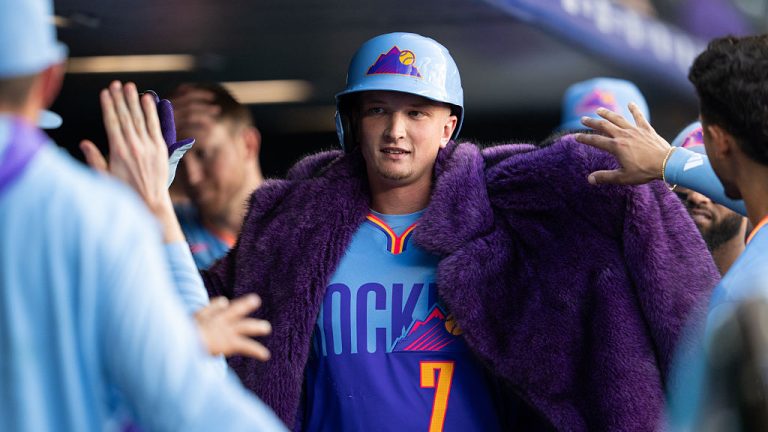
Todd Helton, a former first baseman and 2024 Hall of Fame inductee, spent all 17 of his major league seasons with the Colorado Rockies and easily established himself as the best player in franchise history.
The only problem is that Helton hasn’t played since 2013, and the Rockies have struggled to find a consistent, long-term option at first base. The organization has seen solid individual performances over the years, but no one has stuck around for the long haul.
Since the 2014 season, the Rockies have cycled through plenty of first basemen, including Justin Morneau (2014), Ben Paulsen (2015), Mark Reynolds (2016-17), Ian Desmond (2018), Daniel Murphy (2019-20), C.J. Cron (2021-22), Elehuris Montero (2023), and Michael Toglia (2024-25).
A majority of the eight players mentioned above put up solid numbers during their brief time with the ball club, but none of them really stood out as a core first baseman to build a team around.
This season, the Rockies finally stumbled upon a young first baseman who quietly delivered an excellent rookie season and looks like a franchise anchor for years to come. Finally, they may have found a quality long-term option at first base.
TJ Rumfield might not be getting the attention he deserves, considering he put together a rookie campaign worth 3.5 bWAR, but he should be getting more hype in the National League Rookie of the Year race.
So where exactly did Rumfield come from, and how well did he fare in 2026?
Where Did TJ Rumfield Come From?
Rumfield, 26, was originally a 12th-round draft pick by the Philadelphia Phillies in 2021 out of Virginia Tech. However, the Phillies would end up being the first of three major league organizations he’d spend time with.
Just a few months after he was drafted, on November 19, 2021, the Phillies traded Rumfield along with left-hander Joel Valdez to the New York Yankees in exchange for right-hander Nick Nelson and catcher Donny Sands.
After just one minor league season within the Phillies organization, he went on to spend his next four minor league campaigns with the Yankees, a stretch that spanned from 2022 to 2025.
In 2022, his first year in the Yankees’ minor league system, he participated in the Arizona Fall League as a member of the Mesa Solar Sox, where he put together a really strong performance.
Across 17 games and 65 plate appearances, Rumfield hit for a superb .400 batting average and posted a 1.059 OPS. He logged seven doubles and one home run, helping him drive in 10 runs.
In fact, Rumfield’s entire four-year stretch with the Yankees organization, playing at all levels of the minors, went really well, as he showed he could put up consistent numbers.
He demonstrated an excellent ability to hit for average and provide respectable power while maintaining a professional approach at the plate.
| 2022 | 2023 | 2024 | 2025 | |
| HR | 4 | 17 | 15 | 16 |
| RBI | 35 | 58 | 73 | 87 |
| AVG | .273 | .222 | .294 | .285 |
| OPS | .759 | .757 | .824 | .825 |
With all that being said, the Rockies front office took notice of Rumfield’s encouraging minor league performance and decided it might be worth taking a shot on the young first baseman.
They got it done on January 28 of this year, when the Rockies acquired Rumfield from the Yankees in a trade that sent right-hander Angel Chivilli back to New York.
After a full season of seeing what Rumfield could do at the major league level, he didn’t disappoint, to put it simply.
An Underrated and Underlooked Rookie Campaign
The Colorado Rockies organization and fanbase really didn’t know exactly what to expect from Rumfield entering his first season in the majors. He put up steady numbers in the minors but never established himself as a top prospect.
Rumfield proved this year that he’s a legitimate major leaguer and made his presence felt instantly. He cracked both the Opening Day roster and lineup, collecting the first hit and walk of his career in a road matchup against the Miami Marlins to get the Rockies’ 2026 season underway.
After the Rockies’ first game of the 2026 season wrapped up, Rumfield was sitting on a .333 batting average and .833 OPS. Who would’ve thought that, once the 2026 campaign was in the books, those numbers wouldn’t look much different?
Well, Rumfield’s batting average and OPS didn’t skip a beat throughout the season. Over 155 games and 631 plate appearances, he finished the year with a .300 batting average and .843 OPS.
Across the entire 2026 campaign, Rumfield did an excellent job of showing that he was a plus player in multiple aspects of the game.
He showcased his ability to hit for a high average, provide solid power, get on base at a high clip, and maintain excellent plate discipline, all while playing solid defense at first base.
Rumfield’s power profile is interesting because, while he collected an impressive 16 home runs, 30 doubles, and three triples, his underlying metrics in that department weren’t great. Nevertheless, his power numbers rank among the best in a very talented group of National League rookies.
Here’s how he fared against qualified National League rookies.
| 2B | 3B | HR |
| 1st (30) | 5th (3) | 6th (16) |
As mentioned previously, Rumfield’s power profile is interesting because his underlying metrics don’t really support the numbers he actually put up, as can be seen on the stat sheet.
This can be easily summed up by Rumfield’s expected slugging percentage, which sat below average at .386, ranking in the 38th percentile. That could partially be due to how hitter-friendly Coors Field is, but his home and road splits are very similar, as you’ll see later.
The reason for this is that he posted an 84.3 mph average exit velocity (2nd percentile), barreled up just 5% of the pitches he made contact with (22nd percentile), and managed only a 27.9% hard-hit rate (6th percentile).
Now, the best part of Rumfield’s offensive profile is his elite ability to make contact and get on base. He might not have the flashy home run totals typically expected from a first baseman, but he’s doing everything else right.
Rumfield made contact at an elite level this year, posting a 93.1% zone-contact rate, a 65.2% out-of-zone contact rate, and an 83.4% overall contact rate. All three marks rank exceptionally well and help explain his .300 batting average.
His .300 batting average ranks first among National League rookies and fifth overall in the National League, trailing only Nick Gonzales (.303), Otto Lopez (.305), Luis Arraez (.310), and Gabriel Moreno (.311).
On the other hand, Rumfield’s .390 on-base percentage again led all qualified National League rookies and, even better, led the entire National League. According to the Colorado Rockies’ X page, Rumfield became the first rookie in 100 years to lead the National League in on-base percentage.
It’s pretty impressive to see what Rumfield accomplished with his ability to make great contact and get on base at a very high clip. He’s been able to do that while also demonstrating an elite approach at the plate, resulting in great plate discipline.
While Rumfield does chase out of the zone at a slightly above-average 30.4% clip, he only whiffs on 18.8% of offerings, as previously mentioned with his great bat-to-ball abilities. As a result, he is striking out just 13.6% of the time (90th percentile) while drawing walks at an 11.4% rate (80th percentile).
All of this contributes to the fact that Rumfield was worth 29 batting run value, a mark that ranks in the 96th percentile. His offensive run value ranked 12th among all qualified hitters, which is really impressive. It’s also the highest mark among all qualified rookies.
That pretty much wraps up Rumfield’s excellent offensive abilities, but he was also really strong defensively at first base. He posted two outs above average, which ranks in the 81st percentile, and was worth three fielding run value, ranking in the 69th percentile.
In summary, Rumfield posted a very strong rookie season. The only question is whether he’ll be able to compete with the other impressive rookie names in his class.
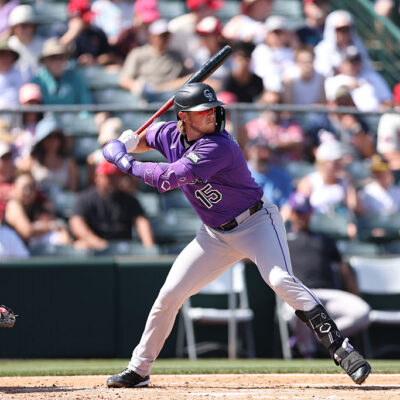
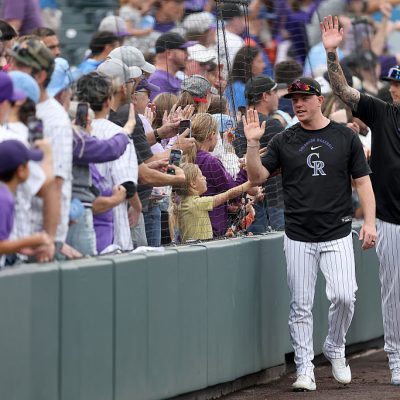
Does TJ Rumfield Have a Shot at National League Rookie of the Year?
Even though Rumfield put up an excellent and shockingly overlooked rookie campaign, it still seems unlikely that he’ll take home National League Rookie of the Year honors when it’s all said and done.
In the latest National League Rookie of the Year poll published by MLB on August 5, JJ Wetherholt and Sal Stewart tied for first with 144 total votes, followed by Nolan McLean with 100 votes and Rumfield in fourth with 57 votes.
If you rank the top National League rookies by WAR produced, according to FanGraphs, the order is almost exactly the same: Wetherholt (4.6), Benge (4.3), McLean (3.5), and Rumfield (2.5).
Rumfield is considered a dark horse to take home the hardware, but that doesn’t mean his efforts in 2026 shouldn’t be appreciated. That’s what this article was meant for — simply showing appreciation for his performance.
What he was able to accomplish this year was super impressive and shows that the Rockies finally have a young first baseman who can anchor the position for a long time.
Become a Member of Just Baseball
Subscribe and upgrade to go ad-free!
* Save 25% by subscribing annually.

Written by
Cade Lalim is a freshman at Irvine Valley College. He's currently a writer at Just Baseball, covering the Los Angeles Angels and various other topics, while…