
5 Standout Top Prospects To Watch in the All-Star Futures Game
Here's a quick look at some noteworthy names with exciting tools to watch during this year's Futures Game.
On Sunday, July 12, the baseball world will get to see MLB’s top prospects face off in Philadelphia.
Ranging from consensus top-10 prospects to up-and-coming top-100 names to those on the verge of breaking through, the All-Star Futures Game gives a glimpse into the stars of the next generation.
Just on this year’s All-Star roster, 14 players participated in the Futures Game this decade, with Bobby Witt Jr., Junior Caminero, and CJ Abrams starting the game.
This sample doesn’t capture the countless award-winners, future All-Stars, and everyday regulars on all 30 rosters around the league. Per MLB.com, 86.8% of all Futures Game participants have played in at least one MLB game, and 21.3% have been named All-Stars.
By this time, the public has already been exposed to the talents of top-10 prospects Jesus Made, Leo De Vries, and Seth Hernandez, plus 2025 number one overall pick Eli Willits and last year’s Futures Game MVP Josue De Paula, but all of the selected participants have their individual appeals.
It’s not enough to just have name value; you need exciting traits to stand out in a single seven-inning game. Here’s a look at five noteworthy names with standout tools to watch during the Futures Game.
Stats recorded prior to play on July 9.
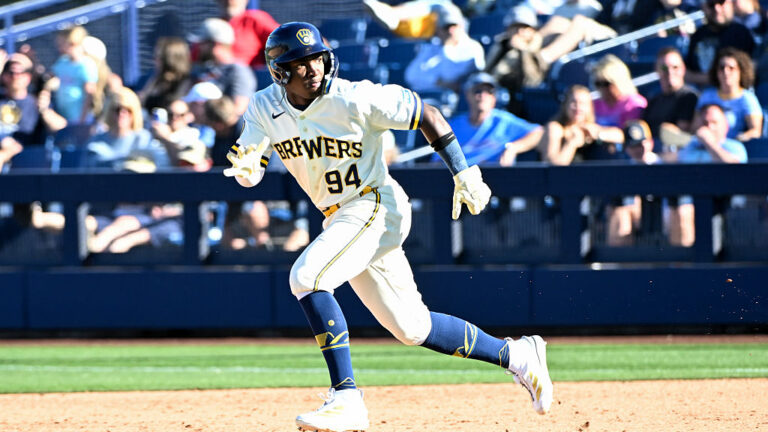
SS Luis Pena, Milwaukee Brewers
Pena was one of the bigger breakout names last season, slashing .308/.375/.469 alongside Made as an 18-year-old in full-season ball. He would struggle upon his promotion to High-A, but has recaptured some of his success this season, and the hit tool remains one of the more potent tools in the lower minor leagues.
Just 5-foot-11, 185 pounds, Pena is as twitchy as they come, leveraging his lower half to generate as much force as he can through the baseball. The result is plus raw power projection from an undersized middle infielder, already exceeding 110 mph exit speeds as a teenager, already peaking at 114 mph.
To add on to his prodigious power potential, Pena never swings and misses in the zone, creating one of the more potent offensive profiles in the minor leagues. He does chase a hefty amount, though that’s not as big a knock in a single game, as he’s sure to get the game moving.
On top of his bat, Pena will be the fastest player on the field at any given time. Pena has stolen 19 bags through 30 games this season.
OF Edward Florentino, Pittsburgh Pirates
If you were to place a bet on who would hit a home run in the Futures Game, Florentino may be the safest pick. Over the past two years, in his age-18 and 19 seasons, Florentino has hit 30 home runs in 142 games – ridiculous game power for a teenager.
The lanky 6-foot-3 lefty swings a whippy barrel geared to lift, running a 55.5% air rate and 23% air-pull rate at High-A, paired with exit velocities consistently north of 100 mph.
Florentino didn’t need much time in Low-A this season, slugging .750 with three home runs in nine games, and has seen some success during his promotion. Lauded for his hit-power combination last season, whiff has crept in, dropping his contact rates into fringy territory, as opposed to the above-average outlook he displayed.
Still, Florentino is two to three years younger than the average player at the level, and the game power projection has remained plus.
RHP Caden Scarborough, Texas Rangers
A pop-up name last season as a former sixth-round pick, Scarborough flashed improved command with a killer fastball-slider combo, good for a 2.45 ERA and 27.1 K-BB% over 88 innings across Single-A and High-A. After coming back from surgery to remove a melanoma, Scarborough has picked up right where he left off.
Carrying a lanky 6-foot-5 frame, Scarborough extends well and delivers from a low three-quarters arm slot, making his big two-plane fastball play extremely well at the top of the zone. It rests around 94-96, exhibiting immense arm-side run and moderate carry.
Off it is a big low-to-mid 80s sweeper that’s been a nightmare for opposing batters, righties in particular. It’s a sharp breaker approaching 3,000 rom that induces chase and freezes in-zone. He commands both offerings well, and is dominant when he’s up at the top rail with the fastball and glove side with the sweeper.
His changeup profiles well with killed spin and vertical break, though he’ll need more feel for the offering. Expect a flurry of ugly swings on Sunday.
LHP Liam Doyle, St. Louis Cardinals
High heat is fun, and Doyle brings that in spades. The Cardinals’ fifth overall pick last summer may have the best fastball in the minor leagues, and will have it on full display in his inning of work.
Doyle’s four-seam averages 96 mph, capable of reaching triple digits, commonly north of 20 inches of iVB. He’ll pepper the top of the zone, giving him a flat vertical approach angle despite more of a stock release, generating elite whiff rates with the pitch. It’s every bit of a 70-grade offering.
But Doyle hasn’t generated the best of results, rocking a 5.46 ERA, primarily due to his lack of a reliable secondary. His mid-to-upper 80s baby sweeper/cutter shape has gotten nice results, but he doesn’t have much feel for his bigger slider and splitter. He’s attempting to mix in his secondaries more often, to inconsistent results, though he’s still striking out 29.6% of batters.
There’s an elite fastball foundation with a high ceiling as a starter, but if it doesn’t work out, Doyle has the makings of a high-leverage relief pitcher.
SS Xavier Neyens, Houston Astros
Labeled with 70-grade raw power as a high schooler, Neyens’ first pro home run left the bat at 116 mph, and he’s only continued to heat up, posting a 1.137 OPS with eight home runs in his last 26 games.
It’s an ultra-physical frame and imposing figure from the left side, employing a big leg kick and lofty stroke to produce power to all fields. He’s on the ground more than he should, due in part to his pitch selection, and he doesn’t make the most of his double-plus juice with his batted ball distribution, not commonly taking balls to the pull side.
Neyens produces some pretty shots when he does turn on a pitch, though. The approach is extremely passive, swinging under 30% of the time, though it’s led to an 11% chase rate and 26.8% walk rate. The hope is he’ll be more inclined to pull the trigger in an exhibition game on the national stage.
Become a Member of Just Baseball
Subscribe and upgrade to go ad-free!
* Save 25% by subscribing annually.

Written by
Landon is a recent high school graduate, currently 18 years old, studying Media and Cultural Studies at UC Riverside. He excels with data analysis inside baseball…