
The Rangers Could Win the Offseason if They Decide To Trade Assets
Sometimes, the best way to move forward is to take a step back first. For Texas, this offseason may be the time to do exactly that.

It was September 27, 2026. Game 162. The Texas Rangers had been eliminated from playoff contention, while their in-state rival, the Houston Astros, clinched the American League West. For most teams, falling just short of the postseason, especially with a division title within reach, would reinforce a familiar offseason mentality: “We’re close. We just need one more piece.”
But with this being their third consecutive season failing to finish with a record above .500, the mindset in Arlington might need to be different this winter.
The truth is, a playoff berth would have done little to change the bigger picture for the Rangers. It would have been putting lipstick on a pig for an organization coming off a disappointing 2026 campaign and one that, despite winning the World Series in 2023, has struggled to consistently meet expectations at the major league level since hoisting the trophy.
Over the past several years, the transactions orchestrated by President of Baseball Operations Chris Young have reflected a clear mentality: win now and sacrifice the future. Whether it was trading five prospects for MacKenzie Gore last offseason, signing veteran bat Joc Pederson to a three-year deal in the 2024 offseason, or making a smaller, less notable move like acquiring Jake Burger for three prospects in December 2024, the approach has remained largely the same.
Everything the Rangers have done over the past several years has been geared toward one goal: recapturing the glory and success of 2023.
But at what point does that approach need to change?
Rather than treating this offseason as another opportunity to make incremental upgrades in hopes of getting over the hump, perhaps it’s time for Texas to take a harder look at its roster and consider whether trading away some valuable assets could put the organization in a better position for the future. Instead of continuing to sacrifice tomorrow for another shot at yesterday’s success, the Rangers may need to recognize that the best path back to contention could involve taking a step back before moving forward.
If Chris Young and the Rangers’ front office do choose to explore the possibility of selling this winter, what would that look like? If the Rangers are serious about changing direction this offseason, they need to identify which players hold the most trade value and determine whether keeping them makes sense for the organization’s future. With that in mind, here are the players Chris Young should consider moving this winter.
The Texas Veterans
Despite struggling to reach .500 over the past few years, the Rangers have a roster that, on paper, resembles that of a World Series contender when it comes to veteran talent. Both sides of the ball feature established players with impressive resumes who are still performing at a high level. However, that combination of age, production, and expensive contracts could also present Texas with an opportunity to reshape its roster.
The Batman and Robin of the rotation, Jacob deGrom and Nathan Eovaldi, are both on the wrong side of 35 and will enter the offseason with a combined age of 74. The duo also combined to make $67 million in 2026, a significant financial commitment for an organization coming off a disappointing season. Despite putting together respectable campaigns and continuing to pitch effectively, their age and salaries have to be weighing on the minds of the Rangers’ front office as it evaluates the future of the rotation.
Both deGrom and Eovaldi have just one year remaining on their current contracts, making them intriguing options for contenders looking to add an established, reliable starter to their rotations. For Texas, moving either pitcher could provide an opportunity to recoup valuable assets before they reach free agency.
The lineup presents a similar situation. Two of the Rangers’ middle-of-the-order bats, Corey Seager and recently acquired Brandon Nimmo, bring their own questions regarding age, salary, and the organization’s long-term direction.
Both players are still productive, but what role would they serve on a team looking to rebuild or retool? Seager has been in Texas since signing ahead of the 2022 season and was a central figure in the club’s World Series run. Nimmo, meanwhile, has only recently arrived after nearly a decade with the New York Mets. Both have established themselves as important pieces, but their place on the roster becomes a more complicated question if the Rangers decide to shift their focus toward the future.
Unlike deGrom and Eovaldi, however, Seager and Nimmo would be much more difficult to move. Nimmo has four years remaining on his contract, while Seager has five, with both deals carrying significant financial commitments into the players’ late 30s. Those contracts could limit the number of interested teams and the return Texas could realistically expect.
Still, the potential long-term benefits of exploring a trade for either left-handed slugger may outweigh the risks. Age-related regression is an unavoidable consideration, and there is a legitimate question of whether the Rangers’ current competitive window aligns with the timeline of their veteran core. If the organization believes a retool is necessary, moving one of these players could bring back younger talent and provide greater flexibility moving forward.
Of course, trading away four established veterans is much easier said than done.


All four players possess no-trade clauses, giving them significant control over their respective futures. These clauses can allow players to block trades to certain teams or, depending on their desire to remain in Texas, prevent a move altogether. In other words, even if Chris Young decides that trading one of these veterans is in the organization’s best interest, the player will have the final say.
At the trade deadline, reports surfaced that a potential Jacob deGrom trade to Atlanta involving Spencer Strider was being discussed before deGrom ultimately nixed the deal by exercising his no-trade clause. That situation illustrates the challenge Texas could face this offseason. Moving these players may require a collaborative process involving the front office, the players, and their agents. Even then, there is no guarantee a deal gets done.
Ultimately, this creates a difficult situation for Chris Young as he looks to reshape the roster and get younger. The Rangers have four potentially valuable trade chips, but their contracts, ages, and no-trade clauses complicate matters. If Texas is serious about changing course, Young will have to balance what makes sense for the organization with what these players are willing to accept.
Mackenzie Gore

The biggest move by the Rangers’ front office during the 2025 offseason was a trade they made with the Washington Nationals on January 22, 2026. To that point, the Rangers had been reasonably quiet, coming off an 81-81 season without seeming to have picked a direction, whether that meant pushing toward contention or beginning a retool. It was on that day in January that they made their direction clear, trading for the crown jewel of their offseason, left-handed pitcher MacKenzie Gore.
Gore was coming off some turbulent years in Washington as he entered his fifth major league season. He was an incredibly polarizing asset for the Nats, as he would often flash top-of-the-rotation-caliber ability and then just as often show an inability to get outs efficiently. When the dust settled, Gore consistently found himself with an ERA around 4.00 despite the ups and downs he experienced.
The sentiment from the Rangers’ front office was that bringing him to Texas and away from the tumultuous organization the Nationals had been throughout the 2020s would likely result in more consistent production from the left-hander.
Frustratingly, however, it does not seem as if the Rangers’ new pitching coach, Jordan Tiegs, had the key to unlocking MacKenzie Gore’s potential.
The 2026 season marked a career-worst campaign for Gore, who posted a disappointing 4.58 ERA while issuing a career-high number of walks and recording a career-low strikeout rate per nine innings. Rather than taking the next step in his development, the former first-round pick appeared to regress, doing little to improve a Rangers rotation that needed him to make an immediate impact.
Now, Texas faces an important decision. With 2027 representing Gore’s final year of team control, the organization must determine whether he remains part of its long-term plans or whether his disappointing first season in Arlington has given Chris Young enough reason to move on.
If Young and the front office believe the latter, they should act sooner rather than later. Unlike the veteran players discussed previously, Gore does not have a no-trade clause, giving Texas greater control over where he could be moved and making him a more straightforward trade candidate.
Of course, Gore’s value has taken a hit. With just one year of team control remaining and a disappointing 2026 campaign behind him, the Rangers are unlikely to receive the same return they gave Washington for his services last year. Nevertheless, his value should not be nonexistent.
Quality starting pitching remains in high demand across the big leagues, and there are undoubtedly organizations that still believe they can unlock the potential that made Gore such an intriguing prospect in the first place. For Texas, the question is whether it makes more sense to give him another year to figure things out or capitalize on whatever trade value remains before the opportunity disappears.
Josh Jung
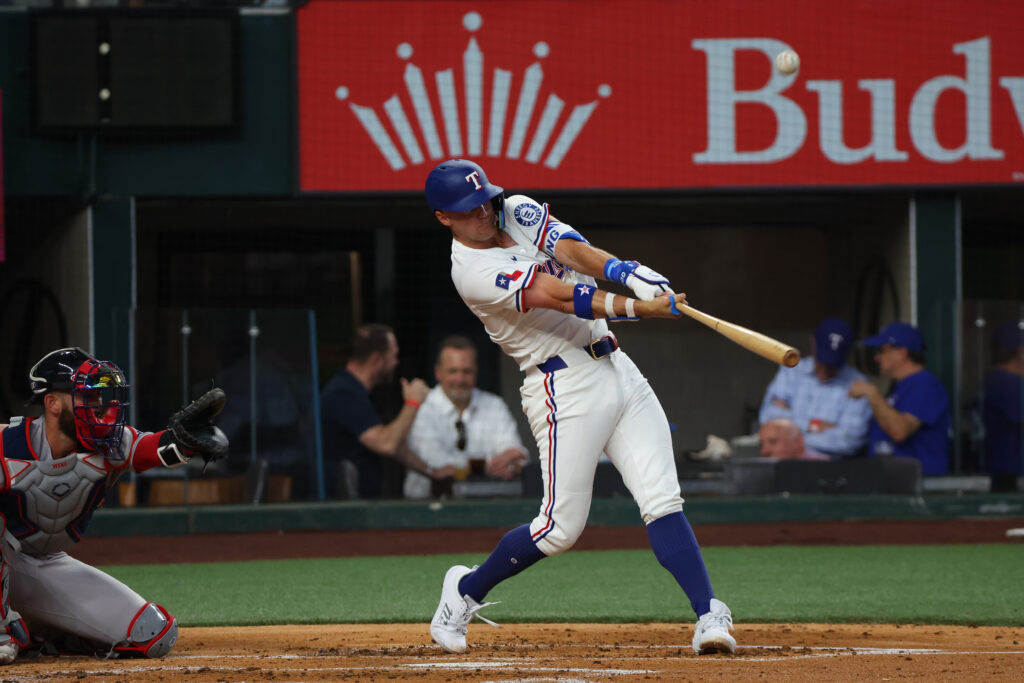
Another former first-round pick rounds out the list of potential trade candidates for Texas as the Rangers head into the 2026 offseason: third baseman Josh Jung.
Selected eighth overall in the 2019 MLB Draft out of Texas Tech, Jung was a highly touted prospect with the kind of offensive upside Rangers fans could dream on in the early 2020s. He was viewed as a potential middle-of-the-order bat who could anchor the hot corner for the next great Rangers team.
Thankfully for Texas, that dream didn’t take long to become a reality. Jung played a vital role in the franchise’s championship run in 2023, finishing fourth in American League Rookie of the Year voting after an impressive regular season before continuing to rake in the playoffs. He posted an .867 OPS and launched three home runs during the Rangers’ run to a World Series title.
Rangers fans and the front office had every reason to believe the future was bright for their young third baseman. At the time, Jung looked to be a fixture in the middle of their order for the better part of the next decade.
However, baseball is a game of ups and downs, and that has certainly been the case for Jung since the championship. The following two seasons were riddled with injuries, and when he did take the field, he struggled to find consistency at the plate. In a relatively short period, the conversation around Jung shifted from viewing him as a potential franchise cornerstone to questioning whether he should remain part of the organization’s long-term plans.
Entering 2026, those questions were louder than ever. Coming off an underwhelming .684 OPS, Jung desperately needed a bounce-back season to reestablish himself as a key piece of the Rangers’ future.
Thankfully for Jung, that bounce-back season arrived in 2026.
The third baseman slashed .299/.365/.462, offering a glimpse of the hitter Texas envisioned when he first arrived in the majors. He was one of the few bright spots in the Rangers’ lineup and emerged as a particularly dangerous hitter against left-handed pitching, giving the organization reason to believe his bat could still be a valuable part of its future.
The caveat, however, was his ability to stay on the field. Jung suffered a left calf strain in July that forced him to miss much of that month and all of August. After returning, he fractured his right hand in September, effectively ending his season. So, while his production at the plate suggested a return to form, the injury concerns that have followed him throughout his career remained very much alive.
The Rangers have two more years of control over Jung, who enters his second year of arbitration this offseason before becoming eligible for free agency following the 2028 season. That combination of cost control, offensive upside, and a strong 2026 campaign could make him an attractive trade target for other organizations. Unlike the veteran players discussed earlier, Jung also lacks a no-trade clause, giving Texas greater flexibility to explore potential deals.
Out of all the names mentioned in this article, Jung might present the Rangers with their most difficult trade decision. His 2026 rebound makes him more valuable, but his injury history makes it harder to know whether Texas should trust him as its long-term answer at third base. Are his injury concerns and struggles prior to 2026 enough reason to move on from him? Or do the Rangers feel that his injury concerns are a thing of the past and that he will be able to build on his success over a full season moving forward?
Regardless of where they land, Jung deserves to be part of the conversation as Texas evaluates the direction of its organization. If the Rangers decide to move assets this offseason, he could be one of their more intriguing trade chips, allowing them to capitalize on his recent resurgence and potentially bring back the young talent needed to build their next contender.
Final Thoughts
In an offseason expected to be filled with uncertainty, from CBA negotiations to questions surrounding the direction of numerous teams across Major League Baseball, the Rangers need to establish a clear path forward. After three consecutive seasons without a winning record, it may be time for Texas to retool its roster with younger talent and move on from players who may not fit into the organization’s next window of contention.
Chris Young and the rest of the front office need to have difficult conversations about each of the players mentioned above, as well as others throughout the roster. No potential trade should be off the table if it presents an opportunity to improve the organization’s long-term outlook.
With a weaker-than-usual free-agent market, teams around the league may increasingly turn to the trade market to address their needs. Fortunately, the Rangers have several intriguing assets who could appeal to clubs looking to improve their major league rosters. If Young and his staff are willing to explore those opportunities, Texas could turn its current roster into a valuable foundation for the next generation of Rangers baseball.
Rather than remaining mired in mediocrity while chasing the success of 2023, the Rangers need to recognize that the path back to contention may require difficult decisions and a willingness to change course. Sometimes, the best way to move forward is to take a step back first. For Texas, this offseason may be the time to do exactly that and begin building a team capable of bringing another championship to Arlington.
Become a Member of Just Baseball
Subscribe and upgrade to go ad-free!
* Save 25% by subscribing annually.

Written by