
Is Now the Time for the Red Sox To Move on From Trevor Story?
Entering the final year of Trevor Story's contract, the Red Sox front office is at a crossroads. What should Boston do with its 33-year-old shortstop in 2027?
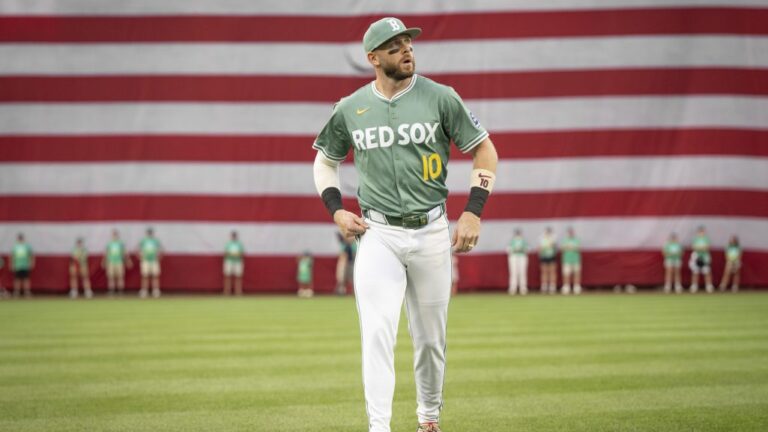
The Trevor Story experience has been a whirlwind for Boston Red Sox fans. When he initially signed in Boston, Story was a hot commodity hitting the free-agent market one season before a mass exodus of the game’s top shortstops.
Boston, knowing then-SS Xander Bogaerts had just one season left on his contract, signed Story to be its second baseman for a season before transitioning back to shortstop. This six-year, $140 million contract has resulted in an injury-riddled stretch of highs and lows.
Through the first five years of this contract, Story has only played 100 or more games once. That was in 2025, when he played in 157 games and produced a 4.1 rWAR. But after a 2026 campaign in which Story played only 64 games and posted a 75 OPS+, it has become more difficult to justify a spot on the 26-man roster.
Entering the final year of Story’s contract, the Red Sox front office is at a crossroads. On one hand, Story is a veteran clubhouse presence who has produced a 3.5 rWAR per 162 games. If he stays healthy, there’s an argument that he’s an above-average shortstop compared to the rest of the league.
However, Story has also failed to produce an OPS+ higher than 107 in any of his five seasons in Boston. While he did steal 31 bases in 2025, it’s also fair to wonder how age could impact Story’s agility on the basepaths.
The final factor in this decision-making process is a potential lockout. Negotiations between the owners and Players Association have included talks of a salary cap or salary regulations. While a salary cap is reportedly a non-starter for many players, the possibility of further salary regulations may be a factor to consider with Story’s hefty contract.
The Red Sox have five distinct ways to move forward with Trevor Story entering 2027. Let’s explore each option.
Option 1: Trade Him
If the Red Sox hope to make a splash in free agency, there’s a strong chance that one of their larger contracts will need to be offloaded. This could be Masataka Yoshida, Trevor Story, Jarren Duran, or some combination of these players.
The problem is that Story’s current value doesn’t command a huge market. There might be a suitor via trade, but teams are not exactly lining up to make that deal.
A Trevor Story trade would also likely require one of two things: either the Red Sox continue to take on a large portion of his contract, or they offload a prospect to balance out the financial concerns.
While the Red Sox would likely not receive more than a depth piece in return for Story, the ability to lower their overall payroll is enticing. The major question centers around which prospect would need to be included to make the deal worthwhile for another team. With the level of pitching depth already in the Red Sox farm system, chief baseball officer Craig Breslow may see a player like Juan Valera or Sadbiel Delzine as movable alongside Trevor Story.
Ultimately, the decision to keep or trade Story boils down to two major factors. First, when will Franklin Arias be ready to become an everyday player? Second, how big of a splash is Breslow looking to make, and how much money can he spend?
Option 2: Keep Him on the Roster
This is easily the simplest option on the list, but it does require a level of faith that Story can return to his 2025 form. Depending on the depths of John Henry’s pockets, it also may hamstring Boston’s front office into keeping a stagnant roster rather than spending on a free-agent bat.
For those who followed the Red Sox closely in 2025, however, there is a level of faith in Trevor Story’s ability to anchor a lineup. There just remains the same hesitancy about his health.
While Boston operated with plenty of backup options in 2026, there is no solidified star at the major league level. Arias has the highest ceiling, but he has yet to play a game in the big leagues. Nick Sogard looked strong in a small sample, but will likely stay at second base. Andruw Monasterio and Anthony Seigler were streaky backup options, and Isiah Kiner-Falefa is now a free agent.
Despite the inherent injury risk, with no proven replacement, the safest bet might be to keep Story around until Arias develops. If Story looks like a four-win player again, he or Arias could shift to second, sliding Monasterio or Sogard into a bench role for the last year of Story’s deal.
Breslow certainly has a wide array of options to explore. If the right deal presents itself, Story could be traded, but in many ways, the oft-injured bat is one of the safest players to have on a roster full of developing infielders.
Option 3: Release Him
This is a far less likely option, as it would set an ugly precedent for future players looking to sign long-term contracts in Boston. While it wouldn’t be the first time the Red Sox have operated this way, it’s hard to imagine this happening without a major clubhouse controversy.
Ultimately, though, Story’s trade market may be very tough to capitalize on, with teams hesitant to take on additional payroll in an uncertain environment. If the season is delayed due to a lockout or new payroll measures come into place, the Red Sox may not have an avenue to trade Story.
If the 2027 season continues with Story struggling at the plate and a prospect like Franklin Arias forcing his way into an everyday role, the Red Sox may be left with no choice but to release the aging veteran.
Option 4: Phantom IL for Coaching and Depth
While Story’s on-field contributions in Boston were minimal during an injury-riddled 2026 campaign, his training camps have played a part in developing the defensive skills of young infielders.
These camps, typically run before the start of spring training, have cemented Story’s role as a leader and mentor within the Boston clubhouse. It also makes him a natural fit for a defensive coaching role, such as an infield coordinator.
From a strategic standpoint, it would benefit the Red Sox to have Story around as a coach, even if there are doubts about the level of on-field production he can provide.
This is not a likely option, and even if the front office deems it best, the fans would never know. It’s not as if general managers ever truly reveal whether an injury is real or not.
Option 5: Create a Coaching Role
The last option is certainly the least likely, but the Ian Kinsler treatment could be an option. After the first year of a two-year contract with the San Diego Padres, the then-37-year-old Kinsler moved into the team’s front office.
Story will be 34 on Opening Day. There’s certainly an argument that he would rather try to make another big league roster before he hangs up his cleats and becomes a coach. Story’s experience working with players at a hands-on level also makes him a more natural fit as an on-field coach than as a front office special advisor.
This is admittedly a fairly unlikely solution, especially for a player who is only one year removed from a four-win season. Story could certainly become a coach in Boston after his eventual retirement. That retirement, however, is likely more than one season away.
Become a Member of Just Baseball
Subscribe and upgrade to go ad-free!
* Save 25% by subscribing annually.

Written by
Gabe Shumway is a prospect writer for Just Baseball. He is a student at Northwestern University studying Journalism and Environmental Policy, and can be seen or…