
Red Sox Stock Watch: Where Every Key Player Stands Headed into 2027
Let's take stock of every notable Boston Red Sox player and where they might fit into the team's 2027 puzzle.
At first glance, it may appears like the Boston Red Sox have a fairly simple offseason in front of them.
Other than veteran starting pitcher Sonny Gray, every single significant member of the 2026 team is under contract for 2027. This includes trade deadline acquisition Adley Rutschman, who will now take over the lion’s share of the catcher duties from the ineffective first-half combination of Connor Wong and Carlos Narvaez.
With Garrett Crochet, Curtis Mead, and Roman Anthony set to return from injuries that kept them off the field for most of last season, the Red Sox could twiddle their thumbs all winter and still enter 2027 a better than they ended 2026.
Dig a little deeper, however, and you will see a roster filled with question marks and what-ifs. The 2026 Red Sox had such distinct and contrasting chapters, from the 32-46 disaster through June to the historic 32-5 run in July to the hobbled, .500 output in August and September, that it’s nearly impossible to project what they will be moving forward.
What we do know is that the end result wasn’t good enough, as their offense once against provided little resistance against the Yankees top starters in their second-straight Wild Card defeat to their archrivals.
The Red Sox’s deep pitching staff and elite defense gives them a high floor as a playoff team, but there is a lot of work to be done to build a roster capable of winning their first AL East title since 2018.
With just a few weeks until the start of free agency, now is a good time to take stock of where the Red Sox roster stands heading into free agency. In this article, we’ll recap every key player’s 2026 performance and project what their role might be in 2027.

Franchise Cornerstones
SP Payton Tolle
- Regular Season Stats: 26 GS, 148.2 IP, 3.03 ERA, 3.04 FIP, 2.4 BB/9, 10/4 K/9, 2.9 bWAR
- 2027 Age: 24
- Contract Status: Through 2031
The best development of the 2026 season was undoubtedly the progression of Payton Tolle. From beginning the year in Worcester to starting Game 1 of the postseason, Tolle exceeded any and all expectations which, coupled with his infectious personality, made him a fan favorite.
As good as the surface-level numbers are, the underlying metrics suggest they could have been even better. His 2.70 xERA trailed only Jacob Misiorowski and Max Fried among qualified starting pitchers, while his .199 xBA also ranked inside the top five.
Tolle still has a few boxes to check to become a true number one starter. He struggled to sustain his velocity deep into his outings, often starting in the upper-90s and dropping to the mid-90s by the third or fourth inning. The Red Sox pulling Tolle after just 83 pitches in Game 1 of the Wild Card Series continued the trend of how they used him during the regular season, as they frequently limited him to around 90 pitches and never had him top the century mark in any of his 26 starts of the season.
And while Tolle’s curveball was far better than it was during his initial MLB salvo, holding batters to a .108 expected batting average and generating a 43.4% whiff rate, he only threw it 9.3% of the time. There were a number of starts in which Tolle simply lost confidence in the pitch, allowing hitters to lock in on his fastball-sinker-cutter combination.
That said, Tolle has shown he can adapt on the fly, and it’s not inconceivable he could make a Cam Schlittler-type leap with another offseason of development. And even if that is too big an ask, his 2026 performance firmly cemented his place as a foundational piece of the team moving forward.
SP Garrett Crochet
- Regular Season Stats: 6 GS, 30.0 IP, 6.30 ERA, 4.30 FIP, 3.3 BB/9, 11.1 K/9, -0.5 bWAR
- 2027 Age: 28
- Contract Status: $28.33 AAV through 2031, $15 million club option for 2032
Garrett Crochet’s nightmare second season in Boston had one final, unexpected twist of the knife. After missing over five months with shoulder inflammation, Crochet worked his way back in time to be part of the Red Sox postseason roster…. only to allow four straight batters to reach base and walk off the mound without recording an out.
From a long-term perspective, the most important thing to come out of the game was that Crochet looked far closer to the Cy Young runner-up version of himself than the guy who posted a 6.30 ERA over his six starts in April:
4/27 vs Orioles:
- Four-Seam Fastball Velocity: 95.7
- Sinker Velo: 94.6
- Sweeper Velo: 83.7
9/30 vs Yankees:
- Four-Seam Fastball Velocity: 97.3
- Sinker Velocity: 96.9
- Sweeper Velocity: 85.3
The shorter stint undoubtedly helped Crochet’s stuff play up, but it was still an encouraging sign for a guy who hadn’t pitched in a live game since April.
Of all the injuries the Red Sox suffered in 2026, none were more impactful than the loss of their ace. The initial thought may be that the Red Sox didn’t miss him that much because their pitching staff still ranked third in MLB in ERA, but every issue they had with the staff could be traced back to the absence of Crochet.
Having to effectively replace him with Patrick Sandoval was the most obvious side-effect, but there was a trickle-down effect that isn’t being talked about enough. The lack of a true innings-eater began to show itself in the second half. Jake Bennett regressed significantly after a dominant June and July; Tyron Guerrero, Garrett Whitlock and Justin Slaten all landed on the injured list, and Ranger Suarez posted a 5.01 ERA in his first seven starts after being activated from the injured list.
Even if Crochet is closer to the 175 innings mark than the league-leading 205 frames he tossed in 2025, he will still take a ton of pressure off the rest of the staff. The Red Sox will be able to better manage Tolle and Bennett’s innings coming off career-high workloads, give Suarez a breather when the seemingly inevitable leg injuries crop up, and put less pressure on a late-inning relief corps that will feature a 39-year-old Aroldis Chapman, 36-year-old Guerrero, and the oft-injured Whitlock and Slaten.
As good as it was to see Crochet return to the mound in 2026, it was also a sober reminder of what they missed for nearly the entire season. You could also argue that the Red Sox never had Garrett Crochet all season, since the guy who made six starts in April looked nothing like the monster we saw in 2025.
Tolle, Suarez, Bennett, and Bello will all play a major role in the rotation, but none of them can fill the role Crochet filled in 2025. Any path for the Red Sox to be a serious World Series contender includes a healthy Crochet, one who is ready to take the ball on both Opening Day in March and Game One in October.
OF Roman Anthony
- Regular Season Stats: 55 G, 242 PA, 5 HR, 19 RBI, .245/.339/.396, 108 OPS+, 12.0 BB%, 27.3 K%. 1.3 bWAR
- Age: 23
- Contract Status: $16.25 million AAV through 2033, $30 million club option for 2034
Let’s begin with a stat, shall we?
Players with an average exit velocity above 92, a chase rate below 24%, and a strikeout rate below 30% (min 200 PA):
| Average Exit Velocity | Chase Rate | Strikeout Rate | |
| James Wood | 95.4 mph | 21.3% | 28.7% |
| Juan Soto | 92.6 mph | 20.9% | 13.5% |
| Jake Bauers | 92.1 mph | 21.7% | 27.0% |
| Roman Anthony | 92.0 mph | 23.7% | 27.3% |
| Lars Nootbaar | 92.0 mph | 20.7% | 21.0% |
Amid all the noise, criticism, and expectations, Roman Anthony is still a special hitter. There’s a reason why he was selected as the youngest hitter on Team USA and why he and Aaron Judge were the only two players to start every game.
This doesn’t mean that there aren’t still growing pains: His 27.3% strikeout rate would have ranked in the 13th percentile if he had enough plate appearances, and his struggles against left-handed pitchers were far more noticeable than they were in his rookie season:
vs LHP:
- 34.5% hard-hit rate
- .357 expected slugging percentage
vs RHP:
- 55.2% hard-hit rate
- .462 expected slugging percentage
Of course, these aren’t uncommon issues for a 22-year-old hitter, particularly one whose development has been interrupted by injuries, and there are far more reasons to be bullish on his offensive profile than bearish.
The much bigger concern is his ability to stay on the field, as he has already had four separate injuries in his short big league career that have occurred while swinging a bat:
- September 2, 2025: Strained oblique (Missed final 22 games and postseason)
- April 21, 2026: Upper back spasm (Missed four games)
- May 4, 2026: Torn finger ligament (Missed 103 games)
September 29, 2026: Re-aggravated finger injury and sprained other muscles in wrist (Missed rest of postseason)
Though Anthony was injury-free throughout his minor-league career, it’s fair to wonder whether something in his swing is leading to these injuries, especially with other Red Sox hitters like Triston Casas, Marcelo Mayer, Isiah Kiner-Falefa, and Mickey Gasper suffering similar swing-related issues.
Given the upside Anthony showed over his first two big-league seasons and the eight-year, $130 million contract he got last summer, the Red Sox must do everything in their power to figure out how to keep him on the field and at the top of their lineup.

Impact Veterans
SP Ranger Suarez
- Regular Season Stats: 28 GS, 148.1 IP, 3.22 ERA, 3.16 FIP, 2.8 BB/9, 8.5 K/9, 2.7 bWAR
- Age: 31
- Contract Status: $26 million through 2030
The consistency of Ranger Suarez was one of the few exceptions in a Red Sox season that saw little else go according to plan. After losing out on Alex Bregman, the Red Sox decided to dive deeper into their “run-prevention” philosophy by inking Suarez to a five-year, $130 million deal, and he delivered a season that was perfectly in line with his last two seasons in Philadelphia:
- 2024: 27 GS, 150.2 IP, 3.46 ERA, 3.37 FIP, 6.5 BB%, 23.2 K%
- 2025: 26 GS, 157.1 IP, 3.20 ERA, 3.21 FIP, 5.8 BB%, 23.2 K%
- 2026: 28 GS, 148.1 IP, 3.22 ERA, 3.16 FIP, 7.5 BB%, 22.9 K%
Other than some slight changes to his pitch mix, namely scaling back the usage of a changeup in favor of more fastballs, Suarez was largely the same All-Star caliber pitcher he has been since the start of the decade.
While it seems inevitable that Suarez will miss around five starts a year with some sort of lower-body injury (this year was a hamstring and a groin), he should remain one of the most overqualified number-three starters in the game and the perfect change-of-pace to the power arms of Tolle and Crochet.
- Regular Season Stats: 130 G, 535 PA, 27 HR, 81 RBI, .275/.386/.516, 153 OPS+, 11.0 BB%, 25.2 K%, 4.6 bWAR
- Age: 35
- Contract Status: $18.5 million for 2027, $20 million club option for 2028
Initially viewed as an underwhelming alternative to Pete Alonso, Willson Contreras proved to be the perfect acquisition on and off the field. A 7% increase in pull-air percentage helped the 34-year-old post career highs in home runs (27) and OPS (.901), the latter ranking second in the American League behind Yordan Alvarez.
Contreras’ fiery personality also helped set the tone for a team that seemed to sleepwalk through the first half of the season, and he slashed an incredible .311/.451/.600 with 7 home runs during the 32-5 stretch.
Contreras looked on track for an MVP-caliber season before succumbing to a hamstring injury that hampered his performance throughout August. Contreras missed the first 12 games of September, then missed 8 more at the end of the month after an errant Jakob Junis fastball bruised his right hand.
Without their biggest bat in the lineup, the Red Sox offense cratered, scoring a league-71 runs in September and receiving just six home runs from a right-handed hitter all month.
Even as Contreras enters his age-34 season, there are no indicators that he’s nearing the end of the road. His bat speed remained stable at an elite 77.0 mph, and both his barrel percentage (13.3%) and xSLG (.484) were above his career average. And even though Contreras’ average exit velocity dipped slightly from 2025, he offset it by significantly raising his average launch angle, leading to a career-high .376 xWOBA.
The question moving forward isn’t whether Contreras can remain a productive hitter, but whether the Red Sox offense can withstand his absence. Contreras has averaged just 119 games played since 2021, and while moving from catcher to first base has helped him stay in the lineup, he still missed 32 games last season due to a variety of ailments. This includes the aforementioned hand injury, which feels almost inevitable with how much Contreras leans over the plate.
Finding a second power bat to take the pressure off Contreras will obviously be a top priority for the Red Sox this winter, but it would also be prudent to find someone who can spell him at first base to prevent some of the nagging injuries that slowed him in the second half.
RP Aroldis Chapman
- Regular Season Stats: 53 G, 51.2 IP, 1.92 ERA, 2.50 FIP, 4.0 BB/9, 12.4 K/9, 2.0 bWAR
- Age: 39
- Contract Status: $13 million salary for 2027
How long can he keep this up? Aroldis Chapman is now approaching two decades as one of the game’s premier closers, and he still appears to have a lot left in the tank. He may not throw as consistently hard as he did in his twenties, but the development of his splitter and slider has made him a more complete pitcher, and he still has triple-digit heat in his back pocket when he needs it.
That being said, Chapman’s second season in Boston did not quite reach the historic heights of the first. His walk rate climbed from 6.6% in 2025 to 10.8%, still well below his career average, but ranking in the 19th percentile among all qualified pitchers. His BABIP, LOB%, and HR/FB ratio also veered in the wrong direction, leading to a 75-point increase in ERA and a 77-point increase in FIP.
The remarkably durable left-hander also showed rare signs of mortality, dealing with a nagging injury throughout the summer and missing a week at the end of the season with lat soreness. Neither of these issues put Chapman on the injured list, but they were a reminder of the risk that a 39-year-old pitcher with 17 MLB seasons under his belt carries.
The good news is that Chapman passed his end-of-season physical that guaranteed his 2027 contract at $13 million, a bargain compared to the contracts of other premier free-agent relievers. He may require more guardrails than he did a decade ago, but Chapman is a near-lock to outperform his contract for a third consecutive season.
RP Garrett Whitlock
- Regular Season Stats: 54 G, 60.2 IP, 1.72 ERA, 2.11 FIP, 1.5 BB/9, 10.1 K/9, 2.0 bWAR
- Age: 31
- Contract Status: $8.25 club option for 2027, $10.5 club option for 2028
For all the twists and turns of the last two seasons of Red Sox baseball, the one constant has been the back-end combination of Chapman and Whitlock.
Ranks among relievers from 2025-2026 (min. 100 innings pitched)
| ERA | WAR | FIP | |
| Aroldis Chapman | 1st (1.51) | 5th (4.2) | 4th (2.08) |
| Garrett Whitlock | 5th (2.03) | 5th (4.2) | 6th (2.15) |
Yet while Chapman took a minor step back in 2026, Whitlock became an even more indispensable cog in the Red Sox late-inning machine. An absurd 42.1% chase rate helped him cut his BB/9 in half from 3.0 to 1.5 while improving both his hard-hit rate and barrel %.
These feats become even more impressive when you consider all the various ailments Whitlock had to deal with this year, including two stints on the injured list with knee and elbow soreness. We also learned after the season that he pitched through an undiagnosed fractured tibia for most of September, a month in which he allowed didn’t allow an earned run over 7.1 innings (because he is Garrett Whitlock, after all).
Injuries have unfortunately been a major part of Whitlock’s story, as elbow and hip issues limited him to just 168.1 innings between 2022 and 2024. The Red Sox condensed his role even further in 2026, having him record four or more outs just once after doing so 16 times in 2025.
Though there have been some rumblings about Whitlock making a Michael King-esque transition back to the rotation, his track record shows that a one-inning relief role is the best chance of keeping him both healthy and productive:
As a Starter: 109 IP, 4.29 ERA, 1.27 WHIP, 8.4 K/9
As a Reliever: 257 IP, 2.35 ERA, 1.03 WHIP, 10.5 K/9
The Red Sox don’t need another league-average starter with injury concerns, particularly with the impending returns of Tanner Houck, Johan Oviedo and Kutter Crawford. What they need is a set-up man who can bridge the gap to Chapman in the ninth inning, and there is nobody in baseball more qualified for that than Whitlock.
Flawed Stars
OF Wilyer Abreu
- Regular Season Stats: 157 G, 681 PA, 24 HR, 76 RBI, .248/.327/.446, 117 OPS+, 10.4 BB%, 20.7 K%, 5.9 bWAR
- 2027 Age: 28
- Contract Status: Club control through 2029
To his credit, Wilyer Abreu answered the two biggest questions that had surrounded him through the early stages of his big league career. After three separate IL stints between 2024 and 2025, Abreu led the Red Sox with 157 games played and 681 plate appearances.
He also squashed the notion that he was just a platoon bat, improving his line against fellow southpaws from .205/.276/.328 over his last two seasons to .295/.375/.479 this season.
There were also a number of small steps forward in other areas, such as a three-and-a-half-point reduction in strikeout rate and a four-point increase in launch-angle sweet-spot percentage. All of this led to a career-high 5.9 bWAR, the fourth-highest total in the American League.
That said, it’s still hard to call Abreu’s season a total success. When Abreu is hot, he has the potential to carry an offense, but there were once again too many stretches where he was a complete non-factor offensively:
- April 11-April 21: 4-for-31
- June 24-July 9: 8-for-52, 0 HR, 19 K
- July 19-July 29: 3-for-39
- September 15-End of Season: 5-for-42
That end-of-season stretch was particularly concerning, as his anemic September carried over into a 1-for-7 line in the Wild Card Series. It felt like Abreu had run out of gas after seven high-pressure WBC games and 157 regular-season games, not to mention the energy it took to play the most difficult right field in baseball at a Gold Glove level.
Like so many of his teammates, injuries forced Abreu to take on a bigger role than he should have. The Red Sox were depending on him to be the second-best hitter in their lineup for 162 games, and that’s not the type of hitter he is.
Though Abreu’s insane hot streaks invoke memories of David Ortiz, his overall body of work is far closer to one of his right field predecessors:
Trot Nixon 1999-2003 averages: 3.4 bWAR, 28 2B, 21 HR, 76 RBI, 121 OPS+
Wilyer Abreu: 2024-2026 averages: 4.3 bWAR, 29 2B, 20 HR, 67 RBI, 117 OPS+
Nixon was a key cog in the Red Sox’s record-setting 2003 offense and 2004 World Series Championship team, but he rarely batted at the top of the order and served more as a complementary piece to the booming bats of Ortiz and Manny Ramirez.
While there is certainly a path for Abreu to take another leap, it’s unlikely he will ever be consistent enough to be a true centerpiece of an offense. Having him as a six-hole hitter would make the ups and downs easier to live with than if he batted cleanup, especially if he can sustain his Platinum Glove-caliber defense.

OF Ceddanne Rafaela
- Regular Season Stats: 138 G, 576 PA, 16 HR, 70 RBI, .283/.319/.442, 117 OPS+, 3.8 BB%, 20.3 K%, 5.7 bWAR
- 2027 Age: 26
- Contract Status: $6.25 million AAV through 2031, $16 million club option for 2032
There was a moment where it looked like Ceddanne Rafaela had made the leap into superstardom. Weeks removed from his first-ever All-Star appearance, the 25-year-old hit four home runs in a three-game set against the Dodgers, including two off Yoshinobu Yamamoto.
At that point, Rafaela was slashing a career-high .289/.328/.477 and ranked third among outfielders with a 3.9 fWAR, trailing only superstars Pete-Crow Armstrong and James Wood. Under the hood, however, flashing red lights suggested his offensive breakout was something of a mirage. He was outperforming his wOBA by a whopping 60 points, reflecting a .339 BABIP that didn’t line up with his batting data.
Sure enough, Rafaela hit a measly .262/.289/.326 with a single home run over the final two months of the season, marking the third time in three full MLB seasons that his offense fell off a cliff in the second half.
2024
- Through August 3: .258/.287/.420, 13 HR
- After August 3: .218/.242/.314, 2 HR
2025
- Through July 13: .271/.314/.483, 14 HR
- After July 13: .218/.268/.319, 2 HR
2026
- Through August 4: .289/.330/.478, 15 HR
- After August 4: .260/.282/.317, 1 HR
While it’s fair to wonder how much the quad injury that eventually forced him on the injured list played an impact in this particular collapse, Rafaela’s approach at the plate had begun to crumble even during his best offensive stretches:
Ceddanne Rafaela‘s Chase Rate by Month:
- March/April: 35.4%
- May: 33.3%
- June: 55.0%
- July: 45.4%
- August: 54.8%
- September: 46.7%
His second-half falloff foreshadowed his disastrous performance against the Yankees in the wild-card round, going 0-for-7 without a single hard-hit ball and a chase rate over 60%. In fact, Rafaela has gone hitless in all five of his career postseason games, making him just the third player and first position player since 2000 to go 15 or more postseason plate appearances without a hit.
Rafaela’s place as one of the best defensive center fielders in the game has never been in question, but as he enters his fourth full MLB campaign, it’s time to be honest about who he is as a hitter.
He will have stretches where he can put the offense on his back, but his approach and plate discipline will never be consistent enough to be more than an average-to-slightly-above-average hitter, and one that is extremely susceptible to elite pitching in October.
This doesn’t mean he can’t still be valuable, but it does mean he should never hit at the top of the order as frequently as he did in 2026. The Red Sox lineup is best when Rafaela’s offense is a bonus rather than a necessity, and their dependence on him as a miscast two-hole hitter was a major culprit of their offensive inconsistency in 2026.
Extension Necessity
C Adley Rutschman
- Regular Season Stats (w/BOS and BAL): .242/.315/.426, 13 HR, 60 RBI, 109 OPS+, 9.5 BB%, 16.6 K%, 2.6 bWAR
- 2027 Age: 29
- Contract Status: Free Agent after 2027
There are five factors that make Rutschman the most polarizing player on the Red Sox:
- The massive prospect capital it took to acquire him.
- His career is viewed as somewhat of a disappointment because of his draft pedigree.
- Most of his value comes on defense, which is much harder for the average fan to quantify
- He has been limited to just 189 games over the past two seasons due to injury
- His dreadful 1-for-17 start left a bad first impression, and his 1-for-8 postseason left a poor lasting impression.
While Rutschman’s standing with the fanbase is complicated, the organazation clearly views him as a true needle-mover on both sides of the ball. They would not have given up three of their top five prospects if they didn’t believe that, and it can be presumed that they would not have done so if they didn’t envision locking him up beyond 2027.
At this point in his career, the odds are against Rutschman meeting the expectations that come with being the first overall pick, and he may never match the 128 OPS+ he posted in his first two MLB seasons.
Yet even with injuries hampering his offensive production and limiting him to less than 100 games played in both 2025 and 2026, Rutschman has still been one of the most valuable catchers in the game over the past five seasons:
Rutschman’s catcher ranks since his debut on May 22nd, 2022 (min 1,000 plate appearances)
- fWAR: 3rd (18.1)
- Defensive runs: 6th (55.1)
- OBP: 7th (.339)
- wRC+: 8th (114)
- HR: 8th (74)
- xWOBA: 8th (.340)
His 2026 season also provided a number of encouraging signs, including a career-high 39.5 sweet-spot percentage and his highest wOBA and xwOBA since 2023. He also posted his best defensive metrics since his rookie season, ranking in the 93rd percentile in framing runs and throwing out a league-leading 21 of 62 would-be base stealers.
As a result, he was one of just six catchers to accumulate at least three fWAR despite playing in just 99 games. The state of the catching position around the game is necessary context when evaluating Rutschman, as there are very few backstops who can provide both above-average production at the plate and elite defense behind it.
Catchers with a wRC+ over 100 and Fielding Run Value above 10 in 2026
| WRC+ | Fielding Run Value | |
| Dillon Dingler | 107 | 22.1 |
| Adley Rutschman | 107 | 13.6 |
| Alejandro Kirk | 114 | 13.2 |
Rarer still is one of these players hitting the open market. The only two free-agent catchers over the last decade to command a contract over $50 million were Yasmani Grandal in 2019 (four years, $73 million) and J.T. Realmuto in 2021 (five years, $115.5 million), with All-Stars like Will Smith and Cal Raleigh receiving long-term extensions before they even approached free agency.
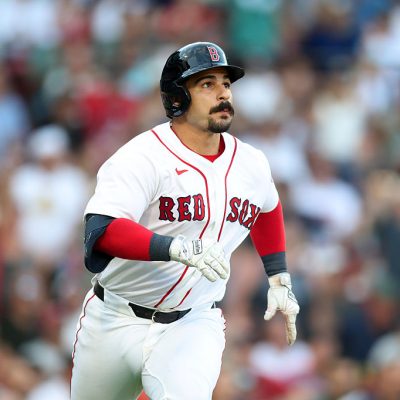
All of this is to say that someone of Rutschman’s pedigree and abilities hitting free agency is nearly unprecedented. There will certainly be risks, but the Red Sox already pushed their chips into the middle of the table when they traded three of the five prospects for his services.
This doesn’t mean that the Red Sox should extend him just because of the prospect capital they traded him, but rather that they shouldn’t let someone they were so convicted about walk out the door after a single full season.
Repeatable Breakouts?
INF Curtis Mead
- Regular Season Stats (w/WSH and BOS): 87 G, 327 AB, 17 HR, 48 RBI, .253/.353/.498, 132 OPS+, 11.9 BB%, 19.1 K%, 2.0 bWAR
- 2027 Age: 26
- Contract Status: Through 2030
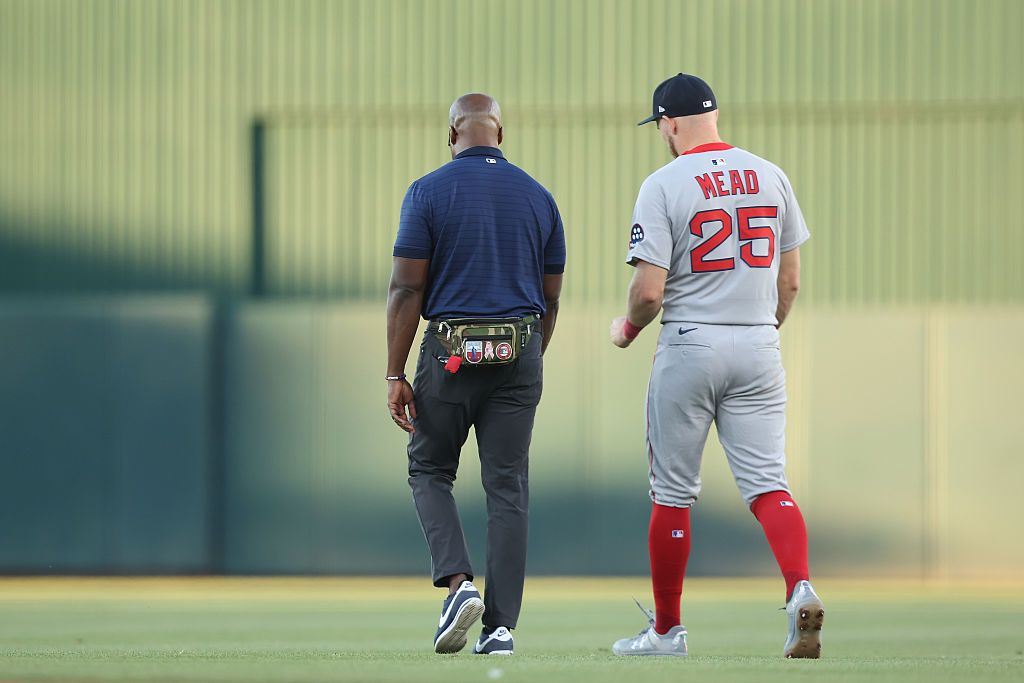
There is no bigger “what if” with the 2026 Red Sox season than Curtis Mead. Acquired a week before the trade deadline to be the second right-handed power bat alongside Contreras, Mead lasted just two at-bats before an errant Jack Perkins sinker broke his forearm. Originally projected as a 6-to-8 week injury, Mead couldn’t return by the end of the regular season, and while he was added to the postseason roster in a desperate move after Anthony’s injury, he wouldn’t take another at-bat in 2026.
Because he only played one game with Boston, it’s easy to forget why the the club acquired him in the first place. For a team that lacked power, didn’t draw enough walks, and was frequently overwhelmed by power pitching, Mead could have been the perfect antidote:
Players with an xSLG above .450, a walk rate above 10%, and a strikeout rate below 20% (min 300 plate appearances)
| xSLG | K% | BB% | |
| Yordan Alvarez | .636 | 17.2 | 15.8 |
| Juan Soto | .574 | 13.5 | 16.2 |
| Bobby Witt Jr. | .504 | 17.2 | 10.6 |
| Junior Caminero | .499 | 18.4 | 11.3 |
| Miguel Vargas | .496 | 17.9 | 14.3 |
| Freddie Freeman | .463 | 17.7 | 10.0 |
| Curtis Mead | .457 | 19.1 | 11.9 |
| Gabriel Moreno | .451 | 14.6 | 11.1 |
Mead’s absence was particularly felt during the postseason, where his ability to hit elite velocity would have come in handy against Cam Schlittler’s triple-digit heat. He posted a .404 xWOBA against fastballs over 95 mph, the 15th-highest mark among all batters who saw at least 1,000 total pitches. The Red Sox, meanwhile, were among the worst teams in baseball against such pitches, ranked 24th in xWOBA and 26th in slugging percentage.
Some will doubt whether Mead can truly be an impact hitter given his early career struggles with the Rays and White Sox, but he’s hardly the first former first-round pick to find his footing after a change of scenery. Mead also made tangible changes that led to his breakout, remaking his stance by moving his feet closer together, opening his stance, standing more upright and closer to the plate, and dropping his hands from above his shoulders to below the letters.
This gave Mead more time to react to the pitch and simplified his path to the contact point, which in turn helped him pull the ball more often and with more authority:
| Hard Hit Rate | Pull Air % | xSLG | |
| 2023 | 22.6% | 14.5% | .310 |
| 2024 | 36.6% | 19.4% | .357 |
| 2025 | 34.8% | 15.7% | .353 |
| 2026 | 42.3% | 22.5% | .457 |
Even with average raw power, Mead’s newfound ability to pull the ball in the air makes him a high-floor offensive player, as he has always made strong swing decisions even when the surface-level numbers weren’t there.
The bigger questions about Mead come on the other side of the ball, particularly regarding his long-term defensive home. The Nationals used him primarily at third base with disastrous results (-9 OAA), and the Red Sox plan to shift him to second base, where his 9th-percentile arm strength will presumably be less of an issue.
Mead’s second-base metrics over his career have been closer to average, but the sample size isn’t large enough to draw definitive conclusions. Evidence from both his minor-league and major-league days suggests he is best utilized as a first baseman, which is a non-starter for the Red Sox as long as Contreras is in town.
With a team centered around pitching and defense, the Red Sox can’t afford to have a liability up the middle, and using him as a DH would only muddy up a roster that already has a lot of moving parts . Getting Mead to at least a passable level at second base would go a long way toward fitting the puzzle pieces together, but that is far easier said than done.
DH/C/1B Mickey Gasper
- Regular Season Stats: 67 G, 225 PA, 10 HR, 24 RBI, .251/.357/.466, 132 OPS+, 12.0 BB%, 17.3 K%, 1.2 bWAR
- 2027 Age: 31
- Contract Status: Through 2031
Though he wasn’t part of the 32-5 stretch, Gasper’s incredible late-August stretch became the latest improbable feat in a season full of them. After an underwhelming two-month stint in the season’s first half, Gasper got called up again in August after Masataka Yoshida’s injury history and went absolutely nuclear.
The 30-year-old journeyman slashed .378/.525/.1000 with 8 home runs in the 16 games following his promotion, a run that put him in some truly hilarious company:
The initial instinct may be to brush off Gasper’s streak as a Quad-A player having a hot month, but there’s a reason Chad Tracy called him the best hitter he managed during his time in Triple-A. His 17.3% strikeout rate, 12.0% walk rate, and 21.0% walk rate were all well above league average, while his .353 xWOBA surpassed All-Stars like Matt Olson (.351), Ketel Marte (.349), and Yandy Diaz (.346)
Perhaps most importantly, Gasper was one of MLB’s best hitters at handling velocity, leading all hitters who saw at least 100 such pitches with a .492 xwOBA. This skill was invaluable for a Red Sox team that ranked 27th in xwOBA and 29th in xSLG against 95+ mph fastballs, and Gasper’s absence from the postseason with a torn biceps tendon loomed large as Schlittler once again blew through the Red Sox lineup.
While expecting him to hit like Ted Williams again may be unrealistic, Gasper can clearly handle big-league pitching. His defensive versatility also makes him well-equipped for an MLB bench role, as he held his own at catcher and first base and can even fake it at second base.
Whether he makes the Opening Day roster will depend heavily on his recovery timeline and any other offseason moves, but Gasper could be one of the primary beneficiaries if the Red Sox move on from Jarren Duran and/or Yoshida.
SP Jake Bennett
- Regular Season Stats: 20 G (19 GS), 113.1 IP, 3.65 ERA, 3.51 FIP, 1.7 BB/9, 7.2 K/9, 1.5 bWAR
- 2027 Age: 26
- Contract: Through 2032
A relative unknown after being acquired in the rare prospect-for-prospect trade for Luis Perales, Jake Bennett began the year without ever pitching above Double-A and ended it as a key cog in the Red Sox rotation. The 25-year-old ranked among the best at inducing chases (98th percentile) and avoiding free passes (99th percentile), helping him overcome a 32nd-percentile strikeout rate.
As good as Bennett was, it’s fair to question whether the Red Sox asked too much of him. With Crochet sidelined, Early dealt to Washington, and Bello banished to the bullpen, Bennett’s rotation role went from a bonus to a necessity, and he predictably began to wear down under a career-high workload:
- Through July 17: 53.2 IP, 14 ER, 9 BB, 38 K, 3 HR, 2.35 ERA, 3.03 FIP
- After July 17: 59.2 IP, 32 ER, 12 BB, 53 K, 9 HR, 4.83 ERA, 3.94 FIP
With Crochet, Oviedo, Houck, and potentially Crawford returning from injury, and Bello hopefully able to pitch in the first inning again, the Red Sox should be able to manage his innings more carefully. That is, of course, if he is still in the organization in spring training, as Bennett represents an intriguing trade chip.
A command-and-control left-hander who relies heavily on generating whiffs and weak contact is a volatile profile, especially given Bennett’s injury history and lack of track record. Additionally, the free-agent class of starting pitchers is much stronger than the class of position players, meaning the Red Sox could sell high on Bennett, use him as part of a package for offensive help, and replace him with a veteran free agent like Kevin Gausman.
This isn’t to say the Red Sox need to trade Bennett, but rather that they could use one of their strengths (left-handed starting pitchers) to address their offensive weakness. It’s something the Red Sox need to consider given the state of both their farm system and the free agent market.
RP Tyron Guerrero
- Regular Season Stats: 40 G, 40.2 IP, 3.10 ERA, 2.46 FIP, 1.8 BB/9, 9.1 K/9, 0.2 bWAR
- 2027 Age: 36
- Contract: Through 2030
Though the turnaround didn’t start for another month, a key moment in the Red Sox season was when they called up Tyron Guerrero to aid a top-heavy bullpen. The decision was far from obvious: Guerrero was a 35-year-old who had yet to establish himself at the big-league level because of a severe lack of command, and he spent the 2025 season in Japan.
It quickly became apparent that this version of Guerrero was a different animal than any of his previous MLB stops. Armed with a triple-digit sinker and sudden pinpoint command, Guerrero quickly earned Tracy’s trust and became one of the best relievers in baseball.
Alongside Slaten, Whitlock, and Chapman, Guerrero played a key role in a Red Sox bullpen that posted an absurd 2.14 ERA during the 32-5 stretch.
Unfortunately, Guerrero suffered the same fate as many of his teammates, peaking in July before fading down the stretch:
- Through August 11: 31 IP, 7 ER, 3 BB, 34 K, 2.03 ERA
- After August 11: 9.2 IP, 7 ER, 5 BB, 7 K, 6.52 ERA
The wear and tear of a career-high innings pitched finally caught up to him in September. He landed on the injured list with shoulder inflammation after allowing 3 runs and recording just one out on August 31 and, after making two appearances in the final week, landed back on the injured list with a lat strain that knocked him out for the postseason.
Even at 35, Guerrero still has the stuff to be a late-inning reliever, but whether he can re-establish his place inside Tracy’s circle of trust will depend on his ability to avoid both free passes and the injured list.
Seeking Consistency
3B Caleb Durbin
- Regular Season Stats: 153 G, 586 PA, 13 HR, 64 RBI, 20-26 SB, .248/.332/.378, 101 OPS+, 8.7 BB%, 13.5 K%, 4.4 bWAR
- 2027 Age: 27
- Contract Status: Through 2031
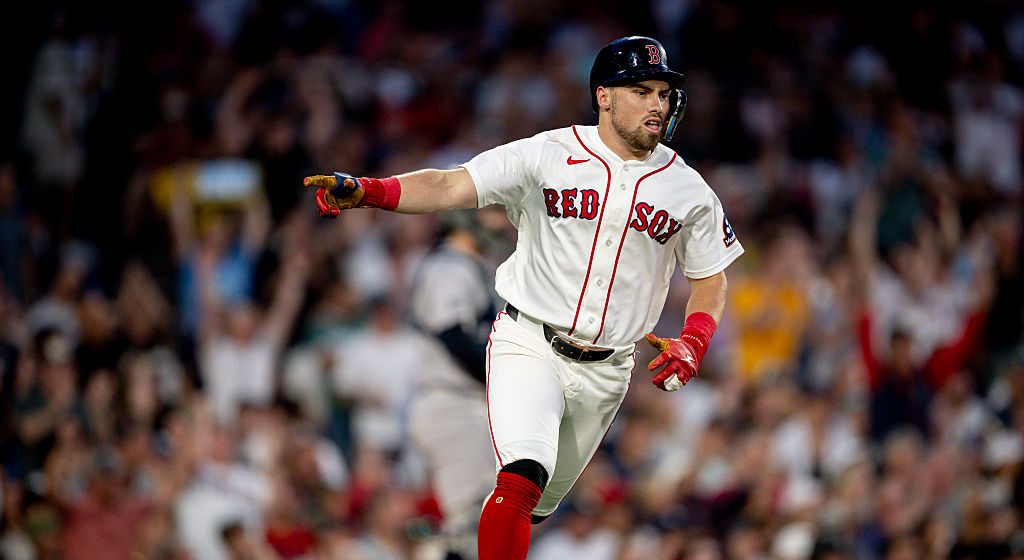
For better or for worse, Caleb Durbin’s 2026 campaign perfectly mirrored the team’s rollercoaster performance. He became the face of the team’s early-season struggles with a nightmarish .163/.241/238 line over his first 40 games, then became the defining figure of the club’s turnaround when he slashed .311/.374/.521 in 61 games from May 28 to August 7.
It was in that wild August 7, 13-12 victory over the White Sox where Durbin re-aggravated a pinky injury from June, which clearly affected his ability to impact the ball over the season’s final six weeks. He was by no means as bad as he was in the first 40 games of the season, as he still managed to get on base at a .359 clip, but the power disappeared as quickly as it arrived.
He managed just six extra-base hits over his final 44 games, then became one of the many Red Sock hitters to appear overmatched by the Yankees pitching staff, going hitless in eight at-bats and making the last out against David Bednar in Game 2.
When the dust settled on his rollercoaster season, Durbin’s 2026 numbers look eerily similar to his rookie season. Moving forward, he seems like a safe bet for Gold Glove-caliber defense at the hot corner, 10-15 home runs, 20 steals and an OPS around the league average. That is good enough to start for many teams, but it’s fair to wonder whether the Red Sox can afford such middling slugging at one of the premier power positions.
The third-base free-agent market offers few solutions even if Bo Bichette opts out of his contract with the Mets, but the Red Sox could easily make room for a trade target like Isaac Paredes by shifting Mead to DH and sliding Durbin to second base.
SP Brayan Bello
- Regular Season Stats: 26 G (11 GS), 40.2 IP, 4.33 ERA, 3.97 FIP, 2.8 BB/9, 7.1 K/9, 0.3 bWAR
- 2027 Age: 28
- Contract Status: $9.167 million AAV through 2029, $21 million club option
It’s hard to know where to even begin with Bello’s 2026 season. In many ways, it was a microcosm of a career that has had brilliant moments sandwiched between long stretches of frustration.
It looked like he was finally on track to reach his mid-rotation starter season after a strong 2025 campaign, but his shiny 3.11 ERA overshadowed some extremely concerning underlying metrics. His expected ERA was a mediocre 4.48, driven by an unsustainable .268 BABIP and a 75.3% strand rate.
All that good fortune flipped in the first half of 2026, as Bello was lit up to the tune of a 6.23 ERA over his first 12 innings. This included a bizarre inability to pitch in the first inning, allowing 15 runs over his eight starts and forcing the Red Sox to pitch him after an opener in an attempt to stop the bleeding.
Eventually, the Red Sox had enough of rearranging their entire rotation to accommodate his issues, optioning him to Triple-A after yet another disaster against the Orioles on June 12 when he allowed six runs in the top of the first.
To his credit, Bello didn’t pout after his demotion to Worcester, nor when he returned to the majors in a relief role. Instead, he returned to what made him successful in the past: scaling back his cutter usage in favor of more fastballs, sweepers, and changeups.
A pitcher who looked to be barreling toward the end of his Red Sox career suddenly became one of the club’s best pitchers down the stretch. His 1.2 second-half fWAR ranked third on the team behind Tolle and Gray, while his 2.12 ERA trailed only Chapman and Alec Gamboa among pitchers to throw at least 20 innings. This dominant run included allowing just one run in two dominant September starts, a reflection of the trust he had regained with the coaching staff.
So where does that leave Bello? The pitcher we saw in September and throughout the second half was certainly worthy of a spot in the rotation, but as we have seen time and time again, Bello’s lowest moments tend to happen right when you think you have him figured out.
The best course of action is to give Bello the chance to earn a rotation spot out of camp, but not guarantee him anything. And if he can’t beat out the likes of Oviedo, Houck, or whoever else the Red Sox bring in this winter, returning to the multi-inning relief role where he was so dominant in is an intriguing fallback.
Either way, Bello should enter 2027 as a key member of the Red Sox pitching staff, which is something that would have seemed unthinkable just a few months ago.
RP Justin Slaten
- Regular Season Stats: 36 G, 31.1 IP, 4.60 ERA, 3.04 FIP, 2.3 BB/9, 11.2 K/9, -0.6 bWAR
- 2027 Age: 29
- Contract Status: Through 2029
Speaking of frustrating pitchers, Slaten’s Red Sox tenure thus far can only be described as unfulfilled. He has the makings of a legitimate late-inning weapon, with a nasty fastball/sweeper combination and a 4.88 strikeout-to-walk ratio that trailed only Guerrero and Whitlock among Red Sox pitchers with at least 20 innings pitched.
His 3.04 FIP is over a run-and-a-half lower than his 4.60 ERA, driven by a wildly unlucky .360 BABIP. There are stretches where Slaten looks like a closer in the making, such as a dominant month of July in which he allowed just one run in 8.1 innings with a 10-to-1 strikeout-to-walk ratio.
Yet for every week Slaten is nearly untouchable, there is a week he is practically unusable in any leverage situation. At the core of his problems is his insistence on throwing his cutter more than any pitch in his repertoire despite its complete lack of effectiveness:
| Usage | xBA | xSLG | xWOBA | |
| Cutter | 41.5% | .316 | .506 | .375 |
| Four-seamer | 25.2% | .204 | .308 | .244 |
| Sweeper | 17.1% | .104 | .158 | .157 |
| Sinker | 12.8% | .266 | .302 | .273 |
| Curveball | 3.3% | .167 | .167 | .025 |
The emergence of Guerrero and the acquisition of Erik Miller slotted Slaten into lower-leverage opportunities in August, but his heavy workload during the club’s midseason resurgence had already taken a toll. He landed on the injured list on August 16 with elbow inflammation, an injury that was supposed to be minor but ended up keeping him off the mound for the rest of the season.
Injuries and setbacks have defined Slaten’s Red Sox tenure, with lengthy injured-list stints in each of his three MLB seasons. That, along with his propensity for meltdowns, will make it difficult for the Red Sox to rely on him in any leverage role in 2027.
RP Erik Miller
- Regular Season Stats (w SFG and BOS): 57 G, 51.1 IP, 2.98 ERA, 3.26 FIP, 6.0 BB/9, 13.0 K/9, 0.8 bWAR
- 2027 Age: 29
- Contract Status: Through 2029
The life of a middle reliever is cruel. In his first month with the Red Sox, Erik Miller looked like Craig Breslow’s best trade deadline acquisition to date, allowing just one earned run over his first 13.2 innings with an absurd 24-to-5 strikeout-to-walk ratio.
A shaky outing in the rain against the Royals, however, kicked off a dismal four-appearance stretch in which he allowed six runs with eight combined walks and hit-by-pitches. A perfect inning in his final regular-season outing offered hope that he had righted the ship, but he promptly gave up back-breaking hits in both postseason appearances, ending his season on a sour note.
The reality is that Miller is not as good as he was in August nor as bad as he was in September. He can generate both whiffs and soft contact with the best of them, but he has far too many command issues to be trusted as a closer or primary setup man. As a result, he is perfectly fine in his role as the second lefty in a bullpen which, considering he is under team control through 2029, is a solid return for a distressed asset like Marcelo Mayer.
- Regular Season Stats: 63 G, 60.2 IP, 3.26 ERA, 3.97 FIP, 3.0 BB/9, 8.9 K/9, 0.2 bWAR
- 2027 Age: 32
- Contract Status: Through 2029
Every team has a middle reliever who draws the ire of the fanbase, and there is little question about who fills that role for the Red Sox. Greg Weissert’s propensity for meltdowns hit a new low in the first half of 2026, as he played a hand in nearly every bullpen collapse during the team’s dreadful start:
- March 29: Allowed go-ahead three-run home run to Eugenio Suarez
- April 5th: Allowed go-ahead three-run homer to Manny Machado
- April 23: Allowed go-ahead two-run single to Cody Bellinger
- May 3: Allowed game-tying sac fly to Brice Matthews
- May 28: Allowed a go-ahead, bases-loaded walk to Mike Yastrzemski, followed by a grand slam to Ronald Acuna Jr.
These two months relegated Weissert to low-leverage work, a much-needed move if only to get the fanbase off his back. But while Guerrero, Slaten, Whitlock, and Chapman got most of the attention during the Red Sox’s July rampage, Weissert quietly turned the corner as well, driven by a substantial decrease in arm angle.
After allowing five home runs over his first 22.1 innings, Weissert allowed just three longballs over his final 38.1 frames. From May 31 on, Weissert posted a 2.58 ERA and a 3.18 FIP and struck out over a batter per inning.
The downside to Weissert’s submarine-maxxing is that his already worrisome platoon splits became even more drastic, with left-handers slashing .300/.387/.463 against him compared to the .208/.261/.349 line from righties. This makes him a poor fit for any back-end role, but if you want someone to eat innings, generate weak contact, and be uncomfortable at the plate against even the best right-handed hitters, you can do a lot worse than Greg Weissert.
Make or Break
SP Johan Oviedo
- Regular Season Stats: 1 G, 3.2 IP, 9.82 ERA, 10.19 FIP, 2.5 BB/9, 7.4 K/9, 0.2 bWAR
- 2027 Age: 29
- Contract Status: Through 2027
SP Tanner Houck
- Regular Season Stats: 1 G, 3.0 IP, 9.00 ERA, 11.10 FIP, 0.0 BB/9, 7.4 K/9, -0.1 bWAR
- 2027 Age: 31
- Contract Status: Through 2027
As we did in July, we’re grouping these two pitchers together since neither made a full comeback to MLB in 2026. Oviedo’s late-season comeback attempt stalled at Triple-A, and while Houck returned in time for Game 162, his performance didn’t inspire enough confidence to earn a postseason roster spot.
Though their 2026 seasons were a complete wash, Oviedo and Houck aren’t that far removed from being quality MLB starters. Oviedo posted a 104 ERA+ in 32 outings for the 2023 Pirates and struck out over a batter an inning in a nine-start return from Tommy John Surgery in 2025, and Houck earned an All-Star appearance in 2024 and finished 7th in the AL with a 3.12 ERA.
If they survive the 40-man roster crunch this winter, both pitchers should have healthy offseasons and enter the season as legitimate rotation depth, an important role for the Red Sox given the workload concerns of their current five starters.
On the flip side, another long-term injury would likely end their Red Sox careers, as both righties are free agents after the 2027 season.
1B Triston Casas
- Regular Season Stats: DNP (Injury)
- 2027 Age: 27
- Contract Status: Through 2028
It feels like a lifetime ago that Casas was considered one of baseball’s best young hitters. Only nine players posted a higher wRC+ than Casas over the last four months of 2023, and it seemed like he and Rafael Devers would anchor the Red Sox lineup for the rest of the decade.
Suffice to say that didn’t happen. Casas was limited to just 63 games in 2024 with a fractured rib and struggled mightily through the first month of 2025 before suffering a season-ending ruptured patellar tendon while trying to leg out an infield single.
Though Casas initially planned to be ready for Opening Day in 2026, an intercostal strain sent him back to the 60-day injured list, and a wrist injury kept him out of game action for the rest of the season.
Still just 27, Casas’ offensive upside makes him a piece worth holding on to, especially since MLB Trade Rumors projects him to make just $1.7 million and we’ve got him pegged for $1.61 million in arbitration in 2027. His multi-year absence from game action will require a lengthy stay at Worcester, but if he proves he can stay on the field and looks anything like the 120 wRC+ guy from 2023-24, he could return to Boston in time for the prime hitting months.
- Regular Season Stats (Triple-A): 109 G, 462 PA, 8 HR, 51 RBI, .256/.383/.378, 15.8 BB%, 27.3 K%,
- 2027 Age: 27
- Contract Status: Through 2028
The fact that Kristian Campbell was the only position player on the 40-man roster not to see MLB time was a pretty clear reflection of the organization’s plan for him in 2026
After a whirlwind first two months in the big leagues that included an eight-year, $60 million contract extension, a Rookie of the Month award, a rib injury, a constant shuffle between second base and center field, and a brutal slump that ultimately got him optioned to Triple-A, the Red Sox prioritized Campbell’s development over his ability to impact the big league club in 2026.
Campbell played more Triple-A games (109) than he did in 2024 and 2025 combined, all as DH or in one of the three outfield spots. For a while, it looked like even this simplified approach couldn’t fix Campbell: The former Minor League Hitter of the Year hit .219/.355/.291 over the first half of the season, striking out far more often than he did in his initial Triple-A stop while producing much less power.
Just when it seemed like he had played himself out of the Red Sox’s future plans, Campbell returned from the All-Star break a changed hitter. Hits and walks started coming in bunches, and Campbell’s confidence grew with every passing game. The result was a second half that was unrecognizable from the first:
- First Half: 314 PA, 2 HR .219/.355/.291, 2 HR, 15.9 BB%, 29.2 K%
- Second Half: 148 PA, 6 HR .333/.442/.567, 6 HR, 15.5 BB%, 23.0 K%
Given how disastrous the last two years have been, it cannot be overstated how important it was for Campbell to finish the season on a positive note. He will now enter 2027 looking to build upon something rather than start from scratch, which will hopefully prevent the kind of start we saw in the first three months of 2026.
While Campbell may have played his way out of purgatory, he still has a lot of work to do to fulfill his potential as an everyday big-leaguer. Two strong months won’t force the Red Sox to pencil him into their Opening Day plans, and it will take another extended period of Triple-A dominance for Campbell to earn his way back to the big leagues.
Shortstop of the Future…. Or the Present
SS Franklin Arias
- Regular Season Stats (with Double-A and Triple-A): 117 G, 520 PA, 25 HR, 91 RBI, .323/.400/.557, 10.0 BB%, 14.2 K%,
- 2027 Age: 21
You could forgive Red Sox fans for being wary of another hyped-up shortstop prospect after the struggles of Marcelo Mayer, but make no mistake: This kid is the real deal. The 20-year-old Arias passed every test as he raced through the Red Sox system, blasting 19 home runs in just 75 Double-A games before slashing .331/.388/.506 in Triple-A Worcester.
If not for the team’s strange loyalty to Trevor Story and the impending lockout that will cut off the team’s communication with players on the 40-man roster, Arias would likely have gotten a September call-up and a chance to make the postseason roster. Regardless, Arias will now enter 2027 as a consensus top-five prospect, a remarkable jump for a player who posted an uninspiring .723 OPS in 2025.
While Mayer had well-known issues against lefties and breaking stuff in the minors, Arias doesn’t have a clear hole in his game. Just Baseball’s 20-80 scale rates him at average to better across the board, with 60 grades on both his hit tool and fielding tool.
The power he showed in the minors this year may not be repeatable, but it highlighted a significant increase in game power and exit velocity that should make him a consistent double-digit homer guy. Even more importantly, Arias added this power without sacrificing his bat-to-ball skills, ranking in the 90th percentile or higher in zone-contact percentage at both Double-A and Triple-A.
Part of the issues the Red Sox have had with their prospects has been asking far too much of them too early. Campbell was given a long-term extension in his first week in the majors and was batting cleanup by the end of his first month. Mayer was called up after Alex Bregman’s injury last May and rushed into an everyday role. Even Roman Anthony, the only one of the Big 3 with sustained big-league success, was batting leadoff within a week of his debut and asked to carry an offense that had just dealt Rafael Devers.
Arias won’t face nearly the same pressure. The Red Sox don’t need him to hit at the top of the order and be the centerpiece of the offense. They need him to be an upgrade over what they got at shortstop in 2026, where a group primarily consisting of Isaiah Kiner-Falefa, Andruw Monasterio, Mayer, and Story combined for some of the worst production in the game:
- fWAR: 24th (1.0)
- Home Runs: 28th (9)
- wOBA: 22nd (.294)
- wRC+: 23rd (83)
Whether you believe Arias should have been called up at the end of the season, there’s little debate that he will enter 2027 as the club’s best internal option at shortstop. As long as he doesn’t get flipped as the centerpiece for a bigger name (which you can never be sure of given Breslow’s recent trade history), Arias should get every opportunity to win the Opening Day shortstop job out of camp.
Controllable Depth
2B Nick Sogard
- Regular Season Stats: 66 G, 277 PA, 5 HR, 19 RBI, .255/.342/.385, 106 OPS+, 11.2 BB%, 20.2 K%, 1.4 bWAR
- 2027 Age: 29
- Contract Status: Through 2031
Sometimes the obvious move is the correct one. While -Kiner Falefa and Mayer combined for one of the weakest second-base platoons in recent memory, Sogard was tearing up Triple-A, slashing .269/.417/.454 over his first 36 games and matching his 2025 home run total by May with five round-trippers.
Injuries to nearly every middle-infield option finally gave Sogard the runway as the starting second baseman, and he quickly proved the Red Sox waited far too long to make the change. He became one of the most dependable bats in a lineup hampered by injury and underperformance, running excellent walk and chase rates, rarely whiffing, and even showcasing a bit of pop.
As fun and necessary as the Sogard experience was over the season’s final two months, he is probably underqualified to be an everyday second baseman for a contending club. There is a reason why it took until his age-28 season for Sogard to get more than 100 at-bats at the big-league level, as his 86.5 mph average exit velocity, 28.6% hard-hit rate, and .355 xSLG are all well below the major-league average, and his defense and baserunning skills are far closer to average than elite.
What Sogard is is a high-end utility man, one that can adequately fill in at all four infield positions and who you are never disappointed to see penciled into the lineup. With question marks around Curtis Mead’s defense at second base and injury concerns for Contreras, Sogard’s role on the 2027 Red Sox could be every bit as important as it was this year.
OF Eli White
- Regular Season Stats: 27 G, 60 PA, 1 HR, 12 RBI,.274/.347/.399, 91 OPS+, 5.4 BB%, 22.1 K%, 0.3 bWAR
- 2027 Age: 33
- Contract Status: Through 2029
Overshadowed by the acquisitions of Rutschman and Miller, Eli White played a surprisingly important role on an increasingly banged-up Red Sox roster. The 32-year-old not only provided excellent contributions on the bases and in the field, but also hit a perfectly adequate .276/.300/.379 with 12 RBI in just 60 plate appearances.
White looked like a certain lock for the postseason roster before suffering a ligament injury in his right foot while colliding with the center-field fence that required season-ending surgery.
Though his 2026 season had a bitter end, White still has two years of club control and will enter 2027 in a strong position for the fourth outfield role.
INF Romy Gonzalez
- Regular Season Stats: 19 G, 73 PA, 1 HR, 7 RBI, .185/.264/.308, 62 OPS+, 6.8 BB%, 28.8 K%, -0.2 bWAR
- 2027 Age: 33
- Contract Status: Through 2029
It was a nightmare season for Romy Gonzalez, who had become an integral piece of the Red Sox’s 2025 team due to his defensive versatility and ability to absolutely mash left-handed pitching. Offseason shoulder surgery kept him out of action for the first three months of 2026, but that didn’t stop the Red Sox from expediting his rehab in a desperate attempt to boost an ailing offense.
Though he got off to a reasonably strong start, it quickly became apparent that Gonzalez was nowhere close to regaining his timing, and he wasn’t going to find it playing just once or twice a week. The Red Sox optioned him to Worcester after the trade-deadline acquisition of White and never recalled him over the season’s last two months despite Monasterio’s offense falling off a cliff.
The decision to stick with Monasterio during a 2-for-32 slump was only made more peculiar by Gonzalez’s resurgence in Triple-A. He slashed .347/.402/.526 over 107 plate appearances in Worcester, looking far closer to the guy who ranked in the 99th percentile in hard-hit percentage in 2025 than he did during his abbreviated rehab stint.
Provided he survives the offseason roster crunch and enters spring training fully recovered from and the hyperextended elbow that kept him off the Wild Card roster, Gonzalez should have the inside track for the right-handed platoon role over Monasterio and Jahmai Jones.
INF Anthony Seigler
- Regular Season Stats: 49 G, 173 PA, 3 HR, 13 RBI, .247/.327/.400, 105 OPS+, 10.4 BB%, 16.2 K%, 0.5 bWAR
- 2027 Age: 30
- Contract Status: Through 2031
The numbers don’t do justice to the spark that Anthony Seigler gave the Red Sox. The switch-hitter was thought to be the third piece in the deal that brought Durbin and Monasterio to Boston, but he parlayed a strong performance in Worcester to a late-June call-up and was the primary leadoff hitter during the club’s 27-3 run.
The emergence of Sogard, however, resulted in a sharp playing time reduction for Seigler in August, and he was eventually optioned to Worcester upon Story’s return. Seigler did get the call again on September 12 but lasted just one game before landing on the injured list with wrist inflammation.
Given that Seigler only got an MLB callup after every other middle-infield option went down with injury, it’s impossible to be anything less than thrilled with the production he gave the Red Sox during their most important stretch of the season. He may never be a regular leadoff hitter again, but Seigler has solidified his place as important big-league depth headed into 2027.
INF Andruw Monasterio
- Regular Season Stats: 107 G, 347 PA, 6 HR, 43 RBI, .233/.295/.371, 88 OPS+, 7.5 BB%, 19.6 K%, 0.6 bWAR
- 2027 Age: 30
- Contract Status: Through 2029
Monasterio is a classic example of a “less is more” player. He is perfectly qualified to be the short side of a second-base platoon, which he did in the first half of the season with acceptable results.
What he is not qualified to do is to be an everyday shortstop for a team with championship aspirations. An absurd July performance led the Red Sox to think he could handle that role until Story returned, but the magic quickly ran out. Monasterio hit just .140/.204/.161 from August 9 on and continued to struggle defensively, finishing the season with a whopping -15 Outs Above Average.
Monasterio’s falloff coincided with Sogard emerging as the everyday second baseman, and with the return of Mead and the impending arrival of Arias, it’s more likely than not that he starts the season in Worcester as minor-league depth.
RP Wyatt Olds
- Regular Season Stats: 14 G, 15.2 IP, 1.15 ERA, 4.12 FIP, 4.6 BB/9, 11.5 K/9, 0.3 bWAR
- 2027 Age: 27
Quick, who had the lowest ERA on the Red Sox? No, it wasn’t Chapman or Whitlock or any other high-profile member of their vaunted bullpen. It was Wyatt Olds, an anonymous 26-year-old minor leaguer who got called up in August and allowed just two runs in 15.2 regular-season innings.
Like many other right-handed middle relievers, Olds relies heavily on an upper-90s fastball/slider combo, with the latter generating an outstanding 46.8% whiff rate. Even when hitters made contact, it typically worked out in Olds’ favor, as his 28.9% hard-hit percentage ranked 23rd among all pitchers with at least 35 batted-ball events.
What held Olds back was, to put it generously, spotty command, which was unfortunately on full display in his lone disastrous postseason appearance. A walk rate north of 12% will likely keep him from ever holding down a late-inning role, but he is more than qualified for the up-and-down reliever role he took on last year.
RP Alec Gamboa
- 21 G, 33.0 IP, 1.91 ERA, 3.19 FIP, 3.0 BB/9, 6.3 K/9, 0.3 bWAR
- 2027 Age: 30
- Contract Status: Through 2031
It took a lot of unexpected contributions for the Red Sox to overcome the loss of Crochet and post the major’s third-lowest team ERA, and none were as unlikely as Gamboa.
After stalling out at Triple-A with the Dodgers and spending most of 2025 in Korea, the 29-year-old left-hander parlayed a strong opening month in Worcester into a big-league callup. While he pitched well in abbreviated stints, he often got caught in the options game and was sent back to Worcester whenever the big-league club needed a fresh arm.
It took until mid-August for Gamboa to earn a full-time role, and he proved an integral part of the Red Sox bullpen. His elite ground-ball rate (53.6%) and barrel rate (3.1%) held batters to a measly .225 batting average, and his ability to work multiple innings was invaluable with Slaten and Guerrero sidelined.
He was so impressive, in fact, that he beat out the more experienced Jovani Moran for the final postseason spot, which could foreshadow how the Red Sox view the two lefties moving forward.
Though his two minor league options may result in a return to Worcester, Gamboa is the kind of versatile pitching depth any good team needs throughout the course of a 162-game season, and he will undoubtedly factor into the Red Sox’s pitching plans at some point in 2027.

during the seventh inning at Oriole Park at Camden Yards on April 25, 2026 in Baltimore, Maryland. (Photo by Scott Taetsch/Getty Images)
Trade/Non-Tender Candidates
OF Jarren Duran
- Regular Season Stats: 151 G, 608 PA, 20 HR, 69 RBI, 21-25 SB,.207/.266/.361, 75 OPS+, 6.7 BB%, 27.1 K%, 0.2 bWAR
- Age: 30
- Contract Status: Through 2028
Like a cat with nine lives, Duran found a way to remain in the Red Sox lineup despite his offensive production absolutely cratering. Every time it seemed like he would be the odd man out, someone got hurt and Duran would take over their at-bats.
Anthony’s injury in May allowed Rafaela, Duran, Abreu, and Yoshida to be in the lineup every day, and by the time Anthony was activated on August 29, Yoshida had suffered a season-ending hamstring injury and Rafaela was days away from landing on the injured list himself. Rafaela’s return in the final week of the regular season looked like it would keep Duran out of the postseason lineup, only for Mickey Gasper to blow out his bicep and reopen the DH spot.
To his credit, Duran was always available, something you couldn’t say for many of his teammates. The issue is that even though he ranked second on the Red Sox in games and plate appearances, he was just their 15th most valuable position player, trailing the likes of Connor Wong, Seigler and even Nate Eaton, who played in just 24 games and batted .160.
The issues that had cropped up during his 2025 regression hit an extreme in 2026, as he became the defining figure of a streaky offense that chased far too often and posed little resistance against elite pitching:
| Chase Rate | Whiff Rate | Vs Power Pitchers* | |
| 2024 | 28.1% | 24.8% | .226/.301/.390, 35 K% |
| 2025 | 31.1% | 29.3% | .241/.348/.386, 26 K% |
| 2026 | 34.4% | 33.5% | .162/.236/.279, 31 K% |
*Pitchers in the top third of the league in K+BB
With Anthony sidelined for nearly four months and so many of the DH options either unproductive or unavailable, the Red Sox had no choice but to keep trotting him out and hope he would eventually adjust. Yet beyond a few hot stretches here and there, Duran never came close to consistent offensive production.
Duran had one final chance to rewrite his season’s story in September, a month when Contreras and Rafaela combined to play just 11 games. The Red Sox desperately needed Duran to catch fire and drag the offense to some semblance of respectability. Instead, he slashed just .206 /.286 /.302 with a single home run, and the Red Sox scored 16 fewer runs than any other MLB team in the month.
As the Red Sox set out constructing their 2027 roster, there is no argument for Duran to still be on the team when they arrive in Fort Myers for spring training. The Red Sox have Abreu, Anthony and Rafaela locked up through at least 2029, Gasper and Yoshida as superior DH options, and White and Eaton as solid fourth outfield candidates.
That’s seven guys for four spots, and that’s not even including Campbell, who had a strong end of the year at Triple-A and is still owed over $56.5 million the next six years.
Keeping Duran on the roster becomes even less feasible as his salary balloons, now projected by MLBTR to reach $11 million and Just Baseball at $10.7 million in 2027. That is an unreasonable amount to pay a fourth outfielder, especially with the Red Sox already devoting a combined $43 million to Story and Yoshida.
The exit strategy with Duran will be one of the Red Sox’s most important and complicated decisions this winter. Non-tendering would be the cleanest way to cut bait, but it would also be an embarrassing admission of fault for a player they stubbornly held on to through multiple seasons of trade rumors.
Though they won’t get anywhere near the return they would have last winter, Duran’s trade value has not completely evaporated. There will be teams willing to take a chance on him based on tools and pedigree alone, and his defensive turnaround in 2026 at least partially offsets his nearly unprecedented offensive drop-off.
Whatever path the Red Sox choose, Duran’s time with the team has reached its final chapter, and expecting the outfield carousel to solve itself again in 2027 would be a completely unacceptable outcome.
SS Trevor Story
- Regular Season Stats: 64 G, 266 PA, 5 HR, 29 RBI, 5-5 SB, .235/.271/.351, 75 OPS+, 4.1 BB%, 32.3 K%, 0.2 bWAR
- 2027 Age: 34
- Contract Status: $25 million for 2027
It’s easy to forget now how indispensable Trevor Story was to the 2025 Red Sox. After struggling so badly through the first two months of the season that a DFA seemed inevitable, Story slashed .287/.331/.494 from May 30 on, accumulating the most RBI (75), the third-most home runs (19), and the fourth-most fWAR (3.2) among AL shortstops in the span.
This bounceback gave hope that Story could salvage the last two years of his six-year, $140 million contract, but it quickly became apparent that wasn’t in the cards. Hampered by a sports hernia suffered in spring injury, Story hit just .206 before finally landing on the IL on May 15 and undergoing surgery that knocked him out for over three months.
He provided a couple of clutch hits upon his return to the lineup, including a walk-off single against the Mariners and a go-ahead three-run homer against the Rangers, but the overall story was more of the same. He struck out 29 times against just 3 walks and it took an unsustainable .418 BABIP to squeak out a passable .765 OPS.
The good news for the Red Sox is that they have finally reached the last year of Story’s six-year, $140 million contract, but that doesn’t solve the issue at hand in 2027. His $25 million salary is more than any other position player on the team, an absurd amount for an oft-injured shortstop who is decidedly below average at the plate and in the field.
No team will trade for that unless the Red Sox eat most of the salary and/or attach a prospect, which leaves them with three alternative options:
- DFA Story and eat $25 million
- Let Story start the season at shortstop and wait until he struggles or gets injured to hand the keys off to Arias
- Make Arias the SS and have Story enter camp in a lesser role
None of those choices are particularly appealing, but there is a potential twist. If MLB institutes a salary floor in the new CBA, Story’s expiring contract would make him an ideal candidate for a team needing to get above the threshold. The Red Sox could also benefit from a weak class of free-agent shortstops, as the headliners of Mauricio Dubon and J.P. Crawford are both best suited for bench roles at this point in their careers.
It wouldn’t be surprising to see the Red Sox kick the can down the road, fill other holes on their roster, and wait for more clarity on the new collective bargaining agreement and which teams may be in the shortstop market.
DH Masataka Yoshida
- Regular Season Stats: 87 G, 297 PA, 5 HR, 28 RBI, .274/.347/.399, 111 OPS+, 9.4 BB%, 11.1K%, 0.7 bWAR
- 2027 Age: 33
- Contract Status: $18 million for 2027
Each of Masataka Yoshida’s four seasons with the Red Sox has followed a similar script. His moderate offensive contributions have been largely overshadowed by a complete lack of defensive ability that has made him a clunky fit on each roster.
The last three seasons have also been interrupted by a major injury, most recently a severe hamstring pull that sidelined him for the last month and a half of the regular season and postseason.
There are certainly teams that can use a hitter like Yoshida, but the Red Sox’s desperate need for power makes it borderline malpractice to roster a platoon DH with a slugging percentage below .400.
With his five-year, $90 million contract set to expire after the 2027 season, now is the Red Sox’s best opportunity to move on, though they will still likely have to eat a portion of his $18 million salary.
RP Jovani Moran
- Regular Season Stats: 50 G, 65.2 IP, 3.15 ERA, 4.26 FIP, 4.5 BB/9, 10.0 K/9, 0.9 bWAR
- 2027 Age: 30
- Contract Status: Through 2030
Despite a solid regular season, the Red Sox’s confidence in Moran (or lack thereof) was shown in their decision to leave him off the postseason roster. A 12.1% walk rate was likely the culprit, as his inability to avoid the free pass frequently overshadowed his surprisingly excellent ability to generate soft contact (29.3% hard-hit percentage, .196 batting average)
Moran is a more-than-capable third lefty in a bullpen, but his lack of minor-league options, along with other capable options in the upper minors, makes him a strong trade candidate this winter.
OF/DH Jahmai Jones
- Regular Season Stats (w BOS and DET): 94 G, 181 PA, 6 HR, 16 RBI,.206/.298/.369, 87 OPS+, 9.4 BB%, 32.0 K%, 0.8 bWAR
- 2027 Age: 29
- Contract Status: Through 2031
A summertime barrage, an ice-cold September, and a non-competitive Wild-Card series: Jahmai Jones’s tenure with the Red Sox in 2026 mirrored the club’s second-half offense. Claimed off waivers from the Tigers at the All-Star break, Jones arrived in Boston the following weekend and quickly got caught up in the 32-5 magic. He homered in his first start and slashed a remarkable .520/.586/.1000 through his 26 at-bats.
With Contreras and Rafaela landing on the injured list at the end of August, Jones’s role as a lefty masher became even more vital, but he showed why a Tigers team desperate for offense was willing to move on. He managed just two extra-base hits and a lowly .175 batting average over his final 47 plate appearances, and went 0-for-4 with a pair of punchouts in his only playoff start.
While Jones is under team control through 2031 and is only projected to make 900k in 2027, his lack of options and defensive versatility make him an awkward roster fit. He would essentially need to post Rob Refsnyder-lines to be worth the trouble, a tall task given his career 29.7% strikeout rate.
Using Gonzalez, who can play every infield position except shortstop and still has a minor league option remaining, as the primary righty off the bench would give the Red Sox far more roster flexibility.
SP Kutter Crawford
- Regular Season Stats: DNP (Injured)
- 2027 Age: 31
- Contract Status: Through 2028
After an MLB-leading 33 starts in 2024, Crawford’s last two seasons have been marked by injuries and setbacks. Knee and wrist issues kept him off the mound for the entirety of 2025, and though he was able to make a single rehab start in 2026, he quickly returned to the 60-day injured list with inflammation.
Crawford made one last attempt to return to the mound in September, but rain canceled his scheduled start on the last day of the Triple-A season, a fitting end to a cruel season.
The 31-year-old now finds himself at a similar career crossroads as Casas, yet while the slugging first baseman still possesses middle-of-the-order upside when healthy, Crawford has never been anything more than a fifth starter when healthy, as severe home run issues have undercut his solid strikeout and walk rates.
Coupled with his injury concerns, the Red Sox will likely side against tendering him a contract in favor of other arms with more upside.
OF Nate Eaton
- Regular Season Stats: 24 G, 60 PA, 1 HR, 6 RBI, .160/.300/.260, 61 OPS+, 13.3 BB%, 26.7 K%, 0.5 bWAR
- 2027 Age: 30
- Contract Status: Through 2030
You can’t say that he didn’t get his shot. After a strong performance at Worcester over the season’s two three months, Eaton was called up in mid-June and got a full month of runway as the club’s fourth outfielder.
Yet while the rest of the offense caught fire, Eaton hit just .125/.282/. 281 before the Red Sox traded for Jones at the All-Star break to take over the left field at-bats against lefties. The acquisition of White further cut off Eaton’s path to MLB playing time, though he would get another shot in September after Rafaela landed on the IL and produced similarly underwhelming results.
Eaton still has value in an organization because of his wheels (96th percentile sprint speed) and defense, but his time with the Red Sox may be up now that he is out of minor league options. Provided that White recovers from his foot injury in time for Opening Day, Eaton won’t have a clear pathway for an Opening Day roster spot, making him a prime trade candidate for teams looking to bolster their outfield depth.
One and Done?
SP Sonny Gray
- Regular Season Stats: 29 GS, 169.0 IP, 2.72 ERA, 3.47 FIP, 2.4 BB/9, 7.9 K/9, 4.3 bWAR
- 2027 Age: 37
- Contract Status: $30 million mutual option
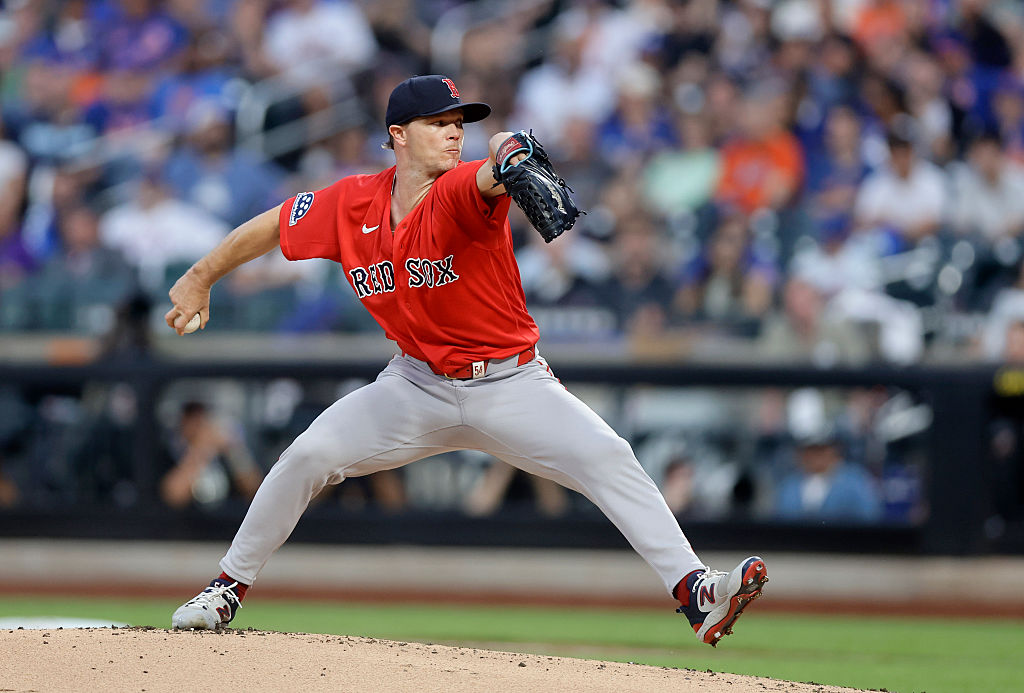
You could argue that Gray was as valuable to the Red Sox last season as Crochet was in 2025. Every other member of the Red Sox rotation had some sort of workload concern, whether it be rookies Bennett and Tolle surpassing their career-high innings, Sandoval coming off Tommy John surgery, or Suarez dealing with nagging groin and hamstring injuries throughout the summer.
The Red Sox desperately needed a veteran to anchor their rotation, and Gray answered the bell and then some. His numbers may not have matched those of the 2025 Cy Young runner-up, but he provided a nearly identical level of stability:
- Record in Garrett Crochet starts, 2025: 23-9
- Record in non-Garrett Crochet starts, 2025: 66-64
- Record in Sonny Gray starts, 2026: 21-8
- Record in non-Gray starts, 2026: 66-67
Unfortunately, Gray’s most memorable start wasn’t one of his league-leading 18 wins but a season-ending Wild Card loss in which he was pulled after throwing just 70 pitches over 4.2 one-run innings.
One of the key veteran voices in the Red Sox clubhouse alongside Contreras, Gray was not afraid to voice his displeasure with the decision:
The impending free agent was also non-committal about his future, saying “I don’t know” when asked if Boston would be a place he’d want to return to.
Gray later clarified his desire to pitch in 2027, but it’s fair to question whether this bitter ending will affect his desire to return to Boston. On the flip side, the Red Sox may not even want to enter a bidding war for a pitcher entering his age-37 season, particularly with the massive investments they have already made in both Crochet and Suarez.
While Gray’s season was up there with the best of his storied career, the underlying metrics indicate that it may not be repeatable:
- 21.8% strikeout rate: Lowest since 2017
- 3.74 FIP: Highest since 2021
- 83.2% LOB percentage: Career-low
- 1.15 xERA-ERA: 12th-highest among pitchers to face at least 500 batters
The league-wide shortage of proven, reliable starting pitchers will likely see Gray paid like a top-end number two starter, but he’ll struggle to meet that expectation if his good fortune levels out.
Even putting aside how 2026 ended, the Red Sox would probably be better off spending elsewhere and letting another team give Gray his final big contract.
The End of the Road
INF Isaiah Kiner-Falefa
- Regular Season Stats: 66 G, 183 PA, 2 HR, 16 RBI, .242/.322/.311, 81 OPS+, 10.4 BB%,14/8 K%
- 2027 Age: 32
- Contract Status: Free Agent
The signing of “IKF” to a one-year, $6 million deal never made much sense, given the Red Sox’s desperate need for power and the fact that they had plenty of infield depth sitting at Triple-A. Sure enough, Kiner-Falefa bookended his first and likely only season in Boston with two truly terrible stretches, slashing .195/.250/.195 through his first 21 games and posting a .143/.265/.167 line after returning from a forearm injury in September.
To his credit, those two stretches sandwiched an utterly bizarre .455/.526/.606 stretch through the final two weeks of May, which saved his season-long numbers from sinking even lower. The most detrimental aspect of Kiner-Falefa’s season, however, was that he couldn’t be optioned to the minors, which blocked Sogard and Siegler from being called up over the first two months of the season.
Though he provided a solid glove and veteran leadership, IKF’s presence on the roster did far more harm than good, and it would be a major surprise if he returns to Boston next season.
SP Patrick Sandoval
- Regular Season Stats: 15 G (13 GS), 70.1 IP, 5.12 ERA, 3.77 FIP, 4.1 BB/9, 9.3 K/9, -0.6 bWAR
- 2027 Age: 31
- Contract Status: Free Agent
The best thing you can say about the Patrick Sandoval Red Sox experience is that he took the ball every fifth day and soaked up 12.2 innings in the season’s final week to preserve the bullpen for the playoffs. Of course, it didn’t end up making much of a difference, but Sandoval deserves props for biting the bullet even though it was clear he wasn’t going to make the postseason roster.
The actual quality of Sandoval’s performance, however, left a lot to be desired. It looked like he would be able to give the Red Sox a shot in the arm when he pitched to a 3.32 ERA over his first four starts after being activated in July, but the walk issues that had plagued him throughout his entire career quickly resurfaced, and this time he didn’t strike out enough batters to overcome it. His 1.68 WHIP was the third-worst mark among any pitchers to throw at least 70 innings, “besting” only Juan Mejia and Michael Lorenzen.
Though he got pitiful run support, it’s hardly a coincidence that the Red Sox lost nine of Sandoval’s final ten starts, given how often he put them in big early holes. The Red Sox can only hope to get more production from their depth starters in 2027.
Become a Member of Just Baseball
Subscribe and upgrade to go ad-free!
* Save 25% by subscribing annually.

Written by
Daniel Fox is a contributing writer for Just Baseball. He has previously written for Pitcher List, BoSoxInjection, and in the Cape Cod Baseball League. He is…