
Pete Crow-Armstrong’s 2026 Season Is Already Historic
Pete Crow-Armstrong has already reached extraordinary heights in 2026 with a historic season. But at just 24 years old, it begs the question: How good can PCA become?

Pete Crow-Armstrong is going to win the National League MVP.
At this point, that is almost the least interesting part of his season.
There is a difference between being the best player in a given year and producing the type of season that deserves to be discussed long after that year is over. Crow-Armstrong has crossed that threshold in 2026.
His season stands out against his contemporaries. It stands out against the greatest center fielders of the past quarter-century. It stands out among players his age. And perhaps most importantly for what comes next, it has been accompanied by tangible changes to the way he hits that suggest this is more than a young player simply catching fire for six months.
So, rather than asking whether Pete Crow-Armstrong is the National League MVP, there are three more interesting questions to answer:
How much better has he been than everyone else?
How does this season compare historically?
And at just 24 years old, how good can he become?
PCA vs. the Field
To properly encapsulate why Crow-Armstrong is going to run away and hide with the National League MVP, it is important to understand just how much better he has been than the field.
Start with WAR.
PCA leads baseball with 10.7 fWAR, a staggering 3.9 wins ahead of Bobby Witt Jr. at 6.8. The next-closest National League player, Elly De La Cruz, sits 4.3 wins behind him.
The gap between PCA and everyone else is not merely the difference between first and second in a normal MVP race. It is the defining feature of the race itself.
Perhaps WAR is not your measure of choice. The counting stats like him, too.
Crow-Armstrong is tied for the major-league lead with 45 home runs while stealing 40 bases. He is the only player near the very top of both leaderboards and one of only two players among baseball’s top 20 base stealers with more than 30 home runs. The other, CJ Abrams, has 33.
To put it bluntly, he has been a force of nature offensively.
And all of that comes before discussing what was once the defining part of his game.
Crow-Armstrong has also been the most valuable defender in baseball.
He leads MLB in FanGraphs defensive runs, Fielding Run Value, and Outs Above Average. By virtually any available defensive measure — and certainly by the eye test — PCA has been the best defender in the sport.
That is where this season separates itself from a traditional offensive MVP campaign.
Among the top 10 players in FanGraphs defensive value, only one other player has a wRC+ above 120: Bobby Witt Jr. PCA sits at 158.
What makes his season so dominant relative to his peers is not brilliance in any single category. It is the full complement of skills.
His power, speed, and defense could each independently create meaningful major-league value.
In 2026, he has put all three together at once.
The first half of 2025 gave us flashes of what that player might look like. Crow-Armstrong showed superstar-level ability before crashing back toward earth during the second half of the season.
In retrospect, it looks less like an outlier than a preview.
2026 is the actualized version of Pete Crow-Armstrong.
And the result is not merely an MVP season.
It is the type of historically dominant season that demands a different comparison group entirely.


PCA vs. History
So just how special is this Pete Crow-Armstrong season?
Start again with WAR, but widen the lens beyond 2026.
If his current advantage holds, PCA’s lead in fWAR among position players will be the largest gap between first and second since 2022, when Aaron Judge produced 11.1 fWAR while Nolan Arenado finished second at 7.2.
The company gets even more exclusive when narrowing the comparison to center fielders.
Crow-Armstrong’s 10.7 fWAR is the third-highest mark by a center fielder since 2000, trailing only Judge’s 2022 and 2024 seasons and sitting just ahead of Mike Trout’s 2012 and 2013 campaigns.
His power stacks up historically, too.
PCA’s 45 home runs are tied for the fourth-most by a center fielder since 2000, behind two Judge seasons and Andruw Jones’ 51-homer campaign in 2005, while matching Mike Trout’s 45 in 2019.
Then add the speed.
Among the 20 highest home-run seasons by center fielders over that span, only one player stole as many bases as Crow-Armstrong’s 40: Matt Kemp, who stole 40 while hitting 39 home runs in 2011.
Even when the comparison group is reduced to some of the greatest center-field seasons of the past quarter-century, PCA resides near the top.
What makes all of this even more remarkable is how far away this version of Crow-Armstrong seemed just two months into the season.
Through the end of May, PCA had accumulated just 1.9 fWAR with a 91 wRC+.
After the breakout first half of 2025 and subsequent second-half regression, it was fair to wonder whether the superstar version of Crow-Armstrong had been a heater rather than a new baseline.
Then June arrived.
Since June 1, Crow-Armstrong is slashing .304/.398/.681, good for a 189 wRC+, with 38 home runs and 27 stolen bases.
He has accumulated 8.8 fWAR over that stretch alone.
The next-closest player, Fernando Tatis Jr., has produced 4.6.
That gap is almost difficult to contextualize, so consider another superstar who overcame a slow start.
Aaron Judge’s historic 2024 season included an absurd run of its own after the calendar flipped to June. Judge produced roughly 8 fWAR from June 1 onward, but Bobby Witt Jr. was right behind him at 7.1.
PCA has not merely been the best player in baseball since June.
He has separated from the rest of the sport in a way even other historic individual seasons rarely do.
And he has done it at 24 years old.
Among players age 25 or younger since 1996, Crow-Armstrong’s 10.6 fWAR is the highest mark, narrowly surpassing Bobby Witt Jr.’s 10.5-win 2024 season.
The list of young players who have even approached this level in the current decade is tiny.
The only other players to produce at least seven fWAR in an age-25-or-younger season are Bobby Witt Jr., Gunnar Henderson, Ronald Acuña Jr., Juan Soto, and Geraldo Perdomo.
PCA’s 2026 season is historic from almost any direction you approach it.
Among his contemporaries, he has lapped the field.
Among center fielders, he is producing one of the best seasons of the century.
Among young players, essentially nobody in the past three decades has been better.
And perhaps the most interesting part is that the player who produced this season may not yet be a finished product.
Which begs the question:
How good can Pete Crow-Armstrong become?
PCA vs. PCA
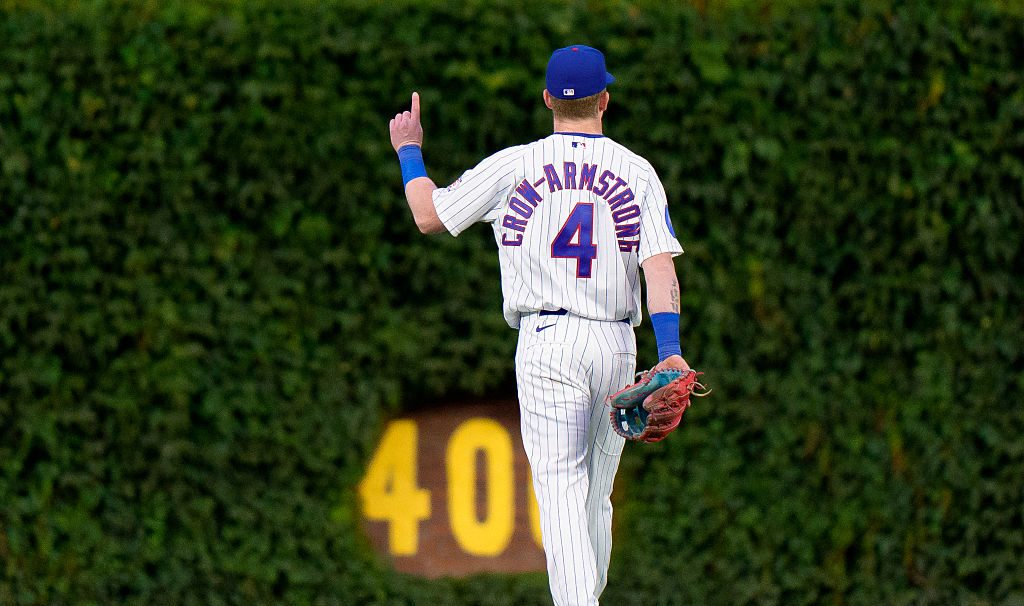
When a player breaks out before he can legally rent a car, there is a tendency to get hyperbolic about what comes next.
Elly De La Cruz is a useful reminder of that.
After producing 6.8 fWAR in his age-22 season, De La Cruz followed it with 4.6 fWAR at 23.
That was still an excellent season.
Yet after establishing such an outrageous standard so young, natural year-to-year variance could almost feel like a fall from grace rather than the normal progression of a young superstar.
Pete Crow-Armstrong is about to face the same problem.
The expectation cannot be that PCA simply produces 10-win seasons every year.
Seasons like this one are historic precisely because players do not casually reproduce them.
So the more useful question is not whether 10.6 fWAR becomes his new baseline.
It is: What does a realistic version of Pete Crow-Armstrong look like from here?
The answer starts with his defense.
Crow-Armstrong possesses something most offensive superstars do not: an exceptionally high floor.
Before becoming one of the best hitters in baseball, he was already accumulating substantial value.
In 2024, PCA produced 2.6 fWAR despite a below-average offensive season. A year later, a modest offensive step forward to a 109 wRC+ helped push him to 5.4 fWAR.
That is the luxury of playing elite defense at a premium position while also providing substantial value on the bases.
PCA does not have to hit like an MVP to be an All-Star-caliber player.
What happened offensively in 2026, however, changed the conversation entirely.
Part of that leap looks like natural development. Crow-Armstrong is 24 years old, physically maturing and continuing to add bat speed.
But there has also been a tangible refinement to how he hits.
Crow-Armstrong moved away from the toe tap that had become part of his setup and incorporated more of a hovering leg kick around June.
That is also right around the time his season exploded.
The mechanical adjustment is interesting on its own. Being able to make a substantive swing change during a major-league season and immediately unlock another level of damage is extraordinarily impressive.
The accompanying change in his swing decisions may be even more important.
Crow-Armstrong spent much of his young career as an ultra-aggressive hitter capable of doing enormous damage but also capable of giving pitchers at-bats by expanding the strike zone.
That player has started to disappear.
His chase rate has fallen. His walk rate has climbed. His offensive approach has become considerably more mature without sacrificing the aggression that makes him dangerous.
The hovering leg kick appears to have given PCA a more comfortable timing mechanism, while the broader refinement of his approach has allowed him to make better decisions about when to unleash the swing.
His bat speed has continued to jump as he physically matures, but he is no longer merely an all-or-nothing hitter trying to overwhelm pitchers with athleticism.
He is beginning to pair those extraordinary physical tools with a much more sophisticated plan in the batter’s box.
That combination is frightening.
There may not be another level of raw power waiting to emerge, but there does not have to be.
At present, Crow-Armstrong looks capable of becoming a perennial 30-homer, 30-steal player while playing Platinum Glove-level defense in center field.
The historical comparison that keeps coming to mind is Andruw Jones.
Jones paired enormous power with generational center-field defense and ultimately accumulated 67 fWAR, with the overwhelming majority of that value coming before he turned 30.
PCA offers a similar foundational combination, with considerably more impact on the bases.
Calling a 24-year-old a souped-up version of Andruw Jones is an enormous expectation.
It should feel enormous.
We are talking about a young player who can wear his emotions on his sleeve and who clearly felt the pressure when his performance cratered during the second half of 2025.
There will be slumps.
There will be years where the ball does not leave the yard 45 times.
There will probably be seasons where a 6- or 7-win campaign somehow feels disappointing because of what he showed us in 2026.
But heavy is the head that wears the MVP crown.
These are the expectations that arrive when a young player becomes a superstar in Chicago.
Believers in PCA should not run from them.
Embrace them.
The most important point is that Crow-Armstrong’s future does not depend on recreating 2026.
His offense could regress considerably and he could still be a roughly six-win player because of everything else he provides.
That is an extraordinarily valuable floor.
If the offensive gains prove durable, though, the ceiling becomes almost uncomfortable to discuss.
Ten-win seasons belong to baseball’s highest tier.
Barry Bonds lived there.
Aaron Judge has reached it.
Mike Trout reached it.
Pete Crow-Armstrong has now reached it at 24 years old.
That does not mean he will stay there every season.
It means we can no longer pretend that ceiling is theoretical.
Even if Pete Crow-Armstrong never again reaches the heights of 2026, we are watching one of the most electrifying talents in baseball.
And if this really is the player he has become?
We may only be at the beginning.
Become a Member of Just Baseball
Subscribe and upgrade to go ad-free!
* Save 25% by subscribing annually.

Written by