
Who Matches Up Best To Take Down the Dodgers in the Playoffs?
The two-time reigning World Series champions are the best team in baseball until proven otherwise. Which of their NL rivals could send them home this fall?
 | |
| | 
The Dodgers are dynasty by any definition. They have won three of the last six World Series titles. They’ve won five of the last 10 NL pennants. This year will mark their 14th consecutive playoff appearance.
Over those 14 seasons, the Dodgers have won an MLB-leading 1,313 games. No NL team comes within 150 wins of that total. In other words, L.A. has averaged about 11 more wins per season than any other NL club.
This team just seems to have it all. A $400 million payroll. A farm system that is always highly regarded. Average attendance near 50,000 fans per game. No team brings in more star power than the Dodgers, and there’s nowhere stars want to play more than Chavez Ravine.
The Dodgers don’t actually have the best record in baseball in 2026. That distinction belongs to the Brewers. Still, it’s hard to see anyone other than the two-time defending champs as the World Series favorites right now.
Of course, most fans outside of L.A. would love to see someone take down the Dodgers. The big question is who that might be.
So, inspired by this conversation from the Just Baseball Show, I asked Joey Peterson and Taylor Greenhut to join me in trying to make an argument for how each of the other top four teams in the NL could beat the Dodgers in October.
We all know that anything can happen in the postseason. Maybe the Dodgers will win a third consecutive title. Maybe they’ll make it to the Fall Classic, only to lose to whoever makes it out of the American League. Maybe they’ll get swept by the Padres in the NLDS.
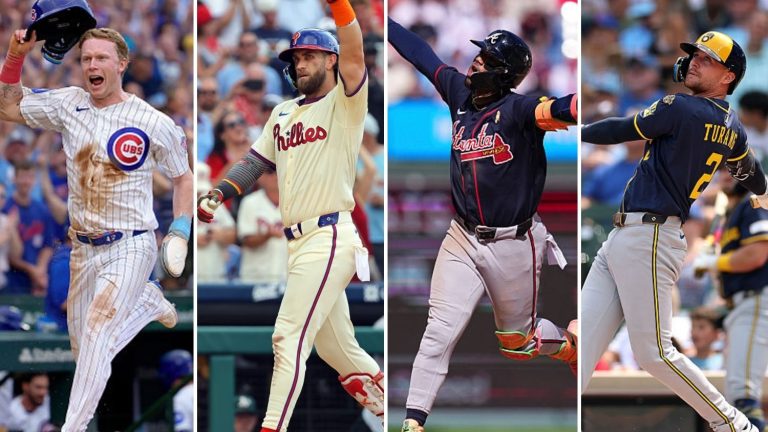
Today, however, we’re talking about the Brewers, Braves, Cubs, and Phillies.
Stats, standings, and rankings from before games on September 15.
The Case for the Brewers
By Joey Peterson
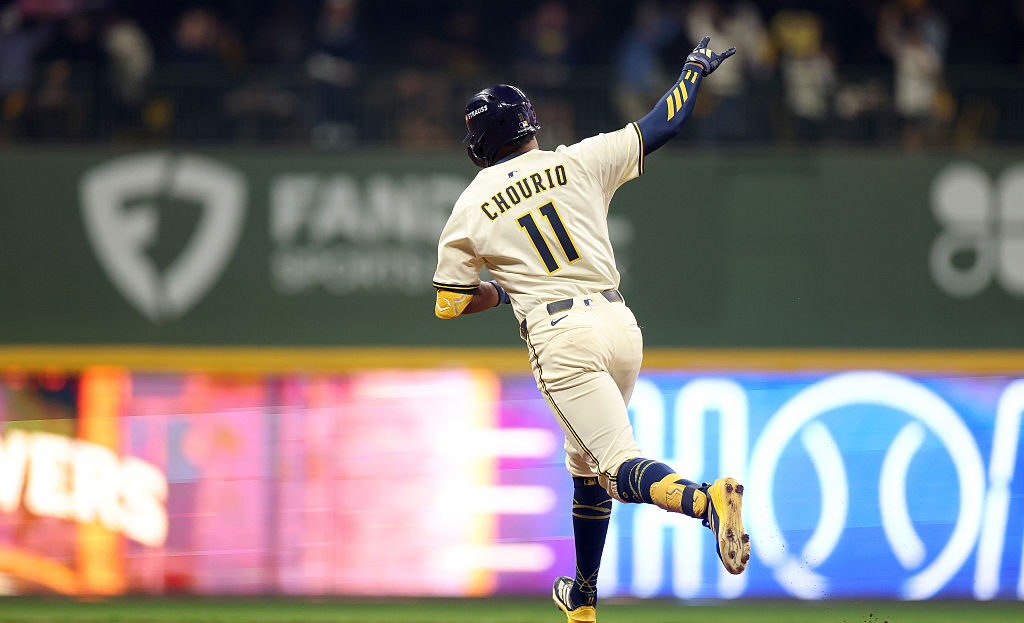
The Milwaukee Brewers have perfected regular-season baseball. They are on track to finish with the best record in baseball for the second straight season, something that hasn’t been done since the 2010-11 Phillies, and they are once again one of the most well-rounded ball clubs in the sport.
But after all the regular-season success they’ve had over the past decade, the Brewers are still trying to find the formula that gets them over the hump in October and past the two-time defending World Series champions.
At face value, it’s fair to say that the Brewers stand the best chance of knocking off the Dodgers. As a team, the Brewers rank third in wRC+, second in batting average, fourth in OPS, fifth in stolen bases, fifth in rotation ERA, fifth in bullpen ERA, and sixth in defensive runs saved.
No matter how you slice it, you’d be hard-pressed to find a team that is more complete. They simply do everything well.
And yet, there is still a looming shadow of doubt sitting in the back of Brewers fans’ minds. How come?
The elephant in the room is something we seemingly come back to every offseason with the Brewers: the ability to slug. While the team has been on a home run barrage over the past week and has scored the most runs in MLB in September with 92 (the next closest being the Mets with 79), the offense’s ability to generate power will ultimately determine the fate of this team.
Heading into play on Friday, September 11, the Brewers ranked 17th in baseball with a .400 slugging percentage. That number now sits at .406, placing them 10th in the league. While one can’t place too much weight on recent performance, the team’s power stroke is starting to click at the right time.
Still, the Brewers hold the sixth-lowest isolated power (ISO) and the third-fewest home runs in Major League Baseball.
Sure, they make up for their lack of home run power with their ability to drive the ball into the gaps and take advantage of their outstanding speed, posting the fifth-most doubles and sixth-most triples in the sport. But when facing a team like the Dodgers, who rank third in slugging percentage and against whom hits will come at a premium, the ability to come up with that one big swing could be the difference between reaching the mountaintop and facing another early postseason exit.
On the flip side, another key to beating the Dodgers and their unprecedented postseason rotation is patience and a sound approach throughout the lineup. That’s an area nobody is better at than the Brewers and something that closes the gap between the two ball clubs.
| Brewers | Dodgers | |
| Pitches Per PA | 3.97 (T-1st) | 3.93 (8th) |
| Swing% | 44.0% (Lowest) | 46.9% (9th Lowest) |
| Zone Swing% | 62.6% (Lowest) | 67.2% (11th Highest) |
| BB% | 10.6% (2nd) | 10.1% (3rd) |
| Chase% | 26.7% (1st) | 27.5% (2nd) |
| Whiff% | 23.9% (8th) | 24.2% (10th) |
The Dodgers are good in many of these categories, but the Brewers are better. What the offense lacks in home run pop it makes up for in peskiness and discipline. Work deep counts, don’t expand the zone, and wait for your pitch to hit. That’s been the Brewers’ identity this season and is how they have manufactured a top-five offense.
In last year’s NLCS matchup between Milwaukee and Los Angeles, the Dodgers were able to get the Brewers completely out of their element and force them away from their identity. In that four-game sweep, the Brewers struck out over 31% of the time, hit just .118, and got on base at a .191 clip. Milwaukee abandoned the approach that got them there, and it sent them packing early. If the same thing happens this time around, the 2026 Brewers could suffer the same fate as the year prior.
What’s more, the Brewers and the Dodgers have both been two of the best teams when hitting with runners in scoring position this year as well. But for a team like Milwaukee that relies on traffic on the basepaths, moving runners over, and manufacturing runs, timely hitting has been key for their offense all season.
I mentioned the Brewers rank 10th in slugging percentage on the year, but with RISP, that mark jumps 36 percentage points to .442, which puts them third in the league. Likewise, when hitting with RISP, the Brewers boast the best on-base percentage in baseball at .363. Milwaukee’s average of .276 is second only to Tampa Bay, and their wOBA of .346 is the best in the majors.
Point being, it’s not always about how you get the big hit, but when you get it as well. The Brewers, when at their best, elevate their play with runners on, and it’s a key element to their offense that makes them extraordinarily hard to beat. Again, the Dodgers are good in many of these categories, but the Brewers are better.
Lastly is the Brewers’ pitching, which is evolving into an interesting conversation.
The Dodgers have a clear-cut starting four that would be arguably the greatest postseason rotation ever assembled in Tarik Skubal, Yoshinobu Yamamoto, Blake Snell, and Tyler Glasnow.
The Brewers, on the other hand, have Miz anchoring the top, along with Logan Henderson, who has emerged as a shoo-in Game 2 starter for Milwaukee with his 2.34 ERA. Beyond those two, there are serious questions as to who fills out Milwaukee’s postseason rotation.
For a majority of the season, the answer was Kyle Harrison. But since coming off the injured list, he has simply not been himself, as evidenced by a 7.00 ERA since his return. His stuff looks diminished, his velocity is trending in the wrong direction, and the current version of Harrison is not one Murphy can feel comfortable handing the ball to in opposition to Snell or Glasnow.
The problem is, the same can be said of the Brewers’ alternative options.
Former Dodger Dustin May was brought in at the trade deadline to be that potential No. 3 or No. 4 starter, but the results haven’t been there since he changed uniforms. He did post his strongest outing yet as a Brewer last time out, so there’s still hope he can round into that No. 3 form. Shane Drohan stepped into his starter role nicely at the beginning of the season, but he has a 5.96 ERA across his last 11 outings (10 starts) since July 11.
That leaves Robert Gasser, whose performance has been shaky at times this season, or perhaps even Brandon Woodruff, who shockingly eluded surgery and could end up making a postseason return.
Either way, the Brewers would be at a severe pitching disadvantage after Game 2, and the last thing they want is to be forced into throwing a bullpen game every other game like they were doing at the tail end of the postseason in 2025.
Of course, when things are clicking, the Brewers are the best team in Major League Baseball and have what it takes to knock off anybody, even the Dodgers.
However, I will leave you with this nugget. Dating back to the beginning of 2023, in the regular season, the Brewers are slashing .251/.330/.399 with a .729 OPS and 103 wRC+. In that same span, in their last three postseason trips, the team is slashing .226/.295/.365 with a .660 OPS and 85 wRC+.
The Brewers have what it takes to compete in the regular season, but they need to prove that they can carry that identity into October and stay true to what got them there. They showed that ability against the Cubs in the NLDS last season, but the team ran out of gas once they met up with Los Angeles.
That said, there is a certain type of magic surrounding the team this year, and that’s something that won’t show up on FanGraphs or Baseball Reference. It’s something that has been illustrated on countless occasions through signature wins all season long, and perhaps that’s just what this team needs to reach the mountaintop.
If they can get over the mental battle that is playoff baseball, the Brewers have what it takes to end the Dodgers’ reign as world champions. They just need to prove that they can stick to the formula that got them there.
The Case for the Braves
By Taylor Greenhut
There might not be a more Jekyll and Hyde team in Major League Baseball than the Atlanta Braves.
At times, the offense, led by Ronald Acuña Jr., Matt Olson, Drake Baldwin, and Michael Harris II, looks nearly impossible to get out. Yet, they sport a team 98 wRC+ through the midway point of September.
On paper, the pitching staff behind Chris Sale can look underwhelming. Then Bryce Elder records 15 quality starts, Martín Pérez posts a 3.16 ERA across 24 starts, and Tyler Mahle performs like the best trade deadline acquisition in baseball.
Then there is the bullpen. At the All-Star break, the Braves bullpen led the league in ERA, FIP, WHIP, and fWAR, with four different relievers ranking inside the top 30. The second half of the season, however, has been a completely different story.
Atlanta currently ranks in the bottom half of the league in each of those categories, with just 0.1 fWAR across 56 games. Both Dylan Lee and Raisel Iglesias have hit rough patches, while Robert Suarez is still ramping up to make his long-awaited return.
Unlike some teams, there is not one specific position group you can point to as the definitive reason the Atlanta Braves can take down the Los Angeles Dodgers. Can the offense score enough? Sure. Can the pitching hold down their offense? We have seen it happen before.
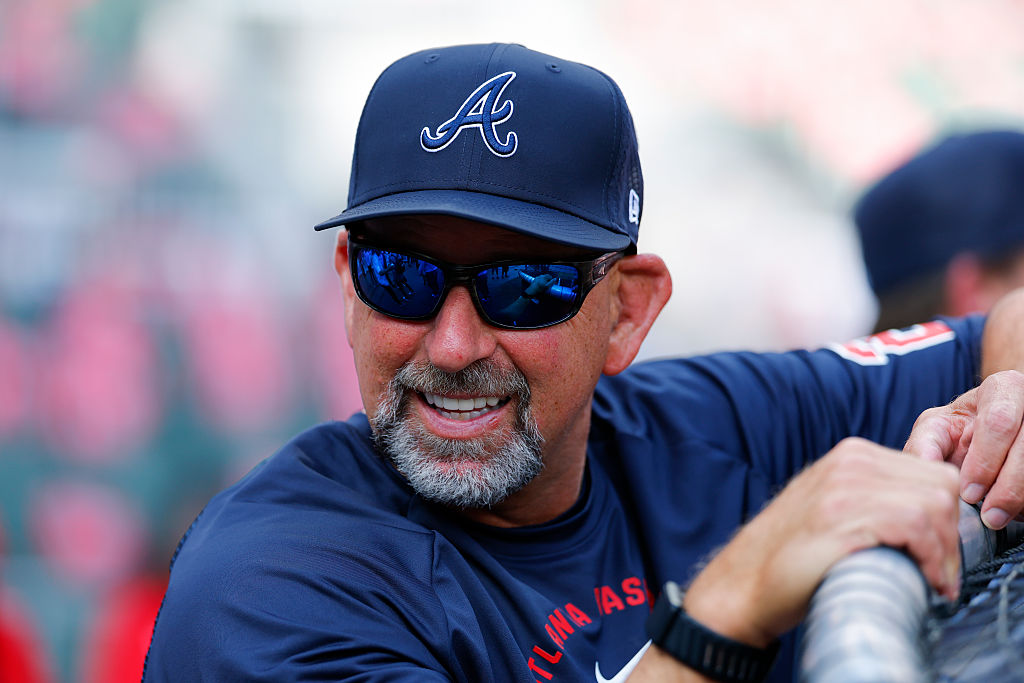
Instead, it is the sum of Atlanta’s parts that gives this team a real chance in an October series. Overseeing all of it is a coaching staff led by Walt Weiss, Tim Hyers, and Jeremy Hefner. They are the keys to Atlanta’s success.
This season, Atlanta is 5-1 against the Dodgers. The Braves lost the first matchup of the season in L.A. before rattling off five straight wins and outscoring Los Angeles 26 to 15. That stretch included victories in games started by Yoshinobu Yamamoto, Blake Snell, and Tyler Glasnow, three of the top pitchers any team will likely see come October.
Of course, that leaves the likely Game 2 starter, Tarik Skubal. The somewhat good news is that Atlanta has seen and gotten to him in the past. During his first Cy Young season in 2024, Atlanta tagged him for five runs on seven hits, including two home runs. Earlier this season, when he was a Detroit Tiger, the Braves managed to scratch across two runs on five hits, including another home run.
That does not mean Atlanta has Skubal or the rest of the rotation figured out, but there is reason to believe this offense can score enough against elite pitching to give itself a chance to win.
Both Harris and Mauricio Dubón are batting over .400 this year against Dodgers starters. Olson, Baldwin, Austin Riley, and Ozzie Albies all have at least two hits. As a team, Atlanta has a .701 OPS through the first five innings in games against Los Angeles this season.
This becomes particularly important because the key to beating a team like the Dodgers is finding a way to get to the bullpen. The starting pitching staff the Dodgers will deploy in October may go down as one of the greatest collections of starting pitching talent in MLB history on paper. The bullpen is a different story.
Despite investing more than $60 million into the bullpen for the 2026 season, the results have not matched. The Dodgers bullpen ranks 14th in baseball with a 3.96 ERA. Since the All-Star break, that ranking falls to 20th with a 4.26 ERA.
Los Angeles also sits around league average in bullpen WHIP, ranking 12th for the season at 1.27 and 16th since the All-Star break at 1.33. The stuff is still there. This group possesses plenty of high-octane, swing-and-miss arms. Where it can run into trouble, however, is with walks.
In both splits, the Dodgers bullpen has a walk rate just above 10.0%. That would seemingly create an opportunity for Atlanta, but the Braves offense ranks in the bottom three in walk rate, below 8.0%. Regardless of the opponent, this will need to be something Hyers and the offense key in on come October. Working counts and taking walks is something Braves fans have been calling for all year.
Atlanta’s starters have had success against the Dodgers this season as well.
| Starter | GS | IP | H | ER | BB | K |
| Chris Sale | 2 | 16.0 | 10 | 2 | 0 | 18 |
| Bryce Elder | 2 | 11.2 | 9 | 3 | 4 | 13 |
| AJ Smith-Shawver | 1 | 5.0 | 5 | 3 | 3 | 3 |
| Spencer Strider | 1 | 6.0 | 1 | 0 | 2 | 8 |
In fact, the Dodgers only have two players batting at least .300 through the first five innings against Atlanta this season: Hunter Feduccia (3-for-3) and Tommy Edman (3-for-7). Mookie Betts, Kyle Tucker, and Shohei Ohtani are the only other players with multiple hits during that span.
What this tells me is that if Weiss and Hefner can deploy their pitching staff in the most optimal way possible, Atlanta has a real chance to keep their offense down.
In a previous piece detailing one path the Braves can take with their pitching staff come October, I discussed how Atlanta could use a piggyback approach in games not started by Sale or Mahle to optimize the pitchers it does have. That becomes especially important with Elder’s recent IL stint, leaving his availability and potential usage slightly more uncertain.
The MLB average ERA for starters the first time through an opposing team’s batting order is 3.45 this season. Atlanta has six starters with at least five starts who have posted a lower ERA: Sale (1.53), Mahle (1.76), AJ Smith-Shawver (1.86), Grant Holmes (2.60), JR Ritchie (2.81), and Pérez (3.02).
As things stand midway through September, the best path for Atlanta would be combining two of Smith-Shawver, Holmes, and Pérez in one outing. Sale and Mahle are as locked in as your Game 1 and 2 starters as can be. Both have been phenomenal this season, especially since the trade deadline.
Against the Dodgers specifically, Pérez would be my choice to start. Left-handed bats such as Ohtani, Tucker, Freddie Freeman, and Max Muncy will likely all sit in the top half of the Los Angeles lineup.
Ideally, Pérez gets you at least into the fourth. If needed, Atlanta could use a reliever such as Dylan Dodd or Victor Mederos to complete an inning before giving Holmes or Smith-Shawver a chance to enter with a clean inning. From there, the next pitcher bridges Atlanta to hopefully at least the seventh, where the bullpen can take over.
That bullpen will then need to do their job. Iglesias will be relied upon to close out close games. Lee and Suarez will have to be healthy and effective. Didier Fuentes, arguably one of the most important players for Atlanta this season, will need to continue to pitch like a 10-year veteran rather than a 21-year-old.
It’s not as ideal as having a certified Game 3 starter like some other contenders, but it is a strategy that has had success and, more importantly, it allows Atlanta to put its pitchers in situations where they have been at their best.
The advantage the Braves have over many other teams is that they have that type of flexibility in their pitching staff. In my currently projected October pitching staff, they have at least five pitchers with both starting and relieving experience over the last few years. This makes covering 27 outs per game much easier to visualize.
Of course, October is a different animal. The Los Angeles Dodgers they faced during the regular season are likely not the same beast Atlanta will see in the postseason. For a team like the Braves, getting through a playoff series against them will require relying on the sum of their parts to not only be optimally positioned by manager Walt Weiss, but to perform as well.
Chris Sale has to be the ace he has been since becoming a Brave. Tyler Mahle will need to continue his impressive performances. Ronald Acuña Jr., Matt Olson, Drake Baldwin, and Michael Harris II will be relied on to help push the offense forward.
But to win a series against a team like the Dodgers, it will take a combined effort from more than just those stars. From the coaching staff to the bench, everyone has to do their job.
The Case for the Cubs
By Joey Peterson
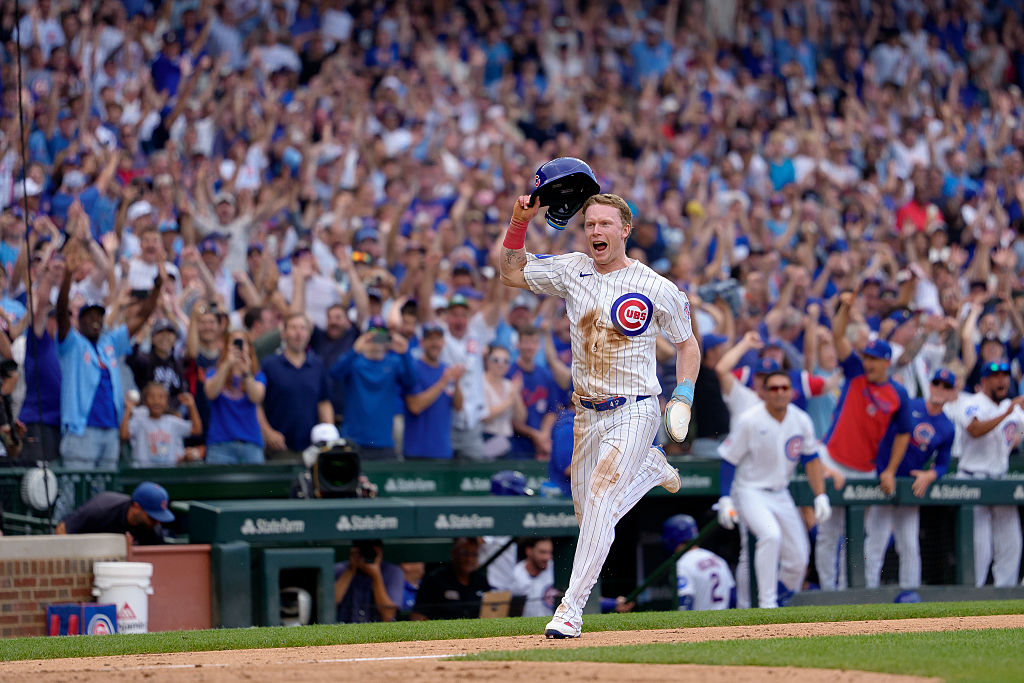
Perhaps no other team across Major League Baseball is better suited to go toe-to-toe with the Dodgers’ offense than the Chicago Cubs. The Cubs have the best offense in the sport and the National League MVP, which is certainly a good place to start when talking about teams that could topple the Dodgers’ run.
The Cubs lead baseball with a whopping 5.34 runs per game, 0.15 more than the next-closest team. The offense as a whole ranks first in slugging percentage, OPS, wOBA, and wRC+. They rank sixth in the league in batting average and are second in OBP, thanks to a league-leading 10.7% walk rate.
There are few holes to poke in their lineup, if any. No team has scored more runs, hit more homers, or has a better batting order from one to nine when it comes to run production. All but one hitter in the current Cubs starting lineup has a wRC+ of 100 or better, with Nico Hoerner (91) serving as the lone exception, and even he is rocking a 112 wRC+ since the All-Star break.
They are patient, ranking fourth in pitches per plate appearance while boasting the second-lowest swing rate in MLB. They put bat to ball as well as any team in the sport, as evidenced by the fourth-highest zone-contact rate and fifth-lowest whiff rate. And they do damage on that contact, with the third-best xwOBA in baseball.
Simply put, while there are questions surrounding the pitching staff, this is the one team that could get past the Dodgers thanks to its ability to hit better than anybody else. Sure, adding Tarik Skubal to the Dodgers’ pitching staff is certainly significant, but the Cubs are the No. 1 offense against left-handed pitching in the sport with a 124 wRC+ and .805 OPS. Against righties, they rank tied for second in wRC+ and fourth in OPS. It’s very difficult to find a weakness in this lineup.
The pitching side of things is where the Dodgers have the major advantage over the Cubs.
The Dodgers would unequivocally have a significant pitching advantage in every single game of a potential series. That’s an area where the same can’t necessarily be said for the Brewers (Misiorowski), Braves (Sale), or Phillies (choose your fighter).
Kevin Gausman was the big trade deadline addition to lead the way, but he has a 5.31 ERA across his first seven starts in a Cubs uniform. Matthew Boyd has a 5.18 ERA across eight starts since the calendar turned to August, and Cubs fans already saw how he lost steam toward the end of the regular season in 2025.
Shota Imanaga has put together a solid season, but it really becomes a flip of the coin as to whether or not he can keep the ball in the ballpark on a given day. He sports a mid-4.00s ERA and 5.60 FIP with 12 home runs surrendered across his last eight starts.
It’s been Clay Holmes who has emerged as the leader of the staff down the stretch, with a mid-3.00s ERA since joining the Cubs. At the end of the day, this is a Cubs rotation that ranks in the bottom half of the league compared to a Dodgers rotation that is one of the best and should only continue to improve.
While the Cubs’ bullpen has been leaking oil over the past couple of weeks, the Dodgers’ unit hasn’t been much better. Since August 1, the Cubs rank 15th in bullpen ERA, while the Dodgers rank 13th. In September, the Cubs rank 10th compared to the Dodgers at 15th.
Neither relief corps is firing on all cylinders, but there’s a lot more confidence that the Dodgers’ bullpen will turn things around once October hits. They have names who have been there and done that, as opposed to a Cubs bullpen that is simply struggling to find a late-inning rock as of late.
The argument for how the Cubs can take down the Dodgers boils down to this: The offense needs to continue to perform like the best lineup in baseball, which I’m sure many believe it can and will, while the pitching staff needs to do just enough to suppress the Dodgers’ bats.
With how the pitching staff is currently performing, the latter half of that Dodgers-beating formula could be the Cubs’ undoing. There are less than two weeks left to figure things out, however, which is more than enough time for the veterans on the Cubs’ pitching staff to do exactly that.
While the offense is as prolific as any in the game, is the pitching good enough to keep a Dodgers lineup littered with future Hall of Famers at bay? That is the million-dollar question.
The Case for the Phillies
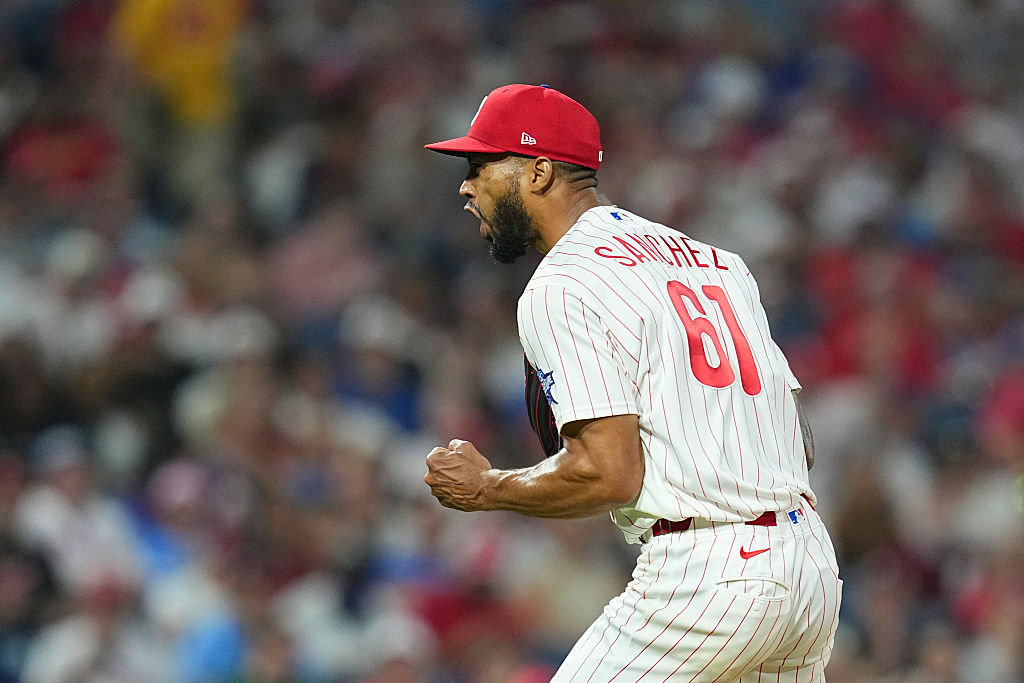
By Leo Morgenstern
The Phillies will live and die by the top three arms in their starting rotation.
There’s the 2025 NL Cy Young runner-up, Cristopher Sánchez. Over the last three years, Sánchez has been, perhaps, the most reliable pitcher in baseball. There’s the 2024 NL Cy Young runner-up, Zack Wheeler. Over the last decade, Wheeler has been, perhaps, the most reliable pitcher in baseball. And then there’s the guy who has pitched better than either of them over the past three months.
Jesús Luzardo has been the best pitcher in baseball for the last three months. He’s been so dominant, I was planning to make the case that he deserved the ball in Game 1 of Philadelphia’s first postseason series – until the Phillies placed him on the injured list on Tuesday. Ugh.
The good news is that the injury doesn’t seem particularly serious. The Phillies are being cautious, and Luzardo should still be available in the playoffs. That’s good news for Philadelphia, good news for Luzardo, and good news for me, because the argument I’m about to make pretty much hinges on the Phillies having three aces.
Sánchez, Wheeler, and Luzardo have combined for 84 starts this year. They have averaged just over six innings per game with a 2.92 ERA. The Phillies are 60-24 (.714) with their three aces on the bump.
No other team has a top three like this one. But if anyone can come close, it’s the Dodgers.
Yoshinobu Yamamoto, last year’s World Series MVP, has been the Dodgers’ rock all year. Back-to-back AL Cy Young winner Tarik Skubal joined him at the trade deadline. Rounding out L.A.’s trio of aces is Blake Snell, himself a two-time Cy Young winner. Snell has been injured for most of his Dodgers tenure, but he’s been healthy for the last month, pitching to a 1.04 ERA in six starts.
The Dodgers have more rotation depth than the Phillies. They have a deeper bullpen and a deeper lineup too. Simply put, their roster is stronger. Even as a Phillies fan, I can’t help but admit that.
But here’s the thing. The same baseball team can have vastly different odds of winning on different days depending on the starting pitcher. When anyone other than Sánchez, Wheeler, or Luzardo is starting, the Phillies don’t even look like a team that belongs in the playoffs. When one of those three is on the mound, this might be the best team in baseball.
When Sánchez, Wheeler, and Luzardo are on their game, it doesn’t matter that Philadelphia’s offense is basically just Bryce Harper and Kyle Schwarber. It doesn’t matter that their bullpen has series question marks after Jhoan Duran. As long as those six players do what they need to do, well, that’s pretty much all you need to win a ballgame.
I still don’t think I could ever call the Phillies the favorites over the Dodgers. Yet, if Sánchez, Wheeler, and Luzardo can pitch as much of a hypothetical Phillies-Dodgers series as possible, these two teams could make for a much closer matchup than one might expect.
Thankfully for Philadelphia, the extra off days in the postseason will allow Sánchez, Wheeler, and Luzardo to take on a much higher percentage of the team’s pitching workload than they can in the regular season.
If the season ended today, the Cubs would host the Phillies in a three-game Wild Card Series. The winner would play the Brewers in the NLDS. For my purposes, I’m going to presume that winner is the Phillies. (Sorry, Cubs fans.)
Here’s what the schedule for those two series would look like:
- NLWC Game 1: September 29
- NLWC Game 2: September 30
- NLWC Game 3*: October
- NLDS Game 1: October 3
- NLDS Game 2: October 4
- NLDS Game 3: October 6
- NLDS Game 4*: October 7
- NLDS Game 5*: October 9
Presuming no one is pitching on short rest, the off days in the schedule allow a pitcher who starts Game 1 in the Wild Card round to also start Games 2 and 5 of the NLDS. That means that one of Sánchez, Wheeler, and Luzardo could pitch four of the five possible NLDS contests.
If the Wild Card round were to go all three games, the Phillies would need Aaron Nola to start Game 1 of the NLDS. Otherwise, they wouldn’t need him until Game 4. Either way, Sánchez, Wheeler, and Luzardo could start the rest of the games.
Now, I don’t mean to understate how difficult it would be for the Phillies to beat the Brewers in the NLDS, but this article is about beating the Dodgers. So, once again, I’m just going to presume that Philadelphia wins.
Here is what the schedule for the NLCS looks like:
- Game 1: October 11
- Game 2: October 12
- Game 3: October 14
- Game 4: October 15
- Game 5*: October 16
- Game 6*: October 18
- Game 7*: October 19
If the Phillies make the NLCS, they’ll get at least one off day before the series starts, another off day before Game 3, and a third day of rest between a potential Game 5 and 6. That’s enough time off to allow Sánchez, Wheeler, and Luzardo to start six of the seven games, no matter what happens in the NLDS.
So far in 2026, the Phillies have won more than 70% of their games with Sánchez, Wheeler, and Luzardo pitching. Of course, the Dodgers (and any other postseason opponents) will pose a tougher threat than most of the teams that trio has beaten.
Still, let’s just imagine the Phillies continue to win at a similar pace with their three aces on the hill in the playoffs. That’s two of three in the Wild Card round, three of four in the NLDS, and four of six in the NLCS. In other words, that’s an NL pennant and a trip to the World Series.
Obviously, that’s no guarantee. There are so many other factors to consider, so much that could go wrong, and so much that could change. This is playoff baseball, after all.
However, my job today was to lay out a case for how the Phillies could topple the two-time reigning World Series champions, and I did the best I could. If the Phillies are going to take down the Dodgers, their best shot is by relying even more heavily on the three-headed three-armed monster that has carried them this far.
Become a Member of Just Baseball
Subscribe and upgrade to go ad-free!
* Save 25% by subscribing annually.