
Kyle Leahy Is Just What the Doctor Ordered for the Cardinals
Entering 2026, Leahy was a lottery ticket. Now, it's safe to say St. Louis has hit big on his promotion to the starting staff.
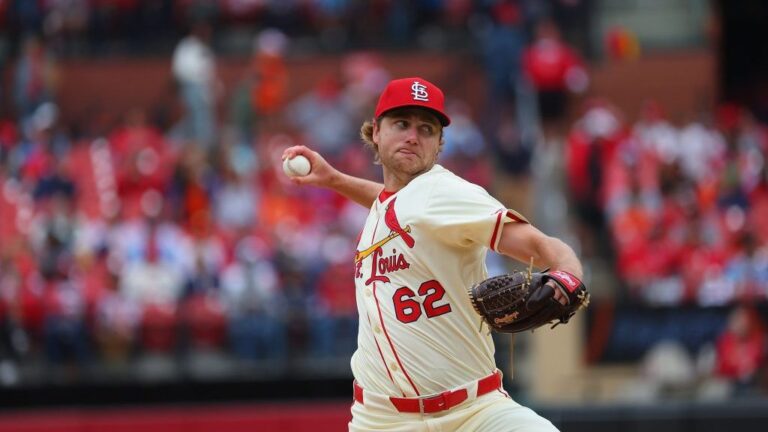
One of baseball’s biggest mysteries is the starting pitcher.
Finding innings in a game that’s become so synonymous with injury is hard. So much so that teams have started to introduce young hurlers to the big leagues in a bullpen role – and it’s working. The Brewers turned Freddy Peralta and Corbin Burnes into monsters after short stints in later innings, and the Cardinals may have done the same with newfound starter Kyle Leahy.
Leahy, 29, made his mark as a reliever last season. Through 88 innings, the right-hander posted 1.5 bWAR, a 3.07 ERA, and an ERA+ of 133. The Cardinals had seen enough: It was time to give him a shot in the rotation.
Now, for reference, starting pitching has been anything but a commodity in modern St. Louis baseball. Since the departure of Lance Lynn and the decomposition of Jack Flaherty’s Cardinal career, St. Louis has struggled mightily to produce homegrown hurlers.
In 2025, the Cardinals trotted out a rotation with multiple young arms, including Andre Pallante, Matthew Liberatore, and spot starts from Michael McGreevy.
Unfortunately, the rainy day for young starters held, and the three combined for an ineffective 0.4 bWAR, weighed down mostly by Pallante’s very poor -1.2 mark.
The Cardinals needed a new, young face in the rotation like a squirrel needs a nut to crack. It wasn’t a must immediately, but over time, they’d be starved for innings without fresh faces.
Enter Leahy.
Kyle Leahy Has Fortified the Cardinals’ Rotation
It isn’t often that a reliever makes the seamless transition to starter. Clay Holmes, now of the Chicago Cubs, is one of the most prominent examples. However, he seems to be one of the few to make a flawless maneuver from bullpen to bona fide ace.
Leahy took those slim odds and cashed out big. His 2026 season has been a monumental success.
Through 25 starts and 126.1 innings, the newest Cardinal starter has a 3.17 ERA, 2.8 bWAR, 115 strikeouts, and a 124 ERA+.
Leahy always profiled as a potential starter. His pitch mix runs deep, with a four-seam fastball, sinker, curveball, sweeper, slider, and changeup.
His best pitches this season have been his changeup and curveball. The latter has a .177 batting average against and has functioned as Leahy’s go-to putaway pitch.
He uses his excellent offspeed stuff, 97th-percentile extension, and above-average groundball rate to navigate traffic and cultivate success.
Leahy is one of many on the Cardinals in the midst of a career year, joining the likes of Jordan Walker, Andre Pallante, Alec Burleson, George Soriano, Riley O’Brien, and more.
There are no questions as to his success, but some metrics hint at potential regression.
What Should Cardinal Fans Make of Kyle Leahy’s Underlying Numbers?
Leahy, like his brother in birds McGreevy, is a byproduct of old-school pitching.
Painting the corners, controlling the run game, and posting value in niche ways across the board have characterized McGreevy’s breakout season – which contrasts with his brutal underlying data.
Similarly, Leahy’s xERA of 4.84 and baseline measurement of 3.13 stand in stark contrast. That could be cause for concern.
When hitters make contact, they bully Leahy’s many offerings. The hurler does his best to mitigate the barrage by limiting walks and inducing groundballs. Unfortunately, despite serviceable metrics in those departments, hard-hit and barrel rates dwell in the clouds.
What could be causing such a drastic difference between what fans see on the screen and what Leahy looks like behind the curtain? It’s like Jekyll and Hyde with curveballs and barrels.
Well, it’s those darn lefties.
Leahy is a force versus right-handed hitters. He’s held opposing sluggers from said side to a baby .597 OPS. With so many different wrinkles diving away from the right side, it makes sense that Leahy finds it second nature to abstain from their barrel.
In contrast, when a hitter flips handedness, he holds an All-Star-esque .839 OPS and pushes the young Leahy’s WHIP up to an alarming 1.72.
Leahy’s best bet to destabilize left-handed hitters when he toes the rubber is to stop challenging them. Opposing batters have an xSLG of .631 against the 29-year-old’s four-seamer. That’s higher than Yordan Alvarez’s slugging percentage.
It could serve him well to tweak his fastball offering (a cutter/more sinkers) or rely more heavily on his best pitches, being his curveball and changeup.
Leahy’s second trouble is longevity. It seems when batters get a third look at the right-hander, they erupt, based on his 6.20 ERA in the fifth inning and 16.20 ERA in the sixth. Where there’s smoke, there’s fire.
To further Leahy’s success, the Cardinals have him on a strict pitch count and have him exiting games as early as the fourth inning. This has him soaring down the stretch, and he’s posted a 1.44 ERA over his last five outings (averaging five innings per start).
However, fans are wondering: If he needs to learn to pitch deeper into games and struggles against lefties, why isn’t the organization allowing him to work on it now?
Kyle Leahy’s Pitch Count Is a Good Thing
For Leahy to be an everyday starter, he needs to be available to start.
He’s already surpassed his career-high mark of 88 innings from last season, and continues to build upon it with every outing. The Cardinals, now several games out of a playoff spot, have identified an opportunity for rest. Leahy’s future outweighs the remainder of his season.
St. Louis has a surplus of young talent in its minor league system for the first time in recent memory. Leahy was once a part of that system, and he’s blooming in real time. The last thing the Redbirds need is another stalled arm like Jordan Hicks, Alex Reyes, Giovanny Gallegos, or even twilight Ryan Helsley.
This pitch count enables Leahy to stay on track down the stretch, and not roll into the offseason exasperated and fuming. The Cardinals have no reason to spoil his success.
Furthermore, with 2028 seeming like a realistic target for competency organization-wide, the Redbirds will likely have another average season in 2027. Call it the calm before the storm.
They need Leahy next year. If he goes down, someone has to file upwards to replace him, and if the Cardinals had anyone they were ready to promote anytime soon, they’d already be up.
Leahy is an interesting case. He’s got analytics that scream Regression!, a pitch mix that looks like it was bought in bulk, and numbers that hold hands with success.
With an improvement against left-handed foes and conditioning in the offseason – serving as maintenance for the fifth inning and later – Leahy could really ramp himself into long-term conversations.
However, that remains speculation until he proves his ascension leads to those heights. Here, in the now, Leahy serves as one of many success stories from the first year of new POBO Chaim Bloom’s reign.
From bullpen standout to rotation anchor, Leahy has earned praise from the St. Louis faithful. And moving forward, he could be an integral part of the plan.
Become a Member of Just Baseball
Subscribe and upgrade to go ad-free!
* Save 25% by subscribing annually.

Written by
AJ Stone is a sportswriter and journalist currently attending the University of Missouri School of Journalism. His work has appeared on Redbird Rants, Heavy.com, Arcadia News,…