
James Wood Has Become the Offensive Anchor the Nationals Needed
Wood is no longer just an exciting young player with immense upside. He is becoming the type of centerpiece capable of anchoring a playoff-caliber lineup.
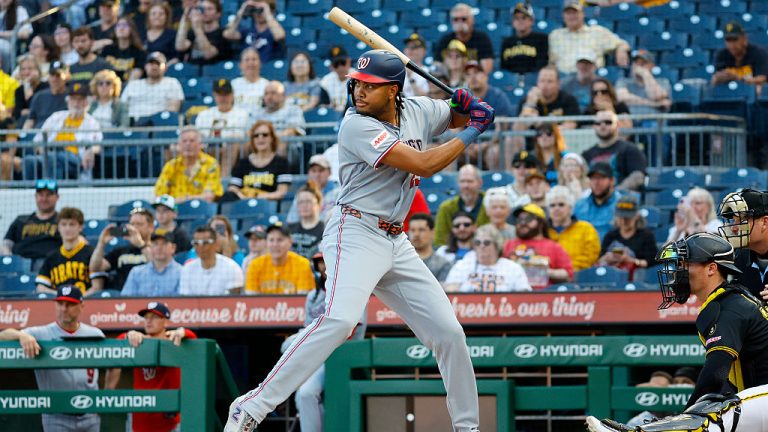
For the better part of the past several seasons, the Washington Nationals have been searching for the foundational pieces of their next competitive roster.
James Wood was always the most obvious candidate to become the centerpiece. The raw ingredients were difficult to ignore: top-of-the-scale power, advanced plate discipline and unusual athleticism for a hitter with his imposing frame. But his first full major-league season also demonstrated why development is rarely linear. Wood’s ceiling was immense. The path toward reaching it remained incomplete.
That has changed in 2026.
Wood has not eliminated the swing-and-miss from his profile. He has not become a radically different hitter. Instead, he has doubled down on the strengths that made him special, made meaningful adjustments in the areas that limited him and emerged as one of the most dangerous offensive players in baseball.
The result is more significant than an early-season breakout. Wood is showing that the Nationals already possess the most difficult player to find in a rebuild: a true middle-of-the-order anchor capable of lifting an entire lineup.
Stats were taken prior to play on June 7.
Making Sense of 2025
Wood was electric out of the gate in 2025.
Through the first half of the season, the 22-year-old slugger posted a 150 wRC+ with 24 home runs. His combination of patience and power made him a justifiable All-Star and offered an early glimpse of what a fully realized version of Wood could eventually look like in the heart of a major-league lineup.
The second half was a very different story.
Wood’s walk rate fell from approximately 14% to just under 10%, while his strikeout rate spiked to nearly 40%. His slugging percentage dropped from .534 to .388, and he produced only seven home runs after the All-Star break.
His 93 second-half wRC+ was not disastrous, particularly for a player navigating his first full major-league season, but it represented a dramatic decline from the star-level production he had provided during the opening months of the year.
There is no singular explanation for the drop-off.
Wood’s difficult second half unfolded as the Nationals were sliding out of contention and entering a period of organizational transition. Mike Rizzo and Dave Martinez were dismissed in July, bringing an era of Nationals baseball to a close. Wood was also a young player encountering the physical and mental grind of a full major-league schedule for the first time.
It is impossible to isolate how much each factor contributed. Whatever the precise combination, the version of Wood that finished the season was not the same hitter who had overwhelmed pitchers early in the year.
The underlying numbers also revealed a clear area for growth.
Wood already possessed some of the most imposing raw power in the sport, but his ability to inflict damage varied dramatically depending on the type of pitch he encountered. He produced a 98.9 mph average exit velocity against fastballs in 2025 but failed to reach a 90 mph average exit velocity against either breaking balls or offspeed pitches.
That gap was not especially surprising for a towering, long-levered hitter who was still only 22 years old. Wood had already demonstrated that he could punish velocity with the authority of an elite power hitter. The next step was proving that pitchers could not neutralize that power simply by changing speeds and shapes.
The uneven finish should not obscure the success of the season as a whole. Wood concluded his first full major-league campaign with 31 home runs, a 127 wRC+ and 3.3 fWAR. For a player whose profile always contained some volatility, 2025 established an impressive baseline while making the path toward another leap relatively clear.
The Breakout
Wood has leaned even further into his three-true-outcome profile in 2026.
The strikeouts remain, but so does some of the best plate discipline in baseball. His 17.4% walk rate ranks in the 98th percentile, raising his offensive floor and giving him a margin for error that few hitters with his swing-and-miss tendencies possess.
The most important development has occurred when Wood puts the ball in play.
Wood has slashed his ground-ball rate by 11.6 percentage points, falling from 49.7% in 2025 to 38.1% this season. His fly-ball rate has climbed from 21.3% to 31.6%. For a hitter with top-of-the-scale raw power, getting the ball into the air more consistently was always the most direct path toward another level of production.
His barrel rate has surged from 16.4% to 25.2%, placing him among the premier power hitters in the sport.
The improvement is particularly notable because it has come in the area that limited him most clearly during his first full season. Wood was already capable of overwhelming fastballs in 2025. The more pressing question was whether he could prevent pitchers from exploiting him with a steady diet of secondary pitches.
He has begun to answer it emphatically.
Wood’s average exit velocity against breaking pitches has jumped to 96.1 mph. He has also made immense progress against changeups. His hard-hit rate against the pitch has climbed from approximately 44% to nearly 56%, while his run value has swung from -3 in 2025 to +4 this season.
For a left-handed hitter who will continue to see a steady diet of changeups from right-handed pitchers, that adjustment is monumental.
Notably, Wood has not made these gains by eliminating the swing-and-miss from his game. In some respects, the opposite is true. He is still whiffing frequently against breaking pitches. Pitchers can still exploit the length in his swing, and strikeouts will remain part of the equation.
The difference is that his increasingly refined swing decisions allow him to avoid pitchers’ pitches more consistently, while his immense raw power ensures that mistakes are punished severely. He does not need to eliminate every weakness. He needs to force pitchers to navigate an increasingly narrow margin for error.
Players who strike out in more than 30% of their plate appearances rarely become elite offensive performers. Most hitters cannot withstand that level of swing-and-miss.
Wood is proving that he may be one of the exceptions.
His combination of patience, raw power and improved damage against secondary pitches is overwhelming enough to support star-level production even without a dramatic reduction in strikeouts.
The Centerpiece of the Lineup
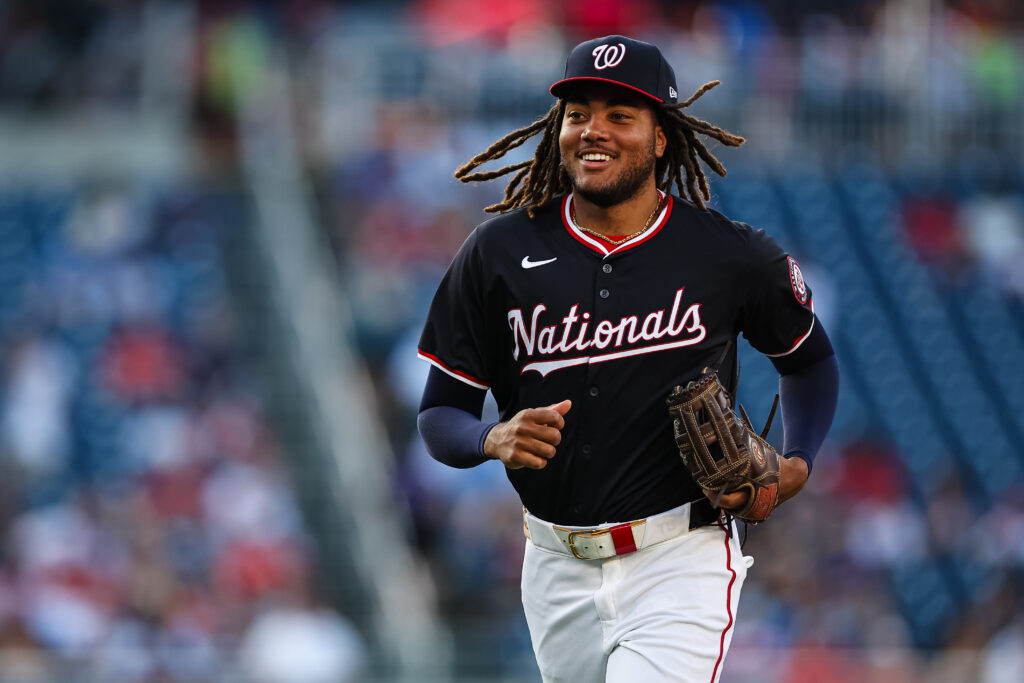
Wood’s breakout presents an exciting reality for Paul Toboni and the Nationals’ new front office.
Wood will not turn 24 until September. Under the current collective bargaining agreement, Washington controls his rights through the 2030 season.
The hardest thing to find as a roster builder is a true offensive anchor — the kind of needle-moving bat capable of elevating an entire lineup. Toboni and company inherited one in Wood.
The Nationals remain early in their transition, but the early results have been more encouraging than anticipated.
Washington has remained within striking distance of a wild-card spot after trading MacKenzie Gore, its most established starting pitcher, to the Texas Rangers during the offseason. CJ Abrams is enjoying the strongest offensive season of his career. With Wood at the heart of the order, the Nationals have already built one of the most productive offenses in baseball without relying on a lineup filled with established above-average hitters.
It remains unlikely that Washington is ready to play deep into October. The pitching staff is not yet complete, and the lineup still requires additional depth.
But the outline of a competitive core is beginning to take shape.
Cade Cavalli’s encouraging return has given the Nationals one potential rotation piece at the major-league level. Travis Sykora (JB No. 52) and Jarlin Susana (JB No. 58), two of the premier pitching prospects in the organization, could provide reinforcements as soon as 2027.
Further down the system, Landon Harmon and Miguel Sime Jr. offer the type of high-upside arms that could create additional opportunities for Washington to build a rotation from within.
There is still considerable work ahead. Pitching prospects are inherently volatile. Some of those young arms will encounter setbacks. Others may never reach their ceilings. Toboni will eventually need to supplement the roster externally rather than relying exclusively on internal development.
But the most difficult piece is already in place.
Final Thoughts
Wood has more major-league experience than Nick Kurtz, but the comparison is instructive. Both are 23-year-old left-handed hitters with the offensive upside to sit at the center of a contender. Their paths have been different, and their profiles are not identical. Kurtz announced himself immediately as one of baseball’s most dangerous young sluggers. Wood’s emergence has been more gradual, requiring him to adjust after an uneven first full season.
The broader significance is similar.
Wood has shown that he can control the strike zone, produce elite damage on contact and make meaningful adjustments when pitchers identify a weakness. He is no longer simply an exciting young player with immense upside. He is becoming the type of offensive centerpiece capable of anchoring a playoff-caliber lineup.
For the first time in the Nationals’ rebuild, the question is no longer whether they possess the foundational bat.
The question is how quickly they can assemble the pieces around him.
Become a Member of Just Baseball
Subscribe and upgrade to go ad-free!
* Save 25% by subscribing annually.

Written by