
The White Sox and Nationals Quietly Pulled Off a Perfect Win-Win Trade
When the White Sox and Nationals swapped Curtis Mead and Boston Smith in March, it didn't turn many heads. Two months later, the deal is working out nicely for both sides.
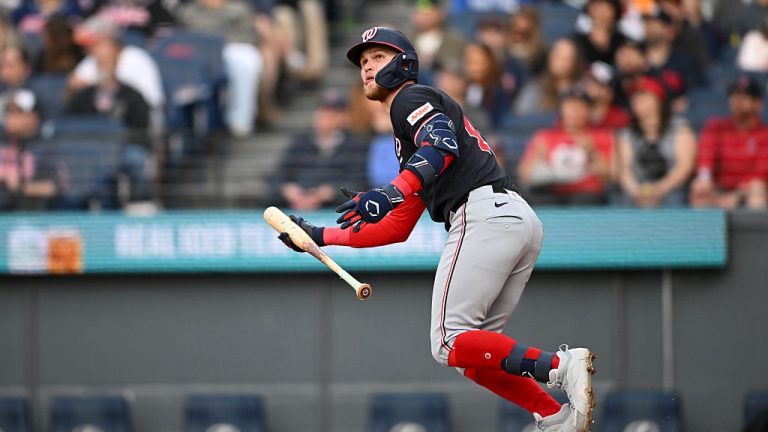
When the Washington Nationals and Chicago White Sox lined up on a minor trade in late March, it didn’t exactly garner a bunch of headlines. Both teams entered the 2026 campaign with expectations of finishing at or near the bottom of their respective divisions, so the one-for-one swap meant next to nothing at the time of its announcement.
Two months and 57 regular-season games later, it now looks like the Curtis Mead for Boston Smith swap could work out long-term for both teams involved.
You’re forgiven if you didn’t circle this swap as one you needed to come back to once each player got going on their new team.
Mead, who’s best known as being the lone piece the Tampa Bay Rays acquired from the Philadelphia Phillies in exchange for Cristopher Sánchez back in 2019, came to the Nationals with 152 big league games under his belt but a measly .617 OPS and 77 wRC+ during that span.
Smith, the Nationals’ sixth-round pick in the 2025 MLB Draft, didn’t play a single game in Washington’s system before the trade went down. He did, however, hit 26 home runs with more walks than strikeouts and a 1.269 OPS in 59 games during his senior year in college.
Curtis Mead Is Finally Capitalizing on His Potential
Mead came to D.C. with a bit of history to his name, because he was at one point viewed as a legitimate can’t-miss prospect in the Rays’ system. At one point, he made it as high as their No. 2 prospect (per MLB Pipeline, 2023) behind only Taj Bradley, who’s having a breakout of his own this year over in Minnesota.
All throughout his journey through the minor leagues, Mead’s done nothing but rake. While that hadn’t translated to the big leagues before this year, it’s still worth mentioning that he’s shown he can rake before.
- 2021: 104 G, 15 HR, 69 RBI, .321 AVG, 142 wRC+
- 2022: 76 G, 13 HR, 50 RBI, .298 AVG, 141 wRC+
- 2023: 65 G, 9 HR, 49 RBI, .287 AVG, 116 wRC+
- 2024: 91 G, 13 HR, 41 RBI, .288 AVG, 115 wRC+
The Australian got looks in parts of three years for the Rays (and one on the White Sox) but could never quite put it together at the game’s highest level. He had a strong month of May last year and has been a regular spring training star, but nothing beyond that
That is, until the 2026 campaign.
The Journey Isn’t Always Linear
The Nationals received below-average production from top prospect Brady House to open the 2026 season, and he’s currently in Triple-A because of it. That’s opened the door for Mead, who’s been swinging the bat really well this year so far, to receive an extended look at third base.
He may not be a qualified hitter yet, but amongst Nationals with at least 140 PA this year, Mead is third on the team in OPS (.823) and wRC+ (134), tied for third in home runs (7), and has the team’s second-highest walk percentage (13.8%).
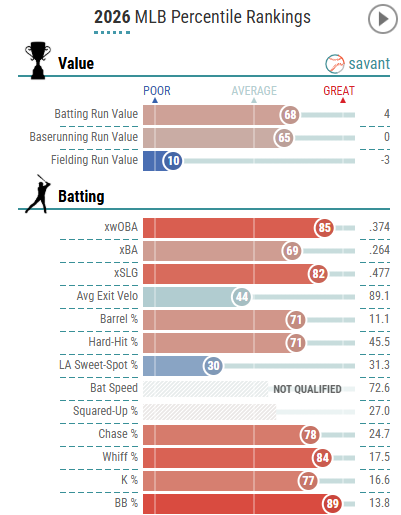
The walks are especially interesting, because Mead’s never had much patience at the plate throughout his professional career. Before this year, he’d never sported a walk percentage above 7.6% in the big leagues, and his strikeout percentage – which currently sits at 16.6% – had never been below 22.7% entering this year. He’s seeing the ball so well, which is clearly translating to his first sustained run of success in The Show.
Earlier this month, Mead told reporters that he’s been making more of a conscious effort to only swing the bat when he thinks he can do the most damage. The changes in his BB/K rate, as well as the fact that he’s chasing pitches less than he ever has before, back that up.
Defensively, Mead isn’t exactly going to bring home any hardware for his glove work over at third base. He’s got 0 Defensive Runs Saved and 1 Out Above Average at the hot corner this year, but he’s also in the 6th percentile in total OAA. Some of that is due to his well below-average play at first base, but he’s at least able to hold his own at the more demanding of the two infield corners.
Mead’s Playing a Huge Role on These Nationals
At some point it might make sense for the Nationals to have one of Mead and Yohandy Morales at each infield corner, especially if they’re looking to push the pedal to the metal with their team’s offensive approach.
While Mead himself obviously deserves credit for making the mechanical adjustments necessary to improve his results, there’s also something in the water over in D.C.
Jacob Young, the Nationals’ glove-first center fielder, hit five home runs from 2023-2025, and already has seven this year. He’s also brought his K% down from where it has been in years past, too.
As a team, the Nationals lead the major leagues (yes, really!) in runs scored (306) and are fourth in wRC+ (110). Clearly, something’s going on over there, and frankly it’s about time we start talking more about this team in a positive light.
Getting everyday at-bats in a relatively low-pressure environment for the first time in his big league career, Mead’s winning over more Nationals fans’ hearts by the day. Just one quick look through X will have you finding fans everywhere thanking their lucky stars that Mead is on their team.
He’s still controllable through 2030 and there’s a chance he winds up being an important piece of this organization’s next push to a contention window.
Yet Another Great Catcher in the White Sox System
But hold on, we’re not here to only talk about Mead and how well the Nationals made out in this trade!
In the White Sox’ farm system, Boston Smith is making a name for himself as well. The backstop was a huge bat in college for the Wright State Raiders, putting up video game-like numbers in his senior year before being picked by the Nationals in the sixth round of last year’s draft.
The expectations were, obviously, that he’d swing a strong bat once he made his pro debut. Of course, things don’t always work out that way, but he’s hit the ground running through his first 39 games in the low-minors of the White Sox system.
So far, Smith has nine home runs and 27 RBI, hitting .288 with a .955 OPS and 146 wRC+. His OPS is 11th amongst all qualifying minor league catchers to open the season, and his wRC+ is 15th amongst MiLB catchers.
He’s already earned his first promotion from Low- to High-A, and his numbers have gotten even better after moving up. It’s not difficult to see why he’s already moving up the ladder in Year One.
Smith has a very lowkey, simple stance and packs a ton of punch into his swing. There’s very little noise and extra movement going on when he’s at the dish, but he’s already proven to be an up-and-comer that’s got some thump in his stick.
Where Does He Fit on the White Sox?
Sure, Smith is a 23-year-old who’s only just began his career, so he’s off to a bit of a late start compared to his peers. However, the kid’s raking and as long as he’s doing that, he’s going to have some eyes on him.
Smith is years away from a big league debut, but you can’t ignore the fact that the White Sox already have a ton of catchers on their roster. Edgar Quero and Drew Romo are holding things down in the big leagues right now, while Kyle Teel is on the MLB injured list as well.
This is without mentioning Landon Hodge and Fernando Graterol, two backstops in MLB Pipeline’s White Sox top-30 who are well younger and further behind Smith developmentally. The point is, the White Sox have so many bright catchers that they don’t even know what to do with them.
Interestingly, the Sox have given Smith six starts in left field early on this year, perhaps in an effort to test any potential versatility he can offer. In college, he primarily played catcher but also earned looks in left, as well as at second and third base and shortstop. He’s always been an agile defender behind the dish, so Chicago leaning into the flexibility as he ascends could help both player and team in the long run.
Become a Member of Just Baseball
Subscribe and upgrade to go ad-free!
* Save 25% by subscribing annually.

Written by
Eric Treuden (troy-din) has covered baseball for years for multiple different outlets including FanSided, Yardbarker, and Wisconsin Sports Heroics. He recently was the editor for Jays…