
Dillon Dingler Is the Best Catcher Nobody Is Talking About
While Detroit’s disappointing season has shifted media attention to Skubal trade speculation, Dingler has quietly emerged as one of the most complete catchers in baseball.
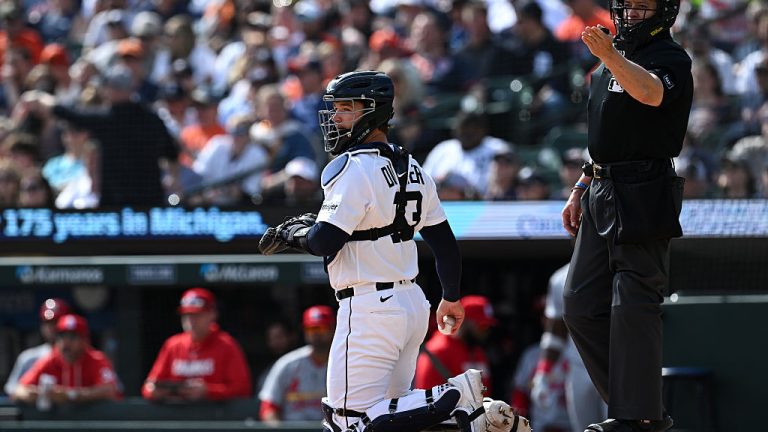
For much of the first half, the conversation surrounding the Detroit Tigers hasn’t been about the players producing. It’s been about the players who might not be around much longer.
As Detroit has stumbled to a 35-48 record and fourth place in the American League Central, attention has shifted toward the trade deadline and the growing speculation surrounding ace Tarik Skubal. That’s what losing does. It turns the focus toward what comes next instead of what’s happening now.
In the process, one of the best seasons by any catcher in baseball has slipped under the national radar.
Stats were taken prior to play on June 28.
The Prospect Who Kept Working
Dillon Dingler‘s rise hasn’t followed the path of most breakout stars.
When the Tigers selected the Ohio State product with the first pick of the second round in the 2020 MLB Draft after he fell out of the first, the appeal was obvious. He was athletic, possessed legitimate raw power, and projected as a quality defender behind the plate.
By 2022, he had climbed to fourth in Detroit’s prospect rankings, trailing only Riley Greene, Spencer Torkelson, and Jackson Jobe.
But while power was improving throughout his time in the minors, evaluators started questioning whether enough contact would come. His speed regressed. Even his once elite arm received slightly lower grades despite remaining a plus tool.
As other prospects emerged, Dingler slid to 16th in the organization entering 2023 and 14th before the 2024 season.
When he debuted in July of 2024, those concerns over his true potential appeared justified.
In 27 games, Dingler hit just .167 with a .505 OPS, walked only three times against 30 strikeouts, and produced a -0.3 bWAR.
But like so many great stories that make sports timeless, rather than letting that rough introduction define him, Dingler used it as fuel.
He broke camp with Detroit in 2025 and never gave the organization a reason to look back. Dingler finished his first full season slashing .278/.327/.425 with 121 hits, 13 home runs, and 57 RBIs while posting a 3.1 bWAR.
More importantly, he established himself as one of the premier defensive catchers in baseball, taking home the American League Gold Glove. For many catchers, a Gold Glove defender who provides enough offense to hold down an everyday role is the ceiling. Instead, it looks like it became a launching point for so much more.
The Numbers Make a Convincing Case
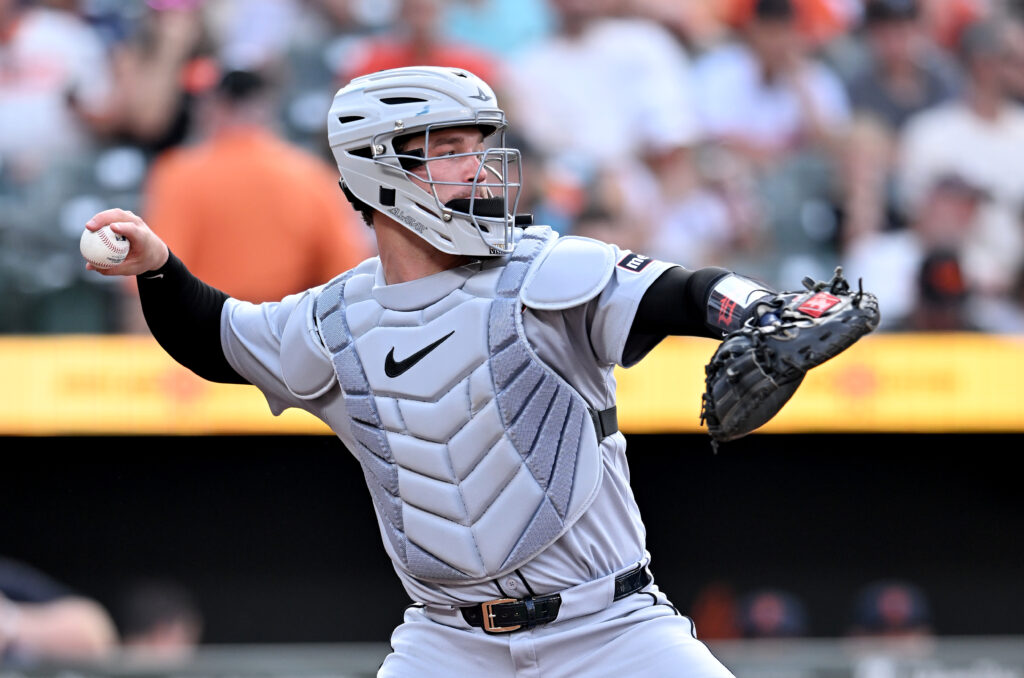
There isn’t another way to frame it. Through the first half of 2026, Dillon Dingler has been one of the most valuable players in Major League Baseball.
Dingler’s .267/.333/.537 slash line translates to an .871 OPS, the highest among qualified catchers. His 19 home runs rank second at the position and are tied for 11th across the majors. His 58 RBIs lead every catcher in baseball while ranking tied for second overall, already eclipsing last season’s total before the calendar even flips to July.
Dingler enters the final weekend of June with a 3.8 fWAR, ranking third among all players in Major League Baseball—not third among catchers, but third overall.
Third!
The next closest catcher on the leaderboard is Shea Langeliers at 2.2 fWAR.
Much of that value comes from becoming a significantly better offensive player without sacrificing what already made him valuable. FanGraphs credits Dingler with 14.0 offensive runs above average between his bat and baserunning after finishing at just 5.0 a season ago.
His defensive value has dipped from an elite 18.9 to 12.1, but even that regression still places him comfortably among the game’s premier defenders.
The production isn’t coming in carefully selected situations, either.
Against right-handed pitching, the matchup he sees nearly 70% of the time, Dingler owns a .286 average and a .930 OPS while launching 15 of his 19 home runs. Whether he’s playing at Comerica Park (.879 OPS) or on the road (.862 OPS), during the day (.935 OPS) or under the lights (.848 OPS), the production is as consistent as can be.
Perhaps the most fascinating split comes when comparing his production by position.
Most catchers welcome the occasional day at designated hitter as a chance to keep their bat in the lineup while giving their legs a break. Dingler has looked like two entirely different hitters depending on whether he’s wearing the gear.
As a designated hitter, he’s batting just .184 with a .660 OPS. Behind the plate, those numbers jump to .291 with a .935 OPS.
It’s an unusual split, but it speaks to the type of player he has become. Some catchers seem to find their rhythm through the constant engagement the position demands. Dingler appears to be one of them.
He’s also become one of Detroit’s most reliable hitters when games begin to turn. Leading off an inning, he’s batting .364 with a 1.172 OPS and five home runs, consistently putting pressure on opposing pitchers and igniting rallies.
Once runners reach scoring position, he becomes even tougher to navigate, hitting .299 with a .948 OPS while driving in 38 runs. Add two outs to the equation, and he’s somehow been even better, batting north of .400 with five home runs in just 42 at-bats.
Why the Breakout Looks Sustainable
Every breakout season invites the same question: is this who the player has become, or is he simply riding an extended hot streak?
The underlying data strongly favors the former.
According to Baseball Savant, Dingler’s framing grades in the 100th percentile, while both his blocking and pop time rank in the 89th percentile or above.
In the batter’s box, his expected weighted on-base average and expected slugging percentage sit in the 97th percentile. His expected batting average ranks in the 96th percentile.
Those expected metrics matter because they evaluate the quality of contact rather than simply the result. Strip away much of the randomness that comes with where a baseball happens to land, and Dingler’s offensive profile actually looks even stronger than his already excellent traditional numbers.
The improvements from last season aren’t difficult to identify.
Dingler’s average exit velocity has jumped from the 50th percentile to the 72nd. His barrel rate has climbed from 9.2% to 13.0%. His hard-hit rate has increased from 45.7% to 49.5%, while his strikeout rate has dropped and he’s squaring baseballs up more consistently than ever before.
Yes, he’ll still expand the zone, and he’s unlikely to ever become a high-walk hitter. But that’s becoming far less consequential because the quality of contact has improved so dramatically. When Dingler puts the ball in play, he’s doing damage.
Perhaps the clearest evidence of his growth is how difficult he’s become to attack.
Pitchers haven’t discovered an obvious weakness. Dingler is hitting .271 against fastballs, .267 against breaking balls, and .263 against off-speed pitches while slugging at least .474 against each pitch type.
His expected batting average against fastballs sits at an eye-popping .334, suggesting he’s actually deserved even better results against the pitch he sees most often.
He’s pulling the baseball five percent more often than he did a year ago while also pulling more balls in the air, a combination that naturally leads to increased power production without dramatically changing the rest of his offensive profile.
Whether Dingler sustains this level for years remains the final question, because that’s ultimately what separates a breakout season from a superstar.
But through the first half of 2026, there hasn’t been a catcher who has impacted winning more completely.
It’s time the rest of the baseball world noticed.
Become a Member of Just Baseball
Subscribe and upgrade to go ad-free!
* Save 25% by subscribing annually.

Written by