
Did the Red Sox Really Lose the Kyle Harrison Trade?
After looking like an early Brewers fleece to start the year, the Kyle Harrison trade is starting to look more like a win-win.
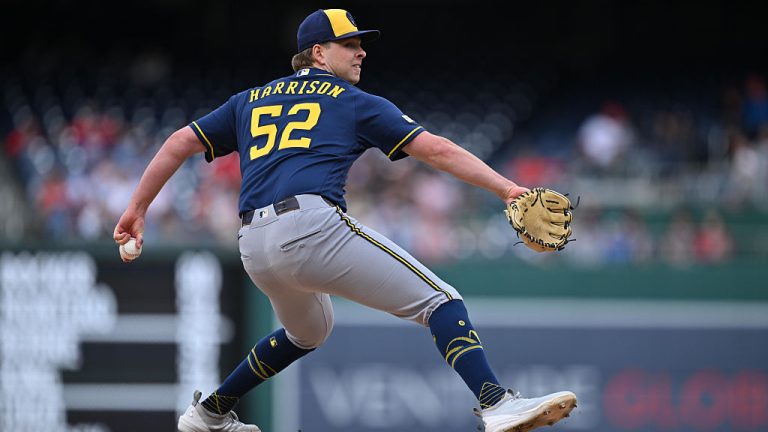
Death, taxes, and the Boston Red Sox trading away back-of-the-rotation pitching arms.
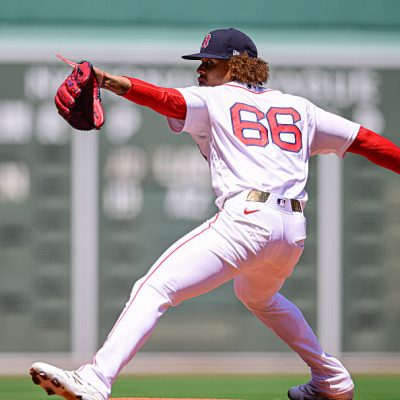
In the past year, the Red Sox have traded away Richard Fitts, Connelly Early, Hunter Dobbins, Shane Drohan, and David Sandlin. Yet, none of these were more controversial than the trade of Kyle Harrison.
As the Red Sox struggled through the first few months of the season, CBO Craig Breslow’s offseason trade with the Milwaukee Brewers had fans screaming “Quinn Priester 2.0.” Harrison was on an All-Star path while Caleb Durbin and Andruw Monasterio struggled. Anthony Seigler, meanwhile, was still in Worcester.
Also included in this trade were Drohan, a 2024 Rule 5 pick by the White Sox who was later returned to Boston, and David Hamilton, a scrappy role player with elite speed.
The perception of this trade has changed rapidly, from a logical win-win to an utter fleece and back. Here’s why.
Why This Trade Made Sense Originally
During the offseason, the Boston Red Sox had a few holes. The largest was at the hot corner, where the Rafael Devers-shaped hole was filled with Alex Bregman. Alas, Bregman signed with the Cubs, forcing Breslow to find some way to fill the gap. His infielder of choice? The Brewers’ Caleb Durbin.
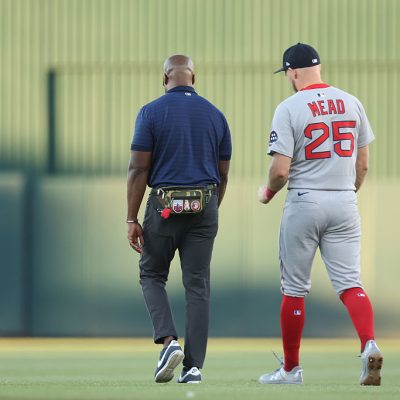
On top of this, the acquisitions of Monasterio and Seigler provided strong depth. Monasterio was an average bench bat with defensive versatility, albeit without great defensive numbers. Seigler was a relatively unheralded prospect at the time, but he was seen as a player who could be a serviceable injury replacement, which he has largely accomplished this season alongside guys like Nick Sogard and Tsung-Che Cheng.
For the Brewers, they needed to sure up the back end of their rotation. Jacob Misiorowski and Quinn Priester were budding young stars looking to step up at the top of the rotation in Milwaukee. Brandon Woodruff returned as well, but he has a turbulent injury history, ensuring that additional depth is never a bad option.
Insert Harrison. Once labeled a top-25 prospect by some, he was mediocre at best for the Giants and made a few spot starts for the Red Sox. Though, he continued to develop nicely in Triple-A Worcester. The Brewers continued their trend of noticing something that the Red Sox missed, and, soon enough, Harrison was mowing down hitters in Milwaukee.
Drohan has also developed into a unique role with the Brewers. There was an early-season period in 2023 where Drohan excelled so much that Boston fans saw him as a serious rotation piece of the future before a massive late-season drop-off sent expectations tumbling. In his time with the Brewers, he began as a swingman before injuries forced him into a full-time starter role in June. Since then, he’s held a sub-4.00 ERA.
The final piece of the pie was Hamilton, who has produced middling offense and even worse defense, but he has maintained a roster spot thanks to his impressive baserunning talents. In a weak Milwaukee infield post-trade, Hamilton has been the go-to player for manager Pat Murphy.
Value in the 2026 Season
If you’d like to compare the two packages from the standpoint of a WAR absolutist, Boston’s acquisitions have produced 5.5 bWAR to Milwaukee’s 4.1. The biggest success story of this ordeal has been Durbin, whose above-average offense combined with Gold Glove-caliber defense has fueled the team’s newfound playoff aspirations.
And yet, this trade remains a win-win. After the Brewers dealt Freddy Peralta and Priester was declared done for the year after a Spring Training injury, the Brewers needed help. Harrison filled that role, allowing another team greater than the sum of its parts to become a legitimate World Series contender.
The unsung impact of this trade has also been the injury need among these role fillers, which has given both teams a more significant advantage. Monasterio has given Boston a mere 1.3 bWAR. But he also wasn’t expected to start in front of Trevor Story, Marcelo Mayer, or even Isiah Kiner-Falefa. Compared to the next man up at shortstop (there is currently not another on the active roster), Monasterio’s value over the potential replacement gives him more situational value to a Red Sox team in need.
The same goes for the Brewers, whose self-inflicted Durbin-sized hole at third base, along with the absence of Peralta and Priester in the rotation, allowed Hamilton and Drohan to have additional value in terms of the team’s positional needs.
Long-Term Value and Contract Status
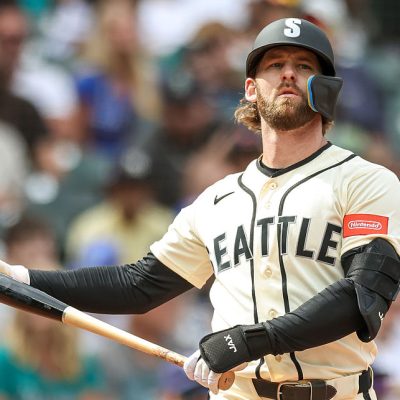
Nearly every player involved in this trade is a controllable piece. Harrison becomes a free agent in 2031, while Durbin reaches that point in 2032. The earliest players to become available at all are Hamilton and Monasterio in 2030.
The subsequent questions that arise in following seasons are about the ceilings of each respective player. Durbin’s floor is high as a result of his consistent defense, but his offensive ceiling allows him to be a potential 120 OPS+, 5.0-WAR player in seasons to come.
Harrison pitched to a sub-three ERA for most of this season, and while his home run numbers leave something to be desired, there doesn’t seem to be intense concern with his peripheral numbers. As he gets older, if he can take on a greater innings load, he could be a No. 2 starter for years to come.
The remaining four players have relatively low ceilings but are the type of role players that can contribute even off the bench on championship teams. Hamilton can steal bases in World Series games. Monasterio and Seigler can go on hot stretches and hit clutch doubles galore. And Shane Drohan can be the type of bullpen swingman who can have a Nate Eovaldi or Will Klein-esque postseason performance.
What Is the Legacy of This Trade?
I’d really rather avoid rushing to any judgments on this take, because if I wrote this article in May, I’d have pie on my face currently. Should Durbin play like June-August Durbin, then this can easily be a win-win ordeal. But the April-May Durbin performances could swap this back to a Brewers fleece.
Only time will tell with this six-player package. The fact that so many players were involved also allows for serious potential growth out of young players in years three or four of their big-league tenures. For all we know, this may be called “the Shane Drohan trade” in five to 10 years.
All this to say, the legacy of a trade changes back and forth. Extensions get signed. Players have off-the-field drama. Youngsters regress. Check back with me in 2033 when all of these players have had the chance to experience free agency if they choose. But for now, this deal doesn’t deserve nearly the type of scrutiny it was receiving back at the beginning of the 2026 season.
Become a Member of Just Baseball
Subscribe and upgrade to go ad-free!
* Save 25% by subscribing annually.

Written by
Gabe Shumway is a prospect writer for Just Baseball. He is a student at Northwestern University studying Journalism and Environmental Policy, and can be seen or…