
Spencer Strider Has Found New Ways To Succeed
He may not have the same stuff he once did, but Strider is showing us that he's becoming more of a pitcher instead of just a thrower.
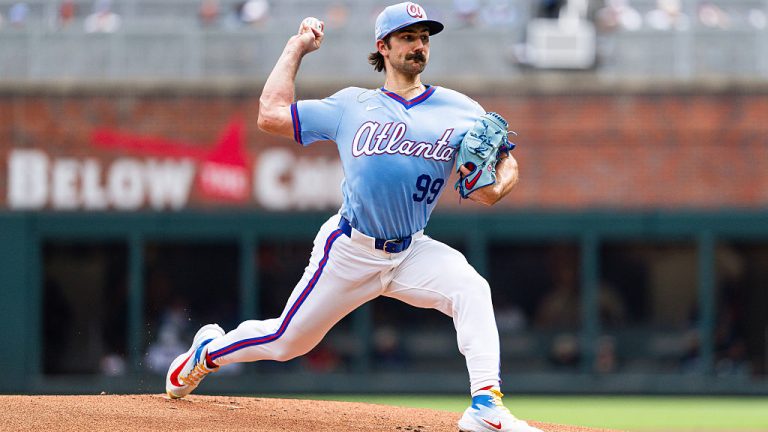
At the conclusion of the 2022 season, the Atlanta Braves found two new budding superstars in the sport. Michael Harris II took home NL Rookie of the Year honors, edging out teammate Spencer Strider for the award.
Strider pitched the first 11 games he appeared in out of the bullpen, but quickly found his way into starting his final 20 games of the season. As a starter in his rookie season, he recorded a 2.77 ERA, 0.99 WHIP, and 38.1% strikeout rate. The following season, he would transition from one of the best rookie pitchers in baseball to one of the best pitchers in baseball, period.
He finished the 2023 season with 20 wins, pitching to a 3.86 ERA, 1.09 WHIP, and a 36.8% strikeout rate. His Baseball Savant page glowed bright red across the board, earning both an All-Star nomination and a fourth-place finish in the NL Cy Young race. On the back of a high-90s fastball, Strider was poised to be one of the most dangerous pitchers in baseball.
Unfortunately, after just two starts in 2024, Strider found himself on the shelf for the entire season, undergoing an internal brace procedure to repair a bone fragment in his pitching elbow. Strider had received Tommy John surgery back in college, so questions about how he would bounce back surrounded his return.
Upon that return to the mound last season, Strider just never seemed to look like himself. His average fastball velocity declined from 97.2 mph in 2023 to 95.5 mph in 2025. Having used his fastball over 50% of the time his entire career, he struggled to adapt to a lower velocity that no longer overpowered batters.
However, in 2026, Strider is looking more and more like himself. No, he does not throw 98-99 mph on a consistent basis. Instead, he has begun to develop into a true pitcher, rather than just a flamethrower with a majority two-pitch mix. He is currently sporting a 4.00 ERA with a 1.28 WHIP and 29.1% strikeout rate, and there’s a lot to like under the hood.
So how does he look without an overpowering fastball? Let’s find out.
Pitch Mix Changes
Strider’s most notable change this year from previous seasons is his pitch mix. In 2022 and 2023, Strider used a combination of his four-seam fastball and slider 95% and 93% of the time, respectively. After the injury, he returned in 2025, throwing those two pitches 87% of the time, and he struggled.
In 2026, Strider has only thrown this combination at a 74.2% usage rate so far. For the first time in his career, he is throwing the fastball under 50% of the time (48.0%), and the slider is down to 26.2% usage.
The key is the addition of a curveball to his arsenal. We had heard during the 2023 season that he was working on a curveball, but he had not introduced it at the MLB level yet. The first signs of it appeared during spring training prior to the 2024 season and debuted in his two starts before injury. Strider then used it just 8.9% of the time last year. This season, his usage rate on the curveball is up to 15.4%, primarily deploying it against left-handed hitters.
The addition of a curveball has seemingly unlocked the rest of his pitches to allow him to record similar outputs to his previous seasons, despite a less overpowering fastball.
| Pitch | ‘26 Velo | ‘25 Velo | ‘23 Velo | ‘22 Velo |
| Fastball | 95.3 | 95.5 | 97.2 | 98.2 |
| Slider | 84.1 | 84.1 | 85.6 | 86.3 |
| Curveball | 78.2 | 78.4 | – | – |
| Change-Up | 85.5 | 85.9 | 87.0 | 88.9 |
Across the board, Strider’s velocity has significantly dipped from his pre-injury seasons, but the outputs have actually been quite similar.
In 2023, Strider’s fastball produced a .237 xBA and .319 xwOBA, with a whiff rate of 28.7%. It gave up hard contact at a 40.7% clip. So far this year, despite averaging nearly 2 mph less velo, his fastball has produced a .260 xBA and .379 xwOBA, with an 18.7% whiff rate and 41.2% hard-hit rate. Yes, the fastball has not been as effective as it was a couple years back, but by no means has it been too much of an issue.
His slider is also interesting to look at. Strider produced a 55.3% whiff rate and 50.9% strikeout rate with the pitch, allowing an expected batting average of just .159 back in 2023. Currently, the slider is “down” to a 39.5% whiff rate and 42.4% strikeout rate, but allowing a .131 xBA. The change-up has actually improved this year, up from a 44.4% whiff and 33.3% strikeout rate to 52.0% and 38.5%, respectively.
That new curveball, however, has been the real weapon. Strider is throwing it 15.1% of the time, and it has produced an insane 51.5% whiff rate and 46.4% strikeout rate this season. He is throwing two pitches that produce a whiff of at least a 50% rate, more than making up for the decrease in fastball effectiveness.
Without his old fastball, it was understandable to think he may never be even close to the same pitcher again. However, that no longer seems the case, as both the expected and actual data stats suggest otherwise.
The Metrics Behind the Numbers
As mentioned, the 2026 version of Spencer Strider is not the same pitcher as the 2023 version of himself. The velocity is down, but he has added a curveball to his pitch mix that now gives batters four pitches to consider when they step into the box.
If you look at just the box score, the numbers are not that far off from what he produced in his Cy Young vote-getting season. Strider’s 4.00 ERA and .213 batting average allowed are currently a tad higher than his 3.86 ERA and .210 average allowed in 2023. His 3.02 xERA and 6.8 hits per nine are a touch under his 3.08 xERA and 7.0 hits per nine allowed in 2023.
However, there are some underlying metrics that suggest that he has not been as good as those numbers may show. Strider’s 4.46 FIP and 4.14 xFIP suggest some regression may come; both are much higher than the 2.85 FIP and 2.92 xFIP he posted in 2023. His 1.28 WHIP is 17 points higher this season, which can be directly attributed to his career-worst 12.8% walk rate.
Yet, when you lay out some of the more popular metrics from Baseball Savant next to each other, his profile is not all that dissimilar to his previous self.
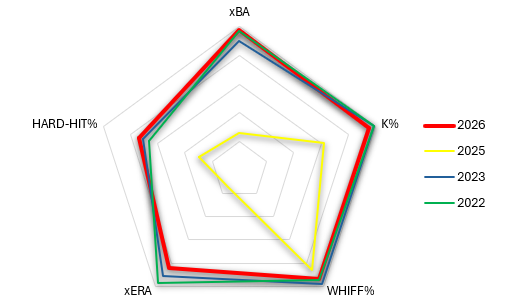
Strider’s .178 xBA is not only the best of his career, but also in the 96th percentile in MLB and ranks second for all pitchers with at least 30 innings pitched behind teammate Dylan Lee.
The most important aspect of Strider’s ability on the mound has always been being a strikeout artist, and that has not disappeared. Despite being lower than it was in 2022 and 2023, his 29.1% strikeout rate is currently in the 89th percentile this season and ranks 15th for pitchers with at least 30 innings pitched as well. His 34.1% whiff rate also still ranks highly in the 88th percentile and 16th overall for pitchers with 30 or more innings.
Quality of Contact
Now that we have dug into both expected and actual numbers, let’s see how opposing hitters have been handling Strider when they do make contact.
At his best, Strider typically ran a groundball rate between 35-40%. This season, however, that number is currently running at a 30.2% rate. While this could be a cause for concern, as balls in the air can do more damage than balls on the ground, Strider is settling into a slightly better outcome.
Yes, he is still allowing barrels and hard-hit balls at times. The occasional home run ball plagued Strider even at his peak. His 10.5% barrel and 36.0% hard-hit rates are a tad worse than those of his pre-injury seasons.
However, it has been how opposing batters have hit the ball that is the interesting part. The 69.8% air rate is the highest of his career, but when broken down into types of batted balls in the air, he is performing quite well. With just 22.1% of balls in the air being classified as line drives, he has been getting batters to pop up (9.3%) and fly out (38.4%) at career-best rates. Opposing batters’ average launch angle is at 22.9 degrees.
Batters are making solid contact just 5.8% of the time, a career best for Strider, with them getting under the ball at a whopping 40.7% rate.
This all means one thing: There will be some baseballs that leave the yard, but the overwhelming majority are simple fly ball outs. Scary? Yes. Effective? So far, yes.


Can We Trust These Changes?
It’s hard to think about Spender Strider and not immediately default to thinking about the flamethrower strikeout machine he was in 2022 and 2023. During that time period, he was arguably the most dangerous pitcher in the league.
Fast forward to today, his fastball is no longer elite like it was back then. This has caused Strider to begin a transition from being a thrower to a true pitcher.
That transition is well underway, as he has added that curveball, which has allowed him to still generate whiffs with the best pitchers in the league. Strider is still getting his strikeouts and limiting damage as well.
We must remember that although he returned to the mound from injury 13 months ago, he is still learning how to adjust to his new pitching philosophy. Last season was more about regaining confidence on the mound, and this season is about learning to pitch with what he has now.
The metrics speak for themselves, and I truly believe they will only continue to get better and better as Strider and pitching coach Jeremy Hefner continue to get more data to look at. That improvement can be seen when you think back to many of his outings just last season. As soon as he is able to limit the walks and keep opposing batters on their heels, he will only get better and better.
Strider’s confidence is back, and now sporting a four-pitch mix, he is looking more and more like himself.
Become a Member of Just Baseball
Subscribe and upgrade to go ad-free!
* Save 25% by subscribing annually.

Written by
Taylor is a baseball enthusiast and a writer for Just Baseball. An Atlanta native, he shares his love for the Braves, card collecting, and scouting the…