
Michael Harris II and Ozzie Albies Have Elevated the Braves’ Lineup
Michael Harris II and Ozzie Albies are off to dominant starts in 2026, helping power the Braves to one of the best records in baseball.
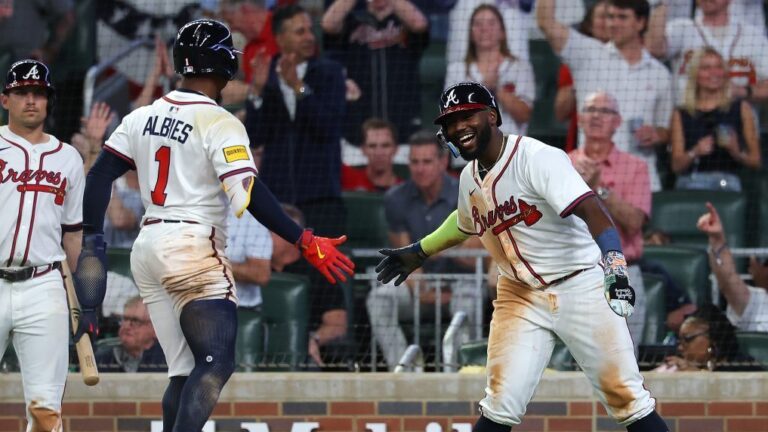
The Atlanta Braves have come out of the gate on an absolute tear to begin their 2026 campaign. At 20-9, they became the first team in baseball to reach the 20-win mark and currently hold a 6.5 game lead in the National League East.
The pitching has been phenomenal, which is especially encouraging considering it was the biggest question mark entering the season due to injuries. Depth pieces like Mauricio Dubón, Dominic Smith, Jorge Mateo, and Jonah Heim have all played key roles in steadying things early on.
That said, the biggest storyline on the offensive side might be the resurgence of Michael Harris II and Ozzie Albies.
A year ago, there were real conversations among Braves fans about how long the leash should be for both players, and whether either would be moved at the deadline. Fast forward to today, and it is hard to imagine a realistic trade that the fanbase would even consider.
Stats were taken prior to play on April 26.
Michael Harris II Is Setting the Tone Early
Since winning Rookie of the Year in 2022, Harris has followed a fairly consistent pattern with his production, struggling in the first half before catching fire in the second. For the first time since that rookie season, the early returns have been strong from the jump.
| Year | AVG | OBP | SLG | OPS | wRC+ | K% |
| 2023 | .255 | .301 | .424 | .725 | 94 | 19.7% |
| 2024 | .250 | .295 | .358 | .653 | 81 | 21.2% |
| 2025 | .210 | .234 | .317 | .551 | 47 | 20.9% |
| 2026 | .333 | .365 | .578 | .942 | 158 | 15.5% |
The steady year-over-year decline had become concerning. A 47 wRC+ last season is simply not good enough from a starting center fielder, especially one on a $72 million pre-arbitration deal under team control through 2032.
I wrote last season about how long Michael Harris II would continue to get the benefit of the doubt. The slump was difficult to watch, to the point where even minor successes felt like a win. He carried a 39.7% chase rate and just a 6.1% barrel rate during that stretch. Some wanted him sent down to Triple-A until he figured things out.
As we have seen before, he eventually caught fire in the second half and salvaged his overall numbers.
The success can be attributed to one key adjustment.
On July 18, Gwinnett Stripers PR and Broadcasting Associate Brady Penn pointed out a change in Harris’ setup. He raised his hands above his head, going back to the stance he used during his rookie season. From that point forward, Harris has posted a .308/.328/.542 slash line with an .870 OPS, 138 wRC+, and a 17.9% strikeout rate.
He is never going to be a low chase rate hitter or someone who walks at a high clip. That is not his profile. Harris is at his best when he is aggressive and attacking pitches in the zone, as he typically pairs that with at least a 75th-percentile average exit velocity.
This season, the underlying data backs it all up. His Baseball Savant page is filled with red. After being a popular dark horse MVP pick in recent years, this is the first season where many cooled on that idea.
Ironically, this might be the year it actually holds more weight, given how strong he has been early. Harris currently ranks inside the top 15 in batting average, slugging, wOBA, wRC+, and RBIs across the entire league.
That level of production has been huge for lineup construction. It lengthens the order and creates a much more difficult path for opposing pitchers when turning things over to Ronald Acuña Jr., Drake Baldwin, and Matt Olson.
It also helps when players like Dubón and Ozzie Albies are getting on base ahead of him, creating constant pressure.
Ozzie Albies Is Answering Questions
Even during his struggles, it would be hard to find a Braves fan who does not appreciate Ozzie Albies. His energy is contagious, and the joy he brings both on the field and in the clubhouse is a real part of this team’s identity.
Still, production matters. And over the past two seasons, the results were not where they needed to be compared to his earlier years.
Like Harris, Albies has always been an aggressive hitter. Last season, that approach reached an extreme, and his numbers reflected it. However, it is also important to acknowledge the freak injuries the past two seasons:
- September 2025 – Fractured hamate bone just fouling off a pitch last season.
- July 2024 – Fractured wrist attempting to tag a baserunner.
- April 2024 – Fractured toe being hit by a pitch.
Those are not minor setbacks. Wrist injuries in particular can linger and often impact hitters well beyond the initial recovery period. Albies had started to turn things around in the second half last season, hitting .272 with a .769 OPS after posting a .220 average and .606 OPS in the first half, before the hamate injury cut things short.
After the Braves exercised his $7 million team option, there were fair questions about his long-term future with the organization. Albies still has another $7 million option for 2027 before reaching free agency, a reminder of one of Alex Anthopoulos’ earliest pre-arbitration deals.
So far in 2026, Albies has answered those questions.
He is slashing .318/.358/.500 with an .858 OPS and a 137 wRC+. Perhaps the most encouraging development is not just the production itself, but where it is coming from. For the first time in his career, he has been more effective from the left side of the plate.
| Year | AVG | OBP | SLG | OPS | wRC+ |
| Career VS LHP | .326 | .350 | .538 | .888 | 135 |
| Career VS rHP | .245 | .310 | .426 | .736 | 96 |
| 2026 VS LHP | .333 | .341 | .500 | .841 | 129 |
| 2026 VS rHP | .309 | .368 | .500 | .868 | 141 |
Historically, Albies has been far more productive as a right-handed hitter, to the point where some suggested he should consider abandoning switch hitting altogether. Seeing him thrive from the left side adds a new dimension to his offensive profile.
Head coach Walt Weiss has placed Albies squarely in the middle of the lineup, typically between the third and sixth spots. That positioning has made a noticeable difference. Opposing pitchers no longer get a breather after navigating the top of the order, which in turn has made life easier for hitters like Dubón, Smith, Yastrzemski, and Harris around him.
What This Means For The Offense
The impact of Harris and Albies on this lineup cannot be overstated. Both currently hold top-five slash lines on the team.
Last season, consistent production outside of Acuña, Olson, Baldwin, and Jurickson Profar after his return from suspension was hard to come by. Through 29 games this year, that has completely changed.
And there is still another level this group can reach.
Neither Acuña nor Austin Riley have fully looked like themselves yet. Even so, the Braves rank near the top of the league in virtually every major offensive category. While expecting a repeat of the record setting 2023 offense might be unrealistic, this version of the lineup looks both dangerous and sustainable.
There will be ups and downs over the course of a season. That is inevitable. But what stands out about this group is its balance. When one part cools off, another has the ability to pick it up.
The Braves offense is legitimate, and Michael Harris II and Ozzie Albies have been right at the center of that early success.
Become a Member of Just Baseball
Subscribe and upgrade to go ad-free!
* Save 25% by subscribing annually.

Written by
Taylor is a baseball enthusiast and a writer for Just Baseball. An Atlanta native, he shares his love for the Braves, card collecting, and scouting the…