
Bryce Elder Is Proving His Doubters Wrong
After starting the season on the fringe of even making the team, one simple shift has put Bryce Elder amongst the league's best pitchers.
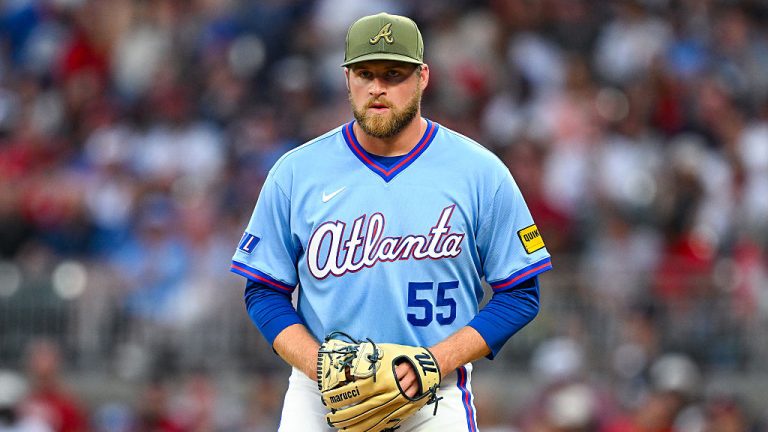
The Atlanta Braves starting rotation has been one of the best units in the league to this point. Braves starters rank first in MLB with a .205 batting average, second in ERA at 3.07, and sixth in WHIP at 1.16.
Chris Sale has looked every bit like the ace Braves Country has hoped for, but the emergence of Bryce Elder has quietly become one of the biggest reasons for Atlanta’s success.
Last season, Atlanta watched all five members of its Opening Day rotation land on the 60-day IL at different points throughout the year.
Elder ended up leading the Braves with 28 starts and 156.1 innings pitched, which was far from the ideal scenario when entering the year. This season began with Spencer Strider, Spencer Schwellenbach, Hurston Waldrep, and AJ Smith-Shawver all opening the year on the injured list, giving Elder another opportunity to prove himself.
Elder has not only proved himself capable of plugging a hole in the rotation, but he may have forced his way into the starting rotation for the foreseeable future.
A Career Rollercoaster
Elder’s five-year career has already featured plenty of highs and lows in a relatively short amount of time. After pitching at the University of Texas, Elder was selected by Atlanta in the fifth round of the 2020 MLB Draft and made his MLB debut in 2022.
In his first season, Elder appeared in 10 games, making nine starts while posting a 3.17 ERA and 1.24 WHIP across 54 innings. He followed that up with a dominant start to the 2023 season, going 7-2 with a 2.97 ERA and 1.20 WHIP, earning his first All-Star selection.
Following the All-Star break, things started to unravel, as he posted a 5.11 ERA over his final 13 starts of the season.
The next two years became a constant shuffle between Triple-A Gwinnett and the major leagues as injuries created opportunities. Across 38 starts during that stretch, Elder posted a 5.59 ERA, 1.45 WHIP, and allowed a 44.5% hard-hit rate.
Still, there were signs late in the 2025 season that things may have been trending in the right direction. His ERA improved from 5.65 to 4.93, while his WHIP improved from 1.51 to 1.28. More importantly, Elder recorded eight quality starts over his final 11 outings, tied for the most in baseball over the final two and a half months of the season.
Now, Elder somehow looks even better than he did during the first half of his 2023 All-Star campaign.
Through 10 starts this season, Elder has recorded seven quality starts, tied for the third most in MLB. He ranks sixth in the league in barrel rate (3.5%), 10th in ERA (2.01), and 13th in WHIP (0.99). He has also posted a career-best 22.5% strikeout rate and has yet to allow four or more runs in a single outing.
What Has Changed?
The transformation actually began back in 2024 with a simple request to Hall of Famer John Smoltz. While Smoltz was visiting Triple-A Gwinnett, Elder asked if he could help arrange a meeting with fellow Hall of Famer Greg Maddux. A few phone calls followed, and once the 2024 season ended, Elder began visiting Maddux at his home.
Much like Elder, Maddux never relied on overpowering velocity. He carved hitters up with sequencing, command, movement, and unpredictability. Together, they decided Elder needed to add a cutter to complement his existing arsenal of a two-seamer, four-seamer, slider, and changeup.
He would spend more than a year developing the pitch before finally feeling comfortable enough to use it consistently at the major-league level this season. The early results have been incredible.
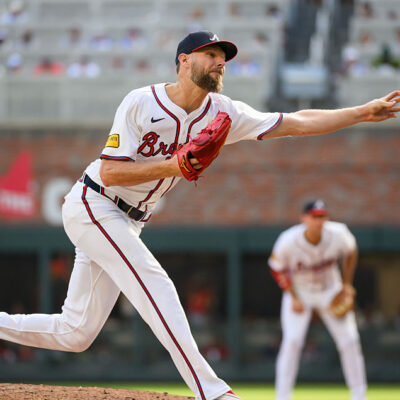

Since his rookie season, Elder had relied heavily on either his slider or two-seamer, which Statcast classifies as a sinker, throwing the combination more than 70% of the time.
As a pitcher who does not rely on overpowering hitters with velocity, opposing lineups were often able to sit on pitches and make hard contact once they identified patterns. His four-seamer (12.3%) and changeup (10.5%) were rarely used consistently.
This has changed in 2026. With the addition of the cutter, Elder’s slider and sinker usage has dropped to roughly 54%, while his four-seamer usage has nearly doubled to 24%. Instead of two pitches, he now throws three pitches roughly 70% of the time.
It may just be one pitch, but that is a huge shift in how opposing hitters then prepare to face Elder. He now mixes in the cutter (11.9%) and changeup (9.9%) enough to force hitters to account for five different pitches instead of just two.
The impact has shown up everywhere statistically.
Every single pitch in Elder’s arsenal has seen a drop in batting average against compared to last season, with the highest mark now sitting at just .206 against his two-seamer. His whiff rates have also climbed across the board, including a massive jump to a 34.3% whiff rate on his changeup, an increase of 17%.
One added pitch, developed over a year and a half, has completely changed the shape of Elder’s pitch mix. More importantly, it looks like it has brought back the confidence and bulldog mentality that Braves fans saw flashes of earlier in his career.
Can This Continue?
Elder has not given anyone much reason to believe this is a fluke. Will he finish the season as one of the absolute best pitchers in baseball? Probably not.
His .228 BABIP is the lowest mark of his career and will likely climb as the season progresses. Even so, the data does not suggest a complete collapse back to the version of Elder Braves fans watched in 2024 and 2025.
He currently ranks in the 90th percentile with a 3.03 xERA and the 77th percentile with a .220 xBA. His 3.21 FIP and 3.74 xFIP both remain comfortably above league average, suggesting his performance is not simply luck driven.
Even with a slight regression, if it were to happen, Elder can easily develop into a reliable middle-of-the-rotation arm capable of eating important innings and giving Atlanta quality starts.
In a lot of ways, working with Greg Maddux has changed the course of Elder’s career. Had Strider, Schwellenbach, Waldrep, and Smith-Shawver all entered the season healthy, he may have opened the year in the bullpen or potentially been DFA’d entirely since he is out of minor-league options.
Even with Atlanta desperately needing rotation help, plenty of fans still wanted the Braves to move on from him based on his prior performances. Hand up, I was one of them.
Instead, Elder has become one of the biggest reasons Atlanta owns the best record in baseball. Not bad for a pitcher who many people thought would not even make the team a few months ago.
Become a Member of Just Baseball
Subscribe and upgrade to go ad-free!
* Save 25% by subscribing annually.

Written by
Taylor is a baseball enthusiast and a writer for Just Baseball. An Atlanta native, he shares his love for the Braves, card collecting, and scouting the…