
Why the New York Mets’ Signing of Paul Goldschmidt Makes a Lot of Sense
Paul Goldschmidt's addition to the Mets pales in comparison to Tarik Skubal's. However, the team will still greatly benefit from his services.
Every offseason has a headline move and a handful of quiet ones that decide whether the headline move pays off. The New York Mets made their headline on Sunday, giving Tarik Skubal nine years and $450 million, the largest contract ever for a pitcher by total value and AAV.
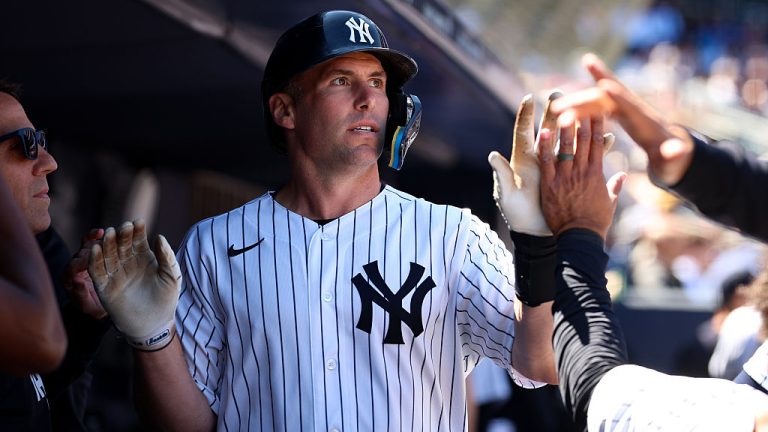
A day earlier, they extended center fielder A.J. Ewing. On Monday morning, they made another more strategic move: a one-year, $8 million deal with 39-year-old first baseman Paul Goldschmidt.
Next to Skubal, Goldschmidt barely registers. But for the former MVP, that’s the wrong comparison, the right one is what the Mets got from first base in 2026, and the one specific job Goldschmidt still does as well as almost anyone: hit left-handed pitching.
Year One After Alonso
Pete Alonso left last winter for a five-year, $155 million deal with Baltimore, and the Mets’ plan to replace him fell apart almost immediately, like comedically fast. Jorge Polanco signed for two years and $40 million with the idea that he’d learn first base.
Instead he slashed .148/.201/.230 with a 20 wRC+ and a -1.4 fWAR in 37 games, needed left ankle surgery, and spent the rest of the year fighting bursitis in his left Achilles.
That pushed 2024 postseason hero Mark Vientos to first, where he was a below-average defender (-10 Outs Above Average in 519.1 innings) and a below-average offensive threat (78 wRC+). Jared Young eventually took over and held his own: .266/.330/.429 with nine homers in 103 games, before a concussion ended his season on September 17.
Add it up and Mets first basemen combined for -0.8 fWAR in 2026, last among all 30 teams. In 2026, Alonso led all MLB first basemen with 5.0 fWAR in Baltimore. That’s the difference between losing a player and losing a position.
The 2027 Platoon Plan
Here’s the thing about Young’s season: almost all of the good stuff came against righties. All nine of his home runs came off right-handers, and he posted a .793 OPS against them. Against lefties, he hit .228 with four extra-base hits and a .606 OPS.
Now flip it. Goldschmidt hit .252 with a .765 OPS overall in 2026, which sounds fine but unremarkable. Against left-handers, he hit .299 with 11 homers and a .967 OPS in 183 plate appearances. That’s 11 of his 18 homers in less than half of his trips to the plate.
| 2026 | vs RHP (OPS) | vs LHP (OPS) |
| Jared Young | .793 | .606 |
| Paul Goldschmidt | .590 | .967 |
The Yankees eventually figured out how to use Goldschmidt at this stage of his career. He took 183 of his 380 plate appearances against lefties, about 48 percent. Across the league, only about 30 percent of plate appearances come against a lefty.
Aaron Boone picked his spots, and the manager Andy Green can do the same thing with a ready-made partner already on the roster. Young starts against righties, Goldschmidt starts against lefties, and the two of them together look a lot more like a real first baseman than either one alone.
Does It Make Sense?
Yes.
The Mets are buying a batted-ball-dependent skill set, damaging contact against left-handed pitching, that Goldschmidt has proven for more than a decade: a career average of .322 and 1.004 OPS against lefties over 16 seasons. And the case is stronger than his 2026 line makes it look.
In late June, Mike Petriello dug into Goldschmidt’s rebound for MLB.com. At that point he had a 153 OPS+, 10th-best among hitters with at least 200 plate appearances, and a 1.304 OPS against lefties, which Petriello identified as the largest platoon split in baseball at the time.
Petriello also flagged the warning signs under the hood: his bat speed had dropped from the 59th percentile to the 39th, and his weak-contact rate had quadrupled from 2% to 8%. He is making it work by selling out for barrels and hunting four-seamers on the outer half.
The easy argument against this deal is that the lefty numbers were a mirage. Split his season against southpaws in two and it doesn’t look great. In May and June, he slashed .437/.500/.859, a 1.359 OPS, in 80 plate appearances. In every other month, he hit .186/.311/.337, a .648 OPS, in 103 plate appearances.
But those are samples of 80 and 103 plate appearances. If the 1.359 OPS is too hot to be real, the .648 is too cold to be his true talent level. Put them back together and you get .299/.393/.573 with 11 home runs in 183 plate appearances. That is not just a six-week heater, that’s a full season.
The second-half fade, including a .667 OPS after the break, has a simpler explanation. The Yankees didn’t keep him in a strict platoon all year. He still took 197 plate appearances against right-handers, and those dragged down both his overall line and his second-half numbers. The Mets aren’t signing him to face righties, they’re signing him to do the one thing he still does at an elite level.
Goldschmidt isn’t a one dimensional player either. In 77 games at first base, he was worth +5 OAA and +2 Defensive Runs Saved. That’s a real defensive contributor at a position where the Mets got below-average glovework in 2026.
The obvious risk is age. Goldschmidt turns 40 in September, and nobody should assume he won’t decline. But the aging curve has been kinder to him than anyone expected. He was a better hitter in 2026 (111 OPS+) than in 2025 (101 OPS+), not a worse one. At $8 million for one year, paired with Young, the Mets aren’t simply paying for prime Goldschmidt, they’re paying for a specific role he already proved he can fill.
What It Means for the Rest of the Offseason
The clock is the first thing to understand. The CBA expires at 11:59 pm ET on Dec. 1, and a lockout is expected right after that, freezing every signing and trade until a new deal is done. The Mets clearly want their big pieces in place before then, and Goldschmidt was the cheapest way to cross first base off the list.
That leaves Polanco without a position, which is fine. He’s owed $23 million in 2027, and the team already planned to keep him off his feet as much as possible because of the Achilles. Moving him to DH full-time gives a $23 million contract a clear job instead of asking him to learn first base again at 33 years old.
Vientos is the one squeezed out. With Young and Goldschmidt sharing first, Polanco at DH and Bo Bichette at third, there’s no obvious spot for the former second-round pick. He could be a bench bat, or he could become a trade chip before that CBA expiration.
The bigger point is what Goldschmidt doesn’t cost. First base was one of the Mets’ biggest holes, and they filled it without a multi-year commitment or a trade that sends out young talent.
That leaves money and prospects for the needs still on the board: another starter behind Skubal, with Sean Manaea and Kodai Senga both in and out of the bullpen in 2026, and another late-inning arm in front of Devin Williams.
Goldschmidt won’t decide whether 2027 is a bounce-back year for the Mets. He just makes the rest of this week easier.
Become a Member of Just Baseball
Subscribe and upgrade to go ad-free!
* Save 25% by subscribing annually.

Written by