
Where Would the White Sox Be Without Randal Grichuk and Tristan Peters?
Neither Grichuk nor Peters entered the season expected to be essential contributors. By September, it’s hard to imagine where the White Sox would be without them.
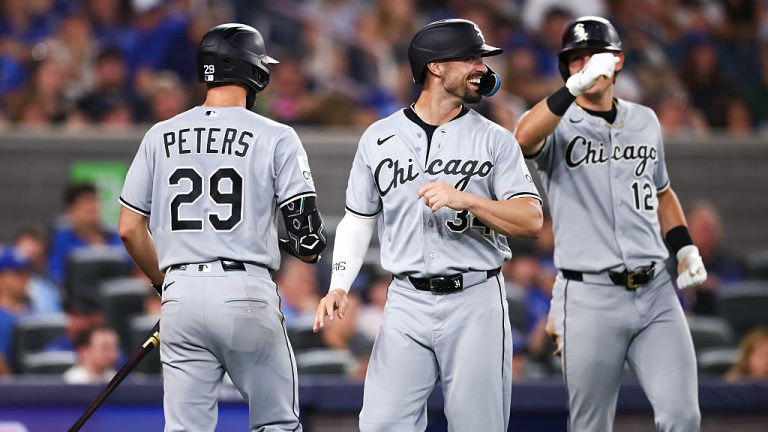
Two low-cost outfield additions have become much more than depth pieces as Chicago fights through a tight AL Central race.
The Chicago White Sox needed Randal Grichuk to swing. Two nights later, they needed Tristan Peters to keep swinging.
Chicago was one strike away from a fifth consecutive loss Saturday night in St. Louis when Grichuk came to the plate against Cardinals closer Riley O’Brien. Kyle Teel had walked, Brenton Doyle pinch-ran and stole second, and Miguel Vargas and Munetaka Murakami followed with strikeouts. Grichuk fell behind 1-2 before O’Brien left a 95.6 mph sinker over the plate.
Grichuk drove it the other way. The ball traveled only a Statcast-projected 358 feet, but it carried over the right-field wall for a two-run homer and a 6-5 White Sox lead. The swing ended a four-game losing streak during a stretch in which Chicago had dropped nine of 12 games.
Peters’ defining plate appearance two days later ended without a ball in play.
Andrew Benintendi opened the sixth inning in Cleveland with a single against Gavin Williams, who had thrown 95 pitches while holding Chicago scoreless. Peters fell behind 1-2 on two called strikes. Williams then spent the next 15 pitches trying to finish him.
Peters fouled off 12 two-strike pitches before finally taking ball four on pitch No. 18. Williams’ night was over at a season-high 113 pitches. The White Sox scored six times in the inning and won 7-3, clinching the season-series tiebreaker over the Guardians.
The plate appearance tied for the fifth-longest since pitches were first tracked in 1988 and matched Adam Kennedy’s 18-pitch walk in 2004 for the longest over that span. It was the longest plate appearance in the majors this season.
Grichuk changed a game by ending an at-bat. Peters changed one by refusing to let his end.
Neither player entered the season among the biggest reasons to believe the White Sox could contend. Peters arrived in December after being designated for assignment by Tampa Bay. Grichuk joined the organization in May after the Yankees moved on from him.
Chicago acquired one for cash and signed the other for $1.25 million.
Safe to say they have become far more important than those transactions suggested.
Tristan Peters Turned an Opportunity Into an All-Star Season
The 18-pitch walk was an extreme version of the approach Peters has shown all season.
By the end of the plate appearance, Peters described himself as operating in “fight mode.” Sean Burke called it one of the most impressive at-bats he had seen all season. Williams had carried a shutout into the inning, but Peters forced him from the game before Cleveland could record an out.
That kind of at-bat would have been difficult to imagine when Chicago acquired Peters on Dec. 18.
The Rays had designated him for assignment two days earlier after adding Steven Matz. Peters was coming off a productive Triple-A season at Durham, but his first major league look had produced 12 hitless at-bats and seven strikeouts in four games.
The White Sox sent cash to Tampa Bay for another outfield option. Robert still occupied center field at the time, leaving Peters without an obvious path to regular playing time.
Peters is hitting .273/.344/.453 with 12 home runs, 31 doubles, four triples, and eight stolen bases through 147 games. He has gone from an offseason depth acquisition to Chicago’s primary center fielder and an American League All-Star.
Peters hit for the seventh cycle in White Sox history on July 10, completing it with both a home run and a triple in the seventh inning. One day later, he was added to the American League All-Star roster as an injury replacement. In August, he homered in five consecutive games to match the franchise record and became the 14th rookie in MLB history to do it. He finished the month hitting .320/.414/.640 with six home runs and earned American League Rookie of the Month honors.
According to Baseball Savant, Peters owns an 87.5 mph average exit velocity. His 34.1% hard-hit rate and 5.7% barrel rate both sit below the major league averages on the same Statcast leaderboard. His .351 wOBA also sits above a .318 expected mark.
Peters has struck out in 18.2% of his plate appearances, below the 22.2% major league average. That has given him more opportunities to put the ball in play even without elite contact quality.
The defense has done even more to separate him.
Statcast credits Peters with 10 Outs Above Average across the outfield. When the White Sox reached 50 games in May, he was at +5. The defensive value that initially made him useful enough to keep in the lineup has held over a much larger sample.
The White Sox acquired Peters as depth. By September, he had become their regular center fielder.
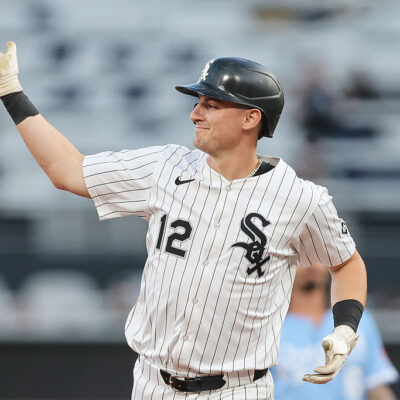
Randal Grichuk Became More Than Injury Insurance
Grichuk’s value has come mostly at the plate.
While Peters has carved out an everyday role through contact and defense, Grichuk has become one of Chicago’s most dangerous complementary bats. His playing time has varied with matchups. Even without an everyday role, he has produced when Venable has turned to him.
St. Louis showed the value of that role. Grichuk came off the bench in the fourth inning and remained in the game long enough to deliver the go-ahead homer in the ninth.
Grichuk has made a habit of doing more damage than his acquisition cost would suggest.
The Yankees designated him for assignment on April 29 after he hit .194/.212/.323 in 33 plate appearances. Chicago signed him to a one-year, $1.25 million major league deal on May 4. On the same day, the White Sox placed Austin Hays on the injured list with a left calf strain.
At first, Grichuk was another veteran option for an outfield thinned by injuries. His role quickly grew beyond that.
In 92 games with the White Sox, Grichuk is hitting .306/.333/.607 with 13 home runs, 19 doubles, and 37 RBIs.
The underlying contact supports the power.
Across Grichuk’s full 2026 season, Statcast has him at a 91.6 mph average exit velocity. His 49.2% hard-hit rate and 10.8% barrel rate are both comfortably above league average. His .470 expected slugging percentage sits below his actual production, but he has still hit the ball with authority throughout the season.
That production has given Venable another reliable matchup option. Grichuk’s role has remained part-time, but the White Sox have also pointed to what he has brought to the clubhouse.
After the St. Louis win, Venable described Grichuk as one of the veteran leaders responsible for keeping the clubhouse aligned before games. Chicago has leaned heavily on young players this season. Grichuk is in his 13th major league season, giving the clubhouse another veteran voice.
New York moved on from him in April. Chicago initially needed him because another veteran outfielder got hurt.
By September, Grichuk was taking one of the biggest at-bats of the season.
This Wasn’t the Outfield Chicago Planned
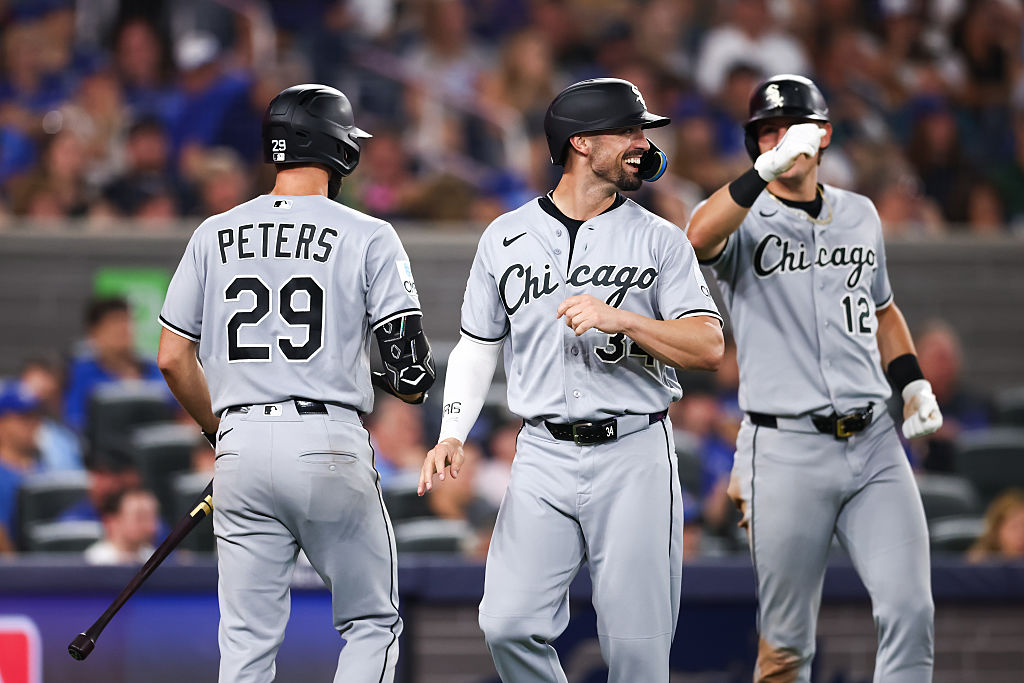
The White Sox did not enter the season expecting the outfield to look this way.
Peters was acquired before Chicago traded Robert to the Mets. The White Sox added him in December, then moved Robert on Jan. 20 for Luisangel Acuña and right-hander Truman Pauley. Robert’s departure did not make Peters the automatic replacement in center field, but it created the type of open competition that allowed another player to seize the position.
The White Sox signed Hays in February to a one-year contract after he had produced an above-average offensive season with Cincinnati. The idea was straightforward. Hays was supposed to give an unsettled corner-outfield group a veteran baseline while younger players developed.
Hays never stayed healthy long enough for that plan to take hold.
Hays played only 12 games for the White Sox and hit .233/.250/.326. A right hamstring strain sent him to the injured list on April 7. He returned April 27 before a left calf strain sent him back to the IL one week later. Chicago eventually transferred him to the 60-day injured list.
That May 4 injury created the opening for Grichuk.
Instead of waiting for Hays to return, the White Sox added another veteran who had unexpectedly become available. By August, Grichuk had established himself in the outfield mix. Chicago activated Hays from the 60-day injured list on Aug. 5 and designated him for assignment in the same transaction. He was released two days later.
Hays never became the stabilizing presence Chicago expected. Grichuk did.
Braden Montgomery’s arrival did not settle right field either.
Montgomery announced himself with a walk-off home run in his major league debut on June 9, the type of first impression that made it easy to imagine Chicago finally finding a long-term solution in right field.
The larger sample has been more difficult.
Montgomery is hitting .210/.307/.338 with six home runs through 83 games. That does not change his long-term upside or make his rookie season a failure. He is 23 years old and reached the majors less than a year and a half after playing his first professional game. It does mean the White Sox have needed other players to produce while he goes through the adjustment process.
The outfield kept evolving. By the trade deadline, Chicago’s place in the AL Central had changed the calculation. Rather than stand pat, the White Sox made a more significant move.
Chicago acquired Brenton Doyle from Colorado on Aug. 3 for right-hander Mason Adams and 16-year-old infielder Carlos Vielma. Unlike Peters and Grichuk, Doyle was not a low-cost flier. Adams was one of the better pitching prospects in the organization, and Doyle arrived as an established major league center fielder.
The White Sox did not find every answer on the first try. Their ability to keep searching for one became increasingly important.
Small Moves Become Bigger in a Tight Race
Roster construction tends to be remembered through the biggest transactions.
The White Sox will ultimately be judged more heavily on the moves that shape their core than on a December cash transaction or a $1.25 million signing in May.
A 162-game season rarely follows the plan drawn up in February. The White Sox kept adjusting as that plan changed, and by September, some of the players carrying meaningful roles were not the ones expected to do so when the season began.
That is where the value of the smaller moves showed up. They gave Chicago enough flexibility to keep finding answers as the roster evolved.
Peters and Grichuk are the clearest examples of the value Chicago found outside its core.
The AL Central is close enough for those decisions to matter in September. Cleveland took the final two games of the series after Chicago won the opener, leaving the White Sox a half-game behind following Wednesday’s finale.
In a race this close, individual at-bats can carry more weight than usual. Neither Grichuk nor Peters entered the season expected to hold that kind of responsibility. By September, both had earned it.
A team can build its core through major acquisitions. It still has to find value around it.
For the White Sox, two of the moves that looked smallest have become difficult to separate from the season itself.
Become a Member of Just Baseball
Subscribe and upgrade to go ad-free!
* Save 25% by subscribing annually.

Written by
Adrian White covers the Chicago White Sox for Just Baseball and FutureSox. He studies sports management at Florida Atlantic University and focuses on player development and…