
Payton Tolle’s 2026 Leap Has Been Essential for Red Sox
Payton Tolle has not only quickly become a fan favorite in Boston, but also one of the most important arms in the Red Sox's rotation.
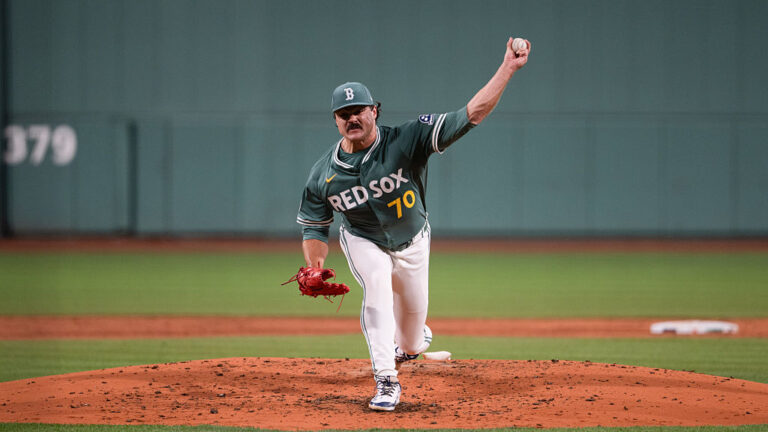
For some, it’s the high fastball velocity and elite extension. For others, it’s the five-pitch mix. For everyone, it’s the Magnum P.I. mustache, niche references, and interview gems.
Payton Tolle is one-of-a-kind on and off the diamond. And he’s been one of the key factors in Boston’s absurd two-month turnaround.
The Boston rotation was a beacon of consistency over its month of excellence from late June to mid-July. In late July and early August, some rotation pieces began to show signs of struggle. Long reliever and spot starter Eduardo Rivera was demoted. Jake Bennett and Patrick Sandoval regressed.
Tolle and Sonny Gray were the most consistent starters over the entire two-month period, allowing Tolle to continue his rise through the rotation. There are several other MLB teams where Tolle could be the ace with the numbers he’s produced.
Throughout this season of change, Tolle has also been a unique presence in the clubhouse, unlike anything Boston Red Sox fans have seen. This dates back to Spring Training, when he gave a presentation to empower his Team USA teammates ahead of the World Baseball Classic.
Let’s dive into the underlying factors that led to Tolle’s initial pitfalls and delayed success at the MLB level.
Tolle’s Rushed Promotion in 2025
Down the stretch in 2025, the Red Sox had three reliable starters in Garrett Crochet, Brayan Bello, and Lucas Giolito. After struggles with Walker Buehler and a slew of injuries to Dustin May, Hunter Dobbins, and Tanner Houck, Boston was left grasping at straws to find the pieces needed for the back end of its rotation.
In response, the Red Sox turned to their top two pitching prospects: Payton Tolle and, later, Connelly Early.
On paper, this move made some sense at the time. The Red Sox were in the midst of a September playoff chase and needed more than a temporary spot starter. But Tolle also had fewer minor league outings than most, with just 27.0 Double-A innings and 15 Triple-A innings.
Tolle started out strong, allowing one hit to the Pirates through his first five major league innings. After this, however, Tolle began to struggle and was moved to the bullpen. At the end of 2025, Tolle held an ERA of 6.06 in 16.1 innings.
When 2026 rolled around, Tolle began in Triple-A once again, with Early and Johan Oviedo beating him out for spots on the major league roster. With three more starts to hone his craft, Tolle came back strong and has developed into a No. 2 starter on a strong Red Sox pitching staff.
Key Improvements in 2026
Tolle went through significant changes to his arsenal following the 2025 season. During Spring Training in 2026, Tolle showed up with a sinker, dropped his slider, and his chase rate nearly doubled.
This was not the only change that Tolle made, as he was able to create additional movement on his primary fastball. He was also able to deliver this movement more consistently, with fewer non-moving outlier pitches compared with his brief string of appearances in 2025.
Let’s break down the three crucial changes to Tolle’s approach on the mound.
Drop the Slider, Add a Sinker
This arsenal change is confusing on the surface, but its success for Tolle has been undeniable. In a small MLB sample size in 2025, Tolle’s slider was arguably his most successful pitch. He only threw it 29 times, but players hit for a .125 slugging percentage against it and a .098 wOBA.
The problem with Tolle’s slider is that it was rarely used as an effective putaway pitch. It did not induce a high amount of whiffs and moved very little when compared with Tolle’s fastball and curveball combo. In his 15-inning sample size at Triple-A in 2025, Tolle threw just one slider with more than five inches of horizontal break, per Prospect Savant.
In 2025, Tolle threw two fastballs, a four-seamer and a cutter. Adding a sinker allowed Tolle to balance his high velocity and extension with more confusing movement. As a result, batters need to prepare for a fastball that appears faster because of extension and could move in three different directions, making his overall arsenal stronger.
“When we first approached him with the development of the sinker idea this offseason, it’s really about accentuating what he does well,” Red Sox pitching coach Andrew Bailey told Boston Sports Journal in April. “We know he has elite extension, elite four-seam; how do we tap into that a little bit more to give hitters a different look?”
Tolle may have removed a serviceable secondary or even tertiary option with his slider. But in its place, he’s added an option that simply makes every other pitch better. This has allowed his fastball run value to rise from -4 to 9, an 86th percentile mark, in 2026.
Four-Seam Movement
Tolle didn’t simply add a sinker, either. He expanded the movement of his fastball to share some similarities with his sinker.
In 2025, Tolle prioritized a rising fastball, with 16.7 inches of vertical movement and 6.8 inches of arm-side break. This season, Tolle’s four-seamer has lost 1.2 inches of vertical movement and replaced it with an extra 2.9 inches of horizontal break.
Tolle’s fastball has also seen a slight dip in velocity, from 96.7 to 96.1 mph. This can, however, be attributed to Tolle exceeding his career-high innings load in 2026. Last season, Tolle threw 108.0 innings across four levels. In 2026, he reached 125.1 before the calendar turned to September. This also far exceeds his collegiate career high of 85.2.
Throwing More Strikes
Sometimes a very complex problem can be aided by a wildly simple solution. Throw more strikes. That’s a key aspect of Tolle’s improvement.
Walks have always been a wildly inconsistent stat for the 6’6″ southpaw. At Wichita State, Tolle walked just 2.0 batters per nine innings. At TCU, his ERA improved drastically, but his walks jumped to 4.1. In the minor leagues in 2025, Tolle limited the walks to 2.3, but saw this number jump to 4.4 after his MLB promotion.
Now, in 2026, Tolle is back on track, with a walk rate in the 76th percentile of MLB pitchers. His strike-throwing is volatile, but for now, he seems to be in control of his newfound arsenal.
Overall Team Impact
It’s easy to look through the numbers and say that Tolle’s impact has been his 2.3 rWAR, 3.09 ERA, and 125.1 innings pitched. You can discuss his K/BB ratio or any other elite statistic you’d like. But perhaps the greatest overall team impact of Tolle’s development has been the added roster flexibility and injury response.
At the start of 2026, the Red Sox had a laundry list of back-end rotation options. So much so that Tolle began in Triple-A. However, had it not been for his development, one could argue that chief baseball officer Craig Breslow would not have made many of his eventual moves.
In one of the first major moves of the deadline, Breslow swapped Early for Nationals second baseman Curtis Mead. While Mead’s freak injury, a result of a hit-by-pitch in his second Red Sox at-bat, leaves this move largely irrelevant, there’s an argument that Tolle’s success allowed Early to be an expendable trade piece.
The same goes for a handful of pitching prospects involved in the Adley Rutschman trade. As part of Tolle’s success and the impending return of injured players like Garrett Crochet and Tanner Houck, there was not a clear path to the majors for Anthony Eyanson and Kyson Witherspoon. Now, these prospects are in the Orioles’ farm system.
Sonny Gray will be a free agent at the end of the 2026 season. Garrett Crochet is expected to be back in full swing as a starter in 2027. Assuming Boston makes zero drastic offseason pitching moves — a massive assumption — Tolle could continue to be a No. 2 starter until he becomes a free agent in 2032.
Become a Member of Just Baseball
Subscribe and upgrade to go ad-free!
* Save 25% by subscribing annually.

Written by
Gabe Shumway is a prospect writer for Just Baseball. He is a student at Northwestern University studying Journalism and Environmental Policy, and can be seen or…