
Breaking Down Payton Tolle’s Dominant Rookie Season
The rookie left-hander has been a rare bright spot in a disappointing Red Sox season.
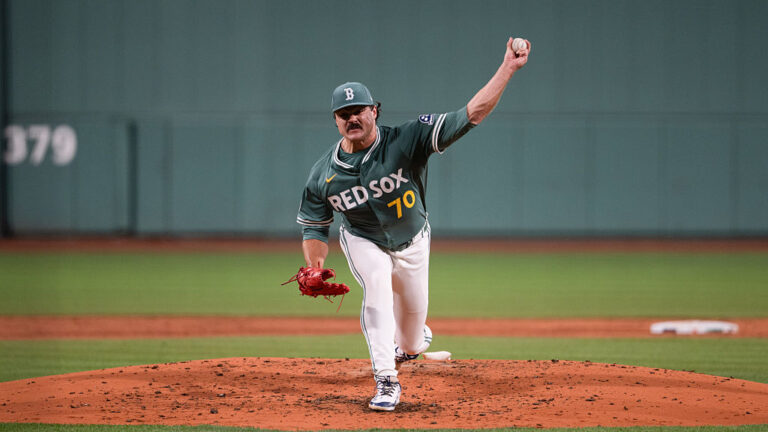
In what has been a Boston Red Sox season defined by offensive underachievement, two rookie left-handers have emerged as long-term rotation building blocks.
After a brilliant five-start cup of coffee at the end of 2025, Connelly Early used a dominant spring training performance to beat out Johan Oviedo for the final Opening Day rotation spot.
This proved to be a wise decision, as Early has dazzled with a 3.21 ERA and has allowed two runs or fewer in seven of his nine starts.
Though none of Early’s seven pitches jump off the page, his ability to expertly toggle between them with a feel for pitching that belies his age has made him a model of consistency since his very first day in the majors.
Just one year after being a relatively unknown Double-A prospect, Early looks poised to slot into the middle of the Red Sox rotation for years to come. Payton Tolle, however, looks like he can be something even greater.
An Emerging Arm In Boston
While Early incrementally climbed the minor-league ladder before receiving a September call-up largely due to injuries to more established arms, Tolle practically forced the Red Sox’s hand by dominating every challenge they threw his way.
The 2024 second-round pick used a startling velocity bump to strike out 79 High-A batters in just 49.2 innings before overmatching the Double-A competition to the tune of a 1.67 ERA in 27 innings. This earned him another promotion to Triple-A Worcester, where three more dominant starts would persuade the Red Sox to call him up to aid their ailing rotation over the season’s final month.
At first, it looked like Tolle would provide the jolt the Red Sox were looking for, as he went pitch-for-pitch with eventual Cy Young winner Paul Skenes in an electric debut. Yet, while the Pirates had no answers for his explosive fastball, Tolle’s lack of confidence in his secondary pitches would prove to be a major issue.
Hitters began to sit on the four-seamer he was throwing nearly two-thirds of the time, betting that Tolle didn’t have the ability to consistently land his changeup and curveballs for strikes.
The Diamondbacks pummeled Tolle for five runs in just three innings in his second start, registering as many extra-base hits (three) as whiffs against his fastball. Another two-homer outing against the Athletics would follow, forcing the Red Sox to shift Tolle to the bullpen for the remainder of the regular season in favor of Early.
As promising as Tolle looked during his major-league debut, his ensuing struggles were not all that surprising for a pitcher who had been pitching in High-A Greenville just three months prior.
With the Red Sox adding Ranger Suarez, Sonny Gray and Oviedo in the offseason, the prevailing thought was that Tolle would spend much of the 2026 regular season in Triple-A.
Yet, with Oviedo going down in the season’s opening week with an elbow injury and veterans Kutter Crawford and Patrick Sandoval suffering setbacks in their rehab, Tolle quickly became the next man up and got called up to the Show when Gray landed on the IL with a hamstring injury on April 21.
Steady Improvements Across the Board
Though Tolle has been pitching well at Triple-A, his performance thus far in the majors has blown away even the most optimistic of projections. The left-hander has posted a 2.05 ERA over his first five starts, striking out 30 and walking just seven in 30.2 superb innings.
These numbers are a testament to a more refined arsenal, one that is still headlined by an elite four-seam fastball but is no longer solely reliant on it. He has scaled back the usage of the pitch from 64% to 44% in favor of more cutters and curveballs, with all three offerings proving to be much more effective than they were last season.
| 2025 xBA | 2026 xBA | 2025 xWOBA | 2026 xWOBA | 2025 Whiff % | 2026 Whiff % | |
| Fastball | .252 | .109 | .341 | .140 | 28.3% | 27.2% |
| Cutter | .206 | .165 | .402 | .228 | 33.3% | 19.5% |
| Curveball | .285 | .152 | .258 | .222 | 16.7% | 44.4% |
The progress Tolle has made this year has shifted in his long-term outlook, as he now looks exponentially more likely to stick in the rotation rather than make a Tanner Scott-esque shift to late relief.
While he still needs to prove he can sustain his performance over a full season’s workload, his ultimate ceiling may look a lot like the man he matched up with in his season debut, New York Yankees right-handed Cam Schlitter.
Though the two may pitch on opposite sides of the rubber, they are practically mirror images of each other on the mound:
| Payton Tolle | Cam Schlittler | |
| Height | 6’6 | 6’6 |
| Extension | 7’4 (98th percentile) | 6’8 (82nd percentile) |
| Fastball Velo | 95.7 (72nd percentile) | 97.6 (92nd percentile) |
| Four-seam Fastball % | 44.6% | 44.5% |
| Cutter % | 17.1% | 27.3% |
| Sinker % | 23.2% | 19.1% |
| Curveball % | 11.2% | 6.5% |
For Tolle to match the leap Schlittler has made this year, he will need to improve the effectiveness of his sinker. Tolle added the pitch this offseason to help neutralize right-handed hitters, yet the pitch has been battered to the tune of a .455 batting average and .681 slugging percentage.
The unreliability of his sinker is a big reason Tolle only ranks in the ninth percentile with a 31.2% ground-ball rate, a stark contrast with Schlittler, who ranks in the 70th percentile.
Nitpicking ground-ball rate, however, seems like a silly endeavor for a guy who has emerged as one of the best young pitchers in baseball less than two full years after being drafted.
Tolle’s rise is a credit to his ability to adapt, a skill on particular display this season regarding the rapid improvement of his cutter and curveball.
The hulking left-hander seems to raise his ceiling with every start, and if he can take similar strides with his sinker that he took with his other secondary pitches, there is no reason why he can’t anchor the Red Sox rotation alongside Garrett Crochet for years to come.
Become a Member of Just Baseball
Subscribe and upgrade to go ad-free!
* Save 25% by subscribing annually.

Written by
Daniel Fox is a contributing writer for Just Baseball. He has previously written for Pitcher List, BoSoxInjection, and in the Cape Cod Baseball League. He is…