
If the Padres Buy, Who Are Their Top Trade Targets?
The Padres are one of many teams still figuring out their trade deadline direction. If they buy, who would represent the best fit?

After dropping five of their first seven games of the second half, the San Diego Padres seemed like prime sell candidates. But after sweeping the Miami Marlins and Colorado Rockies, they are a game over .500 and have re-entered the buyers’ conversation.
Is buying at this year’s deadline the smart thing to do? No. But given A.J. Preller’s aggressive track record, it’s nearly a lock that he will go rogue and buy once again.
The only issue this time around is that Preller has only a few bullets in the chamber. He has exhausted nearly all of his trade capital in previous seasons and is now left with only a few worthy players at the major- and minor-league levels.
Once again, I don’t believe it would be smart to buy at this deadline, but we are going to operate under the assumption that Preller will. With that being said, let’s go through the top trade targets attainable for San Diego.
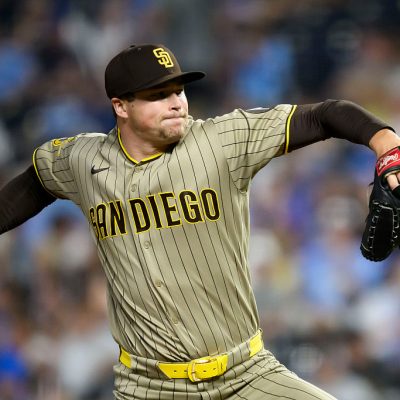

Emerson Hancock
Filling out the rotation should be the Padres’ top priority if they’re going to get serious, and Emerson Hancock would be a great place to start.
Hancock is in the middle of a breakout season, posting a 3.26 ERA in 20 starts, recording 102 strikeouts in 110.1 innings. He would immediately slot into the rotation as the No. 2 starter.
He offers two plus fastballs in his four-seamer and sinker. The four-seamer has a Run Value of 14 and creates outlier arm-side movement, generating 12 inches of run due to his 12-degree arm slot. The same can be said for his sinker, which generates seven more inches of drop than the average sinker, leading to a Run Value of six.
Strengthening the argument for acquiring Hancock is that he is under team control through 2030, which would greatly benefit a Padres team that has the majority of its rotation under expiring contracts.
The only downside is that the underlying metrics aren’t encouraging. His 4.15 expected ERA (xERA) is nearly a full run higher than his actual ERA. He is also giving up plenty of hard contact with an 89.9 mph average exit velocity (27th percentile), an 8.9% barrel rate (29th percentile), and a 43.9% hard-hit rate (14th percentile).
Pitching in Seattle has certainly helped his numbers, but moving to another pitcher-friendly park in San Diego could allow him to continue outperforming those metrics.
Freddy Peralta
If Hancock is out of the Padres’ price range, Freddy Peralta could be a cheaper alternative.
It’s been a disappointing season by Peralta’s standards. After posting a 3.30 ERA over the previous four seasons, his ERA has ballooned to 4.99. It’s a significant step back, but there are reasons to believe he can return to form.
He hasn’t shown any drop in velocity, which is encouraging, and there isn’t anything concerning when it comes to his pitch shapes or movement.
The main issue is that his command has taken a step back. He’s always struggled with walks, but looking at his heat maps, every pitch is much more spread out. In previous seasons, his locations were far more consistent.
Given that the stuff is still intact, it feels like he’s one or two mechanical adjustments away from becoming the Cy Young-caliber starter we saw in Milwaukee. And who better than Ruben Niebla to help get him there?
Given his regression and the fact that he’s a true rental, he’s someone who should fall within the Padres’ price range and could provide a much-needed boost to the rotation.
Clay Holmes
Pivoting to another New York Met, Clay Holmes is someone who could bolster the rotation and, like Peralta, be a cheaper and more realistic option, and according to Jon Heyman, the Mets aren’t looking to extend Holmes.
Holmes got off to a strong start this season, posting a 2.39 ERA with 45 strikeouts in 52.2 innings before landing on the injured list with a fractured fibula. He appears to have made a full recovery after throwing four innings in a rehab start on July 28.
Like Peralta, Holmes is likely to be a rental because of his player option for 2027. If Preller is going to buy, though, it doesn’t seem like the long term is going to be much of a consideration.
There is some risk in acquiring Holmes because of the injury and the Padres’ win-now mentality, but he would be a significant upgrade over everyone in the rotation besides Michael King.
Eugenio Suárez
Coming off a 49-home run campaign, Eugenio Suárez was a natural fit for a Padres lineup desperate for power, and he still is.
It’s been a lost season for the slugger, posting a .666 OPS with 14 home runs in 78 games. He’s seen a steep decline in both hard-hit rate and barrel rate. So why trade for him?
He’s someone who wouldn’t cost Preller much to acquire, and he still offers plenty of upside. There’s no denying he’s a gamble, but it’s a bet worth taking because of the impact he can have if he rediscovers his swing.
Mickey Moniak
Sticking with power bats, Mickey Moniak would provide some juice from the left side.
He’s shown an ability to hit at Petco Park, which isn’t easy for left-handed hitters, slashing .278/.291/.574 in 55 plate appearances. He also has encouraging metrics, including a .433 expected slugging percentage (67th percentile), an 11.1% barrel rate (71st percentile), and a 43.3% hard-hit rate (62nd percentile).
While Jake Cronenworth has provided more offense in the second half, Moniak would slot perfectly into the two-hole. Having him hit between Fernando Tatis Jr. and Manny Machado would create a formidable top of the order.
Moniak comes with some volatility because of his high whiff, chase, and strikeout rates, but if the Padres are looking to add more power without breaking the bank, he’s a gamble worth making.
Heriberto Hernández
Not many people know about Hernández just yet, but he’s quietly putting together a breakout season in Miami and would be a perfect fit for the Padres. He’s slashing .238/.307/.480 with 16 home runs and a 112 wRC+ in 80 games.
Hernández is producing elite quality of contact with a 51.1% hard-hit rate (93rd percentile), a 13.2% barrel rate (86th percentile), and a 92.2 mph average exit velocity (89th percentile). Slotting into left field, he would seamlessly replace the production the Padres have been missing since Ramón Laureano departed.
He offers tremendous upside, though he does whiff and strike out more than you’d like to see. Even so, the quality of contact is good enough to bet on the upside.
The only issue is that he’s under team control through 2031, which could make him expensive. But with the Marlins’ recent losing streak, they may be more inclined to sell. If I’m Preller, this is one of the few players I’d be willing to pay a premium for.
Become a Member of Just Baseball
Subscribe and upgrade to go ad-free!
* Save 25% by subscribing annually.

Written by
Ethan is an aspiring sports analyst who has a passion for all sports. He was a collegiate baseball player and is a recent San Diego State…