
Should the Cardinals Pursue a Jordan Walker Extension?
Walker is one of baseball's newest stars. Will the Cardinals do what it takes to keep him in St. Louis for the long haul?
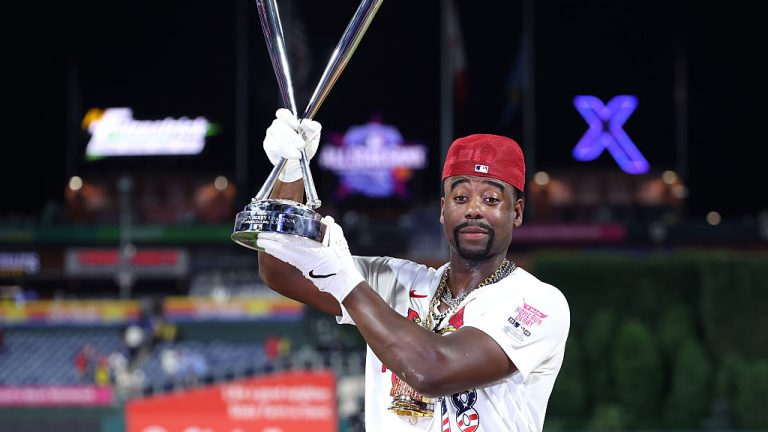
Among the many St. Louis Cardinals storylines to follow this season, it’s hard to argue that Jordan Walker isn’t the biggest. From bust to born again, bottom of the barrel to a Home Run Derby throne. Walker has reinvented himself and simultaneously played his way into contract extension talks.
St. Louis recently dished out an eight-year, $112.5 million deal to star rookie JJ Wetherholt. Cardinals fans were ecstatic. But after taking a breath and watching Walker eclipse Kyle Schwarber in what Barry Bonds called “the greatest Home Run Derby” he’d ever seen, they were asking for another big contract already.
Walker, 24, is in the midst of a career year. The All-Star, Derby champ, and current MLB RBI leader has put on a show all year.
His bat speed ranks among MLB’s best, he’s hitting baseballs in the air more than ever, and he’s improved defensively and on the basepaths. It seems like the star version of Walker is here to stay. However, some fans are hesitant to trust the breakout, given his two prior seasons of poor performance.
With that being the case, should St. Louis pursue an extension? Or is it best to play the waiting game with one of baseball’s most polarizing new stars?
Why Jordan Walker Deserves an Extension
Walker’s return to prominence after being one of baseball’s most highly renowned prospects is one for the ages. Few players have ever mounted a turnaround that comes close to his.
In the first three seasons of his career, Walker bounced between MLB, Triple-A, and the IL. In 279 big league games, he registered a meek -2.6 bWAR that left Cardinals fans losing faith.
Heading into the 2026 season, Walker worked at Driveline to get his attack angle fixed. The focus was simple: Hit the ball in the air.
And with that singular focus, Walker has a new approach, and results have followed.
The first step was to become more aggressive. This season, Walker is swinging about three percent more often than he did last year – even at balls. This aggressive approach has enabled him to avoid two-strike counts and jump on pitches early.
Consequently, when Walker hits the first offering, he’s got an OPS of 1.072.
All of this is to say, Walker’s changes aren’t seasonal; they’re foundational. He’s reconfigured himself as a ballplayer, and although the league may adjust, there’s no doubt that he has the tools to remain an effective bat for years to come.
Another key factor in extension talks is commitment.
The city of St. Louis has been waiting for the next chapter. For newly appointed POBO Chaim Bloom to turn the page. Wetherholt’s extension felt like the beginning, but it still feels like the Cardinals are one or two signings away from a real core.
Team CEO Bill DeWitt III recently said that the Wetherholt extension was hopefully the “first of many.” That immediately sent the fans into a frenzy.
Other players on the roster, such as Iván Herrera, Alec Burleson, and Michael McGreevy, have had stellar seasons, too. Herrera earned his first All-Star nod, Burleson is among MLB’s top run producers, and McGreevy has a 2.92 ERA through 19 games started.
The unfortunate reality is that all of those players have extenuating circumstances that have deterred serious extension talks, as there are currently no reports of the Cardinals pursuing negotiations with any of them.
Walker’s unique blend of skill set, performance, and age is extremely hard to come by. He’s given the Cardinals a taste of what it’s like to have a star, which has eluded them since 2022.
However, a contract is a two-way street. What are the drawbacks on both sides?
The Reasons for Hesitation
The first and biggest reason a deal might fall through comes from Walker’s camp, not the Cardinals’.
Walker is set to hit free agency before turning 30 years old. Even after all the demotions, roadblocks, and service-time manipulation, if he were to perform through the 2029 season, his payday would be massive.
As a result, if St. Louis wants to keep Walker, it’ll be buying into future projections rather than past performance, possibly with the biggest contract in franchise history. That’s a scary bet to hedge.
Even after all his rampant success, Walker was once the belittled former top prospect, barely worth a roster spot. There’s no doubting his work ethic or character, but it’s more than fair to question his consistency moving forward.
Another ‘hold the phone’ on a long-term commitment to Walker comes from the St. Louis farm system. If the Cardinals pay up for Walker on a ‘stay-at-home’ contract, they risk alienating some of their top prospects.
Multiple talented minor leaguers, including position players Joshua Báez, Won-Bin Cho, Leo Bernal, Raniel Rodriguez, and Chase Davis, are well on their way to St. Louis. They’d surely like to think they could be part of the team’s next core, perhaps signing extensions themselves one day.
Yet, St. Louis has never been the type of organization to shell out a lot of large contracts. Wetherholt’s pre-arb extension was the biggest since Albert Pujols donned the Birds on the Bat. With that being the case, it seems feasible to imagine a Walker extension would be the cherry on top of this Redbird core, rather than the beginning of a spending spree.
With the Cardinals front office so outspoken about player development and the future of their once-prestigious organization, that feels like an odd egg to crack – especially only one year into a supposed ‘rebuild.’
Irrespective of that, Walker’s rise to stardom is certainly worth the price of admission, but is it worth the contract projections?
What Would a Jordan Walker Extension Look Like?
Internal contracts rarely offer as much money as the free market. The Braves, Guardians, and Brewers have made a habit of keeping homegrown talent on team-friendly deals. Still, these extensions are always informed by projections of what the player in question could earn as a free agent.
On 101 ESPN’s BK and Ferrario, Cardinals beat writer Derrick Goold stated that a potential Walker extension may be “remarkably close” to the eight-year, $260 million extension Nolan Arenado signed with the Rockies. Goold furthered his opinion by stating it’d likely need to hover closer to nine years and $300 million.
That’s more guaranteed money than the following players got in free agency last season: Alex Bregman, Pete Alonso, Cody Bellinger, and Kyle Tucker.
Do the Cardinals have that kind of money? Most likely. However, should they give it all out in one big bet on a singular player’s future?
That’s the question that St. Louis will have to answer. In due time, the fans will have answers.
With every game, swing, home run, outfield assist, and signed baseball, Walker’s value increases. There’s no telling where he’ll be with a second half that even slightly resembles his first.
The Cardinals seem to have a star in their midst. Is now the time to buy in? Or can they afford to wait for what’s to come? The waiting game is strenuous, but it sure feels better when paired with a ‘J-Bomb’ or thirty.
Become a Member of Just Baseball
Subscribe and upgrade to go ad-free!
* Save 25% by subscribing annually.

Written by
AJ Stone is a sportswriter and journalist currently attending the University of Missouri School of Journalism. His work has appeared on Redbird Rants, Heavy.com, Arcadia News,…