
Braves First Half Report Card: What Went Right and What Went Wrong?
Despite a disappointing finish to the first half, Atlanta remains one of MLB's best teams.
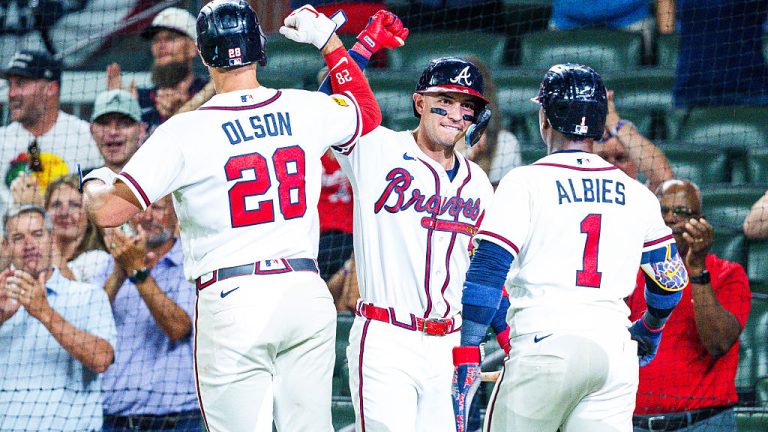
If you asked Atlanta Braves fans back in early March how they would feel about entering the All-Star break with a 55-40 record and a two-game lead in the National League East, more than 95% of them would have said they would be thrilled.
Fast forward to today, and the mood around Braves Country feels much different. After racing out to a 40-20 start through May, Atlanta stumbled into the break, going just 15-20 across June and the first half of July.
To put it simply, June was ugly. It felt like every night the pitching staff struggled to keep runs off the board while the offense forgot how to score them. For many fans, it brought back uncomfortable memories of the 2025 season.
The good news is that every game counts the same. Game 25 carries just as much weight as game 155 in the standings.
Despite that rough stretch, Atlanta enters the break with the fourth best record in baseball and the third best run differential at +92. They own a winning percentage above .560 both at home and on the road, and are one of only three teams to have been swept just once all season.
For me, this is still a legitimate World Series contender. June certainly did not look like championship baseball, but there are plenty of reasons to believe a correction is coming, especially with several key players nearing a return. However, let’s take a look at how the team performed in the first half of the season.
Offense
The Braves offense experienced one of the steepest declines from one month to the next I can remember seeing from a team in recent years.
| Metric | 3/25 – 5/19 | 5/20 – 7/12 | Rank Change |
| AVG | .263 (#1) | .228 (#29) | -28 |
| OPS | .767 (#2) | .673 (#28) | -26 |
| wOBA | .334 (#3) | .297 (#28) | -25 |
| wRC+ | 110 (#3) | 85 (#28) | -25 |
| Barrel% | 10.1% (#5) | 7.2% (#19) | -14 |
Early in the season, Atlanta silenced many of their preseason doubters by fielding arguably the most dangerous lineup in baseball. They ranked near the top of the league in nearly every major offensive category from top to bottom, and it looked like another dominant season was underway.
Then, almost overnight, everything changed. It felt like the Monstars from Space Jam had stolen the lineup’s talent. The quality of at-bats disappeared, rallies became difficult to start, and nearly everyone cooled off at the same time.
Austin Riley is in the midst of the worst offensive season of his career. He looks out of sync at the plate, and if he continues hovering around the Mendoza Line with an OPS beginning with a six and a strikeout rate approaching 30%, very difficult conversations will eventually have to take place.
Ha-Seong Kim has struggled even more, hitting just .068 with a .239 OPS before landing on the injured list. The Braves are planning an extended rehab assignment in hopes of getting him back on track for the stretch run.
Dominic Smith was one of Atlanta’s biggest early-season heroes, delivering timely hit after timely hit despite inconsistent playing time. After hitting above .300 through May, he has collected just 15 hits since the start of June, only three of which have gone for extra bases, while batting below .200.
So where are the positives, you may be asking?
The biggest connection between Atlanta’s hot start and its offensive collapse, for me, came simply when both Ronald Acuña Jr. and Drake Baldwin landed on the injured list. Acuña appeared in only 18 games between May 19 and July 12, posting an .885 OPS while helping Atlanta go 12-6 before suffering a hamstring injury on June 10.
Baldwin hit the injured list on May 19 and returned on June 16 after an aggressive rehab timeline. Unsurprisingly, he struggled immediately after returning, batting just .085 over his first 15 games before beginning to show signs of returning to form in the final weeks before the break.
Both players have an enormous impact on this lineup, and their absences were impossible to ignore. Baldwin looked much more like himself entering the break, while Acuña is already back at the Complex and ramping up for a return shortly after the break.
There are also encouraging signs beneath the surface.
Atlanta’s strikeout rate only increased from 20.8% to 21.8%. Average exit velocity only dipped from 89.9 mph to 88.5 mph, and their hard-hit rate only fell from 41.1% to 38.4%. This is not a pattern you want to see. However, it does match up with the injuries to both Acuña and Baldwin, both of whom rank among the team leaders in those metrics.
As key players get healthy and the club benefits from a week of rest, there is good reason to believe the offense can bounce back closer to the level we saw earlier in the season.
Defense
Defensively, Atlanta has once again established itself as one of the better teams in baseball.
Through 95 games, the Braves have committed 42 errors, tied for the eighth fewest in the league. Out of those errors, 22 have been fielding errors (tied for 12th), and 20 have been throwing errors (tied for sixth).
Riley leads the club with eight total errors, tied for the eighth most in baseball, five of which were throwing errors. Matt Olson surprisingly ranks second on the team with six errors, five of which have been fielding miscues.
While the first baseman has not repeated his spectacular 2025 defensive campaign, he still ranks in the 89th percentile with four Outs Above Average, tied for the second most among first basemen. Ozzie Albies has committed five errors, but no other Braves player has more than three.
As a team, Atlanta ranks fifth in baseball with 40 Defensive Runs Saved, sixth with 14 Outs Above Average, and ninth with a +8 Fielding Run Value. Mauricio Dubón and Michael Harris II have led the way defensively, while Olson, Jorge Mateo, and Eli White have all played major roles in giving Atlanta one of the better defensive clubs in baseball.
The biggest weakness has come behind the plate, although there are understandable reasons why.
Sean Murphy, one of baseball’s premier defensive catchers, has appeared in only four games. Baldwin has caught just 52 games because of injury. That has forced Sandy León, Jonah Heim, Joey Bart, Chadwick Tromp, and Austin Wynns to combine for 63 appearances behind the plate. That instability has shown.
The Braves rank last in baseball at throwing out runners, catching only 12 of 87 attempted base stealers for an abysmal 13.8% caught stealing rate.
Baldwin has never been viewed as an elite defensive catcher, and his throwing has taken a slight step backward this season. However, he remains slightly above league average as both a blocker and framer. As a team, Atlanta also ranks 10th in baseball with only three passed balls and sixth with just 21 wild pitches.
Overall, the defense has been a major positive despite the struggles controlling the running game. As Baldwin continues to get healthy and Murphy works toward a rehab assignment, that weakness has a real chance to improve during the second half.
Pitching
On the surface, the pitching staff has still been very good. The rotation ranks 10th in baseball with a 4.00 ERA, while the bullpen has been among the league’s elite. Its 3.06 ERA, 3.49 FIP, 1.12 WHIP, 15.7% K-BB%, and .215 opponents batting average all rank inside the top three in the MLB.
The bullpen has remained remarkably consistent throughout the season. The rotation, however, has not.
| Metric | 3/25 – 5/19 | 5/20 – 7/12 | Rank Change |
| ERA | 3.09 (#2) | 5.09 (#25) | -23 |
| FIP | 4.02 (#14) | 5.07 (#26) | -12 |
| SIERA | 4.22 (#13) | 4.41 (#21) | -8 |
| WHIP | 1.17 (#7) | 1.47 (#27) | -20 |
| K% | 23.4% (#10) | 20.7% (#23) | -13 |
| EV | 88.6 mph (#6) | 89.3 mph (#23) | -17 |
| Barrel% | 6.4% (#2) | 8.4% (#22) | -20 |
Prior to Opening Day, many questioned just how effective this pitching staff could be. Injuries to Hurston Waldrep, AJ Smith-Shawver, and Spencer Schwellenbach created uncertainty, while Bryce Elder, Grant Holmes, and Reynaldo López still had plenty to prove. There was also the possibility Atlanta would have to rely on rookies such as Didier Fuentes, JR Ritchie, and Owen Murphy.
During the first portion of the season, those concerns disappeared.
Chris Sale pitched like an ace. Bryce Elder ranked among the league leaders in ERA, WHIP, FIP, and opponents’ batting average. Martín Pérez turned back the clock with a 3.13 ERA and a 1.14 WHIP. Holmes, López, Ritchie, and Spencer Strider all contributed to a rotation that ranked second in baseball during that stretch.
Then things changed quickly.
- Chris Sale: 1.96 ERA → 2.51 ERA
- Bryce Elder: 2.01 ERA → 7.43 ERA
- Martín Pérez: 3.13 ERA → 4.24 ERA
- Spencer Strider: 2.45 ERA → 7.03 ERA
Surprisingly, it was only Grant Holmes (3.80 → 3.75 ERA) and Reynaldo López (3.74 → 3.50 ERA) that experienced any steps forward from mid-May to the All-Star break.
Ritchie made his debut but experienced the expected growing pains from a rookie, particularly with his command. He has, however, looked increasingly comfortable with each outing. Fuentes has settled into the bullpen for now, while Murphy not only made his major league debut but is also scheduled to make his first career start immediately after the All-Star break.
The encouraging news is that reinforcements are getting close.
Waldrep recently returned from injury and made a pair of starts before the break after an initial bullpen appearance. The results were not ideal, and he has since returned to Triple-A to continue refining his command, but his availability is encouraging after a breakout 2025 campaign.
Smith-Shawver has already completed three rehab starts, including his latest at Triple-A. His fastball has consistently sat in the upper 90s, and once he builds back up to five or six innings should be in line to rejoin Atlanta’s rotation.
There are also rumblings that Schwellenbach could soon begin throwing at the Complex before starting his own rehab assignment. This would arguably be the biggest addition of them all.
If all three pitchers return by the middle of August, Atlanta’s rotation becomes significantly deeper and more talented heading into the final stretch of the season.
Braves Second Half Outlook
There has been plenty of negativity throughout this report card because the past month has simply not been good baseball.
But there is another way to look at it.
Despite one of the worst stretches of baseball a team as talented as Atlanta could play, they still own the fourth best record in baseball. They still sit atop the National League East. And most importantly, they have yet to be even 80% healthy.
Acuña, Kim, Waldrep, and Smith-Shawver are all progressing toward returning to the active roster. Mike Yastrzemski and Robert Suarez should not be sidelined much longer, and the All-Star break should also benefit Harris as he continues managing lingering injuries.
Meanwhile, Ritchie, Fuentes, and Murphy have steadily improved with each opportunity, reinforcing why all three had been viewed so highly as prospects within the organization.
As several early-season surprise contributors such as Smith, Mateo, and White have cooled off, Jim Jarvis and Brewer Hicklen have begun picking up the slack.
Yastrzemski started to show why he was a solid, underrated signing in the offseason before injury, and Dubón has been one of the early MVPs of the team. Both Harris and Albies finally broke out of the pattern from previous years of early-season woes.
When fully healthy, I am not expecting the Braves to return to the 108-win pace they played at earlier in the season. They do not need to either.
Maintaining their .579 winning percentage in the second half (a 39-28 record) would give Atlanta a 94-win season. That feels well within reach, and if they get there, it should be enough to win the National League East while giving this club a legitimate chance to make another deep October run.
Become a Member of Just Baseball
Subscribe and upgrade to go ad-free!
* Save 25% by subscribing annually.

Written by
Taylor is a baseball enthusiast and a writer for Just Baseball. An Atlanta native, he shares his love for the Braves, card collecting, and scouting the…