
Griffin Jax’s Move to the Rotation Is Paying Off
The Tampa Bay Rays' pitching lab has done it again, converting Griffin Jax into a legitimate, high-upside starter.

Griffin Jax took the ball in Kansas City on July 3, 2021, for what was his fifth career appearance, only this time it did not come via a long trot from the bullpen. Jax had moved into the rotation and was being tried as a starter for Minnesota. It was an experiment that did not last long.
His first start was five innings of disaster: eight hits and six runs leading to a Twins loss. He held his rotation spot through the end of the season, but after posting a 6.10 ERA across 14 starts, he found himself back in the bullpen in 2022 and eventually settled in as a productive relief pitcher before being traded to Tampa Bay last season.
In typical Tampa Bay Rays fashion, they once again worked their pitching magic. I’m sure people have grown tired of the praise for Rays pitching development, but the organization continues to pull rabbits out of the hat with Jax’s transition back to the rotation midseason as their latest example.
After 11 relief appearances, Jax made his first starts — serving more as a two-inning opener — on April 26 and May 2. He has since worked up to five innings and settled in as a surprising rotation option for Tampa.
Jax has now made 11 appearances as a starter and 11 as a reliever. Out of the bullpen, he posted an 8.00 ERA and a 1.89 WHIP. As a starter, however, he owns a 2.40 ERA and a 1.20 WHIP. Tampa Bay needed rotation help, and instead of looking to the minors, they turned to their bullpen — and the move is paying off in a big way.
Griffin Jax’s Rotation Success
Pitchers transitioning from the bullpen into the rotation has been a trend we have seen become more common in recent years.
Michael King, Reynaldo López, Seth Lugo, and Jax’s teammate Nick Martinez have all been recent examples. Signing a reliever and moving him into the rotation is a way for organizations to acquire talent at a lower price point, while the player gets an opportunity to establish himself in a role that can eventually lead to bigger paydays.
Sounds great, right? More teams should simply move bullpen arms to the rotation, especially if they struggle to afford free-agent starters.
In theory, sure. But we have to remember why so many of those arms landed in the bullpen in the first place: poor command, struggles going through a lineup multiple times, and limited repertoires.
In order to successfully make the transition, you typically need a decent number of pitches you can trust and a walk rate that won’t put you in dangerous situations repeatedly. For Jax, he has both.


Jax has six pitches: a sinker, four-seam fastball, and cutter as his fastballs; a sweeper and curveball as his breaking pitches; and a changeup as his offspeed offering. In the bullpen, he leaned heavily on his sweeper (40%+ usage), while mixing his sinker to righties and his four-seam and changeup to lefties. His cutter and curveball were present but rarely featured.
In the rotation, he’s had to expand that mix to navigate lineups multiple times through. Both the curveball and cutter have become fixture offerings, giving Jax more ways to attack lefties. The cutter is still a work in progress, but his other offerings stand out in a way that suggests this transition could be more than a short-term experiment.
Jax’s sweeper has held hitters to a .154 average with a 40.7% whiff rate, his changeup sits at a .228 opponent average with a 41.1% whiff rate, and his curveball has really started to stand out with a .200 average and a 44% whiff rate.
The lone blemish remains his four-seam fastball, which has allowed harder contact (92.6 mph average exit velocity) and surrendered four home runs.
Not only is the pure stuff great, but his command has been excellent. His 3.33 BB/9 on the season is influenced by his time as a reliever, but since moving to the rotation, that number has dropped to 2.60. He’s limiting free passes, and when hitters do reach base, his 47% groundball rate helps limit damage.
You might look at his 10.5% barrel rate and have some concern, but that is largely due to his four-seam fastball getting hit hard. His three most-used pitches — sweeper, changeup, and sinker — have produced elite contact numbers. All have an average exit velocity of 87 mph or lower, with a 12-degree launch angle on his sweeper, -2 on his changeup, and 4 on his sinker.
A major reason for Jax’s success has been his ability to get batters to chase pitches outside the zone. A 33% chase rate paired with a 31% whiff rate is a strong combination, forcing hitters to swing at pitches they struggle to do much damage on.
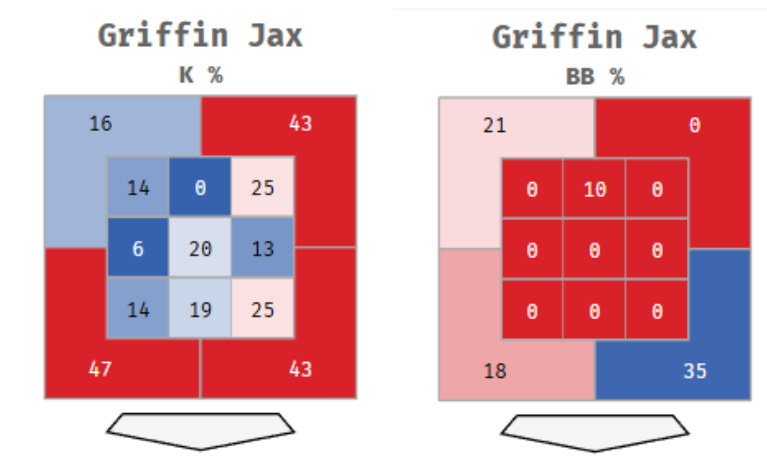
Via Baseball Savant
The picture above shows the drastic difference between his walk rate and strikeout rate on pitches outside of the zone. I’m sure we will see some stabilizing as the sample size grows, but as of now, Jax does not have to land his pitches in the zone in order to be successful. Living on the edges and breaking out of the zone is still leading to a lot more strikeouts than walks.
As the sample size continues to grow, you have to wonder if the success will continue or if we will see a dip in production. Will he be able to pitch a starter’s workload, even limited to five innings, the rest of the year? Will batters start to catch on and adjust? Or will Jax continue to make improvements as he settles in?
To me, the next step is him getting more comfortable with his curveball and fastball offerings to lefties. The curveball has a strong movement profile and has what it takes to be a lethal pitch, but finding comfort in locating the pitch better will help avoid hard contact.
As far as a fastball to attack lefties, he’ll either have to improve his cutter or just lean more heavily on his sinker. His four-seamer does have a decent whiff rate, but it has been hit hard over the past two seasons. Luckily, he’s in the right organization to find the best path forward.
Final Thoughts
There are times were smaller sample sizes look good on the surface but, as you dig deeper, expose red flags that tell you the production is closer to a lie than the truth. Griffin Jax, well-above-average starter, is not one of those cases. He has the stuff, command, and pitch mix to make it work.
Tampa Bay has once again found value in a place no one else was looking. Acquiring Jax to bolster their always-great bullpen was a great move at the time, but it looks even better in hindsight.
Hey, they don’t build their reputation by happenstance One of baseball’s best organizations continues to add to its track record of pitching development, and Jax is the latest example.
Become a Member of Just Baseball
Subscribe and upgrade to go ad-free!
* Save 25% by subscribing annually.

Written by