
The Rays Are Proving You Don’t Need Homers To Win
The Rays have hit fewer home runs than any other team in baseball, but they still have one of the best records in the American League.
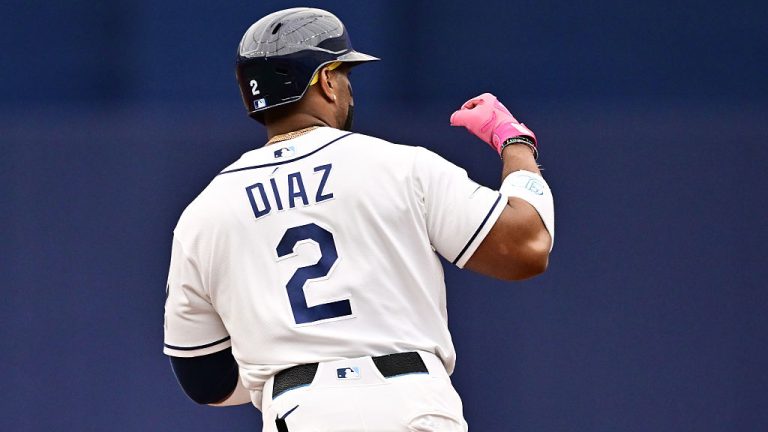
In recent memory, many competing teams tend to share similar traits that help them charge towards October with authority. Whether it’s a strong pitching staff, a bullpen full of flamethrowers, or a strong lineup built with plenty of protection for the club’s stars, these factors can be found in most competing teams.
One of the most common and arguably important traits contending teams usually possess is the ability to slug and do damage on opposing pitchers’ mistakes. After all, without being able to make pitchers pay for their mistakes, lineups are easier to attack and more susceptible to arms of all shapes and sizes around the league.
While this remains true, the Tampa Bay Rays are proving that slugging isn’t a necessity to compete, but rather a luxury. As it currently stands, the Rays hold the top Wild Card position with a record of 41-30, and they’ve been a fascinating story to follow all season long.
Captivatingly, the Rays have only hit 58 homers as a club, a mark that places them dead last in the sport, as they’re one of just two teams with fewer than 60 homers.
With seemingly every day that passes, the Rays are redefining what it means to be a competitive offense. Each player in their lineup is doing their own individual part to push this team back towards postseason greatness, as they’re coming together to propel them forward, rather than relying on a few main sluggers to carry them.
Stats updated prior to games on June 19.
The Rays’ Offensive Approach: Everyone Does Their Part
When diving deep into the Rays’ offensive approach, you begin to see a much larger picture than simply not taking advantage of the long ball. Instead, they’ve structured their lineup in a way that allows their main run producers to succeed, while also capitalizing on role players who regularly produce tough at-bats.
For starters, the Rays have followed a model that’s been successful for almost as long as the game has been played, as they’ve stacked their biggest run producers within the top four spots in their order. This group consists of Junior Caminero, Jonathan Aranda, Yandy Díaz, and Cedric Mullins. Of the Rays’ 58 homers as a team, this group makes up 44 of them (approximately 75%).
However, in order to truly understand the Rays’ offensive focus, we have to dig a little deeper than this group of four hitters.
The Rays are the furthest thing from an offensive juggernaut, even aside from their lack of home runs. They rank 30th in baseball in barrel rate (3.7%) and 26th in average exit velocity (88.1 MPH). Without the ability to do damage, they have to double down on using their entire order as a stepping stone for the top of the order, wearing down arms at every opportunity they’re given — and it’s working.
There might not be a better example to use than Taylor Walls, as he’s done his job in this role incredibly effectively. On average, Walls has seen 4.04 pitches per plate appearance, a mark that’s well above league average and near the top of the offense.
While he may currently possess a 69 wRC+ and poor underlying numbers, he wears down opposing arms. He gives the key run producers in this lineup more looks at the stuff any pitcher has on a given day, which is incredibly valuable. With arms more worn down, they’ll be more susceptible to making mistakes and leaving pitches over the heart of the plate for players like Junior Caminero to capitalize on.
Aside from Walls, the Rays have eight players who see 3.9 pitches per plate appearance, and five of these players regularly hit near the bottom of the order. Jake Fraley is another great example of someone who effectively tires out opposing arms even without the results to show for it, as he leads the team in pitchers per plate appearance with 4.21 while posting a wRC+ of 91 with an OBP of exactly .300.
By taking this approach, every single hitter in the Rays’ order has done their part to produce incredibly positive results, even if they’re not as strong offensively. In fact, the Rays currently only have four players with a wRC+ over 100 (min. 50 PA), but they’re succeeding in spite of that because their entire lineup is wearing down arms.
The Pitching Staff’s Impact
While the lineup’s ability to wear down pitchers has been important, it’s far from the only contributing factor to the club’s success as a whole. The Rays have gotten a tremendous amount of help from their pitching staff, as this group has helped make up for a lot of what the offense has lacked.
As it currently stands, the Rays possess the 12th-best team ERA in the sport, ahead of other pitching powerhouses such as the Pittsburgh Pirates or the Toronto Blue Jays. With their best and most injury-prone arms finally healthy and in a position to contribute, the Rays have taken a huge step because of their impact.
Beginning with their rotation, the Rays have seen three of their starting pitchers really come through for them. At the forefront of this staff is right-hander Drew Rasmussen, arguably the most consistent arm in recent franchise history. With a 2.59 ERA, 84 strikeouts, and 2.2 fWAR in 80 innings pitched, there’s a very good chance that he’s en route to his second straight All-Star season.
Right behind Rasmussen is Shane McClanahan, a former All-Star who has struggled mightily to remain on the field in recent seasons. Now fully healthy, McClanahan has been excellent, as he’s posted a 3.33 ERA with 69 strikeouts and 1.9 fWAR in only 67.2 innings pitched, looking like the version of himself the Rays have eagerly awaited since he was recovering from a plethora of injuries.
The last real bright spot in the rotation has been right-handed veteran Nick Martinez, as he’s been exactly what the club had hoped he would be when they inked him to a one-year deal worth $13 million last offseason. Through 83 innings, Martinez has recorded a 2.60 ERA with 1.8 fWAR, quickly becoming a very valuable asset.
While these three arms have primarily led the way on the pitching side of things, the Rays have had multiple relievers emerge this year to hold down key innings in the bullpen. The team’s closer, Bryan Baker, has completed 18 saves while pitching to a 1.91 ERA and striking out 34 batters along the way. Kevin Kelly has been another revelation, as he’s eaten up 33.1 innings to the tune of a 2.70 ERA.
Without these arms, the Rays wouldn’t be anywhere near contention, as they’ve pitched well enough to keep the offense in games they’d otherwise struggle in. Without the significant power to make up for large deficits, the Rays have been able to scrap together enough run support to pair well with their pitching staff to win games.
Is *Not* Slugging a Sustainable Strategy?
When writing this story, the one thought I kept repeatedly having was, “While the Rays’ lack of slugging has worked to this point, can it continue through a full 162-game marathon?” The answer is more complicated than it may seem, especially when considering how many role players the Rays have used up until this point.
The short answer is probably, for a few reasons. The most important one is that the Rays aren’t really trying to avoid slugging. They’re trying to make it less central to survival.
Even in a season where they sit dead last in home runs, the Rays have built enough offensive pressure points that games rarely hinge on whether one swing clears the wall. Instead, they hinge on whether opposing pitchers can survive the middle innings without losing command and overcome the focal points of their pitching staff, which has been proven to work for numerous teams throughout the sport’s storied history.
A lineup full of demanding at-bats doesn’t show up neatly in box scores, but it shows up in the sixth and seventh innings when starters are still on the mound despite no longer being able to reliably execute at the top of the zone.
It shows up when bullpen arms are used earlier than planned, or when a reliever is forced into high-leverage situations with minimal margin for error. It shows up when the nine-hole hitter sees nine pitches in a plate appearance, wearing down their accuracy for the key bats at the top of the order.
The risk, of course, is that if these players hit a cold streak, it could get ugly fairly quickly. This is especially true considering that many of their everyday starters have very little experience or have spent most of their careers as role players.
However, this risk may push the Rays to make a big move at this year’s deadline, which is exactly the type of move that may push them one step further towards something more sustainable. The 2026 Tampa Bay Rays are proving that you don’t need homers to win games, and it’s been utterly fascinating to watch unfold.
Become a Member of Just Baseball
Subscribe and upgrade to go ad-free!
* Save 25% by subscribing annually.

Written by
Jay Staph, a huge baseball fan and stat nerd, founded and ran his own baseball writing website, BSBWrites, at just 16-years-old. With focal points around prospects,…