
Is Eric Hartman the Next Great Braves Prospect?
One of the fastest-rising prospects in the minors, Eric Hartman has blossomed from a 20th-round selection into a bona fide top-100 prospect.
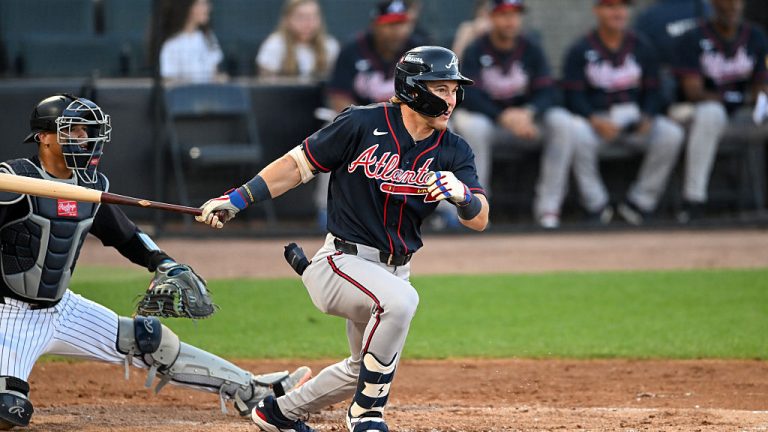
Since the graduations of players such as Ronald Acuña Jr., Ozzie Albies, Dansby Swanson, and Austin Riley, the Atlanta Braves’ farm system has consistently ranked near the bottom of the league.
Much of the talent Atlanta has had in the farm system during that stretch had been on the pitching side, including Spencer Schwellenbach, Spencer Strider, Bryce Elder, Hurston Waldrep, AJ Smith-Shawver, Didier Fuentes, JR Ritchie, and others.
Despite that, the Braves still produced the 2022 and 2025 National League Rookie of the Year winners in Michael Harris II and Drake Baldwin. Both are position players. Even Shea Langeliers and William Contreras spent the majority of their minor-league careers in the Atlanta system before finding success at the big-league level elsewhere.
The point is simple: Despite the narrative surrounding Atlanta’s farm system over recent years, the organization has continued to develop legitimate major league talent at a high level.
Now in 2026, many outlets are beginning to take notice of the Braves’ system once again.
For the first time since before the pandemic, much of the excitement centers around position players. Tate Southisene, John Gil, Owen Carey, Michael Martinez, Diego Tornes, and Conor Essenburg have all started generating buzz throughout the organization.
However, there is one prospect who has exploded onto the national scene, climbing all the way to Just Baseball’s No. 32 overall prospect: Eric Hartman.
Stats were taken prior to play on June 26.
Who Is Eric Hartman?
Hailing from Alberta, Canada, Eric Hartman was an extremely under-scouted prep prospect. Much of the industry either did not see him due to his location or assumed he would honor his strong commitment to the Michigan Wolverines.
The Braves — more specifically, area scout Cody Martin — did not give up.
If you are unfamiliar with Alberta, the province sits above Montana and Idaho, making it far less accessible than talent rich areas such as Ontario, Quebec, or British Columbia. MLB.com recently published a fascinating look at how Martin and the Braves ultimately convinced Hartman to sign.
The story began when Braves vice president of amateur scouting Ronit Shah and amateur scouting video manager Alex Burritt noticed Hartman’s athleticism and swing while watching Team Canada video. They both reached out to Martin, but the expectation remained that Hartman was destined for Michigan.
Martin later attended a tournament in British Columbia and got a chance to see Hartman in person. Even with the belief that college was still the likely path, Martin had a conversation with Hartman about the possibility of beginning his professional career immediately.
During that conversation, Martin learned Hartman had already discussed the decision extensively with his family, particularly his older brother, who plays at Washington State
“Do we play to be college players or professional players? We want to be pro players. If you have the opportunity to get some money out of this and fulfill your dream to be a pro, then you should do it.”
Hartman eventually had to wait until the 20th round, pick No. 611 overall, to hear his name called by the Braves. Atlanta signed him to a well-over-slot bonus of $337,500, a figure that roughly matched a sixth-round slot value in the 2024 MLB Draft.
Fast forward to today, and that gamble appears to be paying off for both sides.
The Numbers Behind The Rise
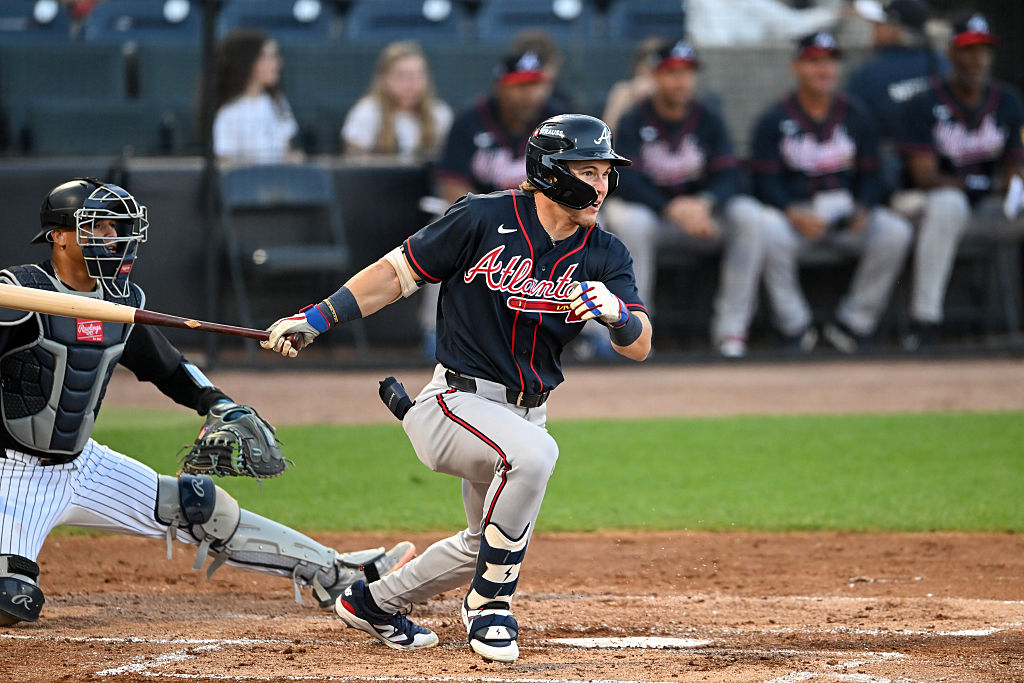
Hartman opened his professional career at the complex level in 2025. Atlanta then aggressively assigned him to Single-A Augusta, but the jump provided him some challenges.
There were still flashes of potential, though. Hartman recorded 13 extra-base hits and stole 20 bases, but he batted just .222 and struck out twice as often as he walked across 39 games.
Atlanta eventually sent him back to the complex for six games before returning him to Augusta for the final 44 games of the season where he would show improvement. Overall, Hartman slashed .240/.341/.358 with a .699 OPS, 26 extra base hits, five home runs, and 48 stolen bases.
The athleticism and tools were obvious, but he still looked like a player who needed significant development time. Despite that, however, Atlanta promoted him to High-A Rome entering the 2026 season.
That decision has looked brilliant.
Through 66 games and 298 plate appearances with the Rome Emperors, Hartman is slashing .297/.359/.560 with a .919 OPS.
| AB | AVG | OBP | SLG | OPS | wOBA | ISO | wRC+ | |
| 2025 (A) | 318 | .248 | .344 | .374 | .718 | .354 | .126 | 113 |
| 2026 (A+) | 266 | .297 | .359 | .560 | .919 | .398 | .263 | 138 |
Among the 43 Braves minor leaguers with at least 150 plate appearances, Hartman ranks first in home runs, second in slugging percentage and OPS, third in hits, fourth in wOBA and wRC+, and fifth in batting average and stolen bases.
The numbers become even more impressive when looking outside the organization.
Among the 228 minor league hitters under the age of 21 with at least 150 plate appearances, Hartman ranks inside the top 25 in nearly every major offensive category. He ranks as high as second in home runs, seventh in hits, and 10th in slugging percentage.
One of the biggest reasons for the breakout has been a dramatic change in his batted-ball profile.
I have always been a believer that ground-ball and fly-ball rates can tell us a lot about future success or failure. In 2025, Hartman posted a 47.1% ground-ball rate and a 34.4% fly-ball rate. This season, his ground-ball rate has dropped to 33.0%, while his fly-ball rate has jumped to 42.1%.
On top of that, his line-drive rate has increased to 24.9%, nearly seven percentage points better than last season. The impact on his power production has been significant.
With 70-grade speed, there still are certainly benefits to hitting the ball on the ground. Hartman can beat out infield hits and turn routine singles into hustle doubles. However, the greatest offensive damage in baseball is still done by driving the ball in the air. Hartman has embraced that approach.
Of his 79 hits this season, 14 have gone for doubles, one has gone for a triple, and 18 have left the yard. His isolated power has jumped from .126 at Low-A last season all the way to .263 this year, and his slugging percentage is up nearly 200 points.
What makes the power surge even more impressive is the environment in which it is happening. Rome is widely considered one of the toughest hitting environments in the minor leagues and one of the least favorable parks for home runs.
Most of Hartman’s home runs have come on the road, which naturally raises the question of what his numbers might look like in a more neutral offensive environment.
Is the Breakout Real?
When a prospect rises this quickly, skepticism is more than understandable.
Hartman was not a household name entering the season, and it is rare to see a player generate this much momentum in such a short period of time without having some sort of pedigree. The natural question becomes whether this is a true breakout or simply a hot streak.
Personally, I have little reason to doubt what we are seeing.
The speed is unquestionably real. It grades out as a 70 tool, or better, and has already helped him steal 77 bases in just 156 professional games. Atlanta has also transitioned him to the outfield, allowing that athleticism to play defensively, and he appears increasingly comfortable in center field.
The power looks legitimate as well. After posting a max exit velocity of 108.5 mph last season, Hartman has already eclipsed that mark multiple times and has reached 113.5 mph this year. His 90th-percentile exit velocity has also jumped by more than four mph.
Combined with a slight adjustment to his stance that helps him lift the baseball more consistently, it is easy to see where the additional power is coming from.
The hit tool remains the biggest question mark. Despite the breakout, Hartman’s strikeout rate has only improved by 0.2% from Low-A, settling at 22.8%. That is not an alarming number, but continued improvement would certainly be encouraging. His walk rate has also dipped from 10.6% overall last season to 8.4% this year.
Hartman is swinging at nearly 10% more pitches than he did last season, yet he has maintained similar contact and strikeout rates. So, while the walk rate isn’t anything to write home about, what happens when he makes contact with the baseball certainly is.
The Road To Atlanta
It has been a long time since a Braves prospect generated this level of excitement. Prospects simply do not put together these types of numbers for extended stretches without earning serious national attention. Hartman’s rise during just his second professional season has been remarkable.
At the same time, it is important to remember that development is rarely linear. No prospect continues improving at this pace forever.
But the ceiling has undoubtedly changed.
It may sound aggressive today, but envisioning a future 30-30 season in the majors is no longer unrealistic based on what Hartman has shown.
The power-and-speed combination gives him the type of upside that could eventually push him into the top-10 overall prospect conversation. He’s already knocking on that door and should rank among the top two prospects in the Braves’ system whenever the next round of rankings is released.
Given how this season has unfolded, Hartman should receive a promotion to Double-A Columbus at some point this year.
At just 20 years old, success at that level would create legitimate discussion about his major-league timeline. If he begins next season in Double-A and continues producing, there is at least a small chance he could make the jump from Columbus to Atlanta before his 21st birthday next June.
More realistically, a 2027 September call-up feels like the beginning of his major-league window, with Opening Day 2028 appearing to be the most likely target as things stand today.
By then, both Jurickson Profar and Mike Yastrzemski will be off the books, while Ronald Acuña Jr. will be entering one of his final years of team control. That could create a seamless transition into an outfield featuring Michael Harris II, Ronald Acuña Jr., and Eric Hartman.
Three under scouted outfielders. Three homegrown players. Three potential stars of the game.
Become a Member of Just Baseball
Subscribe and upgrade to go ad-free!
* Save 25% by subscribing annually.

Written by
Taylor is a baseball enthusiast and a writer for Just Baseball. An Atlanta native, he shares his love for the Braves, card collecting, and scouting the…