
Ranking the Top 10 25-and-Under Starting Pitchers in MLB
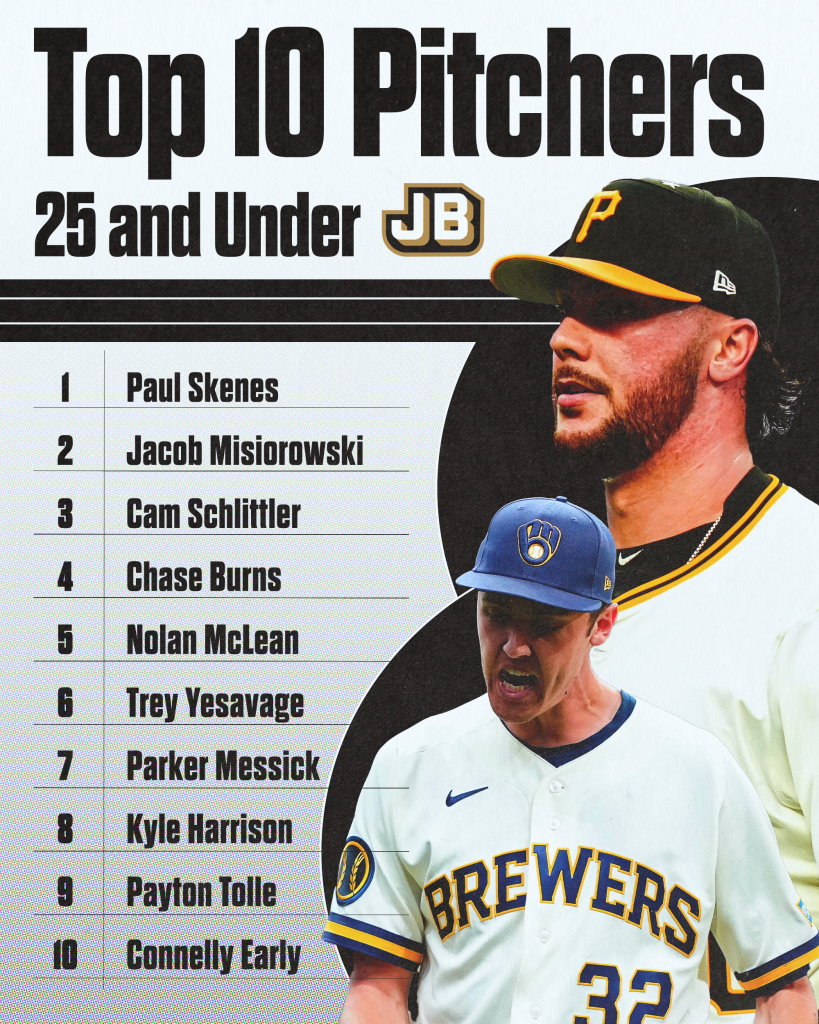
Starting pitching has looked better than ever around the league. Let's rank the 10 best starters age 25 or younger to build a rotation around.
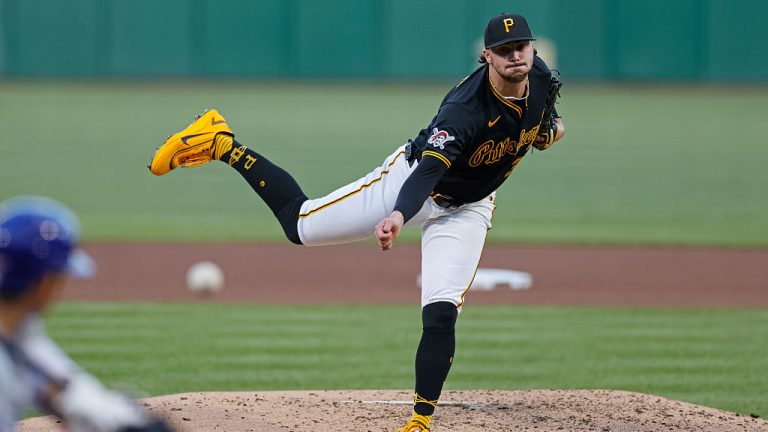
The 2026 MLB season has felt like something as a changing of the guard atop the starting pitching hiearchy.
While perennial Cy Young contenders like Chris Sale, Cristopher Sánchez and Tarik Skubal have continued to dominate, a new crop of young pitchers have emerged as legitimate All-Star candidates, with some even looking poised to challenge the established aces for Cy Young votes.
Today, we’ll look at the ten best starting pitchers age 25 or younger to build a rotation around. While their 2026 performance factor will heavily factor in, the ultimate deciding factor will be each pitcher’s long-term outlook and upside.
Before we get into the rankings, here’s a look at some talented young hurlers who couldn’t quite crack the Top 10.
Honorable Mentions
Eury Pérez would have been a shoo-in for this list three years ago, when he posted a 2.7 bWAR and a 3.15 ERA in 19 starts as a 20-year-old. His 2024 season, however, would be wiped out after undergoing Tommy John surgery, and he has posted a 4.39 ERA with a mediocre 3.4 BB/9 rate over the last two seasons.
Towering left-hander Noah Schultz became the latest top prospect to join the White Sox roster when he got called up on April 14. While he has since landed on the injured list with a subpar 5.82 ERA, he has the stuff to lead a rotation once he irons out his control.
Overshadowed by the likes of Harrison and Misiorowski, Logan Henderson has struggled to solidify his place in the Brewers rotation but has excelled whenever he has gotten the opportunity. He has posted a 2.23 ERA in 10 starts over the last two seasons, striking out 63 batters against just 14 walks.
After three underachieving seasons with the Rays, Taj Bradley got a much-needed change of scenery with a July 2025 trade to the Twins. Though his first eight starts in Minnesota were much of the same, Bradley has shown signs of living up to his massive potential in 2026, pitching to a 3.56 ERA and 10.4 K/9 through his first 11 starts thanks in large part to a reworked splitter.
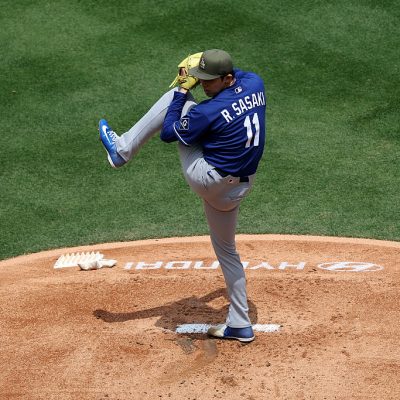
It’s safe to say that Roki Sasaki has not lived up to expectations after signing with the Dodgers prior to the 2024 season, struggling with both command and fastball shape en route to a 4.53 ERA and 5.35 FIP through his first 87.1 big-league innings. He’ll get a long leash due to his pedigree and the Dodgers’ need for healthy starters, but he may ultimately be best suited for a relief role.
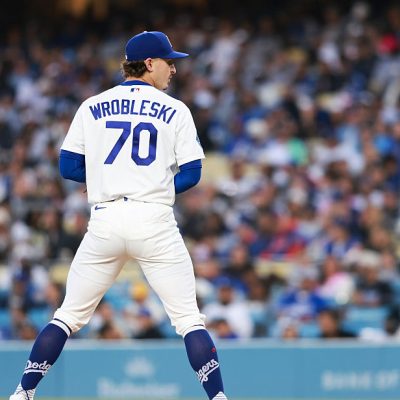
The crafty Justin Wrobleski has been a stabilizing force in the Dodgers’ rotation this year, perfectly slotting into the third spot behind Yoshinobu Yamamoto and Shohei Ohtani with a 2.62 ERA in 68.2 innings. He’ll likely never miss enough bats to be a top-of-the-rotation arm, but Wrobleski looks far more likely to stick as a starter than he did at this point last year.
After a dominant cup of coffee at the end of the 2025 season, Bubba Chandler has been underwhelming through his first 12 starts (and one bulk relief appearance) of 2026, largely thanks to an NL-leading 40 walks. The stuff has never been in question, but his command will need to improve if he wants to stick in the Pirates rotation long-term.
Though he has since landed on the injured list with an elbow injury, the supremely talented Chase Dollander had taken significant steps forward in his second MLB season, slicing his ERA from 6.52 to 3.89 while increasing his K/9 from 7.5 to 9.6. Pitching in Colorado will pose a significant challenge, but Dollander’s triple-digit fastball gives him a chance to succeed in any environment.
All stats updated prior to games on Monday, June 8
10. Connelly Early, Boston Red Sox
- Age: 24
- 12 GS, 3.26 ERA, 4.63 FIP, 66.1 IP, 3.1 BB/9, 8.5 K/9, 1.5 HR/9, 1.1 bWAR
Perhaps the most unlikely postseason starter in recent Red Sox memory, Connelly Early effectively became the last man standing after injuries ravaged the team’s more experienced arms. Though he would be outdueled by fellow rookie Cam Schlittler, the fact that Early was even in that position was a testament to how far he had come in his age 23-season.
The lanky lefty had begun the year as a fairly anonymous Double-A prospect but rode a velocity bump and improved control all the way to a September call-up.
Thrust right in the middle of the playoff race, Early helped the Red Sox clinch a wild-card berth by pitching to a 2.33 ERA over four dominant outings, striking out 29 batters against just four walks.
That performance, along with a standout spring training, helped Early edge out Johan Oviedo for the final spot in the Opening Day rotation. While he hasn’t been able to quite replicate the numbers from last September, Early has arguably been the Red Sox’s most consistent starter during a tumultuous season.
He has allowed more than three runs in just two of his 12 starts this season, including eight starts allowing two runs or fewer. He has also been at his best against the league’s best team, tossing seven shutout innings against both the AL-leading Tampa Bay Rays and the NL-best Atlanta Braves
As opposed to many of the other pitchers on this list, Early’s success is largely a product of his pitchability rather than elite stuff. He throws six pitches at least 6% of the time, leaning on his fastball and changeup against righties while relying on a sinker-sweeper combination against fellow lefties.
The fact that none of these pitches jump off the page, as well as some eye-opening home run issues, will likely prevent him from reaching ace status , but he has already shown he is capable of providing the sort of stability that any team would love to slot into the middle of their rotation.
9. Payton Tolle, Boston Red Sox
- Age: 23
- 8 GS, 2.28 ERA, 2.66 FIP, 47.1 IP, 2.5 BB/9, 9.7 K/9, 0.6 HR/9, 1.0 bWAR
While Early has been a steady figure in the Red Sox rotation from the jump, Payton Tolle received the call to the show in late April and has overmatched the opposition with blazing heat.
Through his first eight starts, Tolle has posted a 2.66 ERA with a sterling 51-to-13 strikeout-to-walk ratio, doing a pretty good impression of injured ace Garrett Crochet.
Tolle’s dominance has signified substantial progress from his rocky major league debut last September, a 16.1-inning cup of coffee in which he posted a 6.06 ERA and served up five home run.
As I dive more into here, the main issue during his September call-up was his lack of confidence in his secondary pitches, allowing opposing hitters to sit on his fastball and do damage.
The 2026 version of Tolle is a far more complete pitcher, scaling back the use of his four-seam fastball, increasing the usage of his curveball and cutter, and implementing a new sinker.
These new pitches have prevented hitters from sitting on his fastball, making the pitch far more successful than his debut:
2025
- Batting Average: .283
- Slugging Percentage:.565
- XwOBA: .341
2026
- Batting Average: .138
- Slugging Percentage: .200
- XwOBA: .191
Even with these positive developments, Tolle still carries some reliever risk, which is why it is at the bottom of these ranking instead of the top. He has had trouble sustaining his velocity and command deep into games even with the Red Sox limiting him to fewer than 90 pitches in five of his seven starts.
His outlier fastball provides a floor of at least a late-inning reliever, but whether he can reach his ultimate ceiling of a frontline starter will come down to his ability to maintain his electric stuff deep into games.
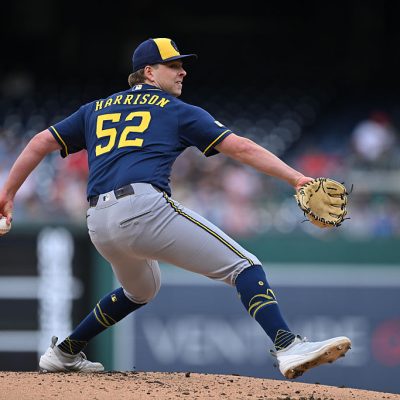
8. Kyle Harrison, Milwaukee Brewers
- Age: 24
- 11 GS, 1.57 ERA, 2.46 FIP, 57.1 IP, 2.5 BB/9, 11.5 K/9, 0.6 HR/9, 2.7 bWAR
Though the success of Tolle and Early has somewhat eased the sting, the Red Sox’s trade of Kyle Harrison for a package centered around light-hitting third baseman Caleb Durbin continues to look worse by the day.
The former first-round pick had shown flashes with both the Giants and Red Sox but had been held back by both walk and home run problems. Enter the Brewers’ pitching lab, which made some drastic changes to help his elite fastball play up even more:
Though his new changeup has performed only marginally better than last season, it hasn’t really mattered with how good his fastball and slurve have been. Both offerings have generated a whiff rate over 28% and rank inside the top ten percentiles in Run Value.
Those two pitches have helped Harrison become a dominant force for the first-place Brewers, allowing two runs or less in each of his first ten starts
As good as Harrison has been this season, however, there are still some boxes he needs to check before he joins the upper echelon of young starters. He has only pitched into the seventh inning once in his 11 starts, and his 3.07 xERA and .232 xBA are both substantially higher than his actual outputs of 1.57 and .205, respectively
It would also be interesting to see how the league adjusts after getting more data and looks at him. There is a small margin for error when you rely so heavily on two pitches, especially when it isn’t paired with elite command.
Yet even if Harrison can’t quite sustain his numbers from the season’s first two months, the Brewers have to feel pretty good about acquiring a 24-year-old pitcher with this kind of upside for an infielder currently possessing a .544 OPS.
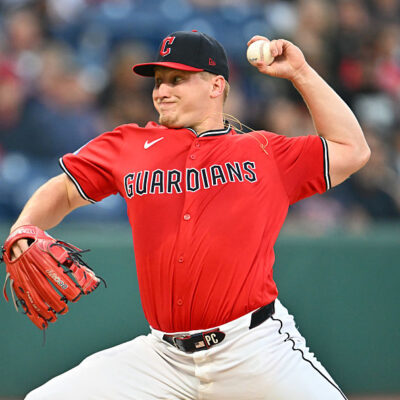
7. Parker Messick, Cleveland Guardians
- Age: 25
- 13 GS, 2.40 ERA, 3.33 FIP, 75 IP, 2.6 BB/9, 9.4 K/9, 1.0 HR/9, 2.7 bWAR
From Carlos Carrasco to Corey Kluber to Shane Bieber, the Cleveland Guardians have a well-documented history of turning overlooked prospects with average stuff into frontline starters.
Parker Messick could be the next in line, as the 25-year-old left-hander has done nothing to excel since getting the call to The Show last September. Per MLB.com, his 2.48 ERA was the lowest by a Cleveland pitcher over their first 18 career outings in the live ball era, while only Herb Score and Danny Salazar topped his 108 strikeouts.
Like his fellow left-hander Early, Messick’s wide-ranging arsenal consists of six pitches he throws more than 8% of the time, allowing him to keep hitters off balance and rank in the 74th percentile or higher in both average exit velocity and hard-hit percentage.
Yet while Early lacks a true standout pitch, Messick’s changeup is one of the best in baseball, holding batters to a .231 batting average and .282 slugging percentage and generating a 45.4% whiff rate.
The presence of this changeup prevents Messick from having the heavy platoon splits typically associated with young left-hander starters, as he has been equally effective against both right-handed hitters (.620 OPS) and left-handed hitters (.633) .
Add in a deceptive delivery in which he hides the ball well and throws with a slight crossfire action, and it’s easy to see why Messick has given hitters fits despite lacking top-end fastball velocity.
6. Trey Yesavage, Toronto Blue Jays
- Age: 22
- 8 GS, 3.16 ERA, 3.06 FIP, 42.2 IP, 4.0 BB/9, 9.3 K/9, 0.4 HR/9, 1.4 bWAR
At first glance, it may seem like Trey Yesavage stuff pales in comparison to many of the game’s best young starters. He doesn’t throw triple-digits like Chase Burns or Paul Skenes, possess elite extensions like Tolle and Schlittler, or have an outlier breaking ball like Nolan McLean.
What sets Yesavage apart is his unique delivery, as his 65 degree arm angle is higher than any other active pitcher. This deception allows his mid-90s fastball to play up, forming a deadly combination with a splitter that induces a 42.6% whiff rate.
Those two pitches have helped Yesavage become one of the game’s best at suppressing hard contact, generating harmless pop-ups with his unique fastball and weak ground balls with his splitter and slider.
Yeavage ranks in the 83rd percentile or higher in both hard-hit percentage and expected batting average, resulting in an excellent isolated slugging percentage in his first 56+ MLB innings.
The ability to prevent extra-base hits has helped mitage the impact of suspect control. His 11.1% career walk rate results in constant traffic on the bases, but the lack of slug means they rarely come around to score.
Such a high reliance on deception may eventually force Yesavage to expand his arsenal as hitters grow more comfortable with his unique delivery, but given that he is the youngest pitcher on the list, it’s hard not to be encouraged by everything the 22-year-old right-hander has shown in both regular season and postseason play.
5. Nolan McLean, New York Mets
- Age: 24
- 13 GS, 3.98 ERA, 3.73 FIP, 72.1 IP, 3.4 BB/9, 10.2 K/9, 1.0 HR/9, 0.3 bWAR
As the 2025 Mets endured one of the biggest collapses in team history, they received a glimpse of the future in the form of Nolan McLean.
The 24-year-old joined the decimated Mets rotation in mid-August and emerged as the club’s unlikely ace, pitching to a 2.06 ERA over eight starts with a sterling 57-to-16 strikeout-to-walk ratio.
Any conversation surrounding McLean must begin with his uncanny feel for spin. His curveball ranks fourth among qualified pitchers in active spin percentage, holding batters to a .081 average while generating a 40.3% whiff rate.
This offering has proven to be the perfect partner for his sinker, a pitch that has held batters to a .183 batting average and a terrific .259 wOBA.
These two pitches have allowed McLean to dominate right-handed hitters, holding them to a .178/.273/.290 slash line with a 29.5% strikeout rate. Yet while lefties haven’t given him too many issues, their .219/.311/.368 line and 26% strikeout rate represent a pretty sizable platoon split and are a reflection of McLean’s lack of a reliable tertiary offering.
Both his sweeper (.290 batting average, .516 slugging percentage) and cutter (.400 batting average, .720 slugging percentage) have been hit hard this season, and while his changeup shows promise, it is only his fifth-most used pitch against opposite-handed hitters.
Finding a trustworthy third option and is the key for McLean to take the next step into true ace status, but the dominance of his sinker and curveball alone is enough to land him inside the top five on this list.
4. Chase Burns, Cincinnati Reds
- Age: 23
- 12 GS, 2.05 ERA, 3.36 FIP, 70.1 IP, 2.7 BB/9, 10.4 K/9, 1.2 HR/9, 3.4 bWAR
Though lacking the fanfare of fellow college-baseball-legend-turned-NL-Central-ace Paul Skenes, Chase Burns experienced a similarly meteoric rise to the big leagues, making his Reds debut less than a year after getting drafted second overall in the 2024 MLB Draft.
Unlike Skenes, however, Burns faced immediate resistance upon his arrival in MLB, allowing seven runs and recording just one out in his second career start against the Red Sox.
Though he flashed his immense upside at times, particularly during a stretch in July in which he struck out 10 batters in four consecutive starts, Burns’ wildness prevented him from locking down a rotation spot, and he was moved to the bullpen for the Reds’ September postseason push.
Despite the command troubles , Burns still showed enough as a rookie and during spring training to lock down an Opening Day rotation start, but even the Reds couldn’t have anticipated the leap he has taken this year.
Burns currently ranks third in the National League with a 2.05 ERA while trailing only Cristopher Sánchez with a 3.0 bWAR.
Like so many young pitchers, the key to Burns’ success has been the necessary trading off of some strikeouts for more command. While he still ranks eighth in the National League in strikeouts, his 28.9% strikeout rate represents a 5.9% drop from 2026.
In exchange, Burns has sliced his BB/9 from 3.3 to 2.7 while also inducing far more weak contact:
Average Exit Velocity
- 2025: 90.2 mph
- 2026: 89.3 mph
Hard Hit Percentage
- 2025: 45.7%
- 2026: 39.2%
Expected Batting Average
- 2025: .218
- 2026: .200
Of course, this doesn’t mean that Burns has completely lost his swing-and-miss ability. With a fastball that averages 98 miles per hour and a slider that generates whiffs on 54.5% on opponents’ swings, Burns possesses two pitches capable of getting a strikeout anytime he needs it.
What prevents Burns from climbing even further on this list is the lack of a go-to third pitch. His changeup has gotten battered to the tune of a .462 average and .769 slugging percentage, mitigating it to nothing more than a show-me pitch rather than a true weapon.
This has made him somewhat vulnerable to left-handed hitters, whose .716 OPS against Burns is close to double what right-handers hit against him.
As pitchers like Spencer Strider have proven, it’s possible to succeed with a two-pitch arsenal when both offerings are among the best of the game, but the development of a changeup could be the final piece of the puzzle to vault Burns into perennial Cy Young contention.
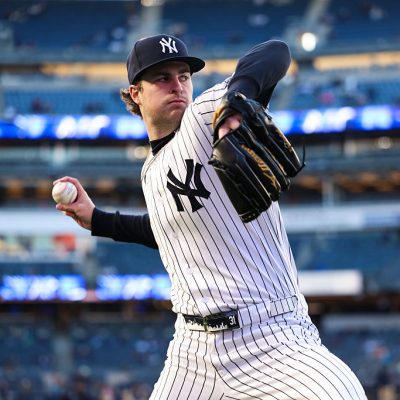
3. Cam Schlittler, New York Yankees
- Age: 25
- 14 GS, 1.87 ERA, 2.12 FIP, 82.0 IP, 1.5 BB/9, 9.8 K/9, 0.4 HR/9, 3.2 bWAR
For all the money the Yankees have poured into the likes of Carlos Rodón, Gerrit Cole and Max Fried , the key to their rotation thus far has been a former seven-round pick in the midst of one of the most meteoric starting pitcher rises in recent memory.
The fact that Cam Schlittler is even in the Yankees rotation is a credit to the Yankees pitching development team, as they overhauled his delivery upon his arrival in the system and helped him steadily add velocity to a low-90s fastball.
By the time he arrived in New York, Schlittler was regularly touching triple digits, and he leaned on that fastball to record a 2.96 ERA and strike out 84 batters in 73 innings. In spite of shaky command, Schlittler still emerged as one of the best young starters in baseball, but the version we have gotten in 2026 looks like something else entirely.
While he is still heavily dependent on his four-seam fastball, he has increased the usage of his cutter, which has added two full mph from last year, and tripled the frequency of his sinker. Even though he throws some variant of his fastball almost 90% of the time, the trio has proven nearly impossible for hitters to discern, resulting in more chases, more weak contact, and more ground balls:
Chase Rate
- 2025: 28.3% (46th percentile)
- 2026: 35.6% (91st percentile)
Average Exit Velocity
- 2025: 89.0 mph (57th percentile)
- 2026: 88.4 mph (60th percentile)
Ground Ball Rate
- 2025: 36.4% (20th percentile)
- 2026: 44.6% (56th percentile)
Armed with the confidence of knowing hitters can’t square him up even if they know what is coming, Schlittler has attacked the zone like never before, allowing him to cut his walk rate from 10.2% all the way down to 4.4%.
Simply put, there is nothing to suggest that Schlittler can’t be one of the best starters in the American League for years to come, and the prospect of him slotting in alongside a healthy Cole, Rodón and Fried will provide nightmares for potential playoff opponents.
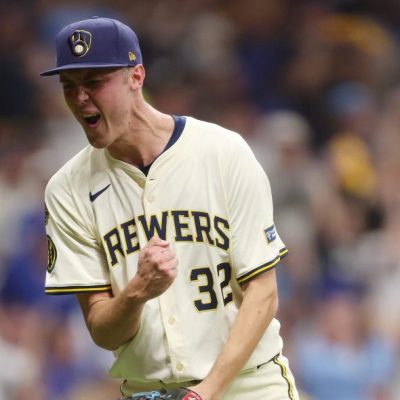
2. Jacob Misiorowski, Milwaukee Brewers
- Age: 24
- 13 GS, 1.50 ERA, 1.91 FIP, 78.0 IP, 2.5 BB/9, 13.4 K/9, 0.5 HR/9, 3.3 bWAR
Much like Schlittler, Jacob Misiorowski has leveled up from an already stellar rookie season, leading MLB with a 13.4 K/9 while allowing hits at the league-low clip.
The headliner will always be Misiorowski’s unprecedented fastball velocity, as his 100 MPH average fastball velocity is surpassed only by relievers Mason Miller and Edgardo Henriquez, but his sophomore progression has been the product of more subtle changes.
He has sliced his walk rate from 11.4% to 7.3% while proving much more adept at limiting hard contact:
Average Exit Velocity
- 2025: 89.0 (57th percentile)
- 2026: 87.2 (80th percentile)
Hard Hit Percentage
- 2025: 37.5% (72nd percentile)
- 2026: 31.8% (84th percentile)
Barrel Percentage
- 2025: 7.9% (59th percentile)
- 2026: 2.5% (96th percentile)
The key to his success has been the progression of his slider, which has progressed not only into a true complementary option alongside his triple-digit fastball but also into one of the best breaking balls in all of baseball.
The pitch has held opposing batters to a .183 batting average and .248 slugging percentage in 2026, a substantial drop-off from the .293 and .534 marks they posted against him during his rookie season.
Add in the occasional curveball that has generated a 48.1% opponent whiff rate, and you have the most unhittable three-pitch mix in the game. This trio is so dominant, in fact, that Misiorowski has essentially scrapped his changeup even though it held opponents to a .050 average with a 37.8% whiff rate in 2025.
The only real concern for Misiorowski is whether he can sustain his incredible velocity through a full season. He hasn’t topped 100 innings pitched in any of his first three professional seasons and has reached the 100-pitch plateau just one time in his 12 starts this season (although he has been in the 90s eight times).
These workload concerns prevent him from occupying the top spot on this list, but on an inning-by-inning basis, you’d be hard-pressed to find a better pitcher in the game right now than The Miz.
1. Paul Skenes, Pittsburgh Pirates
- Age: 24
- 13 GS, 3.09 ERA, 2.61 FIP, 70.0 IP, 1.7 BB/9, 10.5 K/9, 0.8 HR/9, 1.5 bWAR
As dominant as some of the aforementioned pitchers have been through the season’s first two months, Paul Skenes remains in a slightly higher tier.
After allowing five runs and failing to make it out of the first inning on Opening Day, the reigning Cy Young Award winner has picked up right where he left off in 2025, pitching to a 2.47 ERA over his last 12 starts with an absurd 81-to-11 strikeout-to-walk ratio.
What separates Skenes from the other pitchers on this list is not his otherworldly stuff but rather his impeccable control. He has walked just 4.7% of the batters he faced this year, the sixth-lowest among qualified starting pitchers.
This marks the third straight year that Skenes has cut his walk rate while continuing to strike out nearly a third of the batters he has faced. This 2026 version of Skenes is a far more complete pitcher than the one that burst onto the scene in 2024, throwing three different pitches at least 15% of the time with wOBAs of .250 or lower.
The evolution of his sinker, a pitch he didn’t even begin throwing until last season, has been a particular game-changer for Skenes. Though the pitch has only generated a 6.3% whiff rate, it has proven to be a master of generating weak contact, allowing just two-extra base hits in 33 batted ball events
So while the Opening Day blowup has resulted in his season-long numbers trailing some of his fellow young aces, his total body of work, pinpoint command and well-rounded arsenal allow him to hold off the likes of Burns, Schlittler and Misirowski for the time being.
Become a Member of Just Baseball
Subscribe and upgrade to go ad-free!
* Save 25% by subscribing annually.

Written by
Daniel Fox is a contributing writer for Just Baseball. He has previously written for Pitcher List, BoSoxInjection, and in the Cape Cod Baseball League. He is…