
Top Standouts in the St. Louis Cardinals’ Farm System
As we approach the midpoint of the MiLB season, which Cardinals prospects have taken a step forward in 2026?
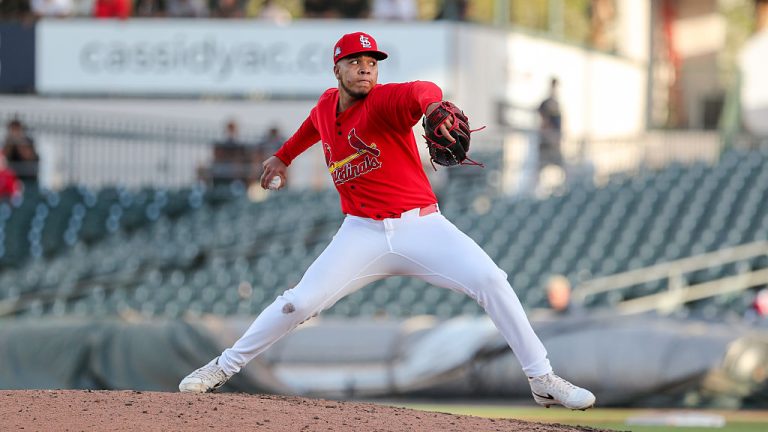
After a tumultuous past three seasons, the St. Louis Cardinals enter 2026 with a clean slate throughout the organization. The franchise has seen many promising young stars take leaps forward throughout their farm system this season; now that we have a decent sample size, let’s take a look at who is shining above the others.
Stats were taken before play on June 21.
Triple-A Memphis
Jimmy Crooks
The former Oklahoma Sooner entered 2026 as a fringe top-100 prospect, splitting scouts and analysts alike on what his first six years of team control may look like.
Crooks has always made a name for himself as a defender, effortlessly stealing extra strikes on the shadow zone, throwing basestealers out with ease, and limiting wild pitches with excellent blocking.
His calling card offensively was his power, which was average at best with a 42% hard-hit rate last year, but lagging well behind were his bat-to-ball and his swing decisions. Fast forward two months to 2026, and it looks like Jimmy has made steady improvements in the latter two departments.
In 2025, Crooks chased at 32.5% of pitches, but has lowered this number to 26.7% in 2026. His zone-contact rate sits at 83.7% this year, a three-point bump year-over-year.
These aren’t drastic improvements, but ones both he and the Cardinals will take in his second go-around at Triple-A. Regardless, they’ve translated to outstanding production at the level, with a 152 wRC+ before he was promoted back to St. Louis.
Though his time as a prospect is now over, Crooks had the chops to be a top-100 talent in more evaluators’ eyes, and it’s becoming increasingly likely that he’ll be a solid starter on a championship-caliber team at worst.
Other Notable Standouts:
Blaze Jordan
In-game power is finally starting to show for Blaze. One look at his offensive profile and there really isn’t a true weakness to his game, except for one ruby-red flag: his swing decisions.
His 38.7% chase rate ranks in the second percentile at the level, and despite his aptitude in each other batting skill, and despite a recent call-up to the big leagues, the swing decisions presently provide a lot of risk going forward.
Brandt Thompson
Brandt Thompson was an 18th-round pick in the 2024 MLB Draft who has cemented himself as a diamond in the rough. He sports a flatter VAA due to his shorter height, which plays despite his low-90s fastball.
Both his curveball and sweeper sit in the low-80s, which gives him a nice attack option against lefties and righties, respectively.
He’s still just 23 years old and has skyrocketed through the system, displaying great command and has bumped his fastball velocity by two ticks since he was initially selected. He currently projects as a depth starter with some room to grow as he continues to add velocity.
Double-A Springfield
Mason Molina
Acquired in the Phil Maton deal at last year’s trade deadline, Mason Molina has turned himself into a top-20 prospect in the organization.
His arsenal is headlined by a high-riding heater sitting 93-94 mph, impressive when considering he sat 89-90 his junior season at Arkansas. It’s this four-mph increase in just two seasons that has vaulted his stock as a professional.
Molina’s signature secondary is his changeup, which generates 12 inches of both vertical and horizontal offset from the fastball, and a 10 mph velocity offset. It’s one of the best off-speed offerings in the organization when he throws it with conviction.

Another improving secondary is his low-80s sweeper, getting over 17 inches of horizontal offset off of the fastball and is arguably his go-to swing-and-miss offering against lefties.
Lagging are his two breaking balls, throwing a gyro slider in the mid-80s and a high-70s curveball. Neither is thrown hard enough, but the bullet will become a legitimate bridge offering if he can consistently live in the mid-80s.
Molina’s command has been steady this year, hovering just over a 10% walk rate. His strike-throwing could be better, as his command can waver by start, but considering the up-ticks in his arsenal, he deserves plenty of runway.
Mason will have to answer two questions as he continues climbing the system. Can he continue adding velocity, primarily to his secondaries? Can he pair this with even better command than presently shown, preferably below a 9-10% walk rate?
He may receive a substantial number of innings at Triple-A Memphis before the season ends. This is a very talented arm with back-end rotation upside if he can continue putting it all together.
Other Notable Standouts:
Ryan Campos
Campos is yet another Cardinals’ catching development success story. This season, he’s tapped into some real power, launching seven homers so far in 229 PA compared to just three in 421 last year. He’s becoming a more complete hitter while still honing his skills behind the dish.
Campos projects as a future major leaguer in some capacity, which wasn’t always the case before his power surge. He’s still a backup in my book, and while his poor arm strength raises questions about his defensive future, it will be intriguing to see how he continues developing over the next few seasons.
Michael Watson
The former Indy Ball signee has sneakily risen through the Cardinals’ system. Powered by an outlier VAA fastball sitting in the low-90s, Watson’s main secondary is a sweeper with 19 inches of glove-side movement, but he will also sprinkle in an impressive mid-80s changeup with just nine inches of IVB and 17 inches of arm-side run.
Strike-throwing has been his kryptonite; with a walk rate of 15.1%, he’ll need to continue refining his command if he wants to continue ascending the MILB ladder.
High-A Peoria
Yhoiker Fajardo
Chaim Bloom and Craig Breslow seemingly became best friends last offseason, with the two orchestrating a pair of blockbuster trades.
Amongst the many prospects acquired from Boston, the most fascinating of them all was arguably right-hander Yhoiker Fajardo.
The Dominican import has shown elite command for his age and has been challenged. He allowed no homers in 2025 between the CPX and Low-A in 72 IP. He’s largely carried over this success in 2026, though he’s hit some road bumps over his past few starts.
A heavy pronator, Fajardo shows elite velocity for a 19-year-old, with a fastball that sits mid-90s and has touched 97 mph. It’s a steeper approach, but it may not matter as much in MLB since he’ll likely be flirting with triple digits in a few years.
His primary secondary is his gyro slider, with a pure bullet shape at zero inches glove side and one inch of drop. It generated a 33.9% zone-whiff percentage and a 31.2% chase rate last year.

His changeup will sit in the upper-80s with swing-and-miss potential. It gets a 13-inch vertical offset from the heater and missed 30.2% of bats in the zone in 2025.
He currently projects as a fourth or fifth starter on a contender, but has the ingredients of a mid-tier-rotation guy if he continues on his current pace. There’s top-100 upside here with Yhoiker, and he has been amongst the most entertaining pitchers in the Cardinals organization to watch tow the slab in 2026.
Other Notable Standouts:
Won-Bin Cho
Just recently eclipsing the 1,000 PA threshold at High-A over three different seasons, the Seongnam Slugger is finally piecing it all together at the level. Cho is a legitimate, though very raw, 4.5-tool threat; he has the defensive aptitude, arm strength, and athleticism to anchor CF at the big-league level.
At the dish, he’s shown the ability to launch baseballs at over 110 mph with solid swing decisions. Still, his inability to make consistent contact has kept him at Peoria for the past two and a half seasons.
Cho still currently projects as a fifth outfielder, but he’s just 22 years old and oozes projection with his toolbag and 6-foot-1 frame.
Jacob Odle
After a shaky 2025 season post-Tommy John, the San Diego native has shown out in 2026, boasting a fastball that sits 97 mph and touching 100 mph. Equally as eye-watering is his power curveball, which he’ll routinely twirl in the low-80s.
Odle can also pump the brakes with a high-80s cambio that gets 16 inches of drop off the fastball and eight inches of arm-side offset.
Odle’s lack of command (14.4% BB%) prevents evaluators from considering him a future starter on a contender. Still, his elite arsenal is enough to make him a legitimate top-30 prospect rather than intriguing organizational depth.
Low-A Palm Beach
Ryan Mitchell
Before 2025, the Cardinals had not drafted and signed a high school player since 2021. They finally went back to the prep well last June when they selected Ryan Mitchell, a contact-over-pop outfielder with their second overall selection.
Mitchell showed out on the 2024 Summer Showcase circuit, registering an .820 OPS and an 85% zone contact. His chase rate was in the 92nd percentile amongst all participants.
As a professional, Mitchell runs a 110 wRC+ with a production line heavily buoyed by elite swing decisions. Contrary to his days as an amateur, he’s running just a 76.5% zone-contact percentage so far at Low-A Palm Beach, but an elite 16.4% chase rate.
While he has the frame to grow into some juice, it hasn’t shown in-game yet, with just a 100.5 mph EV90 and a 105.6 mph max EV in 2026. It’s firmly below average, but should trend upwards in the years ahead.
Ryan was a shortstop throughout his high school career, but has moved to center field as a professional, where his athletic frame and experience up the middle bode well for him going forward.
Firmly a top-30 prospect in the organization, he oozes projection but is understandably very raw. Even so, Mitchell’s archetype is the exact kind teams should be selecting for in troves.
Other Notable Standouts:
Xavier Cruz
Equipped with one of the filthiest arsenals in the system, right-hander Xavier Cruz has raised his fair share of eyebrows at the Cardinals’ Spring Training complex this year.
He’s just 20 years old, but already possesses a high-90s fastball that has T-99 mph. It has outlier spin characteristics at 2,600 RPM and boasts elite backspin, creating an active spin rate similar to what Cardinals fans see with Ryne Stanek at the MLB level.
His secondaries also flash plus potential, with a low-mid-80s gyro slider and a low-80s curveball at over 3,000 RPM. Cruz’s command must improve, but his scathing pitch mix gives him the makings of a back-end rotation starter despite a short track record.
Dylan Driessen
Minor league relievers are usually required to have a longer track record of success before earning notoriety, but given Dylan Driessen’s arsenal, it’s easy to make an exception.
His heater sits in the mid-90s but generates over 20 inches of IVB from a 5.9 ft slot. His signature secondary is his low-80s curveball, but his changeup shows promise with over eleven inches of vertical offset and nine inches of horizontal offset from the fastball.
Like many of the arms on this list, he must continue to pound the zone more frequently, something he’s been slightly better at recently (11.4 BB% since 5/5). He currently projects as an organizational depth piece.
Florida Complex League
Sebastian Dos Santos
Dos Santos was the premier standout of the Cardinals’ 2025 International Free Agent class, mashing to the tune of a 158 wRC+ at 17 years old. He brought his game stateside this Spring, where he posted a 145 wRC+ in 112 CPX PAs. SDS received a promotion to Low-A Palm Beach on June 15, where he’s shown solid swing decisions but has yet to produce.
The Venezuelan import features an elite eye at the dish, with a chase rate below 20%, and runs a zone-contact percentage in the low-80s at the CPX. Dos Santos has recorded relatively average power numbers, with a max EV below 110 mph, but still has plenty of time to grow into his frame.
His bat-to-ball skills allow him to tap into solid game power, with a league-average EV90 that would place him right alongside his MLB contemporaries, including JJ Wetherholt and Masyn Winn.
He’s an average athlete whose lack of arm strength already has him trending off the six, though it’s likely he sticks up the middle.
Dos Santos shows flashes of Jorge Polanco in his latter two years as a Minnesota Twin, showing great plate discipline amid average game power and fringy bat-to-ball and glovework.
As it stands, there’s enough production and raw talent here at such a young age to comfortably rank him as a top-30 prospect in the organization.
Other Notable Standouts:
Cristopher Lebrón
The second-best teenage CPX hitter this year, Lebrón has a bit more projectible frame than Dos Santos, albeit less athleticism.
He has an aggressive approach at the dish, swinging just over 50% of the time with below-average contact rates. Cristopher has been clocked as high as 108.2 mph in-game off the bat in tracked games, which could mean he becomes an above-average power hitter at peak maturity.
He’s been solid defensively at third base and should stay there for a decent chunk of his early career at worst. Lebrón has a fun offensive profile, but it’s tough to give him anything more than an organizational depth grade for now.
Miguel Hernandez
Though Lebrón is arguably the better of the non-Dos Santos CPX position players, Hernández has consistently ranked as the runner-up to Sebastian as far as US-bound 17-year-olds go.
Miggy isn’t as advanced offensively as Dos Santos, with just a 103 mph EV max in tracked games, worse swing decisions, and worse bat-to-ball skills.
What he lacks at the dish, however, he makes up on the dirt. He’s played all but seven innings this year at shortstop and projects to stay there for at least the near future. It’s a solid overall profile, but he’s more of an organizational depth piece right now than a legitimate prospect.
Dominican Summer League
Emanuel Luna
Emanuel represents the Cardinals’ second-largest financial commitment ($2.3M) to an IFA since 2012, and it’s not difficult to see why.
Armed with some of the most thunderous raw power of any player in the 2026 International Free Agent class, Luna has hit the ground running this DSL season, boasting some of the league’s best production lines early on.
It’s easy 70-grade raw juice here, and he has been clocked as high as 112 mph off the bat early on in his professional career. He hasn’t quite shown a knack to go pull-side in the air with his elite juice, but it may not ever matter because he’s so physically gifted.
Luna also shows a patient approach at the dish with just a 43.9% swing rate, though there are heavy questions regarding his bat-to-ball skills, with an overall contact rate in the low-60s early on.
Emanuel is a solid athlete with a strong arm, and while he’s currently getting reps in centerfield, it’s more likely that he’ll end up in right field as he ascends the MILB ladder.
Given the loud tools, Luna is easily worth a top-30 spot on the team’s prospect list; his raw thump may already be the best in the organization despite not being old enough to vote.
It’s difficult to really gauge what kind of player he will become. Still, one can reasonably predict he’ll be the proverbial power-over-hit corner outfielder with solid swing decisions who isn’t athletic enough to patrol centerfield.
Luna has not played since June 11, and will be sidelined for several more weeks due to a hamstring injury. He is expected back in mid-July.
Other Notable Standouts:
Sebastian Rojas
Two weeks into the DSL campaign, it can be reasonably argued that Rojas has been the most successful of the 2026 Cardinals’ IFA class thus far.
Sebastian displays a very balanced skill set at the dish, with a contact rate in the high-70s and an equal number of walks and strikeouts in a 45 PA sample.
As a catcher who hasn’t made it stateside yet, it’s difficult to gauge where he’s at defensively, but given the Cardinals’ elite track record of developing premium backstop talent, it wouldn’t be wrong to lean towards him staying behind the plate long term rather than not.
It’s a fascinating profile, but not one that quite yet merits being ranked on any prospect lists.
Jordan Beltrán
Beltrán was the Cardinals’ second-highest-paid pitcher from their 2026 IFA class, and boasts one of the nastiest fastballs of any pitcher at the DSL. It’s been clocked as high as 96 mph with over 20 inches of IVB, and could sit well into the high-90s as he continues filling out his frame.
He also throws a low-mid 80s sweeping slider with 6-8 inches of gloveside movement, and a high-80s changeup with over 10 inches of vertical and horizontal offset from the fastball.
One can dream on starter potential with Jordan given his raw arsenal; he already has a solid heater, an off-speed, and a breaker. It’s enough to make him an organization depth arm with immense upside right now.
Become a Member of Just Baseball
Subscribe and upgrade to go ad-free!
* Save 25% by subscribing annually.

Written by
Adam Akbani is a writer and analyst from St. Louis, MO. He attended Washington University in St. Louis, double majoring in Economics & Strategy and Political…