
Will the Rays’ Rotation Continue To Shine Brightly This Season?
Is the Tampa Bay Rays' rotation legit, or is regression bound to come?
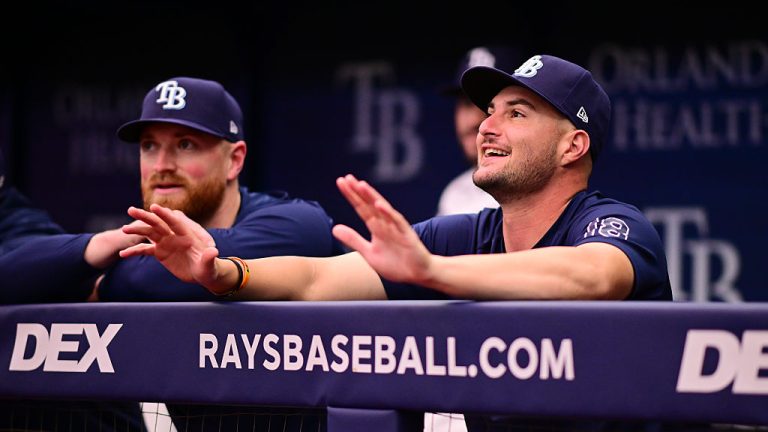
The Tampa Bay Rays have emerged as a dominant force in the American League to begin this season. While many pegged them as a likely last-place finisher in a division filled with big spenders, they are pacing the pack at 34-19.
A big reason why they’ve been able to have so much success has been the effectiveness of their starting rotation. While none of their starters were projected to be upper-echelon aces, the Rays are first in baseball in starter ERA at 2.80.
It’s even more impressive that Tampa Bay has managed to be so successful thus far because one of their most prominent arms, Ryan Pepiot, has been out for the entire season. He will miss the 2026 campaign, due to a right hip procedure. Pepiot’s absence created a void in this rotation, which has been filled capably to this point.
What the Rays, as a staff, are doing most effectively is limiting walks. The team’s walk rate from their starting pitching is fourth in baseball at 7.2%. Tampa Bay’s rotation has also done well to prevent the long ball, as their home runs allowed per nine innings, 0.86, is fifth best in the game.
It’s great to prevent free passes and homers, but there are also reasons to believe that this rotation may not continue to be so extraordinarily effective.
Their strikeout rate, as a staff, is the eighth worst in baseball at 20.5%. Additionally, they have the second-lowest batting average on balls in play (.253) and fourth-highest strand rate (78%).
While the Rays’ starters have been good, they’ve gotten lucky. They may not experience extreme regression, since they have a talented defense and many of their pitchers throw changeups to induce weak contact. More likely than not, however, a few more outs are going to become base hits in the coming months.
To investigate the strongest and weakest links of the Tampa Bay rotation to this point, we’ll be checking in on each member’s progress thus far and see how they project moving forward.
Stats were taken prior to play on May 27.
Drew Rasmussen
2026 Stats: 55 IP, 2.78 ERA, 0.98 WHIP, 18.8% K-BB%, 3.26 SIERA
Rasmussen’s availability is vital to the success of the Rays’ starting pitching. He was good for 150 innings last season, but Rasmussen has only thrown 140 innings twice in his career, and last year’s mark was a career high.
Dating back to last season, Rasmussen has clearly been the team’s best starter. He has plus velocity for a starting pitcher (95.8-mph fastball) and excellent command (4.6% walk rate). His ability to stay in the strike zone and avoid serious damage over a large sample speaks volumes to his overall effectiveness.
While Rasmussen is still expected to be very effective this season by SIERA, there are reasons to believe that he may not finish with a sub-3.00 ERA. Rasmussen currently owns the 12th-lowest BABIP in baseball (.248) and the 24th-highest strand rate. Moving forward, more balls in play may drop in for hits — which could lead to more earned runs.
Rasmussen also sports the 16th-highest zone contact rate (87.2%), meaning that even though he’s able to prevent free passes, he’s not fooling many hitters by living around the zone.
Despite generating less whiff on average, Rasmussen still does well with limiting hard contact. He’s in the top 18% of pitchers in average exit velocity against, likely due to his effective six-pitch arsenal. Four of Rasmussen’s offerings grade as above average, per Stuff+, and he ranks sixth in all of baseball in Pitching+, which combines the effectiveness of his pitches with his ability to locate them.
While Rasmussen’s ERA may slightly regress due to poorer luck on batted balls moving forward, there’s little question that he will continue to be an impactful starter.
Shane McClanahan
2026 Stats: 50 IP, 2.52 ERA, 1.04 WHIP, 15.3% K-BB%, 3.82 SIERA
Nobody really knew what to expect from McClanahan this year. The 2022 AL Cy Young award winner had been out since August of 2023, due to elbow and tricep injuries.
Despite losing 1.4 mph of fastball velocity since his last big-league season, McClanahan has adapted and managed to be effective. He’s throwing a fastball rated 15% worse than average by Stuff+, but his arsenal grades as eight percent better than average. That puts McClanahan’s pitch-mix in the top 15 of all starters with at least 50 IP, in terms of stuff.
A big reason for McClanahan’s success has been the effectiveness of his changeup, which Stuff+ grades as one of baseball’s best. Opposing batters are posting just a .356 OPS and a .017 ISO against the pitch, good for a 15 wRC+.
To be as changeup heavy as he is, without an impact fastball, McClanahan would need to prevent walks at an elite rate to maintain this pace. His walk rate in 2022 was 5.8%, but this year that mark is up to a subpar 9.4%. McClanahan will try to regain his command as he settles into the season.
Another caveat to assessing McClanahan’s impact to this rotation is that he must be limited, in some capacity, all season. When McClanahan has to be pulled from starts early or have starts skipped, that puts more wear on the other organizational pitching options that are likely not as effective.
McClanahan is a solid pitcher, but it’s hard to expect him to be anything more than a mid-rotation starter over the course of a full season this year.

Griffin Jax
2026 Stats: 30 IP, 3.30 ERA, 1.37 WHIP, 9.4% K-BB%, 4.34 SIERA
Jax began his career in Minnesota as a starting pitcher but found greater success in the bullpen. Despite entering this season as the Rays’ closer, Jax has attempted to convert back into a starter due to struggles in the ninth inning.
The move has worked fairly well for Jax, who was pumping his fastball up to 98 mph in his most-recent outing. In six starts this season with a gradually increasing workload, Jax has allowed just three earned runs in 21 innings. Over that span, he has struck out 17 and walked eight.
It’s a bit concerning that Jax has had trouble striking batters out with plus velocity for a starter. Strikeouts are one of the ultimate determiners of a pitcher’s success. If he can’t get punchouts at an above-average rate, he’ll need to bring his walks down, which could come with a loss of velocity.
Jax is likely to experiment with many changes to find the best version of himself throughout the year. The Rays could later experiment with pitching Jax alongside a soft-tossing lefty, like Steven Matz or Ian Seymour. This strategy would allow Tampa Bay to complete a game by using just two arms.
In a starting role, Jax’s ERA is likely to climb. It’s too hard to get through a game with a below-average strikeout rate and consistently put up zeros.
Steven Matz
2026 Stats: 41.1 IP, 3.70 ERA, 1.11 WHIP, 10.8% K-BB%, 4.40 SIERA
The 35-year-old Matz worked primarily in relief last season, where he pitched to a 3.05 ERA. Now with Tampa Bay, he’s already started more games than he had in each of the previous two seasons.
His primary offering is his sinker, which he throws about half of the time to hitters of either handedness. It’s not a great offering, Stuff+ grades it as 8% worse than the average sinker, based on its movement profile.
Matz’s best offering by Stuff+ is his changeup, which he throws about every third pitch to righties and less often to lefties. Opposing batters are slugging just .211 against the changeup, making it a go-to offering for him.
A developing trend for Matz is that he seems to be less effective against same-handed batters. Opposing hitters are slugging over .520 against both his sinker and slider, his two main pitches to get out left-handers. We may see teams with traditional platoons to try playing their lefties against Matz because of this data.
At the end of the day, Matz is an aging pitcher with a below-average fastball and a below-average strikeout rate. He’s a back-end starter with little upside who is likely to post an ERA north of 4.00.
Nick Martinez
2026 Stats: 59.2 IP, 1.51 ERA, 1.11 WHIP, 9.9% K-BB%, 4.51 SIERA
Martinez has been a huge reason why the Rays’ starting rotation owns the lowest ERA in of any team in baseball. This miraculous start has the veteran right-hander in second place on the ERA leaderboard, trailing Cam Schlittler by 0.01.
I’ll start by saying that, while it’s been an impressive stretch for Martinez, I would not expect this trend to continue. His fastball comes in at 92.6 mph, his 14.9% strikeout rate is among the league’s worst, and he hardly gets any swings-and-misses (18.5%).
It helps that Martinez has excellent command, as his 5% walk rate is keeping traffic off of the bases. There’s not much else that leads me to believe he can continue this otherworldly streak.
A huge reason why Martinez has prevented runs at such an outstanding rate is that he’s stranded nearly 93% of runners on base. Only Chase Burns has stranded more runners (94.5%), but his strikeout rate is almost double that of Martinez’s. Martinez has been getting most of these key outs on balls in play, more of which are likely to become hits in the future.
Martinez is likely to surrender more hits because his in-zone contact rate is the fifth-highest among qualified starters (89%), so he isn’t missing bats in the zone.
He’s also recorded the sixth-fewest out-of-zone whiffs (45) among all qualified starters. So when Martinez does pitch out of the zone, he’s still having trouble putting guys away. All of this information tells me that he is unlikely to continue to limit runs in the future, to this degree.
While Martinez is a serviceable major league arm, this scorching-hot start is a facade. If he could finish the campaign with a sub-4.00 ERA, that would be a solid outcome for the veteran right-hander.
The Verdict
Tampa Bay has some solid pieces in their rotation. The staff, as a whole, should continue to be decent, but is unlikely to continue as baseball’s best. The Rays’ SIERA from their starting pitching is 4.03, which is over a full run worse than their team ERA and 14th in the league.
Rasmussen is the only arm that I can confidently rely on to be above average for the remainder of the season. There are reasons for optimism with McClanahan and Jax, though each are likely to have workload concerns as the season progresses.
Martinez and Matz are both palatable as back-end starters, but neither has much upside. Martinez is certain to regress and Matz is likely to have struggles, as well. The Rays had hoped that one of these two would be in the bullpen primarily, but Pepiot’s injury has made that unlikely.
A rotation candidate with upside is Joe Boyle, currently in Triple-A. Boyle has a big fastball and posted a 15.1% K-BB% in 15.1 major league innings thus far, but he was optioned to the minors following a stint on the injured list. He has the potential to raise the ceiling of this rotation, but he has also had his share of command issues.
Tampa Bay is known for getting the most out of their arms, so Martinez and Jax could be better than expected. Even if that were the case, I do not expect the Rays to finish this season in the top five in starter ERA. Their staff has too many question marks to consider them as one of baseball’s best moving forward.
Become a Member of Just Baseball
Subscribe and upgrade to go ad-free!
* Save 25% by subscribing annually.

Written by
Daniel Rotter follows the game of baseball with passion. He was the youngest participant in the inaugural year of The Great Fantasy Baseball Invitational, at 17…