
Will the Guardians’ Aggressive Deadline Vault Them in the AL Central?
Cleveland made one of the most substantial pushes of the trade deadline, adding Foster Griffin, Jo Adell, Nathaniel Lowe and Craig Yoho.
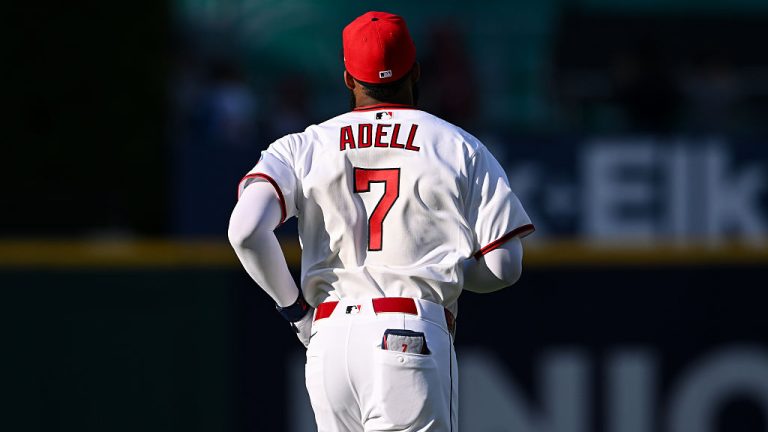
The Cleveland Guardians spent the trade deadline behaving like a team confident in where they were headed, but only if several changes were addressed.
The offense had stalled. The rotation needed another reliable arm. Several players who had been given extended opportunities were no longer producing enough to justify the patience, and the American League Central remains close enough that standing still amounts to conceding ground. So Cleveland acted.
Jo Adell came over from the Angels. Nathaniel Lowe arrived from Cincinnati. Foster Griffin was acquired from Washington after an All-Star first half. Craig Yoho and Blake Perkins were added in a deal with Milwaukee. Kyle Manzardo and David Fry were optioned to Triple-A, while Slade Cecconi was bumped from the rotation into the bullpen.
The Guardians were willing to alter the shape of their roster because the roster they had was no longer enough.
And yet, the first few days after the deadline have not gone according to plan, to say the least.
Cleveland was swept at home by a Mets team that had sold aggressively and entered the series buried in the NL East. Griffin was hit hard in his Guardians debut. Yoho gave up three runs in an inning Thursday. Adell went hitless over the final two games of the series.
But three games are three games, and it should not change how the deadline is evaluated.
The more important question is whether Cleveland added enough to chase down a White Sox team that has been sitting above them in the division race.
Stats were taken prior to play on August 7.
Cleveland Finally Addressed the Offense
The Guardians feature one of baseball’s weakest power profiles.
They rank second-to-last in home runs and dead last in slugging percentage, a difficult way to survive a pennant race when so many close games eventually come down to one swing.
Adell provides something Cleveland’s lineup badly lacked: right-handed power capable of changing a game quickly. He has hit .306 with a .573 slugging percentage and 10 home runs against left-handed pitching this season, giving manager Stephen Vogt a much more dangerous option when opponents turn to a southpaw.
His Guardians career began encouragingly. Adell singled and doubled in his first two plate appearances Tuesday and later drew a walk. He went hitless in the next two games, but the value of the acquisition is larger than one series. Besides, Cleveland needed a hitter capable of punishing mistakes.
Lowe addresses a different weakness. Against right-handed pitching, the veteran first baseman is hitting .288 with a .530 slugging percentage and 13 home runs. He brings a more stable offensive profile to a lineup that had been relying heavily on streaky production.
He also wasted little time showing how he can help. After going hitless in his first two at-bats Tuesday, Lowe collected two hits and drove in two runs Wednesday. He followed that with another two-hit game Thursday, including a three-run homer that pulled Cleveland within one.
For years, Cleveland has been comfortable constructing offense through contact, baserunning, situational hitting and matchup advantages. That formula remains useful, but there comes a point when a lineup simply needs more players who can hit the ball over the fence.
Lowe and Adell give Cleveland the freedom to stop waiting for struggling players to rediscover themselves.
Manzardo hit 27 home runs last season but had slipped to 13 with a .378 slugging percentage through 102 games this year. Fry was batting .182 with a .640 OPS in 71 games and had gradually lost some of the versatility that once made him so valuable.
Foster Griffin Raises the Rotation’s Ceiling, Even With Regression Coming
Griffin’s first start in a Cleveland uniform was not what anyone had envisioned. He allowed five runs on seven hits over four innings Thursday, surrendering two home runs as his recent struggles continued.
His ERA has climbed from 2.68 to 3.31 over his past three starts, during which he has allowed 11 earned runs in his last 9.1 innings.
Griffin’s expected ERA sits above 4.00, and some of the traits that drove his first-half success were always going to be difficult to sustain. He does not overpower hitters. His margin for error is smaller than that of a traditional frontline starter, and his breaking pitches, particularly the slider and sweeper, have been punished during his recent skid.
But Cleveland did not need Griffin to remain a 2.60 ERA pitcher to justify the trade. They needed him to make the rotation better. Even at 70 or 80% of his first-half level, he probably does.
Griffin limits walks, gets hitters to expand the zone and induces enough ground balls and soft contact to survive without elite velocity. That makes him a useful complement to the rest of Cleveland’s staff.
Gavin Williams brings premium velocity and strikeout stuff with a 3.56 ERA. Tanner Bibee offers a more polished right-handed look and has pitched to a 3.85 ERA. Rookie All-Star Parker Messick has been exceptional, using deception and an unusual arm angle to produce a 2.57 ERA. Joey Cantillo brings extension and one of the better curveballs in the sport.
Adding Griffin creates a rotation without an obvious soft spot. It also moves Cecconi, who had been pitching to an ERA north of 5.00, into a relief role where his stuff can potentially play better in shorter bursts.
Cleveland’s Biggest Problem Has Been Bigger Than One Position
The deadline additions also became more important because José Ramírez has not been José Ramírez.
The Guardians’ cornerstone is having his worst offensive season in more than a decade. A career .277 hitter with an .850 OPS, Ramírez is batting .234 with a .721 OPS and 10 home runs through 84 games.
Cleveland built its offense for years around the assumption that Ramírez would be the constant. When Ramírez is hitting like an MVP candidate, Cleveland can survive without overwhelming power elsewhere. When he is not, asking a lineup built largely around contact and sequencing to consistently manufacture four or five runs becomes a much tougher proposition.
Adell and Lowe reduce that burden, and Angel Genao may help as well. Cleveland designated Gabriel Arias for assignment after the deadline and promoted one of the organization’s top prospects, who responded with four hits in his major league debut.
The White Sox Still Have Something Cleveland Doesn’t
The Guardians clearly improved more at the deadline than Chicago did. The White Sox mostly focused on defense, adding Brenton Doyle and Joey Bart rather than making a comparable offensive splash.
Yet I still prefer Chicago over the final two months. The White Sox rank seventh in baseball in home runs and 12th in slugging percentage. Their OPS is comfortably better than Cleveland’s both at home and on the road.
Cleveland can manufacture offense in a dozen different ways, but there are nights when all of that becomes irrelevant because somebody hits a three-run homer. Chicago has more players capable of doing that consistently.
Munetaka Murakami, Colson Montgomery and Miguel Vargas bring legitimate middle-of-the-order power. Around them, Chicago has also built a stronger bat-to-ball group than people might realize.
Defensively, both teams have difference-makers.
Brayan Rocchio has been exceptional at shortstop for Cleveland, producing plus-10 fielding run value, while Steven Kwan, Daniel Schneemann and Ramírez have all provided positive defensive value.
Chicago counters with Tristan Peters, Chase Meidroth, Colson Montgomery and Braden Montgomery all grading strongly in the field.
The Guardians have the advantage in the starting rotation. The White Sox have the better bullpen.
Chicago’s relief corps ranks seventh in baseball with a 3.81 ERA, while Cleveland’s late-inning group has been less dependable behind closer Cade Smith than it was in previous seasons.
The Central Might Come Down to the Games Between Them
Cleveland now heads directly into Chicago for its biggest series of the season.
The Guardians trail the White Sox by three games, and there has barely been anything separating these teams when they share the field.
Six of their seven meetings have been decided by one run. The other was decided by two.
That is remarkable consistency and probably a preview of what is coming this weekend.
Every bullpen decision matters. Every defensive mistake matters. Every extra base matters.
Then they will meet again in Cleveland in September, potentially with the division hanging in the
balance.
That is why the Guardians deserve credit for what they did at the deadline. They recognized
where the roster was deficient and addressed those weaknesses without gutting the farm
system. Adell adds power. Lowe provides stability. Griffin raises the floor of the rotation. Yoho
gives Vogt another bullpen option. Perkins improves the depth.
Those are meaningful upgrades, and they may even be enough to win the division.
I just would not pick them to do it.
The White Sox have played with a combination of power, youth and confidence that feels
sustainable enough to carry them through the final two months. Cleveland’s rotation is better,
and its deadline was more impressive, but Chicago’s ability to consistently change games with
one swing gives it an edge Cleveland still has not completely erased.
Become a Member of Just Baseball
Subscribe and upgrade to go ad-free!
* Save 25% by subscribing annually.

Written by