
Troy Melton Is Breaking Out for the Detroit Tigers
Melton has been so much more than just rotation depth for the Tigers this season.
The 2024 and 2025 seasons ended in a similar fashion for the Detroit Tigers. A playoff loss with a depleted and injured rotation.
In 2024, “pitching chaos,” a term sexier than bullpen games but effectively the same, was the solution. The 2025 season still had some pitching chaos mixed in with expired veterans such as Charlie Morton and Chris Paddock but in the end it wasn’t enough.
Detroit made their offseason priority clear: add to the rotation. They did just that by inking Framber Valdez and Justin Verlander, with Tarik Skubal, Jack Flaherty, Casey Mize, and others still in the mix. Part of the reason for the additions was improvement, but the other part was early-season injuries.
Reese Olson was not ready to go, and Troy Melton, who flashed talent in a small sample in ’25, was also on the shelf. It did not take but a month before the Tigers were right back in injury hell and looking for starters. Skubal went down, Mize and Flaherty, too.
Then Melton returned as what initially looked like promising depth and quickly became frontline production.
Melton’s Early Success
Melton returned at the end of May, making two starts, both on the road and in both allowing only a single run. It started with 5.2 innings of two-hit ball against Baltimore, followed by a seven-inning, six-hit, one-run outing against the White Sox. The results were there, but the swing-and-miss wasn’t there; he struck out only four batters total across those first two starts.
A quick glance at his overall numbers might leave you thinking he’s a prime regression candidate. A 6.55 K/9 and 2.05 ERA but 4.54 FIP usually leaves reasons for hesitation, but context is important. Melton did not get the swing and miss you would hope for across his first three starts, but the four starts since have carried an 8.9 K/9, a much more respectable and success-sustaining number.
I do believe that Melton can sustain a strikeout rate in this range. His four-seamer carries an 18% whiff rate, which is average, with his slider sitting at 30%, his cutter at 26%, and his splitter coming in at 29%. All six of his offerings are used as a strikeout pitch, allowing him to be unpredictable and keep batters off balance.
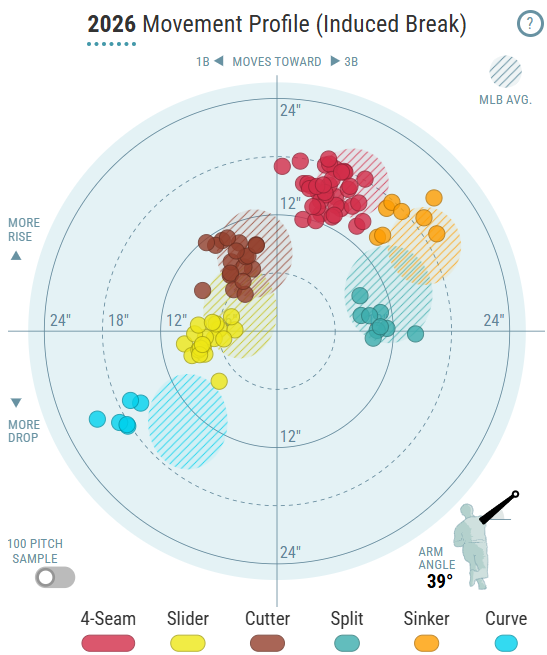
In terms of pure stuff, Melton has more than enough to be a productive pitcher. In his short career, all of his pitches besides his cutter (94) have graded out above 100 on stuff+ models. If you prefer a visual, the picture below highlights Melton’s movement compared to the major league average.
Via Baseball Savant
What you can see is more glove-side (towards first base) movement on the majority of his pitches. This helps Melton get additional movement moving away from righties, which has helped him avoid balls getting on the barrel, leading to only a 35% hard hit rate and 5.7% barrel rate, both well above league average.
Inducing soft contact consistently has helped Melton navigate lineups when his best swing-and-miss stuff isn’t there. Putting the ball in play is not a bad thing as long as the contact is not too hard and you limit baserunners. For the righty, limiting baserunners starts with plus command.
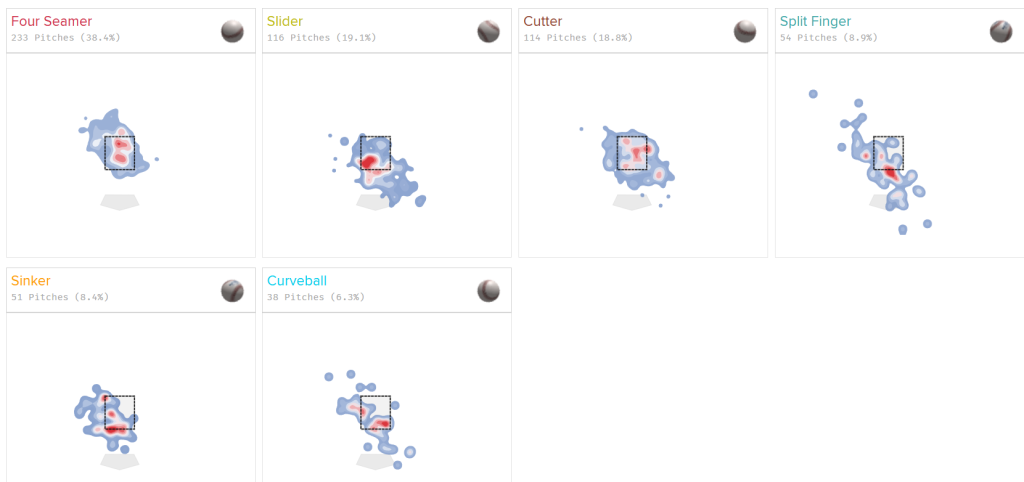
Of Melton’s seven starts, two have been without allowing a walk while two have come with allowing a single base on balls. Overall, his 2.05 BB/9, or 6% walk rate, is in the top 15% of the league. He’s been able to mostly stay away from hard contact due to his ability to locate on the edges of the plate.
Via Baseball Savant
The above graphic shows heat maps of Melton’s pitch location on contact. As you can see, the majority of his contact has been in areas of the zone that are not what I would consider danger zones.
Is there some luck involved? Sure, but I think Melton is the type of pitcher that will allows appear to “get lucky.” His pitch mix and even distribution across the zone will make it hard for batters to have an idea of what’s coming, limiting the frequency they can truly get off their best swing.
Where he has seen issues is with his four-seamer. A pitch that he has let drift too often, getting himself in trouble, allowing five of his seven home runs on the season off this pitch. He does allow harder contact on the pitch and mostly utilizes it to lefties. It could get him in trouble consistently if he is not able to improve the pitch or drop the usage in exchange for a higher usage of his cutter.
The reason I’m so high on Melton’s potential is not only his early success but the different ways he can find success.
I think the swing and miss will continue to improve closer to what we saw in the minors, with his command always leading the way. An effective pitch mix with a solid 10 mph difference in his slider compared to his fastball and a curveball, at 77 mph, that looks like it could be lethal and see an increase in usage.
Melton’s emergence has been refreshing to watch, especially in a season that has not gone as planned for the Tigers. Perhaps the most important piece of his breakout is what it means for the Tigers’ future.
Melton’s Impact Going Forward
As the trade deadline nears, and with the Tigers five games back in the Wild Card race, discussion around trades has intensified. Obviously, back-to-back Cy Young winner Tarik Skubal is atop the deadline watch list, with his contract set to expire at year’s end and the Tigers unlikely to sign him to an extension.
Losing your ace is difficult, but more changes are coming for the Tigers’ rotation. Former first-overall pick Casey Mize is also a hot commodity and will likely have even more suitors than Skubal due to the cost to acquire him. The likelihood of the Tigers signing Mize to an extension is greater than Skubal, but considering his injury past and phenomenal season, capitalizing on his trade value is a strong possibility.
A less impactful piece also on the way out is Jack Flaherty. A frustrating and inefficient year might not make him moveable at the deadline, but him returning in 2027 won’t happen. That makes three rotation pieces on the way out with only Valdez as a sure thing for 2027.
Keider Montero flashed this season and should be in consideration for the rotation, even if he is now in the bullpen. Jackson Jobe, a former top prospect, still has upside and intrigue but will first need to show he can get healthy and stay healthy. The same can be said about Reese Olsen, who has dealt with injuries the past two seasons.
Unfortunately, the Tigers do not have many bona fide prospect arms flying up through the minors. Andrew Sears and Jake Miller are two lefties I could see in the mix, but both are closer to back-end arms or bullpen pieces, not guys you should feel confident about becoming rotation fixtures in the near future.
With so much unknown ahead of the 2027 season, Melton becomes that much more important. A continued trend in the right direction and you could feel confident in him being the team’s number three. If he hits some growing pains, will he recover enough to still be a clear favorite to make the first five on Opening Day? I think his floor alone gives him that grace.
The Tigers are going to have to invest in starters once again this winter. Unless a young and somewhat proven arm (similar to Melton) comes back in a trade, the Tigers will be in search of a top-three arm. Where Melton can prove he slots the rest of the way will have a significant impact on how much the Tigers feel they need to invest into the rotation.
Become a Member of Just Baseball
Subscribe and upgrade to go ad-free!
* Save 25% by subscribing annually.

Written by