
The Case For and Against Trading Jacob Wilson
Could trading Wilson help accelerate the Athletics' path to contention, or would parting with a young, affordable shortstop be a shortsighted decision?
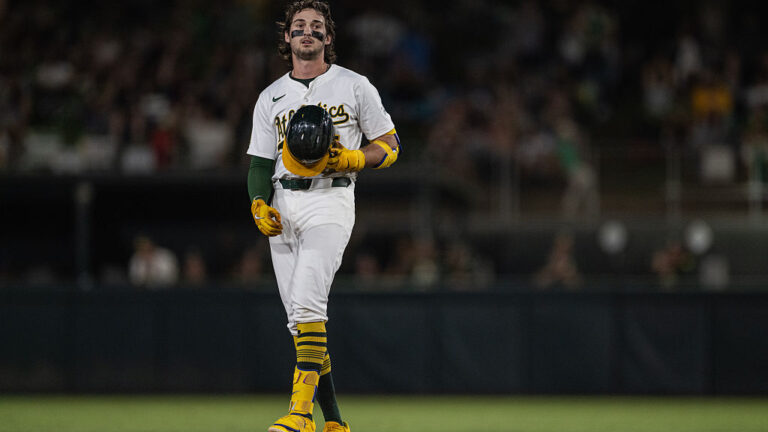
Less than a year ago, the Athletics committed to Jacob Wilson as a cornerstone of their franchise, signing the young shortstop to a seven-year, $70 million contract extension. Now, his name is beginning to surface in trade discussions.
According to USA Today’s Bob Nightengale, multiple teams have inquired about Wilson’s availability this offseason. While there’s no indication the Athletics are actively shopping the 24-year-old, it’s worth exploring why the organization might entertain the idea of moving him.
Coming off a disappointing 64-98 campaign, the Athletics find themselves at a crossroads. Despite assembling an exciting young position-player core, the organization has struggled to build a pitching staff capable of complementing its offensive talent.
With a new front office led by Taylor Smith and Cam Castro, the emergence of one of baseball’s top shortstop prospects in Leo De Vries, and the franchise’s impending relocation to Las Vegas in 2028, the Athletics have some important decisions to make this winter.
Could trading Wilson help accelerate their path to contention, or would parting with a young, affordable shortstop be a shortsighted decision?
Let’s examine Wilson’s trade value and the case for and against moving him this offseason.
Who is Jacob Wilson?
Selected sixth overall in the 2023 MLB Draft out of Grand Canyon University, Wilson established himself as one of the most gifted contact hitters in his draft class. The son of former MLB All-Star shortstop Jack Wilson, he struck out just five times in 217 plate appearances during his final collegiate season.
His elite bat-to-ball skills translated seamlessly to professional baseball, as Wilson slashed .433/.473/.668 across 53 minor league games in 2024. Just over a year after being drafted, the Athletics’ top prospect made his major league debut.
Wilson burst onto the scene in 2025, slashing .311/.355/.444 with 13 home runs and a 116 wRC+ across 125 games. His impressive rookie campaign earned him an All-Star selection and a second-place finish in AL Rookie of the Year voting behind teammate Nick Kurtz.
However, Wilson struggled to replicate that success in his sophomore campaign. Limited to just 80 games due to injuries, the young shortstop slashed .266/.298/.388 with seven home runs and an 83 wRC+ before undergoing season-ending shoulder surgery in September.
Despite his offensive regression in 2026, Wilson’s bat-to-ball ability remains exceptional. Even after posting a career-high 11.6% strikeout rate this past season, he owns a career strikeout rate of just 9.1%.
Perhaps more concerning was the regression in his approach at the plate. Wilson’s chase rate jumped from 34.3% in 2025 to 42.8% in 2026, while his walk rate declined from 5.2% to 3.6%.
Pair that aggressiveness with a career average exit velocity of 84.5 mph, a 25.1% hard-hit rate, and a 2.1% barrel rate, and it’s easy to see how reliant Wilson is on his ability to hit for average.
There were also reasons to question the sustainability of his offensive production following his breakout rookie campaign, considering his .348 wOBA significantly exceeded his .304 xwOBA. While certain contact-oriented hitters have demonstrated an ability to consistently outperform their expected statistics, the magnitude of that discrepancy was noteworthy.
As much as Wilson regressed offensively in 2026, he made encouraging strides defensively. After recording -3 Outs Above Average (OAA) across 1,053 2/3 innings at shortstop in 2025, Wilson registered +9 OAA across just 637 1/3 innings this past season.
Defensive Runs Saved (DRS) painted a less favorable picture, grading Wilson at -6 in 2026. Nevertheless, establishing himself as an above-average defender at a premium position would significantly raise his floor as a major league player.
At just 24 years old, Wilson is far from a finished product. If he can refine his approach at the plate while sustaining his defensive improvements, there’s a path toward becoming a consistent three-to-four-win player, even without significant developments in the power department.
The Case for Trading Jacob Wilson

The strongest argument for trading Wilson is the opportunity for the Athletics to leverage an area of organizational strength to address their biggest weakness: starting pitching.
The Athletics have one of baseball’s most exciting young prospects waiting in the wings in Leo De Vries, the centrepiece of their return from the San Diego Padres in the Mason Miller trade at the 2025 trade deadline.
Currently ranked as Just Baseball’s No. 3 overall prospect, De Vries slashed .290/.378/.458 with 13 home runs and 34 stolen bases across 93 Double-A games as a 19-year-old in 2026.
Given his combination of power, speed, and on-base ability, De Vries possesses a higher offensive ceiling than Wilson. With an estimated major league arrival in 2027, his presence could make Wilson more expendable than other members of the Athletics’ young core.
While the Athletics have assembled an intriguing collection of young position players, the same cannot be said for their pitching staff at the major league level. The club posted a 5.51 ERA in 2026 while surrendering 247 home runs, albeit in an extremely hitter-friendly environment in Sacramento.
As things currently stand, their projected rotation consists of Luis Severino, J.T. Ginn, Jacob Lopez, Gage Jump, and Jack Perkins. While there are promising young arms within the organization, including top pitching prospect Jamie Arnold, the Athletics lack an established, controllable frontline starter.
Given the high cost of frontline starting pitching and the fact that many of this offseason’s top free-agent arms are already off the board, acquiring such a pitcher on the open market could prove difficult for a historically low-spending organization. Wilson represents one of the few assets the Athletics could leverage to acquire that caliber of pitcher without significantly increasing their payroll.
Despite his sophomore struggles, Wilson’s age and team-friendly contract should still make him an attractive target for opposing teams. With six guaranteed years of team control remaining, the Athletics are in a position to command a significant return.
There are also legitimate questions surrounding Wilson’s long-term offensive ceiling. Given his limited power, aggressive approach, and reliance on his elite contact ability, the Athletics may be inclined to capitalize on his trade value if another organization is more optimistic about his offensive upside.
If the organization views De Vries as its shortstop of the future, trading Wilson for an impact starter with multiple years of team control could bring the Athletics one step closer to a return to the postseason.
The Case Against Trading Jacob Wilson
In Wilson, the Athletics already possess the type of player a team in their position should be looking to acquire: a young, productive major leaguer under affordable long-term control.
Wilson will be just 26 years old when the Athletics open their new ballpark in Las Vegas in 2028, positioning him to be a key contributor alongside Nick Kurtz for years to come. Owed just $16 million combined over the next three seasons, Wilson provides the organization with considerable payroll flexibility as it looks to build a contender. Even if he settles in as a consistent two-to-three-win player rather than a perennial All-Star, his contract would still provide substantial value.
While the emergence of De Vries makes the prospect of trading Wilson more intriguing, there’s no reason the two can’t coexist. Wilson could eventually slide over to second base to accommodate De Vries at shortstop, or De Vries could take over at third base, where he appeared in 15 games this past season.
Moreover, as talented as De Vries is, the 20-year-old has yet to play above Double-A and underwent shoulder surgery of his own in September. Moving Wilson before De Vries has established himself at the major league level would introduce another layer of uncertainty.
There’s also the question of whether now is the right time to move Wilson. Coming off an injury-shortened sophomore campaign that saw his offensive production decline considerably, the Athletics risk selling low on the 24-year-old.
With fewer than 1,000 career major league plate appearances under his belt, Wilson is far from a finished product. A healthy rebound campaign in 2027 could significantly improve his trade value, and given the length of his contract, there’s little reason to rush into a decision.
Unless another organization presents an offer that’s too good to pass up, the Athletics have little reason to part with Wilson before seeing what he can become.
What Could the Athletics Get in Return
Trades involving young, established position players with multiple years of team control are relatively uncommon. However, several deals over the past decade provide a reasonable indication of the type of return the Athletics could command for Wilson.
| Player Traded | Year | Age | Remaining Control | Return |
| Christian Yelich | 2018 | 26 | 5 years | Lewis Brinson, Monte Harrison, Isan Díaz, Jordan Yamamoto |
| Willy Adames | 2021 | 25 | 3.5 years | Drew Rasmussen, J.P. Feyereisen |
| Daulton Varsho | 2022 | 26 | 4 years | Gabriel Moreno, Lourdes Gurriel Jr. |
| Luis Arraez | 2023 | 25 | 3 years | Pablo López, José Salas, Byron Chourio |
| Isaac Paredes | 2024 | 25 | 3.5 years | Christopher Morel, Hunter Bigge, Ty Johnson |
The Luis Arraez trade in January 2023 is perhaps the most relevant comparison, given the similarities between Arraez’s and Wilson’s offensive profiles and the Athletics’ need for starting pitching. The Minnesota Twins capitalized on the value of an elite contact hitter with three years of team control remaining, acquiring Pablo López and a pair of prospects from the Miami Marlins in return.
The Daulton Varsho trade offers another interesting comparison. With four years of team control remaining, Varsho netted the Arizona Diamondbacks one of baseball’s top-10 prospects in Gabriel Moreno, alongside an established major league outfielder in Lourdes Gurriel Jr.
While neither player is a perfect comparison for Wilson, both trades demonstrate the type of return a young, controllable position player can command.
With six guaranteed years of team control remaining, Wilson offers even greater contractual certainty than either player did at the time of their respective trades. However, his limited track record, offensive regression, and injury concerns complicate his trade value.
Ideally, a package for Wilson would be headlined by an established starting pitcher with multiple years of team control, potentially accompanied by additional prospect capital depending on the caliber of the pitcher.
Given Wilson’s age and favorable contract, the Athletics can afford to set a high asking price.
Should the Athletics Trade Jacob Wilson?
The emergence of De Vries and the Athletics’ glaring need for starting pitching give the organization legitimate reasons to entertain trade offers for Wilson. If the organization can acquire an established frontline starter with multiple years of team control, there’s a compelling case for moving the young shortstop.
However, the Athletics shouldn’t feel any urgency to trade Wilson this offseason. Given his age, favorable contract, and room for development, the organization is better off retaining him unless presented with an offer that significantly improves its long-term outlook.
Become a Member of Just Baseball
Subscribe and upgrade to go ad-free!
* Save 25% by subscribing annually.

Written by
Will Houslander is from Toronto and studies at Ivey Business School. He covers all things MLB for Just Baseball and writes about the Toronto Blue Jays…