
At Least the Mets Have an Outfield to Build Around
The Mets' season has gone off the rails, but Carson Benge and A.J. Ewing are giving fans a reason to believe in the future.
To say that nothing has gone right for the New York Mets this season would be quite the understatement. The team sits 16 games under .500 and owns the fourth-worst record in all of baseball.
Coming out of the offseason, the Mets were widely viewed as one of baseball’s biggest winners by both analysts and fans. Just a few months later, nearly every one of those free-agent acquisitions has turned into a complete disaster.
Bo Bichette, who’s making $42 million this season, owns an OPS below .700. Jorge Polanco, who’s making $20 million, has appeared in just 18 games after battling injuries. Luis Robert Jr., meanwhile, has played in only 24 games all season. Before landing on the injured list, Marcus Semien owned a .612 OPS, one of the lowest marks among qualified hitters in baseball.
And it hasn’t just been the veteran additions. Even the players the Mets were counting on internally have taken major steps backward. Mark Vientos has posted some of the worst underlying metrics in Major League Baseball, ranking in the bottom 20 percent in batting run value, baserunning run value, and fielding run value.
Brett Baty, who many believed would be the glue of this lineup after posting an .866 OPS over the final two months of last season, has fallen well short of those expectations. Instead, Baty owns just a .618 OPS and a 0.0 fWAR.
It’s almost unfathomable to believe this much could go wrong in a single season between the surge of injuries and the underperformance across the board.
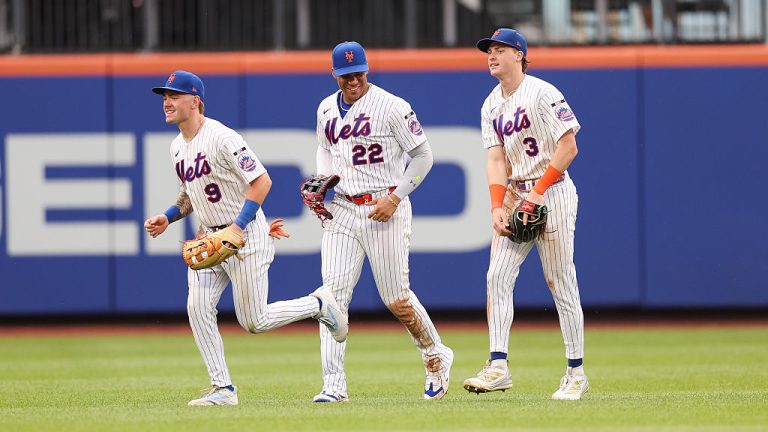
However, among all the dying stars in the night sky that have gone out, two new ones have glowed brighter than anyone expected: Carson Benge and A.J. Ewing.
Stats were taken prior to play on July 12.
Meet the “Psychopaths”
Benge entered the season battling veteran Mike Tauchman for a spot on the Opening Day roster despite being only two years removed from the Mets selecting him 19th overall in the 2024 MLB Draft.
The organization loved the progress he made in the minor leagues last season and knew he’d eventually become an important piece. They just believed he needed a little more seasoning. Or at least that was the plan until Tauchman tore his meniscus during a game, and suddenly the job belonged to Benge.
The early signs weren’t encouraging. Benge looked overmatched by big-league pitching and didn’t seem quite ready for the moment. He struggled mightily for more than a month, hitting below .200 through May 6. Then everything changed when he made an adjustment.
Benge had used a very open batting stance since college, standing 24 degrees open at the plate. It was clear the setup wasn’t working. His timing looked completely out of sync, so he closed off his stance, cutting it down to just six degrees open.
The results since that change have been better than anyone could have expected. Over his last 63 games, Benge is hitting .299 with nine home runs, 31 RBIs and 43 runs scored. After spending more than a month producing well below league-average numbers, his season statistics now rank among the best of any rookie in baseball.
Overall, Benge is hitting .266/.330/.407 with 11 home runs, 12 doubles, 15 stolen bases and a .737 OPS. With the way he’s swinging the bat, there’s every reason to believe he’ll finish his rookie season with a 20/20 campaign.
After looking like he couldn’t catch up to any pitch early in the season, it now feels like there’s no pitch Benge can’t get to. One of the first places pitchers try to attack young hitters is up and in, hoping to expose a weakness in their swing. That approach simply hasn’t worked against Benge.
His ability to turn on the high fastball with authority is rare, especially for a rookie. His swing is so quick that he doesn’t have to sell out for power to drive the baseball.
And all of that doesn’t even include what he’s done defensively. Benge has already found himself on the highlight reel several times this season, with play-by-play announcer Gary Cohen famously calling one of his catches “pulchritudinous.” And rightfully so.
Benge owns +1 outs above average and one of the strongest outfield arms in baseball. A former two-way player at Oklahoma State, he averages 94.6 mph on his throws, which ranks in the 98th percentile in the majors this season. Watching him on both sides of the ball feels completely different from the rest of a team that has looked so rigid for much of the season.
For a while, Benge was the lone bright spot. Then the next young star came seemingly out of nowhere in A.J. Ewing.
The Next Great Ewing in New York
Entering the season, Ewing wasn’t expected to reach the big leagues at just 21 years old after opening the year at Double-A Binghamton. The Mets loved his approach at the plate, but it felt like he still needed a little more time to grow into his own. However, with the season quickly slipping away, the organization called Ewing up anyway on May 12.
From the moment he stepped onto the field, Ewing gave off that same feeling Benge did. His approach at the plate looked incredibly mature for someone his age. He consistently put the bat on the ball without trying to do too much.
The 21-year-old showed elite plate discipline from the moment he arrived, rarely chasing pitches outside the strike zone. It helped him get on base at a high rate, but pitchers eventually adjusted by attacking him earlier in counts.
At times, Ewing looked almost too patient, often letting hittable 3-1 pitches go by. After about a month in the majors, his average dipped to .224 entering June. But just like Benge, he made an adjustment.
It wasn’t a mechanical adjustment like Benge made. Instead, it was a change in mindset. Ewing realized it was okay to attack pitchers early in the count instead of always waiting for the perfect pitch. Since then, he’s looked more comfortable in the batter’s box with each passing game.
On the season, Ewing is hitting .276/.352/.438 with seven home runs, nine stolen bases and an .789 OPS. Despite getting strong production from Benge in the leadoff spot for much of the season, the Mets recently made the decision to move Ewing to the top of the lineup. The reasoning is simple: Their season is essentially over, making this the perfect time to experiment with an eye toward the future.
Ewing has all the tools to become one of the best leadoff hitters in baseball. We already talked about his disciplined approach at the plate, but his speed is just as impressive. His sprint speed of 29.5 ft/sec ranks in the 95th percentile across Major League Baseball.
Since moving into the leadoff spot, the lineup suddenly feels deeper with Soto, Bichette, Lindor and now Benge hitting behind him.
Ewing isn’t the big power bat the rest of them are. Or at least that’s what everyone thought. In 124 minor league games last season, Ewing hit just three home runs. This season, between the majors and minors, he’s already hit nine in only 86 games. He even launched his first leadoff home run against the Royals on July 8.
In fact, it feels like Ewing has looked more comfortable than ever since moving into the leadoff spot. Since taking over that role on July 3, he’s hitting .314 with three home runs, five RBIs and a .351 on-base percentage.
And that’s not even mentioning what he’s done defensively in center field, where the Mets have searched for stability for years. Ewing has already posted +1 Outs Above Average, showcasing outstanding instincts and fearlessness on every ball hit his way. Time after time, he and Benge make highlight-reel diving catches that many outfielders simply don’t attempt. It’s why they’ve started calling themselves “the psychopaths.”
The Foundation of the Future
Their energy is contagious. Although Juan Soto is the veteran of the group at just 27 years old, he hasn’t tried to change who Benge and Ewing are. Instead, he’s embraced their fearless style of play.
“I don’t try to be a mentor,” Soto said. “I try to be one of them.”
That mentality has shown up in his own game. Since moving to left field, Soto is having his best defensive season in years. Then, of course, there’s his bat. On the season, Soto is hitting .294/.410/.570 with 21 home runs and an NL-leading .980 OPS.
With Soto, Benge and Ewing patrolling the outfield and all three under team control for at least the next five seasons, it’s fair to wonder where this group ranks among the best outfields in baseball. Soto is already one of the game’s five best players, while Benge and Ewing look like rising stars who continue to get better with every game.
Not much has gone right for the Mets this season, but they’ve found one thing fans can genuinely be excited about. Their outfield trio looks like it could be the foundation of this franchise for years to come.
Become a Member of Just Baseball
Subscribe and upgrade to go ad-free!
* Save 25% by subscribing annually.

Written by
Thomas Kelson is an intern at Just Baseball and a graduating senior at Rutgers University, where he studied Journalism and Media Studies with a specialization in…