
The NL Second Base Race Is the Best Argument Against All-Star Fan Voting
The fan vote has produced some less-than-worthy All-Star starters in the past and seems on pace to do so yet again.
June has hit its halfway point on the calendar, which means MLB All-Star Game voting is in full swing. With that comes the annual tradition of complaining about All-Star voting and selections.
Taking issue with the All-Star voting process or results certainly isn’t unique to baseball. All of the major sports leagues have their own way to weigh the different votes that come in and use that formula to determine participants, and each league’s fans have their thoughts on how it could be better.
MLB has one thing in particular that sets it apart, however: the fan vote. While other leagues either use fan vote as a part of the equation, or, in the NHL’s case, use it to fill in the back end of rosters, MLB is the only league that solely uses the fan vote to determine the starters for the All-Star game.
Let’s review how the two phases of the MLB fan vote actually work. In the first phase, fans vote for position players and designated hitters, with the top six outfield vote-getters and top two at every other position moving on to phase two.
In phase two, fans vote between the two (or six) players who advanced at each position to determine the All-Star Game starters. The exceptions are the AL and NL’s top overall vote-getters after phase one, who are automatically named starters.
This can, at times, lead to some chaotic voting results. All it takes is one or two very fervent fanbases, and the phase two qualifiers can be watered down with less-than-capable finalists.
Take the most recent NL All-Star voting update, for example. If the results from this update hold, all but two of the players advancing to phase two would be members of the Dodgers, Braves, or Phillies.
Sure, many of those selections can be justified. Atlanta and L.A. have the top two records in baseball and have rosters chock full of talent. The Phillies are arguably performing below expectations but still have some players who will make the Midsummer Classic.
But there are plenty of very deserving players who, at the moment, are on the outside looking in and fuel the question of whether the current format of fan voting should exist. For a prime example, look no further than the second base position.
In first is Atlanta’s Ozzie Albies. While a .279/.334/.438 slash line with a 113 wRC+ and a 1.9 fWAR is nothing to scoff at, but none of those numbers even ranks in the top three at the position.
Behind Albies isn’t Pittsburgh’s Brandon Lowe, whose 17 homers lead all NL second basemen, six more than the next closest. It isn’t the leader in average (Luis Arraez), on base percentage (Xavier Edwards), or fWAR (JJ Wetherholt). Nor is it the player who is arguably the best second baseman in baseball.
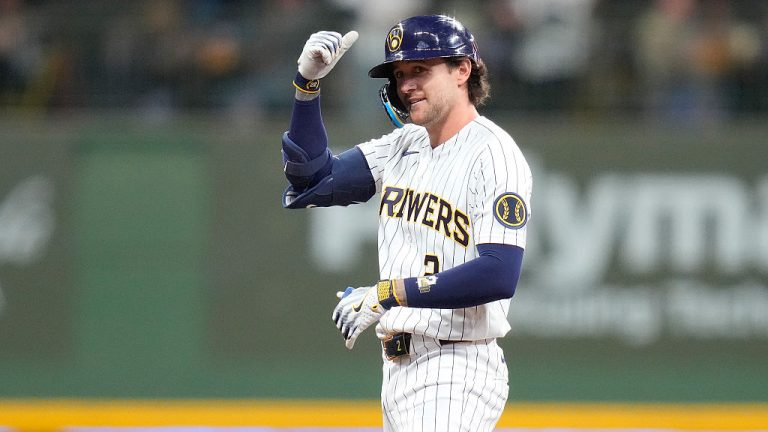
Last year, Brice Turang took a massive leap forward. Already an elite defensive second baseman, he finally started bringing the offensive numbers to match, slashing .288/.359/.435 with 18 homers, 81 RBIs, 24 steals, 97 runs scored, a 124 wRC+, and 4.4 fWAR over 156 games.
The former 21st overall pick was ascending into one of the league’s top second basemen. Hype grew during the World Baseball Classic when Turang put up one of the best offensive performances on Team USA and tied for the tournament lead with four doubles.
The 26-year-old has further elevated his game in 2026. He’s slashing .261/.378/.457 through his first 65 games and has bumped his wRC+ to 134, tops among all qualified second basemen. His 53 runs scored are tied for second in all of baseball, and his 2.5 fWAR is tied for second among MLB second basemen.
Yet after the first All-Star Game voting update, he sits third, just shy of qualifying for the next phase.
In second place in voting is the Phillies’ Bryson Stott. Through 65 games, the Philly second baseman is batting .230 with a .674 OPS, a below-average 85 wRC+, and a 0.9 fWAR.
No one is saying that Stott is a bad player by any means. But by most metrics, his numbers rank closer to the bottom half of players at the second base position than the top half.
Yet, because Phillies and Braves fans have been rabid about getting out the vote, he and Albies are currently on track to be finalists to start the All-Star Game. This is not the only example of voting misconduct, either.
James Wood of the Nationals leads the NL with a 168 wRC+ but is seventh in the voting for NL outfielders. Miami’s Otto Lopez (3.0) and Cincinnati’s Elly De La Cruz (2.6) are first and second in fWAR among NL shortstops but trail the Dodgers’ Mookie Betts, who is hitting .205 with a 78 wRC+ and a 0.5 fWAR.
Plenty of other examples exist in the AL as well, with players like the Tigers’ Kevin McGonigle, the White Sox’s Miguel Vargas, and the Red Sox’s Willson Contreras, among others, deserving much more love.
Of course, the fans should have a say in All-Star voting; they’re the ones paying to watch the games, after all. But many fans vote with their own team in mind and don’t necessarily get to witness the talents of some of the game’s other stars either.
That’s not to say that the players, who help fill the rest of the roster, are perfectly knowledgeable about the rest of the league and are infallible in their votes. But this is why leagues like the NFL, NBA, and WNBA combine votes of the two parties, along with media and/or coaches, to attempt to balance these votes out in the best way.
Now that the first voting update is out, though, and fans can see what deserving candidates need a little help in the polls, some of these “mistakes” will work themselves out in time. However, they wouldn’t even need to if the all-powerful fan vote were tempered into a more reality-based format.
Become a Member of Just Baseball
Subscribe and upgrade to go ad-free!
* Save 25% by subscribing annually.

Written by
Matt Carroll is a writer for Just Baseball and former site expert at Reviewing the Brew. He studied journalism at the University of Wisconsin-Madison and currently…