
Kyle Tucker’s Cubs Future Has Never Been More in Doubt
If Chicago was hoping to give Kyle Tucker reasons to stay in town long-term, they've been doing a poor job of it.
 | |
| | 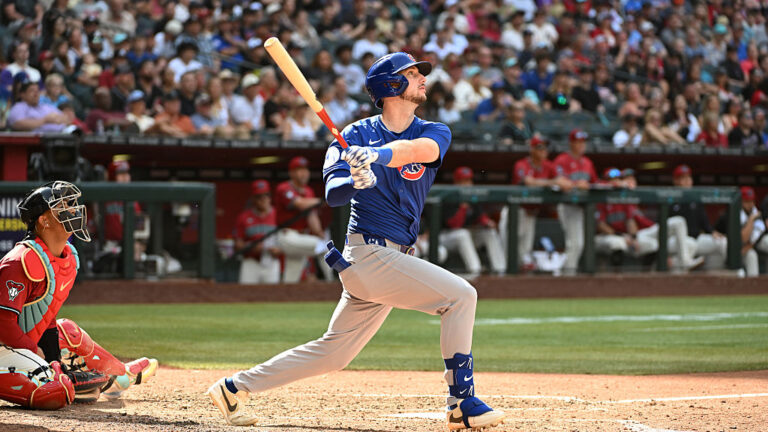
On Monday, with the Chicago Cubs down at home to the Milwaukee Brewers by a score of 3-0 to start the bottom of the sixth inning, outfielder Kyle Tucker came to the plate. Earlier this year, that might have meant the beginning of a late-game rally.
But Tucker had been struggling recently and hadn’t begun this game well either, grounding to first in each of his first two at bats. Sure enough, he would ground out once again, this time to second, on his way to an 0-for-4 day at the plate.
The performance dropped his slash line to a lowly .148/.233/.148 slash line so far for the month of August. Shortly after that, manager Craig Counsell would make a surprising announcement.
Between games of the day’s doubleheader (the night game would actually, ironically, be rescheduled due to rain) Counsell mentioned that Tucker would be getting a few games off. The hope was that his star would get a chance to reset.
And if there was anything the Cubs needed, it was for their slugger to get right. After leading the division for much of the season, the Brewers had stormed to the top of the NL Central with their hot summer. A Milwaukee win in that Monday game stretched their division lead to nine games.
Now, benching a player amidst struggles isn’t that unheard of. But benching a player of Tucker’s caliber, a four-time All-Star and World Series winner, is more rare. Stating that intention to the media right after a recent poor outing? When’s the last time you remember that happening?
The Cubs traded for Tucker this offseason hoping they’d be able to show him a reason to stay with the team past the 2025 season. Instead, it feels like they’ve fumbled multiple opportunities to make him want to do just that.
An Uncertain Future in Chicago

This past offseason, there were so many rumors that Tucker would end up being traded from the Astros, the only organization he’d ever played for, that the move was essentially spoken into existence. The only question was who would make the best offer.
Among the teams expected to potentially acquire him were the Cubs, who could use a big bat in the lineup. On December 13, they struck a deal.
The Cubs traded big leaguers Isaac Paredes and Hayden Wesneski as well as prospect Cam Smith in exchange for Tucker. Many expected that Chicago would try to find a way to keep their new outfielder, who becomes an unrestricted free agent after the season, long-term.
The first opportunity to do that was before the season even began. In fact, the earlier the better, seeing as another strong season would only drive his price tag further up in the coming offseason.
The two sides didn’t get a deal done and the season began. As expected, Tucker looked his normal, productive self in the early going, even garnering early MVP whispers. His .280/.384/.499 slash line with 19 doubles, 17 homers, and 56 RBIs would help earn him his fourth All-Star nod.
The red-hot Brewers had been sneaking up in the division going into the All-Star break, but the Cubs were still up a game at that point. The trade deadline was just around the corner, though, and a strong game plan would not only help fend of their rivals but also show Tucker that they were serious about building around him if he stayed.
But while the Cubs did make moves, they weren’t exactly sexy ones. They brought in a utilityman in Willi Castro and a trio of pitchers in starter Michael Soroka and relievers Andrew Kittredge and Taylor Rogers.
It sort of mirrored the story of the offseason. Matthew Boyd was a very good get for the rotation, but he was really the only other “big” acquisition besides Tucker. Yes, Tucker was a pricey addition, but Chicago isn’t exactly hard up for cash.
So as the Cubs ultimately gave up the division lead and fell further behind the Brewers as the summer went on, Tucker began his post-All-Star break slump. In 26 games since the break, he’s batted just .182 with a .572 OPS, two doubles, and a single homer.
But he wasn’t the only one slumping, and with the Cubs needing to keep pace with the Brewers, the team looked to the minors for a jolt. Last week, they brought up their top outfield prospect, Owen Caissie.
A crowded outfield would delay his debut, but Caissie would finally make it in that Monday game against the Brewers, where he would also collect his first career hit. He would play in the following three games as well, providing a jolt that would lead to three straight Cubs wins.
The boost has been great for the Cubs, who desperately needed it. It’s also come while Tucker has been resting, though. And that’s interesting timing, considering some thought Chicago might trade Caissie if the goal was to keep Tucker in the outfield alongside Pete Crow-Armstrong and Ian Happ going into 2026.
Then came a revelation. On Wednesday, ESPN’s Jesse Rogers revealed that Tucker suffered a hairline fracture to his right hand in June, not long before his slump began. That certainly explains much of his recent performance.
However, is that another way in which the Cubs failed him? It’s extremely admirable that Tucker opted to play through his injury. But should the team have stopped him from himself, if not at the beginning then at some point when they knew the injury was affecting his hitting?
It feels like the Cubs have had multiple opportunities to make Tucker want to stay a Cub in 2026 and beyond. They could’ve extended him already. They could’ve added talent around him. They could’ve been more tactful about his benching. They did none of those things.
Maybe Tucker trusts the process and comes back anyway, or maybe a playoff run helps cement his decision. Still, it seems like his Cubs future ends sooner than we all originally thought it would.
Written by
Matt Carroll is a writer for Just Baseball and former site expert at Reviewing the Brew. He studied journalism at the University of Wisconsin-Madison and currently…