
The Ke’Bryan Hayes Trade Has Been a Disaster for the Reds
Ke'Bryan Hayes' tenure in Cincinnati has not gone as planned, and the clock is ticking for him to turn things around.
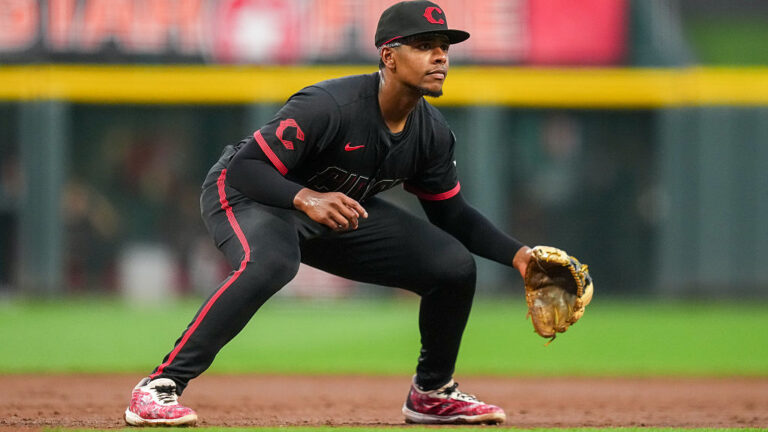
At the 2025 trade deadline, the Cincinnati Reds made a surprise move by acquiring Ke’Bryan Hayes from a familiar NL Central foe in the Pittsburgh Pirates. It was a move in which even the most optimistic fans had to squint to see the light while their fingers were crossed.
Although Hayes was known for his top-notch defense at third, he was coming off a miserable year at the plate where he posted a 60 wRC+ and was headed in the same direction again.
Not only was the move risky due to his bat, but Hayes came with four years left on a deal that paid him north of $8 million per season.
His defense held true through the 2025 season, which was refreshing and an area that Cincinnati needed to improve. Essentially, in order for Hayes to make sense in any lineup, he simply needs to be close to a league-average hitter, and his glove will make up for the rest.
Not so hard, in theory. But in practice? It’s a different story.
Stats were taken prior to play on May 26.
Hayes’ Struggles and Misleading Stats
From the time Hayes was acquired to the end of the season, he slashed .234/.315/.342 with three home runs in 52 games.
It was an improvement, slightly, from his time in Pittsburgh, but the production was still roughly 20% lower than league average. His defense helped him accumulate 1.4 fWAR, but everyone knew how quickly this could sour.
Hayes has had five seasons of at least 250 plate appearances; He has one season with a wRC+ above 100 (101 in 2023), two seasons in the 85-wRC+ range, and his most recent two seasons came in at a 60 and 65 wRC+, respectively.
Twice he finished above a 2.0 fWAR with his last coming in 2023.
There was no doubt that this move had a chance to unravel, and we are seeing that right now. Hayes started the 2026 season slashing an abysmal .142/.195/.225, good for a 12 wRC+ across 44 games before landing on the IL.
At-bats started to feel like automatic outs, and it became clear that there would not be a magical overnight fix. Some may point to his expected stats to try an tell a story of Hayes being unlucky. As we know, expected stats, such as expected batting average (xBA), come with an asterisk.
Hayes has an expected batting average of .259, a massive difference from his actually batting average of of .142. Expected batting average essentially takes the exit velocity and launch angle of a batted ball and compares it to the same combination from years prior and tells you the batting average of those balls.
What it does not consider — and this is very important — is where that ball is hit.
As an example, a batted ball with a 99 mph exit velocity with 28 degree launch angle is a HR to left and a fly out to center.
Let’s look at all of the balls Hayes has hit with an exit velocity over 98 mph, which is the minimum to qualify as a barrel.
Of those 30 events, 10 have resulted in hits: two home runs, one triple, and one double with the rest being singles. A .333 average is great in most context but not when you get into 98+ mph exit velocities.
This chart shows batting average in relation to higher exit velocities, highlighting that Hayes still is falling short.
The video above shows why Hayes’ expected metrics are not telling a true story. Even when he makes great contact, the launch angle is usually subpar. Of his 22 batted balls above 100 mph, only nine had a launch angle over 15 degrees, and six were groundouts.
A problem for Hayes is that so much of his quality contact goes to centerfield, the deepest part of the ballpark. Of his 30 batted balls over 98 mph, 18 were up the middle, resulting in three singles and one double.
This is not a new thing for Hayes, either. A high groundball rate has always been part of his game, and his sub-five percent home run-to-flyball rate this season, and each of the past two, has been due to hitting so many flyballs to center and right, where he has less power.
| GB% | Pull Air% | Straight Air% | Oppo Air% | |
| 2021 | 56.7% | 4.5% | 18.4% | 19.5% |
| 2022 | 49.4% | 6.8% | 18.2% | 25.5% |
| 2023 | 41.8% | 12.5% | 22.9% | 22.6% |
| 2024 | 52.7% | 7.1% | 16.7% | 24.1% |
| 2025 | 49% | 8.4% | 20.1% | 22.5% |
| 2026 | 36% | 13% | 22% | 29% |
From 2024 through 2026, Hayes has three home runs to right field, where he hits the majority of his flyballs. He has one home run to center field in that same sample.
As you can see from the chart above, Hayes has had similar trends most seasons. We have a smaller sample size this season, but the issues still remain.
Expected stats are often used as a predictor of what’s to come. If a player is making good contact, then eventually some of those balls will fall in. Hitters cannot always control where the balls are hit, but solid contact maintained throughout the course of a season will pay off eventually.
The reason I think Hayes is an exception to that rule is based off of the prior years we have of his data. His expected batting average often lands close to his actually batting average, but his expected slugging percentage is usually higher.
Again, this is because he does not pull the ball enough, and those metrics become skewed as many of his well-hit balls land near the warning track.
We are talking about a player with 2,670 career plate appearances at an 81 wRC+ who is slashing .247/.302/.360. To me, he is what he is, and I doubt there will be a drastic change that leads to him finding enough value at the plate to save this trade for the Reds.
Want even worse news? His defense has not been as flawless.
The true reason the Reds acquired Hayes was for his defense. He was spectacular last season but has graded out as a 0-OAA defender through 44 games. Now, OAA is a counting stat, but a player of Hayes’ caliber should not be a zero.
For reference, Hayes led third basemen with +21 OAA last season. This season, he’s in a group tied for 14th, and the leader — Maikel Garcia — has +5 OAA.
I know defensive stats can be wonky and confusing. Typically OAA is a better indicator for outfielders and defensive runs saved is better for infielders. Hayes is currently tied for second amongst third basemen in DRS with +8.
His defense has not been bad, but when you consider how poor he is at the plate, his defense has to be otherworldly for the player’s value to make sense. Even if that standard feels unfair, it’s the reality when a player is light years away from a league-average hitter.
But, Hayes’ struggles are not the only black eye for his outlook in Cincinnati.
Hayes’ Contract and Injury History
Let’s lay out some truth: Cincinnati taking Hayes’ contact off the hands of the Pirates helps a division rival.
These are two teams that truly watch every dollar, and although Hayes is only due $7MM this year and next followed by two years at $8MM, that is enough to restrict both the Pirates and Reds in ways other teams might not feel.
The Reds went out and targeted Hayes and traded assets to bring him in. The salary-dump trades we sometimes see are not the same as the Hayes trade. Cincinnati wanted a top-tier defender at third and decided to live with an ugly contract and no offensive output.
Constructing a roster becomes much more difficult when you have to reserve a spot for Hayes.
If the best option is Suarez at third, Stewart at first, and Lowe at DH, then Hayes becomes a one-position bench player whose only value comes as a late-inning defensive replacement. Stewart and Suarez would face any lefty out of a bullpen, and Lowe filling DH would allow for a different bat to pinch-hit for him if Francona decided to go that route.
It’s a roster fit that the Reds now get more time to think about as Hayes currently resides on the injured list, which brings us to another truth about Hayes: back problems were an issue for Hayes dating back to his Pirates days.
Hayes will go to the Reds spring training facility in Arizona to work on mechanics during his IL stint. We don’t have enough information to make this comparison fair, but it does feel like what the Reds have done in the past with players like Connor Phillips and Brandon Finnegan — players who were lost and in need of a reset.
Sure, having to hit the IL for back problems that have been around for years and being forced to go work on the basics has to be humbling. But, I am glad that the Reds are going down this path.
We all know what is happening with Hayes is not a bad stretch that will eventually work itself out, but instead a problem that needs a rest.
Best, realistic-case scenario? Hayes gets time off to clear his head, improve his back, and tweak a thing or two, and he returns to the Reds and offers something closer to the best version of himself.
Final Thoughts
Cincinnati traded for an underwater contract with a bad back. I don’t want to undervalue Hayes’ defense, as I still think he can be one of, if not the best defender at third in all of baseball. But unless his bat starts to trend closer to league average, he doesn’t carry enough value for the roster spot to make sense.
The Reds are not good enough to have the luxury of a glove-only third baseman. Especially when you consider two of their best bats and their most expensive position players can fill the roster spot.
We are less than one year into the Ke’Bryan Hayes’ Reds tenure, and it is already looking like a mess. Four more years and a buyout to go.
Become a Member of Just Baseball
Subscribe and upgrade to go ad-free!
* Save 25% by subscribing annually.

Written by