
Jackson Holliday Is Proving Why Prospects Are Never Guarantees
Jackson Holliday's early-career struggles show that being a "can't-miss" prospect far from guarantees success against the best in the world.
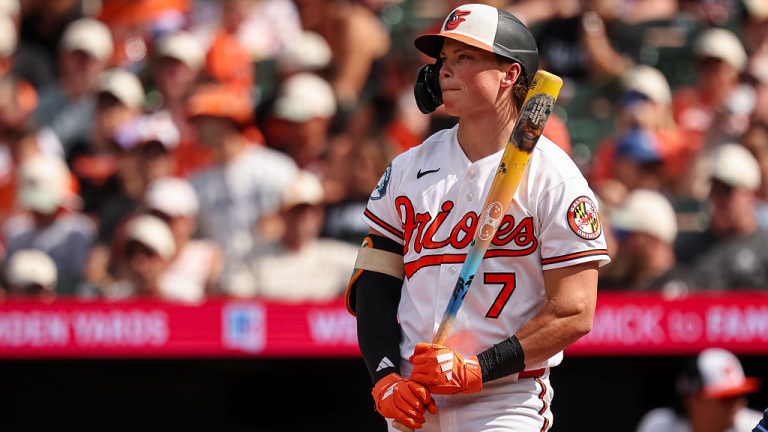
Phrases and terms such as “generational” and “can’t-miss” flood player evaluation more and more with each top prospect.
Baltimore Orioles second baseman Jackson Holliday is another member of that long list. Perhaps some of it is his bloodline, as being the son of an All-Star like Matt Holliday comes with a set of expectations.
We saw those expectations thrust on a trio of young Toronto Blue Jays several years ago. Some meet those expectations — Bo Bichette and Vladimir Guerrero Jr. — while others don’t, like Cavan Biggio.
Holliday is far from a bad major leaguer; he’s just not been anything special yet. In 2026, he’s slashing .230/.314/.349, good for an 89 wRC+ and 0.8 fWAR. He’s made some improvements at second base, up to zero outs above average from negative eight a season ago, but the bat hasn’t played yet in MLB.
It’s a hard game, and one predicated on failure. It’s important to keep in mind Holliday is only 22 years old. Just because he’s not a star now doesn’t mean he won’t ever be one. And even if he’s never a star, that doesn’t mean he’s incapable of having a long, productive career.
Stats were taken prior to play on August 30.
Perspective is Key with Top Prospects
Fans are quick to make drastic declarations on a player while downplaying any nuances. Major League Baseball is a tough game full of smart people and smart players. Pitching especially has become so cerebral in addition to being skilled, with velocity and spin continuing to torment opposing hitters.
Holliday was drafted out of high school, where even the best pitchers he faced were nowhere near as polished as even the worst arms he’s faced in MLB.
Just 2.0 fWAR in 293 games is far from impressive, but he’s been no worse than a replacement-level player in any year he’s been in the bigs. That’s not something we can say about all top prospects, whether they eventually realize their star potential or not.
The extreme example is St. Louis Cardinals outfielder Jordan Walker. After a fine rookie campaign, he posted -2.0 fWAR over his next two seasons, even seeing time in Triple-A during those seasons. This year, he’s exploded into the star evaluators saw him as when he was a prospect. This is his fourth season appearing in MLB, just turning 24 in May.
Again, Holliday is 22, not turning 23 until December. Even though this is Year 3 of him appearing in MLB, he’s far from his prime years. There’s plenty of room for him to physically mature and learn the game. It hasn’t happened yet, but that doesn’t mean it never will.
There’s Cause for Optimism
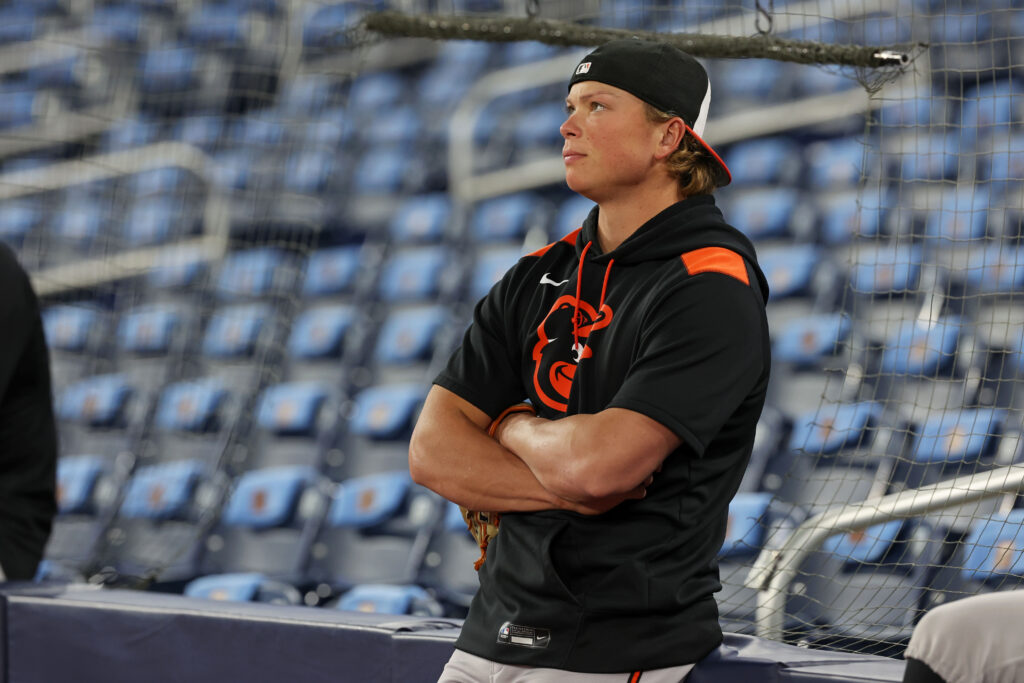
Looking at the raw data, there’s not a lot to suggest things are looking up for Holliday. However, there are a few things to suggest development is happening.
For starters, his feel for the strike zone is markedly improved. Last year, he walked at an 8.6% rate, which is now 11.3%. While the volume is much lower, it’s still a greater frequency. He’s chasing a little bit more, but he’s also making better contact. His launch angle sweet-spot rate is up to the 79th percentile from the 22nd a season ago.
While the power numbers are lower than even his rookie campaign, he’s showcasing a knowledge of the zone he didn’t have early in his career.
Additionally, he’s taken to second base more adequately in 2026. He’s not close to vying for any Gold Gloves, but jumping from -8 OAA to zero, albeit with less volume, is again quite impressive in a one-year span. As a middle infielder, being a quality defender and average bat will make him valuable to a ball club, particularly one with playoff aspirations.
It may not make him a star, but that doesn’t need to be the barometer for him having a successful career, even as a former No. 1 overall pick.
Areas of Improvement
The 2026 campaign brought back some concerning trends in the whiff department for Holliday. Last year, he was a fringe-average hitter in walks, strikeouts, and general whiff rate. This year, he’s whiffing in the 29th percentile while striking out in the 38th.
Strikeouts are an accepted consequence of slug. Holliday doesn’t have the bat speed or the slug to justify the whiffing he does. In 2026, his isolated power is just .119, and he has just 18 extra-base hits in 84 games. Last year, it wasn’t an impressive mark (.133), but he generally had more bat-to-ball and elite command of his swing decisions.
He’s also not proficient in the art of Pull Air. He’s got a career-high 14.2% Pull Air in 2026, but that’s far from where it needs to be to generate slug. Again, whiffs without slug are wasteful. If he’s getting off his A-swing, barreling mistakes, and driving the ball over the fence, you can live with some issues connecting with the ball. An obvious area of needed improvement is there.
He’s a strong kid, and heavy for his 5-foot-11 frame. But perhaps there’s room for him to add a little more muscle given he’s at second base now instead of shortstop, where he was drafted.
At 22, there’s no reason to wave the white flag or sound the alarm. But Holliday has proven in three years that the idea of a “can’t-miss prospect” far from guarantees success against the best in the world.
Become a Member of Just Baseball
Subscribe and upgrade to go ad-free!
* Save 25% by subscribing annually.

Written by