
Why Did the Pirates Draft Derek Curiel 5th Overall?
Here's why the LSU outfielder made the most sense for the Pirates, given the options they had available.
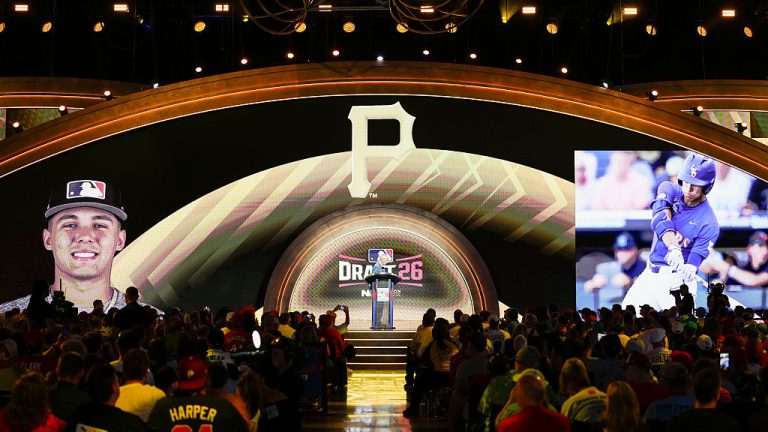
The 2026 MLB Draft was full of electric talents, especially on the college side. From superstars like Roch Cholowsky, Grady Emerson, and Vahn Lackey to other collegiate sluggers like Drew Burress, it didn’t take much to get excited about the very top of this draft class.
However, if there was one thing that seemed like a guarantee outside of the talent that these players brought to the table, it was the sheer amount of chaos that was expected to unfold on draft day.
Outside of the three players I mentioned above, the rest of the draft was more of a toss-up than we’ve seen in recent draft history, especially when you consider that the Chicago White Sox were seemingly undecided until the day of the draft regarding who they’d select number one overall.
Given this, the baseball world knew we’d see a surprise on draft day; we just didn’t know when the surprises would begin to unfold.
The first four picks in the draft unfolded almost entirely as expected. Roch Cholowsky went first overall to the White Sox, Grady Emerson went second to the Rays, and Vahn Lackey went third to the Twins.
Then, the Giants selected arguably the fourth-best player in the class at the fourth overall pick, selecting Jackson Flora, despite not often being mocked to do so. They landed the top pitcher in the class, and also likely took the Pittsburgh Pirates‘ top draft target away from them.
This placed the Pirates in a peculiar situation: Select one of the best college hitters on the board and try to save some money, or potentially take yet another shot on a prep player.
They’d take the first route, selecting LSU outfielder Derek Curiel fifth overall, in a move that was the first real surprise of the draft given that multiple other college sluggers remained on the board, and the majority of them were ranked above him.
While many called this a stretch at the moment, or a “clear” under-slot money play, the Pirates had something bigger in mind. The more time that passes, the more it seems like Curiel was the standout choice for the Pirates at fifth overall, especially when you stack him up against his peers.
Let’s dive in and explain why the Pirates decided to take this route, and also why this decision made the most sense out of the options they had available.
An In-Depth Look at Derek Curiel
Before stacking him up against his peers or examining the other routes the Pirates could have taken, we first have to learn about the type of player Derek Curiel is by taking a closer look at his profile and the underlying data that makes him such a fascinating player. Spoiler alert: There’s a lot to like when digging deeper, as you start to get an idea of what stood out to the Pirates when making this pick.
An Elite Hit Tool
The first thing that really jumps out about Curiel’s game is his tremendous hit tool, which has been given a future value as high as 60 by some publications. This may seem like a stretch at first, but the underlying numbers back it up: This is a legitimate skill, and arguably the best raw hit tool in the draft.
Aside from his hitting .353 with a .431 on-base during his final year at LSU, the underlying numbers are some of the most encouraging you’ll find in college baseball. During the 2026 campaign, Curiel posted an absurd zone contact rate of 94.2%, a mark that immediately separates him from his peers and places him in elite territory by a good margin.
For reference, out of all MLB hitters with at least 150 plate appearances, only six players have posted a zone-contact rate above Curiel’s 94.2%. While comparing MLB competition to collegiate competition is certainly a stretch, this comparison still shows just how ridiculous Curiel’s contact skills truly are.
This is also represented by Curiel’s in-zone whiff rate of 5.8%, which is a mind-bogglingly small mark. Essentially, he is rarely swinging and missing when pitched inside the strike zone, almost always making contact with any strike that comes his way in some fashion. This trait is incredibly valuable when projecting out a successful major leaguer, as it’s more indicative of a high-floor player than any form of absurd power numbers.
An Approach That’s Second to None
Taking things a slight step forward, not only does Curiel rarely swing and miss inside the strike zone, but he also possesses a strong approach as well. He posted a chase rate of 21.3% during his final year at LSU, as he routinely honed in his approach and refused to expand the strike zone. In addition to this, he walked nearly as much as he struck out (34 walks to 43 strikeouts). He ran an overall whiff rate of only 13%, too.
Once again, comparing his chase rate to major leaguers is incredibly eye-opening. Only 11 major league hitters with at least 150 plate appearances have posted a better chase rate this season than Curiel’s 21.3% mark. In fact, none of these 11 major leaguers were part of the six players who posted a better zone-contact rate than Curiel.
In other words, he’d be in a league of his own.
Curiel’s Improving Power
While reading this, you may be thinking that although Curiel’s contact traits are fantastic, he could be more of a one-dimensional offensive player than you’d expect with the fifth overall pick. If so, think again, because Curiel possesses sneaky power that’s only improved as he’s continued his collegiate career.
According to the data I was provided, Curiel posted an average exit velocity of 90.5 mph during the 2026 season, which serves as a good foundation for a hit-over-power profile. His EV 90 came in at 105.1 mph, and he posted a very impressive max exit velocity of 114.8 mph during this season. Both marks should not be taken lightly, as they indicate that Curiel could have more raw power in the tank than originally speculated.
Draft-guru Joe Doyle noted that Curiel’s exit velocities and raw power had been on the rise back in April by breaking things down month-by-month. As you can see in the tweet below, His exit velocities have been on the rise, and he’s pulling the ball in the air more often than ever. With a few more tweaks to his swing in professional baseball to hammer out some more inefficiencies, he could quickly tap into even more power.
These exit velocities are certainly impressive, but it gets even more impressive when you find out that he did all of this while posting a hard-hit rate that was closing in on 53.6%.
It’s important to remember that his exit velocities and hard-hit rates will take a slight step backwards when he transitions to a wood bat, but this is a very good place to be, especially for someone who was once viewed as a true hit-over-power player with little raw juice to dream on. This isn’t the case, as there’s certainly more power left in the tank for the 21-year-old.
A Strong Defensive Game
Aside from Curiel’s strong offensive profile, he’s also very strong on the other side of the baseball. Playing center field during his final year at LSU, most scouts expect that he can handle the position at the next level, being an above-average defender who flashes plus skills with the glove. This immediately raises his floor even further, helping elevate his game to another level.
On top of this, Curiel holds his own on the bases with his above-average speed, which could add another tool to his toolbox in professional baseball. While he won’t be stealing 50 bases a season, he can certainly take his fair share of bags when given the opportunity.
Comparing Curiel to His Peers
In the lead-up to the 2026 MLB Draft, there were a plethora of well-rounded college players who stuck out to me because of their refined offensive profiles.
Chris Hacopian possessed one of the best contact/power blends in recent draft history, AJ Gracia has a swing that’s built to lift the baseball for power, and Drew Burress was one of the most coveted sluggers in the entire class thanks to an elite college career at Georgia Tech.
Throughout this entire cycle, all three of these players were linked to the Pirates. In the first mock draft we put out in this cycle, Chris Hacopian was the pick for the Pirates, and Drew Burress was our pick on the morning of Draft Day. We had also discussed Gracia as a fit early on, especially as a money-saver for the Pirates.
But when comparing these players’ data to Derek Curiel, he stood out far and above the rest.
According to the data I was provided, between these four top-of-the-crop collegiate hitters, Curiel ranked first in zone-contact, whiff rate, and in-zone whiff rate, which was to be expected. Even though this may be impressive on the surface, it’s not exactly surprising given his reputation as a hit-over-power player.
Instead, it’s when you dig a little deeper that Curiel begins to separate himself.
He ranked second in hard-hit rate and max exit velocity, and third in average exit velocity and EV 90. In other words, he avoided being ranked last in every one of these major categories. Most notably, though, Curiel surpassed multiple of these players in some power metrics, which is surprising given that if you asked most scouts and analysts alike, they’d tell you that Curiel has the least power potential of these four players.
Even if he’s not the standout top player in every one of these areas, he doesn’t have to be in order to be successful. Especially when you consider that Curiel comes with a lot less baggage and question marks compared to players such as Burress, who whiff a little more and have swing concerns to match.

Answering the Big Question
Now that we’ve dived into Curiel’s underlying data and compared that data to his peers, we can answer the one overarching question: Why did the Pirates select him fifth overall?
In short, the Pirates likely viewed Curiel as the highest-probability major leaguer remaining on the board when they selected fifth overall, and I’d have to agree with this assessment.
With his potentially elite contact skills and intriguing growing raw power, he seems like the best bet to stick in the big leagues someday down the line. Especially when you add in the fact that he’s capable of being an above-average center fielder and baserunner, which adds even more to his overall game.
At the very worst, the Pirates will likely get a contact-first center fielder who can hold down the position for years to come, which is a fine outcome for any prospect in the draft. This outcome is that of a consistent 2.0 fWAR-caliber player, which translates nicely to everyday run at the big-league level.
Comparing this result to the three other collegiate players I mentioned earlier, you don’t have nearly as high a floor to fall back on.
In Burress’ case, there are concerns surrounding his whiffs and how his swing will translate to the big leagues, as well as his smaller frame. In Gracia’s case, there are more whiffs as well as concerns that his swing will be too uppercut-like at the next level.
In my opinion, Hacopian probably comes the closest to this floor, but he’s struggled to stay healthy and doesn’t have a natural position in the field currently, two things that cannot be said for Curiel.
We still haven’t even touched on the idea that the Pirates could have selected EJ Booth or Jacob Lombard, a pair of prep prospects that had their fair share of concerns as well. For Lombard, the concern has been the hit tool, which profiles as a major concern as he rises through the minor leagues. In Booth’s case, it’s his swing, which tends to have an atypical bat path.
The Pirates cannot select inside the top ten picks in the MLB Draft again until 2028, meaning that they could not afford to mess this pick up. They had to go the safe route, and Curiel’s underlying data indicates that they did just that, selecting the most-likely major leaguer out of the options they had available.
Become a Member of Just Baseball
Subscribe and upgrade to go ad-free!
* Save 25% by subscribing annually.

Written by
Jay Staph, a huge baseball fan and stat nerd, founded and ran his own baseball writing website, BSBWrites, at just 16-years-old. With focal points around prospects,…