
5 Underperforming Stars Due For Positive Regression
Don't jump ship just yet. Here are five stars primed to explode at the plate as we work our way into the second half of the 2026 campaign.
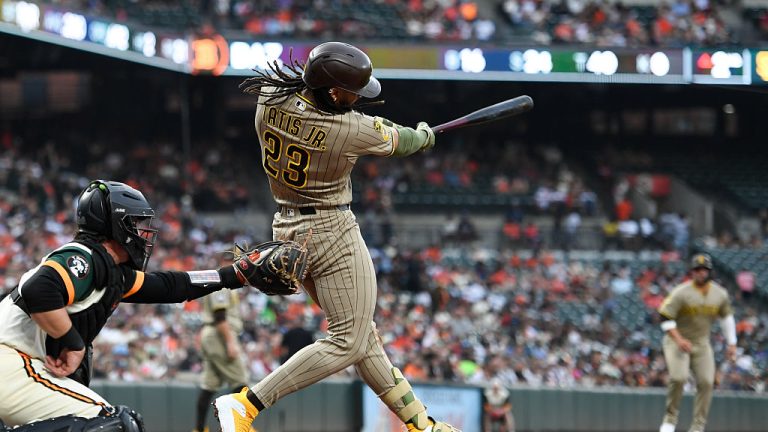
We have officially crossed the two-month mark of the 2026 Major League Baseball season, and if you look at the back of some baseball cards right now, the surface numbers are enough to give you whiplash. Perennial All-Stars are flirting with the Mendoza line and historically elite power hitters are watching their isolated power (ISO) values crater.
Some fan bases are panicking, but as we know all too well, the box score only tells you what happened, not why it happened or what is coming next.
By diving into underlying Statcast data, specifically expected weighted on-base average (xwOBA), expected batting average (xBA), and expected slugging percentage (xSLG), we can strip away the unluckiness of a low Batting Average on Balls in Play (BABIP) and isolate the quality of contact.
Some of these elite hitters are victims of bad luck, while others have minor, incredibly fixable mechanical hitches in their batted-ball profiles.
If you are a fantasy manager looking to execute a season-defining buy-low trade, or a fan waiting for your star player to break out, these five hitters are screaming candidates for positive regression.
Stats updated prior to games on Monday, June 15
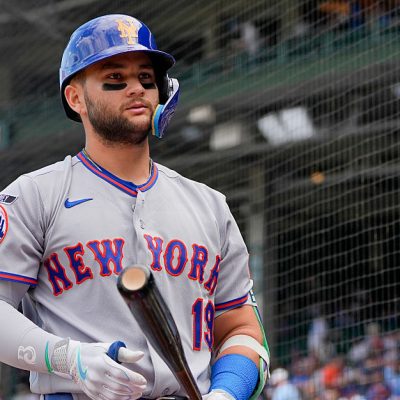
Bo Bichette | 3B/SS, New York Mets
It has been a rough introduction to Queens for Bo Bichette. If you paid close attention last year, watched him nuke a three-run home run off Shohei Ohtani in Game 7 of the World Series on an injured knee, but are just catching up on baseball in 2026, Bichette’s surface line may even look nightmarish, sparking the question, “What’s happening to this guy?”
Through 309 at-bats, he is slashing .239/.285/.361 with eight home runs. Mind you, Bichette is a career .289 hitter who crushed his way to a .311 average and a .483 slugging clip last season. And for a guy who was the best hitter in baseball with men in scoring position last year (.381 AVG, 1.046 OPS with 80 RBIs in 147 at-bats), and who is hitting just .232 with a .666 OPS in such situations this year, it may feel like an unmitigated skills collapse
It isn’t. Here’s what the underlying metrics show:
Bo Bichette: 2025 vs. 2026 Statcast Profiles
2025 (86th Percentile Batting Run Value):
- xwOBA: .353
- xBA: .295
- Hard-Hit%: 48.8%
- K%: 14.5%
2026 (8th Percentile Batting Run Value):
- xwOBA: .329
- xBA: .280
- Hard-Hit%: 46.4%
- K%: 17.5%
The gap between his actual .285 wOBA and his .329 xwOBA (-0.044) is one of the widest in all of baseball. So, what is driving this discrepancy?
First, look at the brutal batted-ball fortune. Bichette is carrying an uncharacteristic .264 BABIP, which is a statistical anomaly for a player with a career mark north of .330 who builds his entire profile on spraying hard line drives across the diamond. His hard-hit rate remains elite (78th percentile), and his average exit velocity is an excellent 91.1 mph (82nd percentile).
He isn’t swinging through pitches either; his whiff rate sits in the 87th percentile, and his strikeout rate is the second-best mark of his entire career. He is keeping his vision, refusing to press, and maintaining a firm 6.1% walk rate.
The one mechanical fix? He has developed a temporary allergy to hitting line drives, with his line-drive rate dipping to a career-low 17.4% while his fly-ball rate has ticked up to a career-high 33.6%.
Because his raw power metrics look normal, his microscopic 10.1% home-run-to-fly-ball (HR/FB) rate and tiny ISO are bound to correct upward the second he corrects his launch angle back to his career 21% line-drive baseline. The floodgates will open soon.
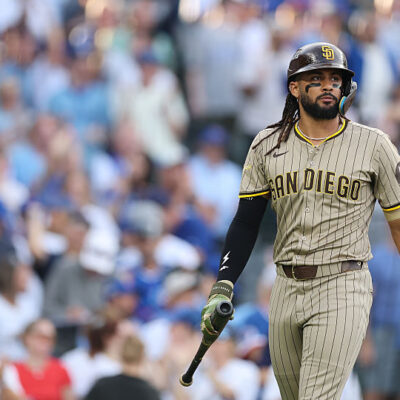
Fernando Tatis Jr. | 2B/RF, San Diego Padres
Fernando Tatis Jr. remains a defensive wizard out in right field (98th percentile Outs Above Average), but his offensive production has left Padres fans wanting far more. A casual glance at his 2026 slash line shows a solid .282 batting average but a shocking lack of over-the-fence thump: he has generated a .350 slugging percentage with only two home runs over 301 at-bats.
Perhaps his walk-off blast on Wednesday over the Cincinnati Reds was the start of something.
But when an elite power-speed threat suddenly has a slugging percentage identical to his on-base percentage (.347), it is natural to assume an upper-body injury or a loss of bat speed. Except Tatis is still swinging a lightning-fast stick.
- Bat Speed: 75.4 mph (88th percentile)
- Hard-Hit Rate: 52% (94th percentile)
- Expected Batting Average (xBA): .286 (88th percentile)
- Expected Slugging (xSLG): .416 (57th percentile)
Tatis is still hammering the baseball. You do not hit the ball hard 52% of the time with near-top-tier bat speed if your physical tools are declining. The primary culprit behind his missing power is a disparity in his launch angle profile. Tatis’s sweet-spot percentage has plummeted to 32.8%.
He is pounding the ball into the dirt at a career-high 50.2% groundball rate, meaning his 91 mph average exit velocity is being wasted directly into the infield grass.
Because he is still crushing fastballs (.309 actual, .315 xBA) and keeping his strikeout rate steady at 20.9%, his offensive floor is incredibly high. The moment Tatis makes a minor back-hip adjustment to lift the ball back into the air, that .348 slugging percentage is going to skyrocket toward his .416 xSLG baseline.
Will Smith | C, Los Angeles Dodgers
If you told Dodgers fans that Will Smith would enter June pacing toward the highest expected metrics of his career, they’d assume he was an MVP frontrunner. Instead, Smith is hitting just .249 with a .382 slugging percentage. For a premier offensive catcher, the surface numbers look decidedly average.
Smith has been out the past week, and Bill Punkett of the Orange County Register did just report that he has been added to the 10-Day IL with a neck injury. Maybe that injury has something to do with the output we have seen from the All-Star backstop thus far.
Underneath the hood, Smith’s Statcast page is a sea of dark red. He is currently carrying an elite .386 xwOBA (93rd percentile) and a .494 xSLG (87th percentile).
Smith’s underperformance is arguably the most baffling in the majors because his quality-of-contact indicators are practically flawless. His 13.4% barrel rate and 43% sweet-spot rate are both career-high marks.
His bat speed is at the highest mark we have on record for him, and his maximum exit velocity has matched his career best. He has pinpoint control of the strike zone, chasing on just 21.3% of pitches (92nd percentile) while walking at an 11.4% clip against a modest 16.9% strikeout rate.
The drag on his actual stats is a bizarre single-digit HR/FB rate and an uncharacteristically low .133 ISO, caused by a weird dip in his overall hard-hit rate (39.4%) despite the high barrel numbers.
Essentially, when Smith hits the ball perfectly, it’s a barrel; when he misses, it’s a soft pop-out. Given how consistently he finds the sweet spot, his luck on fly balls is bound to turn. He is a big time buy-low target behind the dish.
Vladimir Guerrero Jr. | 1B, Toronto Blue Jays
The underlying story of Vladimir Guerrero Jr.’s 2026 campaign is a fascinating tale of traded optimization. He is currently carrying a .366 slugging percentage with an ISO mark – .085 – that looks more like a slap-hitting middle infielder than an elite middle-of-the-order force.
Vladdy is trading raw, unadulterated power for some of the most elite bat-to-ball skills in the sport.
Vladimir Guerrero Jr.: 2025 vs. 2026 Statcast Profiles
2025 (97th Percentile Batting Run Value):
- xwOBA: .391
- xSLG: .510
- Barrel%: 12.2%
- K%: 13.8%
2026 (52nd Percentile Batting Run Value):
- xwOBA: .354
- xSLG: .419
- Barrel%: 6.4%
- K%: 10.4%
The primary culprit behind the missing power is a barrel rate that has been cut nearly in half, dropping to a career-low mark. Because he isn’t finding the center of the bat consistently, his Batting Run Value has plummeted from +38 last year down to +2.
It’s not like the physical tools have vanished though. Guerrero’s average bat speed clocks in at 76.2 mph (93rd percentile). He isn’t swinging and missing, either.
The core issue is a temporary, highly fixable mechanical hitch against spin. Vladdy continues to obliterate fastballs, hitting .341 with a +4 Run Value against four-seamers. But breaking balls are neutralizing him; he is hitting .190 with a .215 slugging percentage against sliders and curves.
But Guerrero is a historically elite slider hitter. As soon as he adjusts his timing to stop rolling over on the soft stuff, his actual .366 slugging percentage could rapidly correct toward his .419 xSLG mark, unlocking a massive second-half power surge.
Additionally, a few mechanical tweaks are in order to bolster the 29.5% launch-angle sweet spot. Because his ground-ball, fly-ball, and line-drive rates are all in line with career norms, but the 4.2% flyball-to-home run ratio is a career-low by 10%.
Ronald Acuña Jr. | RF, Atlanta Braves
No player’s 2026 profile is more jarring than Ronald Acuña Jr.’s. Just a couple of seasons removed from a historic 40-70 MVP campaign, the Braves’ superstar looks like a different hitter at a casual glance. He is slashing .251/.373/.421, which is a line that shows a volatile, modern three-outcomes flavor rather than the dynamic, all-fields dominance baseball fans are accustomed to seeing from him.
With his sprint speed ticking down post-injury and his defense grading out as a distinct liability (-4 Outs Above Average), panic is starting to creep into Atlanta.
But a deeper look into the Statcast metrics reveals that while Acuña’s physical baselines have shifted, his ceiling remains incomparably high. The floor is being insulated by a mature approach at the plate; his walk rate has climbed to a career-high 14.8% (94th percentile), keeping his on-base percentage floating in the upper echelon of the sport.
The primary issue in his profile right now is a lack of consistency. His average exit velocity has dipped to 90.1 mph from 92-94 mph averages from 2023-2025, and his Squared-Up percentage is 21.3% (20th percentile).
In essence, he is making a lot of weak, mis-hit contact. However, when Acuña actually connects cleanly, the ball stays hit. His 13.1% barrel rate still sits comfortably in the 81st percentile.
Pitch Arsenal Insights: The Solution
The fix for Acuña comes down to recalibrating against high velocity. In a bizarre twist for a premier power hitter, four-seam fastballs are completely eating him up this season. He is managing a .123 average and a .140 slugging percentage against four-seamers, translating to a costly -4 Run Value. Last year, he provided +16 run value against four-seam fastballs with a .558 SLG.
Conversely, opposing pitchers cannot throw him a spin pitch or a tracking pitch without it leaving the yard. He is hitting a blistering .370 against sinkers (.696 SLG) and .385 against curveballs (.846 SLG) for a combined +8 Run Value.
Pitchers are exploiting his temporary struggle against the four-seamer, but velocity is the easiest thing for a hitter of Acuña’s caliber to time up. The moment he catches up to the heater, his overall quality of contact will skyrocket, turning those weak pop-outs back into the tape-measure home runs that define his game.
Don’t sell low on a generational talent who is one timing adjustment away from an MVP ceiling.
Become a Member of Just Baseball
Subscribe and upgrade to go ad-free!
* Save 25% by subscribing annually.

Written by