
Who is Fernando Tatis Jr. as a Hitter?
A deep dive into the early struggles for Fernando Tatis Jr. in 2026, and into the inconsistencies he has showed throughout his young career.
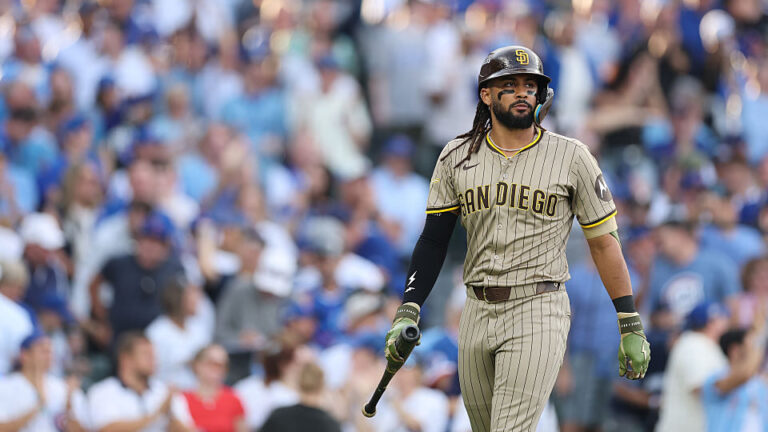
It’s been a rough start to the season for Fernando Tatis Jr., slugging just .286 through his first 30 games while enduring the longest homerless stretch of his big league career.
With a 134 wRC+ over parts of seven MLB seasons, Tatis has proven that he is a well-above-average bat at the highest level. But even with that fact well-established, I still find myself wondering who he really is at the plate.
The guy who hit 42 homers in 130 games and posted a 154 wRC+ from 2019 to 2021 seems to be buried a bit too deep to be unearthed, but in the last two seasons, Tatis turned in a 133 wRC+, trading some slug for more contact and patience.
There’s a disappointing 2023 season sandwiched in between that is hard to make much of, considering Tatis missed all of 2022 with a broken wrist that required surgery and kept him out for longer than anticipated.
The wrist issue was followed by an 80-game PED suspension after testing positive for Clostebol, which spilled into the start of his 2023 campaign as well.
Shortly after accepting his suspension, Tatis decided to undergo surgery for a left labrum tear that he played through in 2021 after suffering multiple shoulder subluxations. Players who undergo shoulder surgery on the lead shoulder will often mention a length of time until feeling like they can swing free and easy again.
Between the injury that gave Tatis a harder time than anticipated, the 80-game ban, and the shoulder repair, it is understandable that the 2023 season is the outlier for him on the low end, hitting .257 with a 111 wRC+.
His average bat speed was down more than a MPH from what his eventual figures in 2024 and 2025 (Baseball Savant bat tracking began in 2023).
Though not the nearly .600 slugging percentage guy he was from age 20-22, Tatis still slugged .465 in the last two seasons with a nearly 8% improvement on the strikeout rate.
Where Tatis settled into the last two seasons offensively provided optimism that he may be evolving into a more well-rounded hitter with an improved foundation of contact and swing decisions, even if it came at the expense of his batted ball angles to a degree.
The pie-in-the-sky MVP-candidate ceiling seemed feasible to dream on in the fortuitous scenario where he could marry the improved contact and chase rates with the pre-injury/suspension game power, especially with the caliber of defense he started to provide in the outfield.
Instead, Tatis finds himself at the complete opposite end of the spectrum through the first month of the 2026 season. The slug has never been less evident, and the at-bats look uncomfortable. He’s still hitting the ball hard, but often straight into the ground and almost never pulled.
In fact, Tatis is the first player in the Statcast era with a hard hit rate north of 60% in a month without hitting a home run (min. 100 PA). The raw exit velocities are on par with his 2021 season, putting to bed the idea that PEDs may explain the prior power.
The Swing Mechanics
While there are some clear mechanical issues to hone in on this season, Tatis has succeeded in the past with different iterations of pre-swing moves. He’s an elite athlete with an incredibly adjustable lower half. Tatis has played around with various setups and pre-swing moves.
In 2025 alone, we saw a lot of variance in Tatis’s moves, which in a way could be restrictive to Tatis even in a productive year. It’s likely not a coincidence that his best season came in 2021, when he most consistently had the same mechanics and swung with intent for damage.
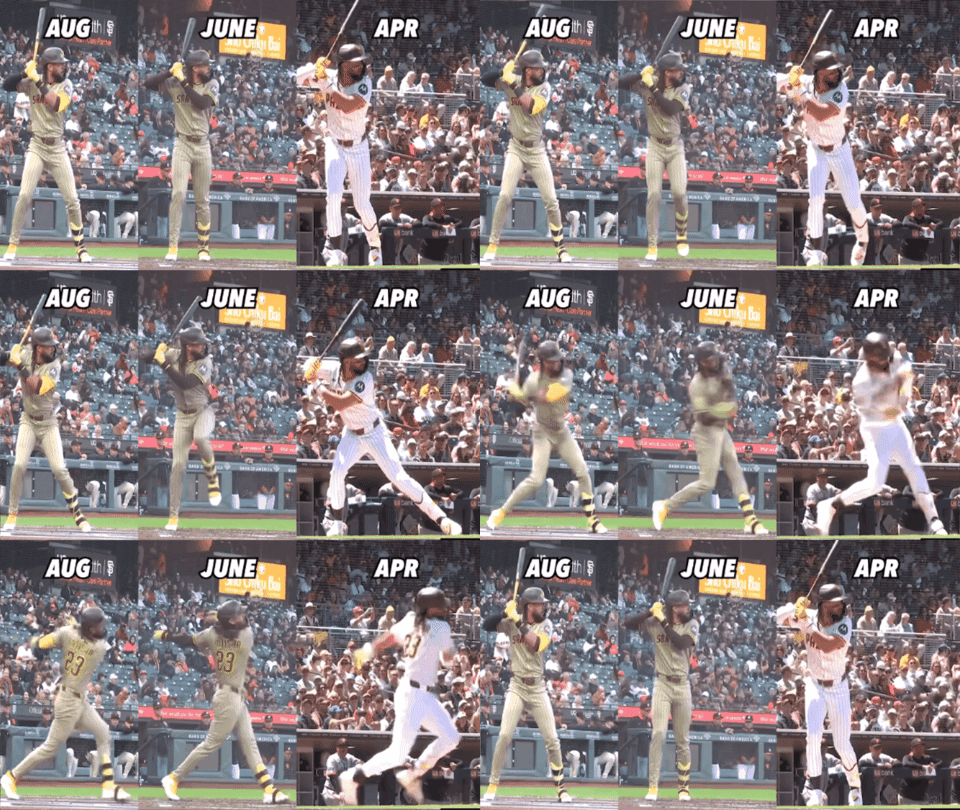
Even with the changes in his setup and lower-half timing, Tatis still seemed to find a way to put himself in position to drive the ball in the air and particularly to the pull side enough. The tinkering likely did contribute to his turbulent season, posting three months with an OPS of .900 or above, along with three other months where his OPS was below .730.
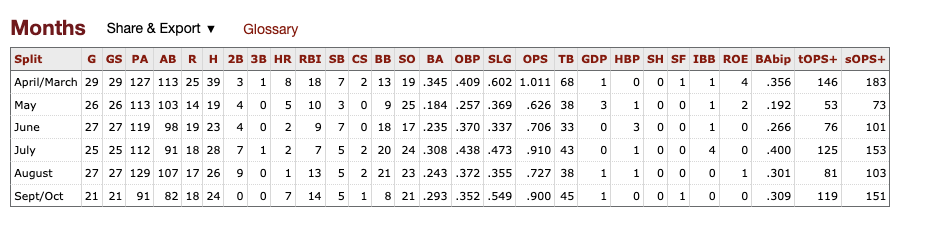
Even with the rough months sandwiched in between, Tatis seemingly would find his way out. That said, the constant tinkering is likely what continues to limit Tatis from achieving the production value that he posted in 2021, likely creating timing inconsistencies. The challenge is that, even in his most productive months, there was still a mixture of strides and timing mechanisms.
He’s able to make different mechanics work more than the average hitter thanks to his otherworldly adjustability and ability to get competitive swings off from different positions, but he also puts his body in spots that make it difficult for him to get his best swing off as frequently as possible.
What Has Gone Wrong?
In an effort to simplify the complicated assessment of Tatis’s 2026 struggles as much as possible, it’s best to start with what looks different from all iterations of his setups and swings from last year. The low-hanging fruit is his setup. Up until the final days of April, Tatis was starting with his feet even, something he really has never done.
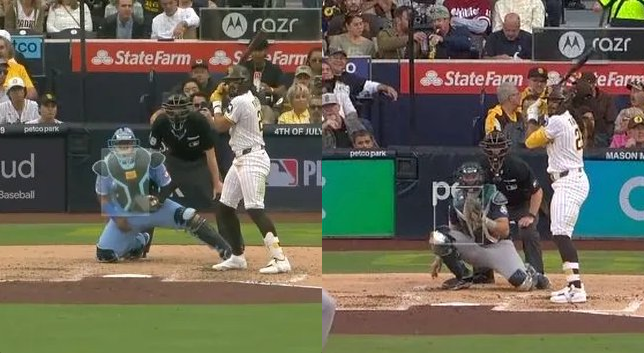
Closing himself off could very well make it more difficult for him to get the barrel out and catch the ball further in front of home plate, but I think it also affects the way that he is interacting with the ground.
So many of Tatis’s 2026 swings seem disconnected between his upper half and lower, resulting in armsy swings where the pitch often gets deep on him. Timing and mechanical issues become clearer if the aforementioned issue is evident in advantage counts like the 2-0 fastball over the heart of the plate that Tatis fights off with his arms below.
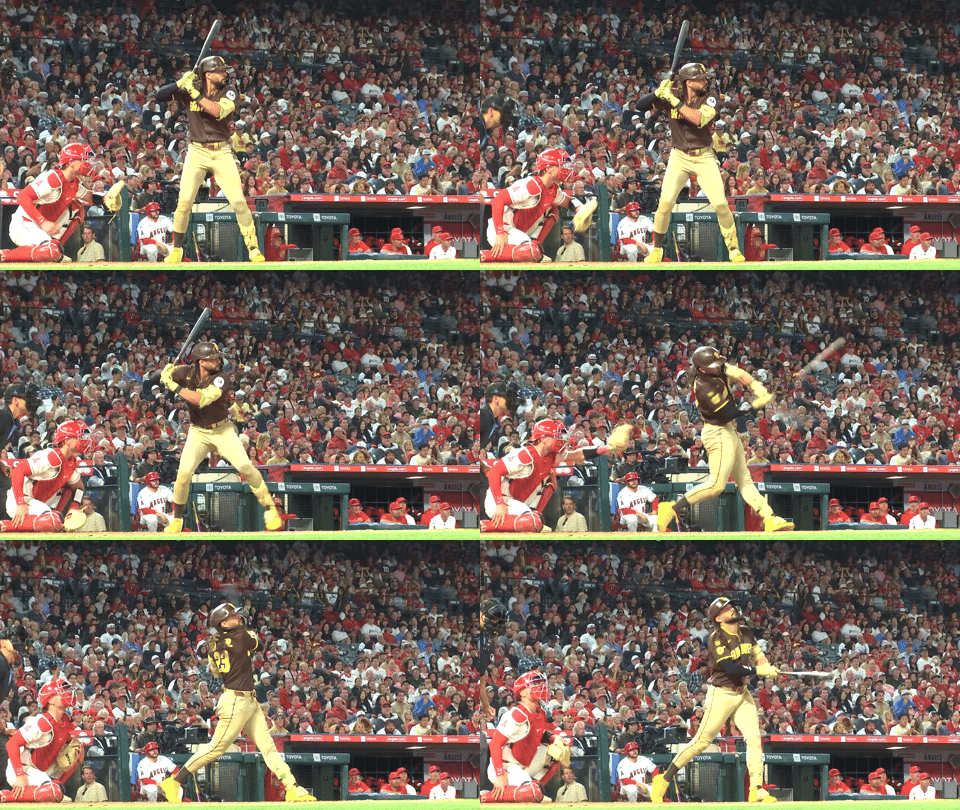
In watching the video of Tatis in 2026, there were a fair number of these defensive swings in offensive counts, which is typically indicative of a guy who is out of rhythm and fighting his mechanics. In the clip above, Tatis’s lower half is mostly uninvolved. He hardly loads into his back side, pushing onto his front side before he even fires the barrel.
Unsurprisingly, Tatis is battling the deepest contact point and flattest swing path of his career, resulting in what would be by far his lowest air pull percentage.
In 2021, Tatis posted his career-best air pull rate at 22% (5% above league average), but hovered closer to 13% in the subsequent three seasons. Through his first 31 games of 2026, Tatis has seen that figure more than cut in half at 5.9%.
It’s going to be difficult for Tatis to hit the ball in the air to left field, given that his pull rate is down 14% from his career average and his average launch angle on fastballs is zero degrees. Of the 115 fastballs Tatis has swung at in 2026, he has yet to pull one in the air — and he hasn’t pulled a four-seamer at all.
There, of course, was the aforementioned push and pull that came with the .611 slugging percentage in 2021 in the form of a career-high 28% strikeout rate (minimum 100 games), but Tatis’ age-22 year was also his first season with more than 400 plate appearances after playing just 84 games in his debut year in 2019 and the COVID-shortened 2020 season.
While Tatis saw his contact rate increase in 2024 and 2025, his wide range of pre-swing moves with his lower half resulted in timing inconsistencies. Tatis would often get his foot down early but would lose much of his tension, putting himself in a position where he is forced to more so just throw his hands at the ball.
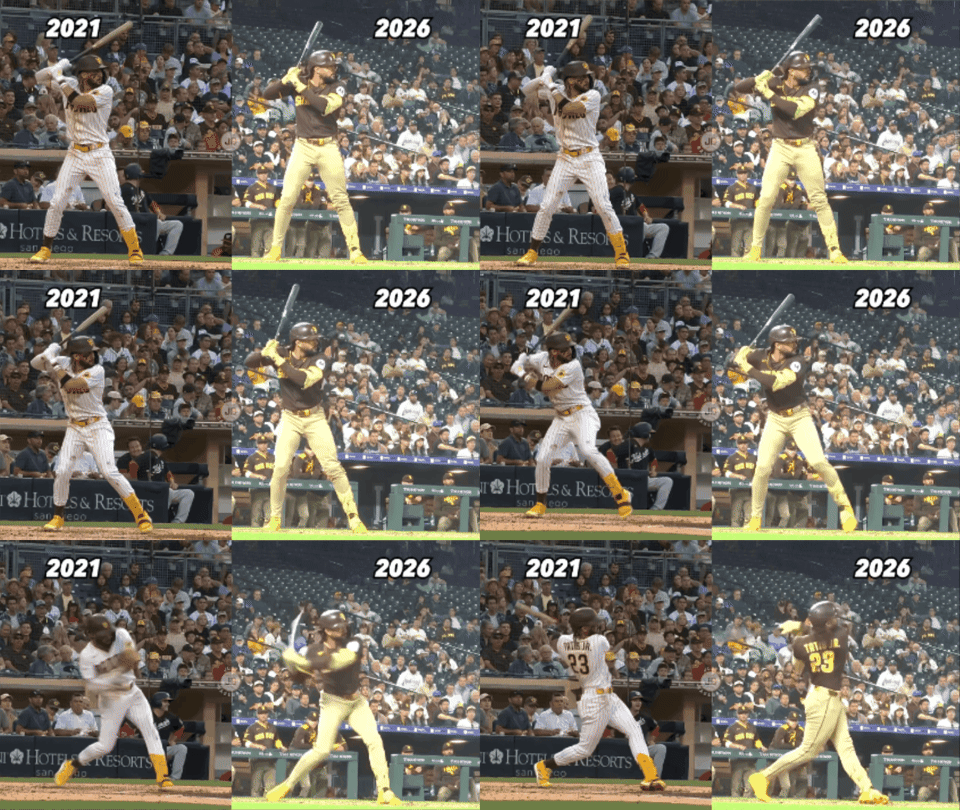
The side-by-side comparison between 2021 and 2026 is especially telling.
In 2021, Tatis was engaging his backside rather than teetering over it the way he does in the 2026 video.
On top of shifting his weight back into his right hip, he coils in tandem with a small hand pump that likely helps him keep his upper and lower half in sync while staying coiled over his backside longer.
The belt is a good visual cue to show the difference in how Tatis is utilizing his rear leg; the buckle reveals the difference in coil, while the angle of the belt shows how much more he is sinking into his backside.
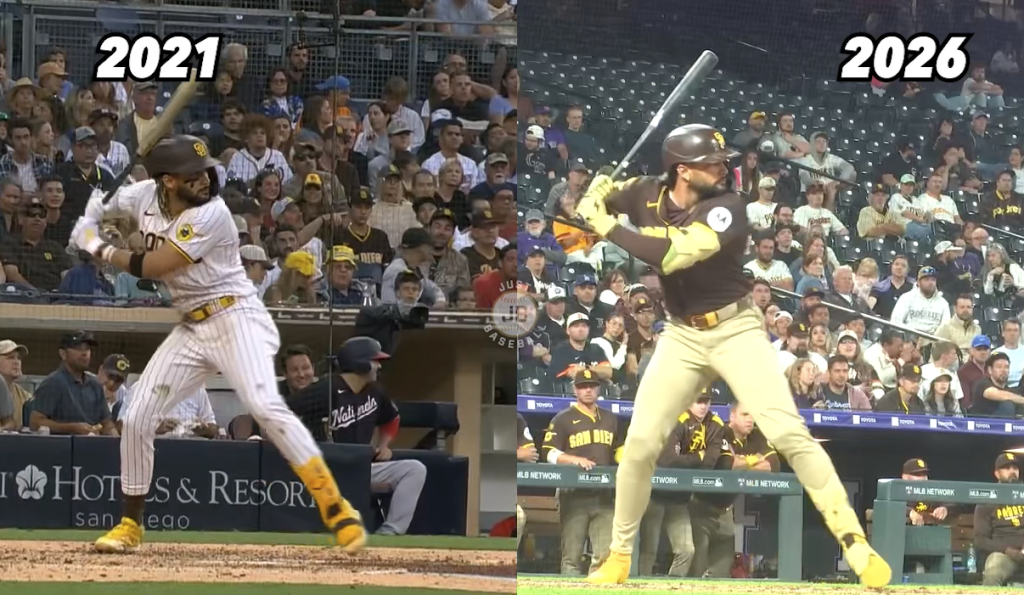
In the 2021 position, it is easier for Tatis to turn the barrel and get on plane. When the body leaks forward prematurely, as Tatis has been in 2026, the hands can get stuck further behind the body, causing the barrel to drag. The body will try to (unsuccessfully) rotate from the front-foot heavy position, which only compounds the barrel drag and causes the path to be more downhill.
Rather than a powerful rotation from an engaged back side, the body leaks forward and opens further, disconnecting the barrel from the body. The result of the aforementioned chain reaction is unsurprisingly going to be challenges to pull the baseball, especially velocity.
What Version of Tatis Can We Expect?
While 2021 was the best and most consistent his moves looked, Tatis seemed to have an easier time holding his backside as he tinkered with front foot timing in his strong 2024 and 2025 seasons.
His 42-home-run season in some ways feels like forever ago, but Tatis has provided plenty of flashes of the player who OPS’d .965 through his first three seasons with a pair of top-four finishes in MVP voting.
In the 10 months where Tatis played at least 20 games between 2024 and 2025, Tatis posted an OPS of .900 or above on four occasions and north of 1.000 twice. The difference is the valleys were much deeper than his first three years, posting an OPS below .730 in four different months.
In comparison, from 2019 to 2021, there were 12 calendar months where Tatis played at least 10 games; he only posted an OPS below .840 in a month once.
Tatis is an outlier athlete who has a rare ability to make different-looking swings and mechanics work in the box. A huge part of what makes hitting so difficult is the degree of variables it comes with. Big league pitchers are the best at disrupting timing, while the best hitters are consistent with theirs.
Tatis could very well be making things harder on himself by varying his own timing.
Over the last few years, similar mechanical challenges have crept into his swing, leading to the aforementioned down months. He has had successful stretches that look completely different from a swing standpoint though. While 2021 seems like the gold standard mechanically, Tatis has shown the ability to hold his back side through his various front foot timing methods.
The non-negotiable for him is likely the closed stance to start the year, could have resulted in him feeling a bit more rushed than usual, creating a slightly more lungey and crowded swing than we’d see through his previous rough patches.
The wide of moves in the box is a double-edged sword. There’s plenty of reason to believe Tatis is willing and able to make the adjustments to work through what was the worst month of his career. But at this point, it would likely behoove him to find what is easiest for him to coil over his back side and rotate from there most consistently.
Superstar Tatis? He’s still in there, but he might be chasing his own tail.
Become a Member of Just Baseball
Subscribe and upgrade to go ad-free!
* Save 25% by subscribing annually.

Written by
Aram Leighton is the Co-Founder and Executive Editor for Just Baseball. A Syracuse University grad, Aram is one of the hosts of the Just Baseball Show…